gets its memorial
pp. 45-48 · Read in the full issue
BP’s main line fleet gets its memorial
Books
The Main Line Fleet of Burns Philp. By B. A. Wilkinson and R. K. Willson. Published by the Nautical Association of Aus tralia Inc. Canberra, Australia.
ISBN 09599079 2 0. Price
Saib.
Thirty-eight ships over three quarters of a century carried the colours of the now extinct Burns Philp (BP) Line from Sydney into the Pacific Islands and to the Near and Far East.
Their arrivals and departures in Asian ports were of only marginal local importance, but to three generations of Islands residents their existence seemed as immutable as the waxing and waning of the moon even if they did not perform with the moon’s regularity.
World War II was to change all that, and by the 1960 s BP vessels were being pronounced unprofitable in an age of air transport and of a new gener ation of ships which carried containers on their backs in stead of general cargoes in their holds.
Ten years after the last of the line was seen in the Islands, they are well on the way to being forgotten. Therefore, everyone who knew these vessels, and the contribution made by the line to Islands life, will be grateful to Bruce Wilkinson and Ross Willson who have meticulously com piled a record of each of the 38 ships involved. Thanks go also to the Nautical Association of Australia which has put it all together in book form under the title of The Main Line Fleet of Burns Philp.
Apart from a two-page intro duction, the text is strictly factual. Each ship is treated in a separate compartment: its builders, its pre-BP history, if any; technical details of its size, engine capacity, hull, accom modation, auxiliary equipment, and so on.
Its subsequent brushes with reefs, whales, fires and other adventures, its refits, its cap lins and changes of itineraries
ire faithfully recorded, leading
finally to its post-BP history, in the hands of other lines, or at the hands of Eastern ship breakers.
Wonderful source material, if rigidly avoiding any sentimen tality although there was romance in these ships, and in the period in which they pro vided the only link with the outside world for isolated com munities in the South Pacific.
Until their last years, all BP ships carried passengers and passengers created human in terest by making voyages in an
extension of life as it was then lived in Papua, New Guinea, the Solomons or New Hebrides.
Post war plane travel has been sterile by comparison.
Although Burns Philp was chartering vessels for the Islands trade from 1885, the company did not own a ship until 1896 when they purchased the 18-year-old, 760 gross tons, German-built Titus. She was capable of carrying 1000 tons of coal for bunkers and burned seven and a half tons of it daily to produce eight and a half knots. Carrying half a dozen allegedly first-class passengers, her first voyage for BP was to Papuan ports, German New Guinea, Solomons, New Hebrides and back to Sydney, a voyage of 47 days. Her sub sequent career consisted of vari ations on the same schedule, with occasional excursions into the Gilberts, Ellice Island and Marshalls. Her active sea life
ended in 1908, although for a further 11 years she served as a coal hulk in Vila harbour.
BP’s second purchase in the same year as Titus was also German-built the 534-tons Ysabel , which traded for the line in Solomons, Norfolk Island, Lord Howe and New Hebrides until transferred to inter-island work in the Marshalls and Carolines. She ended her days there on Namu Reef on June 6, 1907.
The Moresby (Mark I), the first of the seven-letter 'M'
ships, an ugly 17-year-old of 1763 tons, joined the line in 1898. Her photo shows for the first time the black and white checked funnel that became a BP trade mark in later years.
She inaugurated the BP service from the Australian east coast to Java and Singapore. BP sold her in 1915 and she was subsequently torpedoed in the Mediterranean during World War I.
Mambare, the first ship BP had built, joined the line in 1900 but two years later was wrecked on Tutuba Island, be tween New Hebrides and New Caledonia.
Between 1900 and 1904, Tambo, Ovalau, Air lie, Guthrie and Induna were added to the fleet, and then the company commenced to ac quire or build the long line of ‘M’ ships that covered its most productive and progressive period of ship ownership.
Malaita, Makambo, Muni ara, Mataram, Matunga, Mindini, Montoro, Morinda, Marsina, Mawatta, Melusia, Malayan, Marella, Mangola, Malabar, Macdhui, Malaita II and Muliama these ships spanned the years from 1905 to 1937.
Neptuna and Merkur, ex- Norddeutscher Lloyd, joined the fleet in 1935; and Bulolo, the 6000-tons pride of the line, in 1938; Tulagi in 1939.
Postwar additions were Burnside, Braeside, Malekula, Tulagai 11, Montoro 11, Moresby II and Marsina II (chartered).
Many of these vessels gave long service before being dis posed of. Some were wrecked, including the company’s first motor vessel, Malabar, which after only five years service went up in fog on rocks just south of Sydney and became a total loss.
Some were victims of World Wars I or 11. Matunga was sunk by the German raider Wolf in the southwest Pacific in 1917; Macdhui was bombed and sank in Port Moresby harbour in 1942. Malaita was torpedoed off Port Moresby in the same year but limped back to Austra lia after temporary repairs.
Neptuna , full of ammunition and explosives, was unloading alongside the wharf in Darwin in February 1942 when she sustained a direct hit by Japanese bombers and ex ploded. Well-known Captain W. Michie was one of 45 who perished with her.
Tulagi was torpedoed in the Indian Ocean by a German submarine in March 1944 when on war service carrying supplies between Australia and Colombo. Fifteen crew survived the sinking, which took only half a minute, but 39 were lost with the ship. The survivors took to two rafts that had floated off; 59 days later one of the rafts carrying seven men
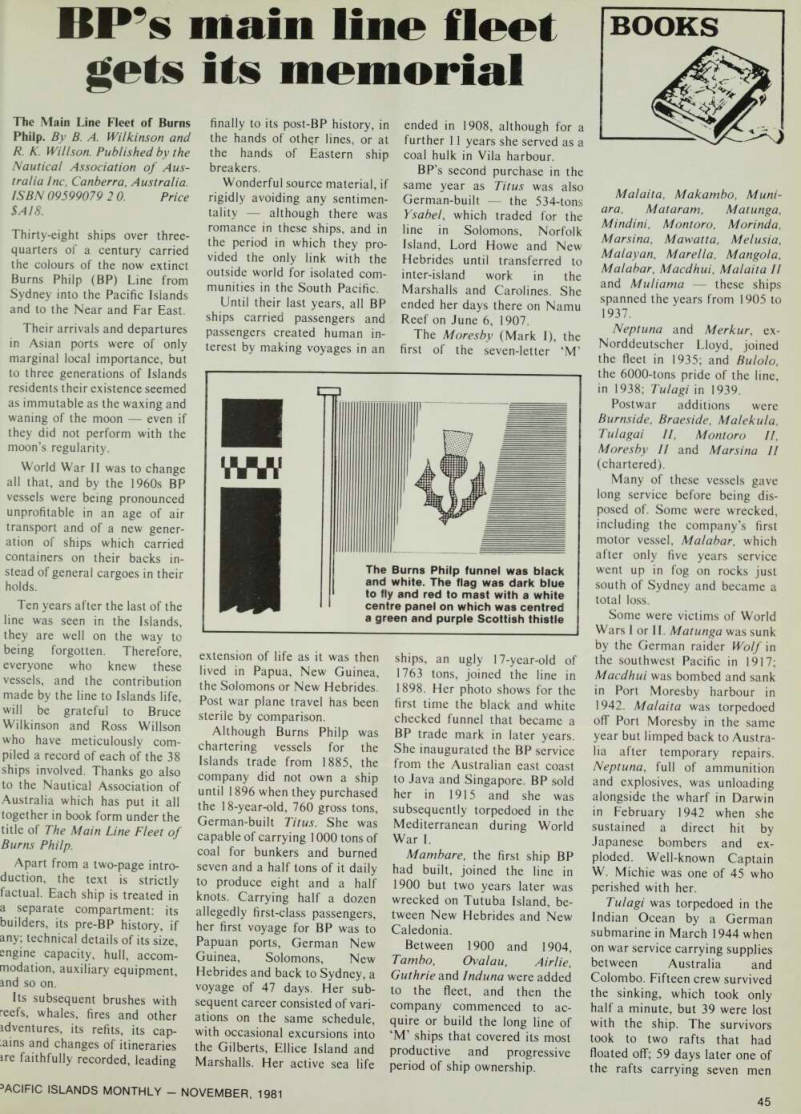
The Burns Philp funnel was black and white. The flag was dark blue to fly and red to mast with a white centre panel on which was centred a green and purple Scottish thistle
landed on one of the islands of the Seychelles group. The eight men on the other raft were never seen again.
The war service of Bulolo is a story in itself, the ship having been taken over by the British Admiralty in September 1939 to lead a charmed life as HQ and communications vessel in every theatre of war in the northern hemisphere. She was refitted and returned to Burns Philp in 1948, serving them and the southwest Pacific for a further 20 years before she went to the breakers in Taiwan.
The period 1970-71 saw the end of ship ownership for the company.
Changed circumstances in the Islands, the cost of main taining ships with crews on Australian articles, booming air transport and the introduction of container ships all played a part in the demise of the line which had played so large a part in the development of the Pacific Islands.
Small, cramped, seasick making as many of the earlier vessels were, and erratic in their
arrivals and departures, they nevertheless gladdened the hearts of every out-port dweller as they brought in the mail, stores and a whiff of the civi lised south. They were cursed often enough for their delays and uncertain habits, but they were loved as well. Who in these days can love a container ship,
or a sardine-packed wide bodied jet?
Messrs Wilkinson and Willson, and the Nautical As sociation, have provided be tween them a memorial to the famous ships, to the men who sailed in them, and to an era, alas now departed. For that,
many thanks.
Judy Tudor.
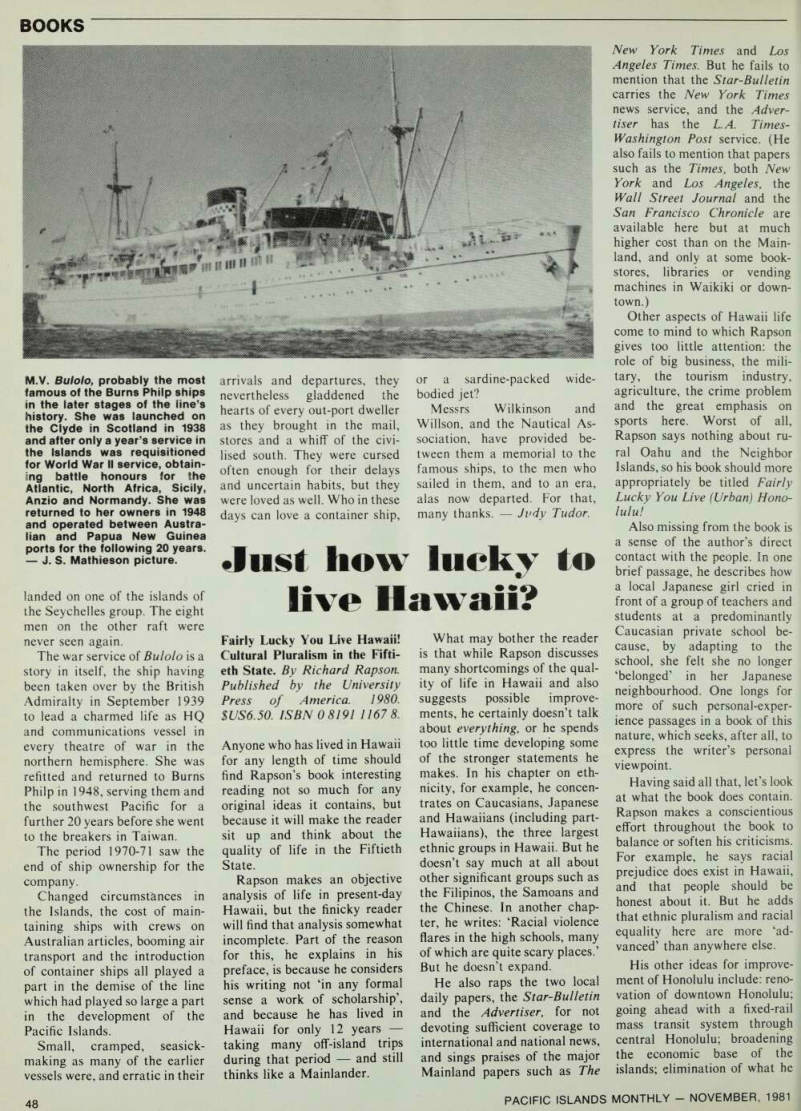
M.V. Bulolo, probably the most famous of the Burns Philp ships in the later stages of the line’s history. She was launched on the Clyde in Scotland in 1938 and after only a year’s service in the Islands was requisitioned for World War II service, obtain ing battle honours for the Atlantic, North Africa, Sicily, Anzio and Normandy. She was returned to her owners in 1948 and operated between Austra lian and Papua New Guinea ports for the following 20 years.
J. S. Mathieson picture.