Governor Albert Hahl:
p. 48 · Read in the full issue
The limits of kindness
Governor in German New Guinea By Albert Hahl. Edited and translated by Peter G.
Sack and Dymphna Clark.
Published by the Australian National University Press, Canberra, 1980. xxii and
164 Pp. 5A19.95. Isbn
0 7081 18208.
For a book which first appeared in Nazi Germany in 1937 Governor in New Guinea is remarkably free of the propa ganda and strident patriotism which characterised German colonial literature of the time.
Albert Hahl tells a straight forward, readable story of his experiences as magistrate in east New Britain 1896-1899, vice-governor in German Ponape 1899-1901, and governor of German New Guinea during the prewar years when it was transformed, at least along the coastal fringes, from an uncontrolled frontier of traders into a flourishing plan tation colony.
Hahl appointed New Guinea’s first luluais\ he led the punitive expedition which at tempted to arrest Ranga, the Buka policeman who murdered
Governor Kurt von Hagen; he nearly drowned when his boat capsized off Kiti in the Carolines and he was forced to swim for the nearest sandbank; he followed the Waria River many kilometres inland along the Papuan border, crossed Bougainville on foot and as cended the Sepik; his knowl edge of the Kuanua language and of the customs of the Tolai was so good that he is remem bered affectionately in the Ga zelle Peninsula even today.
His was an adventurous life, and he was in New Guinea at a unique time to observe the impact of colonial rule upon traditional Melanesian societies. But as he was neither a writer nor a philosopher his pen says little of the adventure and almost nothing of the wider issues at stake in the occupation of New Guinea by a colonising power. Unlike Arthur Gordon in Fiji, Wilhelm Solf in German Samoa or Hubert Murray in Papua, Hahl had no philosophy of colonisation beyond a belief that New Guinea had to be developed economically for the benefit of the Germans, with the villagers being encouraged
to survive as plantation labourers. His book is prosaic evidence of that fact.
Peter Sack, the Canberra academic who edited this excel lent translation, sees Hahl as ‘a kind man, who tried to do his best and whose work was per haps greater than he himself. It is not a wrong judgement but it is a misleading one.
Certainly Hahl was generous in personal dealings whether with Europeans or New Guineans. On one occasion, after arguing that execution alone atoned for the murder of a white person, he sentenced a man called To Taia to death for killing a trader. But when he saw the sufferings of To Taia in the Kokopo gaol he relented and commuted the sentence to a year’s hard labour. Five months in the gaol, said Hahl, was ‘a punishment as severe as death’.
Colonial governors must nevertheless be assessed on more than their attributes of character, for even in a colony as small as German New Guinea foreign rule amounted to much more than personal encounters.
If we are to judge Hahl by
this book, written in self justification 20 years after he left New Guinea, he naturally emerges in a good light. No mention here, for example, of the routine floggings which he authorised, or of the degree to which the Germans depended upon exploiting traditional rivalries to advance their inter ests.
When we look at what Hahl actually did as governor we find him better at some things than others: good at extending con trol over coastal villages, col lecting head-tax, conscripting people into forced labour and opening up the country to labour recruiters; less effective in protecting villagers from diseases, employers and trigger happy police.
And to examine Hahl’s inten tions for the future of New Guinea is to find a man who believed that the New Guineans, to use his own words, were of ‘inferior quality’, and that the only hope for the economic development of the country was permanent mass immigration by Asians. Tell that to Papua New Guineans today and see what they think!
No doubt Hahl was a kind man who tried to do his best.
The real point, though, is how much use such kindness was in the German colonial empire, where the Reichstag controlled the annual New Guinea budget and the plantation companies had the ear of influential men in Berlin; how it should be weighed in the balance against his policies on land, labour and control; and how much difference it made to colonial rule outside the special circum stances of the Gazelle Penin sula, where his just dealings with the Tolai have rightly created a legend.
This said, the book remains a vital addition to the library of any serious collector of New Guineana. Well indexed, el egantly translated, illustrated with photographs of the German era and provided with a thoughtful introduction, it maintains the high standards which Sack and Clark estab lished in their English versions of German New Guinea The Annual Reports (reviewed in PIM Sep p 53). Stewart Firth.
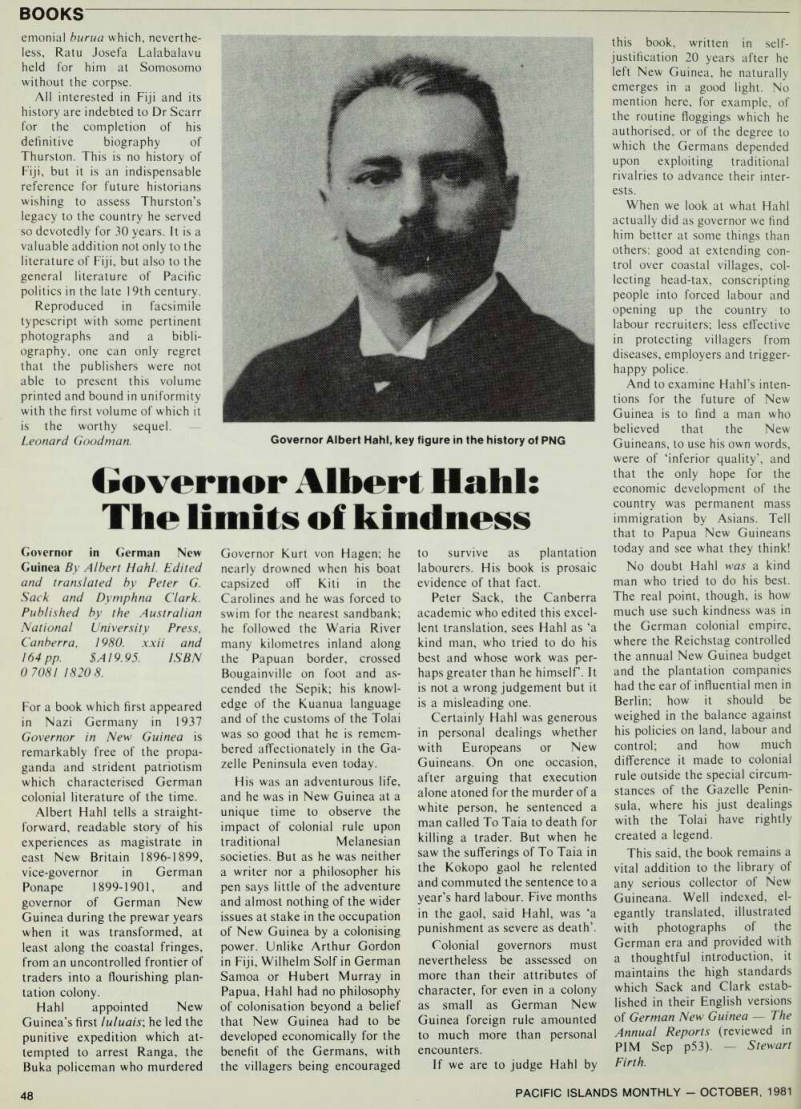
Governor Albert Hahl, key figure in the history of PNG