Lively telling of Tonga’s
p. 49 · Read in the full issue
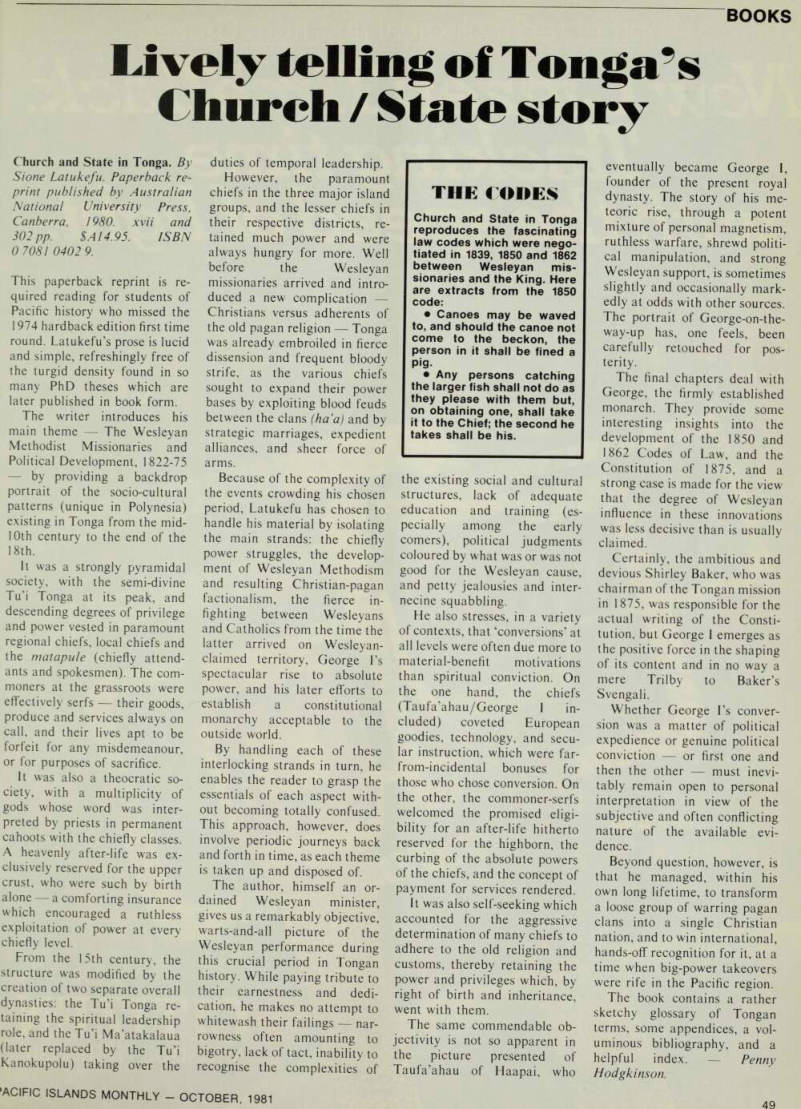
Church/State story
Church and State in Tonga. By Sione Latukefu. Paperback re print published by Australian National University Press, Canberra, 1980. xvii and
302 Pp. San. 95. Isbn
0 7081 0402 9.
This paperback reprint is re quired reading for students of Pacific history who missed the 1974 hardback edition first time round. Latukefu’s prose is lucid and simple, refreshingly free of the turgid density found in so many PhD theses which are later published in book form.
The writer introduces his main theme The Wesleyan Methodist Missionaries and Political Development, 1822-75 by providing a backdrop portrait of the socio-cultural patterns (unique in Polynesia) existing in Tonga from the mid 10th century to the end of the 18th.
It was a strongly pyramidal society, with the semi-divine Tu’i Tonga at its peak, and descending degrees of privilege and power vested in paramount regional chiefs, local chiefs and the matapule (chiefly attend ants and spokesmen). The com moners at the grassroots were effectively serfs their goods, produce and services always on call, and their lives apt to be forfeit for any misdemeanour, or for purposes of sacrifice.
It was also a theocratic so ciety, with a multiplicity of gods whose word was inter preted by priests in permanent cahoots with the chiefly classes.
A heavenly after-life was ex clusively reserved for the upper crust, who were such by birth alone a comforting insurance which encouraged a ruthless exploitation of power at every chiefly level.
From the 15th century, the structure was modified by the creation of two separate overall dynasties; the Tu’i Tonga re taining the spiritual leadership role, and the Tu’i Ma’atakalaua (later replaced by the Tu’i Kanokupolu) taking over the
duties of temporal leadership.
However, the paramount chiefs in the three major island groups, and the lesser chiefs in their respective districts, re tained much power and were always hungry for more. Well before the Wesleyan missionaries arrived and intro duced a new complication - Christians versus adherents of the old pagan religion Tonga was already embroiled in fierce dissension and frequent bloody strife, as the various chiefs sought to expand their power bases by exploiting blood feuds between the clans (ha’a) and by strategic marriages, expedient alliances, and sheer force of arms.
Because of the complexity of the events crowding his chosen period, Latukefu has chosen to handle his material by isolating the main strands: the chiefly power struggles, the develop ment of Wesleyan Methodism and resulting Christian-pagan factionalism, the fierce in fighting between Wesleyans and Catholics from the time the latter arrived on Wesleyan claimed territory, George I’s spectacular rise to absolute power, and his later efforts to establish a constitutional monarchy acceptable to the outside world.
By handling each of these interlocking strands in turn, he enables the reader to grasp the essentials of each aspect with out becoming totally confused.
This approach, however, does involve periodic journeys back and forth in time, as each theme is taken up and disposed of.
The author, himself an or dained Wesleyan minister, gives us a remarkably objective, warts-and-all picture of the Wesleyan performance during this crucial period in Tongan history. While paying tribute to their earnestness and dedi cation, he makes no attempt to whitewash their failings nar rowness often amounting to bigotry, lack of tact, inability to recognise the complexities of
the existing social and cultural structures, lack of adequate education and training (es pecially among the early comers), political judgments coloured by what was or was not good for the Wesleyan cause, and petty jealousies and inter necine squabbling.
He also stresses, in a variety of contexts, that ‘conversions’ at all levels were often due more to material-benefit motivations than spiritual conviction. On the one hand, the chiefs (Taufa’ahau/George I in cluded) coveted European goodies, technology, and secu lar instruction, which were far from-incidental bonuses for those who chose conversion. On the other, the commoner-serfs welcomed the promised eligi bility for an after-life hitherto reserved for the highborn, the curbing of the absolute powers of the chiefs, and the concept of payment for services rendered.
It was also self-seeking which accounted for the aggressive determination of many chiefs to adhere to the old religion and customs, thereby retaining the power and privileges which, by right of birth and inheritance, went with them.
The same commendable ob jectivity is not so apparent in the picture presented of Taufa’ahau of Haapai, who
eventually became George I, founder of the present royal dynasty. The story of his me teoric rise, through a potent mixture of personal magnetism, ruthless warfare, shrewd politi cal manipulation, and strong Wesleyan support, is sometimes slightly and occasionally mark edly at odds with other sources.
The portrait of George-on-the way-up has, one feels, been carefully retouched for pos terity.
The final chapters deal with George, the firmly established monarch. They provide some interesting insights into the development of the 1850 and 1862 Codes of Law, and the Constitution of 1875, and a strong case is made for the view that the degree of Wesleyan influence in these innovations was less decisive than is usually claimed.
Certainly, the ambitious and devious Shirley Baker, who was chairman of the Tongan mission in 1875, was responsible for the actual writing of the Consti tution, but George I emerges as the positive force in the shaping of its content and in no way a mere Trilby to Baker’s Svengali.
Whether George I’s conver sion was a matter of political expedience or genuine political conviction or first one and then the other must inevi tably remain open to personal interpretation in view of the subjective and often conflicting nature of the available evi dence.
Beyond question, however, is that he managed, within his own long lifetime, to transform a loose group of warring pagan clans into a single Christian nation, and to win international, hands-off recognition for it, at a time when big-power takeovers were rife in the Pacific region.
The book contains a rather sketchy glossary of Tongan terms, some appendices, a vol uminous bibliography, and a helpful index. Penny Hodgkinson.