John Thurston-'Our
pp. 47-48 · Read in the full issue
father done Cosetini'
Books
Viceroy of the Pacific: The Majesty of Colour A Life of Sir John Bates Thurston. By Deryck Scarr. Published by the Australian National University. ANU Pacific Research Monograph No 4. Series Editor E. K. Fisk, xvii and 334 pp.
Sa9. Issn 0155 9060, Isbn
0 909150 88 5. tl. . . , ™ m l nf n"l a u SeCO " ™' U ™°, D R r * biography hLn A ‘“u Thurston has been delayed by pubhshmg problems - as the author explains apo ogeucally - for Me (reviewed P.M May 1974 p9I), deal, with the early life of this erstwhile shipwrecked seaman planter ch mni m Tr T with hTrnle n F an To Ces on in S T T volume “• ** j"».
Ihurstons successful efforts nr * i . to unite the Fijian people under King Cakobau, and to persuade them to cede their country to a very reluctant British Queen and Government, had been conducted in the face of considerable opposition from the European community of planters and commercial inter- “ had Fiji to be annexed by, or incorporated in, either the Australian State of Victoria or New Zealand These alternatives had been foreseen b> Thurston who feared they
would lead inevitably to exploi tation of the Fijians by Europeans, and, worse, to war, as was at that time the situation with the Maoris in New Zea land.
Notwithstanding that he was himself the owner of a plan tation in Taveuni, Thurston’s identification with Fijian inter ests continued to bring him into acrimonious conflict with bel and vociferous planters. not |eas| because h|s of taxation b produce y an by cash poM tax kept [he Fijjan in his and thus deprived the p , ante T s 0 f labour: a policy
which, incidentally, was I
.“ed Md^Cur 0 "
Fortunately, the first governor a inted aftcr Cession - Sir Arthur Gordon sha^d Thurston's belief that Fijian SoClCt >’ had a validity of
ToZ" “ T „° f
a 7 s .sris
. . secretary, and over many years, Thnremn u a y \ i piiian to , ‘° , rU ' e f themselves , S> ; Stem government bv H onl, “ ft- d ' S,nCt ' , provm< i ial ' A aad chlel1 3' . annual ““ncils. At the C ’ he eVentually won
reluctant recognition by the expatriate community that the common law applied equally to all.
Thurston was to serve as Gordon’s auditor-general, an apparent demotion which de lighted Thurston’s local enem ies and particularly the missionaries, as well as the train of disciples Gordon had brought with him, who realised that Thurston’s superior local knowl edge was a threat to their career ambitions. And so indeed it proved, for Thurston was reappointed colonial secretary, and was to serve in this ca pacity, and as administrator, and lieutenant-governor to three governors Gordon, Des Voeux, and Mitchell. He was then knighted and appointed to the substantive rank which in cluded the office of High Com missioner and Consul-General of the Western Pacific. This latter, added to his Fijian re sponsibilities, involved him in international politics and, as an obituarist was to note, he be came the ‘Grand Panjandrum of the South Seas’.
His territorial activities covered a very wide field: from investigation of the recruitment of island labour to the inter denominational strife between religious bodies anathema to Thurston, who arranged the deportation of the Rev Shirley Baker from Tonga for activities which not only threatened the integrity of that kingdom, but which, Thurston feared, might even involve Germany and the USA in international compli cations there.
Requested by the British Government to investigate the Bismarckian German activities in the Pacific of which both Downing Street and Thurston were highly suspicious he travelled widely within his juris diction: Samoa, the Cook Islands, Solomons, Tonga, and the Gilberts. In Samoa he was especially concerned at the German influence, and he wrote contemptuously of ‘that very eccentric and fifth-rate novelist, R.L.S.’, whose meddling in
Samoan politics Thurston re garded as near to sedition.
In Fiji, Thurston had identified himself more and more with the Fijians. ‘Fiji is indeed my land’, he had claimed when the chiefs in stalled him formally as governor, and his acceptance of this role was confirmed when the Roko Tui Bua claimed that the Fijians were ‘guided by our father, Jone Cositeni’. It was appropriate that Ratu Tavita should have used this term since Thurston’s life-long role in Fijian affairs was, of course, the apotheosis of what is now dis paragingly called ‘paternal colonialism’, for as a father he had protected them against exploitation, fought for them, defended them, praised and chided them, and even punished them. But above all he had united them and given them a national consciousness and
identity.
By guiding them through the dangers threatening a people emerging from a primitive cul ture amidst the rampant com mercialism of late 19th-century European expansion in the Pacific, his paternalism was, no doubt, for that day and age, the best thing that could have happened to the Fijian people.
The history of Fiji would have been very different, and the people poorer, but for John Bates Thurston.
Tragically, the last year of Thurston’s governorship and his life was marred by an eventually fatal neuromuscular disorder which, cruelly, left a clear and active intelligence in a progressively paralysed body.
He died, aged 61, at sea en route to Melbourne, and was buried there. Notwithstanding his expressed wish to be buried in Fiji, and the earnest requests for this from the Fijian chiefs, neither the British nor the Fijian Government was willing to find the funds necessary to return the body for the cer
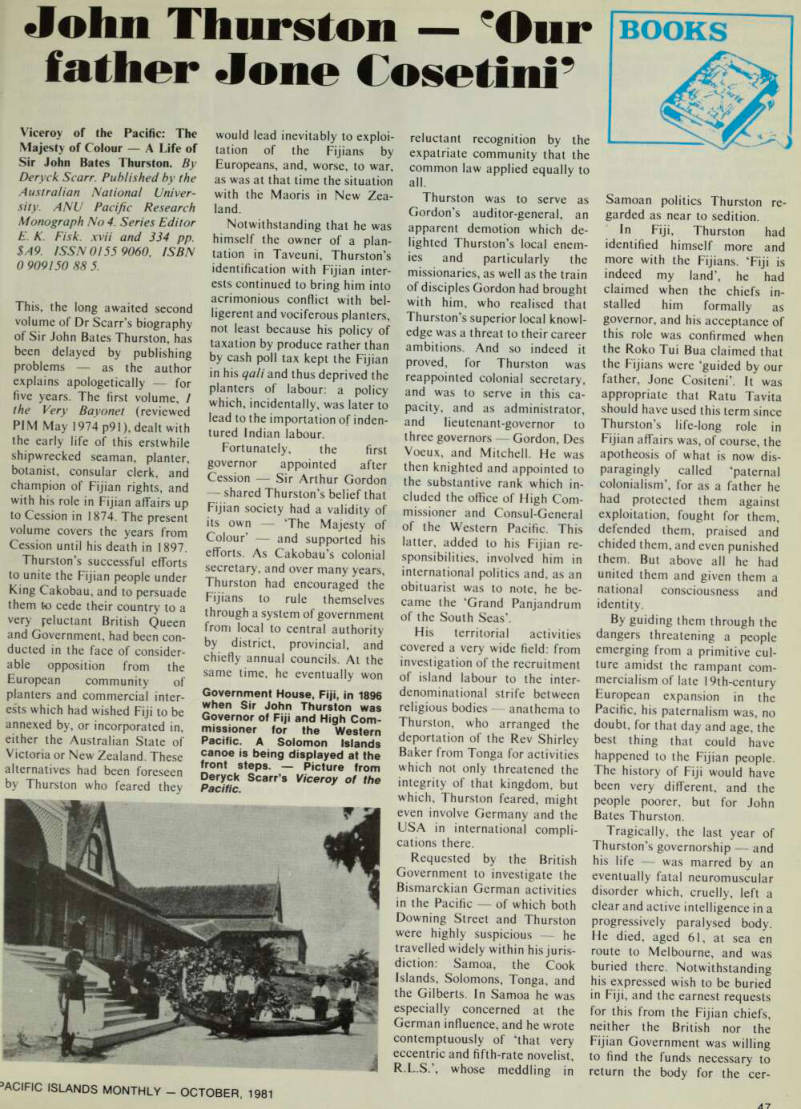
Government House, Fiji, in 1896 when Sir John Thurston was Governor of Fiji and High Com missioner for the Western Pacific. A Solomon Islands canoe is being displayed at the front steps. Picture from Deryck Scarr’s Viceroy of the Pacific.
emonial burua which, neverthe less, Ratu Josefa Lalabalavu held for him at Somosomo without the corpse.
All interested in Fiji and its history are indebted to Dr Scarr for the completion of his definitive biography of Thurston. This is no history of Fiji, but it is an indispensable reference for future historians wishing to assess Thurston’s legacy to the country he served so devotedly for 30 years. It is a valuable addition not only to the literature of Fiji, but also to the general literature of Pacific politics in the late 19th century.
Reproduced in facsimile typescript with some pertinent photographs and a bibli ography, one can only regret that the publishers were not able to present this volume printed and bound in uniformity with the first volume of which it is the worthy sequel.
Leonard Goodman.