People
pp. 41-45 · Read in the full issue
Hideto Kono. Hawaii’s director of planning and economic devel opment, is especially interested in how Hawaii can further contribute to America’s re lationships with Asian and Pacific nations.
Born in Hilo, Hawaii, to Japanese immigrant parents, he served with the US army mili tary intelligence on Saipan and Iwo Jima during World War 11, and later graduated from the University of Hawaii. He worked with the Hawaiian terri torial legislature and later the state legislature. In 1961 he helped establish the East-West Center.
From 1965 to 1971 Kono lived in Japan as a founder and director of the Dole-Itochu Food Company, a US/Japanese private corporation. As a mem ber of Hawaiian Governor George Ariyoshi’s cabinet, he is the governor’s top adviser on Asia and Pacific relations.
Hawaii has a ‘sector sense’ about how to deal with Asian and Pacific peoples, Kono says. ‘lt understands that Asia is different that it has an old civilisation and a less direct manner of dealing in business and personal relations than the United Stales.’
Because it understands the languages and customs of Asia and the Pacific, he adds, ‘Hawaii not only can deal more effectively with the region, but it also can help contribute the knowledge and understanding of these nations to the US community’ . . .
A governor's committee on foreign languages and inter national relations will be ap pointed to promote the teaching of Asian and Pacific languages in Hawaiian public schools.
Through this, Kono says, ‘our third-generation Asian and Pacific Americans can learn the languages of their roots and thus serve as bridges for Hawaii and the United Slates with their grandparents' homelands’
Perhaps the greatest benefit
to Pacific and Asian nations of their special relationship with Hawaii will come in the field of energy, Kono says. Without its own fossil fuels and too far from the mainland United States to link into its electric grid, Hawaii set out several years ago with the aim of developing enough alternative forms of energy to make itself America’s first energy self-sufficient state.
With federal, state and pri vate funds, it has developed numerous demonstration pro jects to generate solar, wind and geothermal energy, each of which will have a place in Hawaii’s energy future, Kono says.
Hawaii has become the first place in the world to demon strate the feasibility under natu ral conditions of tapping the large energy source created by the temperature differences be tween the top and lower layers of ocean water. Ocean Thermal Energy Conversion (OTEC) holds great promise not only for Hawaii, but also for her Pacific Island neighbours and for many Asian nations. Lois Herrmann, USICA Staff Cor respondent.
President Haruo I. Remelik of the Republic of Palau sent Acting Deputy High Com missioner Daniel High the officially declared and certified translation of the Compact of Free Association into Palauan, Tobian and Sonsorolese ver naculars.
Although the inhabitants of the southwest islands of Palau do speak the same language and conversationally understand
I each other, when their language is reduced into writing, the Sonsorolese written version is totally incomprehensible by Tobians and vice versa, ex plained Vic Uherbelau, special presidential representative to the Palau commission on politi cal status negotiation.
The government of the Marshall Islands has also com pleted the translation of the Compact of Free Association, Dut it is still yet to be officially declared and certified. )r Alan Ward, a reader in listory and former chairman of he Research Centre for South zest Pacific Studies at La 'robe University, Melbourne, as taken up a two-year ap ointment as director of the Lands Department in r anuatu.
Dr Ward is directing a staff f six local lands officers. His osition is funded jointly by anuatu and the Australian aid rogramme. In an interview ith the publication La Trobe niversity Record before he ft for Vila, Dr Ward said the sk of his department would be • identify the groups of custom vners entitled to negotiate 'er land, assess the appli itions of former freeholders r a right to negotiate, and Ivise on the negotiations that ke place for leases or joint nture arrangements between e custom owners and expatri e settlers or investors.
His department also would Ip to develop corporate and anagerial structures among stom workers and dispute tiling machinery under the )urts Regulation, and the cording or registration of indi iual and group interests in id among custom owners for cir own commercial enter ises.
Dr Ward has spent many ars studying the adaptation of stomary Pacific land tenure the needs and aspirations of )dern nationhood. As a lec •er at La Trobe, he broadened research to Papua New linea and served there for irly two years in the Lands partment. Recently he has died land reform proposals in w Caledonia. let McCoy, a long-time cam gn press aide of US Presi-
dent Reagan, is the reported choice to be the new High Commissioner of the Trust Ter ritory. The unofficial decision was made public in early August at a Republican gather ing in Honolulu by White House political adviser, Lyn Nofziger.
Janet Mccoy, who lives on the sparsely populated forested Oregon coast, has never been to the territories but ‘it is part of the world I’m extremely inter ested in , she said. She would not comment on how she views the job, saying ‘I can’t get into that yet because I haven’t got the job.’
Papua New Guinea’s Com missioner of Police Phillip Bouraga has been appointed chairman of the National St John Council of Papua New Guinea.
Mr Bouraga replaces Brigadier-General Ted Diro who stepped down recently after being a member of the council for six years, including 1975 to 1981 as its chairman.
The National St John Coun cil of PNG is the controlling body for the activities of the Order of St John in PNG which
lan Campbell of Suva. His ap pointment was announced re cently as Suva port manager for Union Maritime Services.
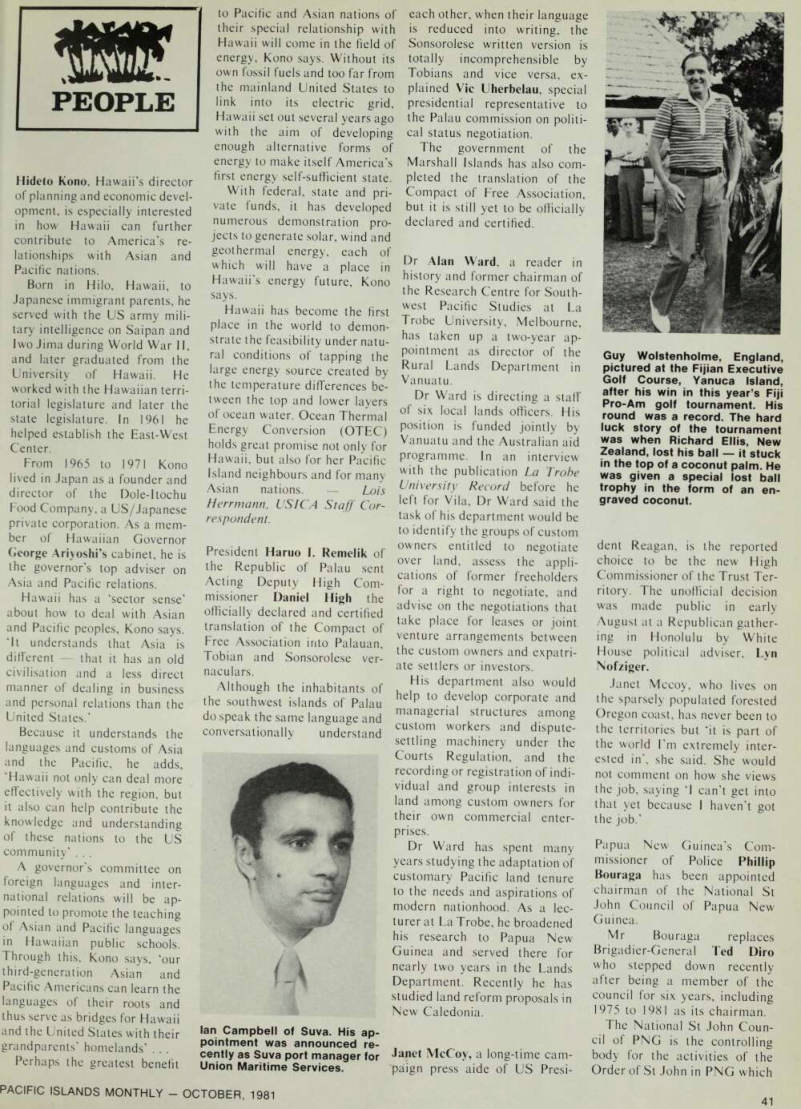
Guy Wolstenholme, England, pictured at the Fijian Executive Golf Course, Yanuca Island, after his win in this year’s Fiji Pro-Am golf tournament. His round was a record. The hard luck story of the tournament was when Richard Ellis, New Zealand, lost his ball - it stuck in the top of a coconut palm. He was given a special lost ball trophy in the form of an en graved coconut.
includes the St John Ambu lance and the St John Associ ation for the Blind.
After 43 years in Papua New Guinea, the Rev Bert Brown and his wife have returned to England.
Elsie Mataio writes in The Times of Papua New Guinea : ‘Whether as musician, linguist, designer or minister, Bert Brown will be long remembered by the people of Papua New Guinea.’
Mr Brown, a representative of the London Missionary So ciety, firsl arrived in PNG in 1938. He settled in Moru, Kerema, and worked as a teacher, doctor and missionary there. He and his wife learned the Toaripi language and spoke it fluently. Over the years Mr Brown translated both Old and New Testaments into the Toaripi longue.
Mr Brown is also remem bered for his musical skills, and for designing many PNG post age stamps.
He was awarded the OBE in 1977 for services to the country.
Vanuatu’s President Ati George Sokomanu was delighted with just about everything associated with the wedding of Prince Charles and Lady Diana Spen cer which he attended in July with Mrs Sokomanu.
But one thing really stunned him: it cost him more than StglOO for Mrs Sokomanu’s accessories, according to a re port in the Porl-Vila weekly Voice of Vanuatu. Mrs Sokomanu’s beige dress was made in Vanuatu by two friends.
When the first lady looked at herself in the mirror she exclaimed: ‘1 look just like my
grandmother . . .’
The president was quick to point out that this was not because she looked old, but because her grandmother always wore a hat when she went to church.
Colonel Gago Mamae was ap pointed in August to succeed Brigadier General Ted Diro as commander of the Papua New Guinea Defence Force.
Brigadier-General Diro re cently resigned from the post (PIM Aug p3l).
Colonel Mamae was promoted to Brigadier-General and took up duties on September 11. ifhe new commander is 36, and has been in the force since 1965. His appointment will cause him to end his full-time studies of economics at the University of PNG. But, he says, he will continue part-time studies for the more than five years it will now take him to complete his degree.
The University of Papua New Guinea has conferred an honor ary doctorate of laws on Pro fessor Oskar Spate, of the Australian National University (ANU), Canberra.
Professor Spate, foundation professor of geography in the ANU’s Research School of Pacific Studies in 1951 and director of the school from 1967 to 1972, has had a close interest in PNG and the Pacific region for more than 30 years.
He has written extensively on the region, as well as being one of three members of the Com
mission on Higher Education in Papua New Guinea (1963-65); a member of the 1969 Com mission on Education in Fiji; and a member of the Councils of the University of the South Pacific in Fiji and the Univer sity of PNG during his aca demic career.
Presenting the degree, the Vice-Chancellor of the Univer sity of Papua New Guinea Renagi Lohia, said Professor Spate, as foundation professor of geography at the ANU’s Research School of Pacific Studies, has played an import ant role in encouraging a num ber of scholars whose work in PNG has had important aca demic and practical conse quences for PNG.
He also had played a decisive role in the Currie Commission’s thinking on the university issue and in the subsequent establish ment of the University of PNG and the PNG University of Technology. (AIS).
Sela Molisa, director of Vanuatu’s Co-operative Feder ation, has resigned. Mr Molisa came to international prominence when he occupied a hot seat as a leading supporter of and spokesman for the Vanuatu Government on the island of Santo during the May- August 1980 secessionist at tempt.
Mr Molisa joined the Co operative Federation in 1977 and became assistant director.
He took over the post of direc tor in 1979.
In a statement announcing his resignation, Mr Molisa said he believed the co-operative movement in Vanuatu was mak ing rapid progress, and had a bright future.
Geoffrey A Henry was elected in August as the new leader of the Cook Islands Party. The elec tion took place at the end of the CIP conference. His opponent in the leadership ballot was Tupui Henry, eldest son of the late Albert Henry.
Geoffrey Henry, a nephew of Albert Henry, has been leader of the opposition in the Cook Islands Parliament since 1978.
He said after his election that the CIP would continue to judge him by the ‘old man’s (his
uncle’s) performance’.
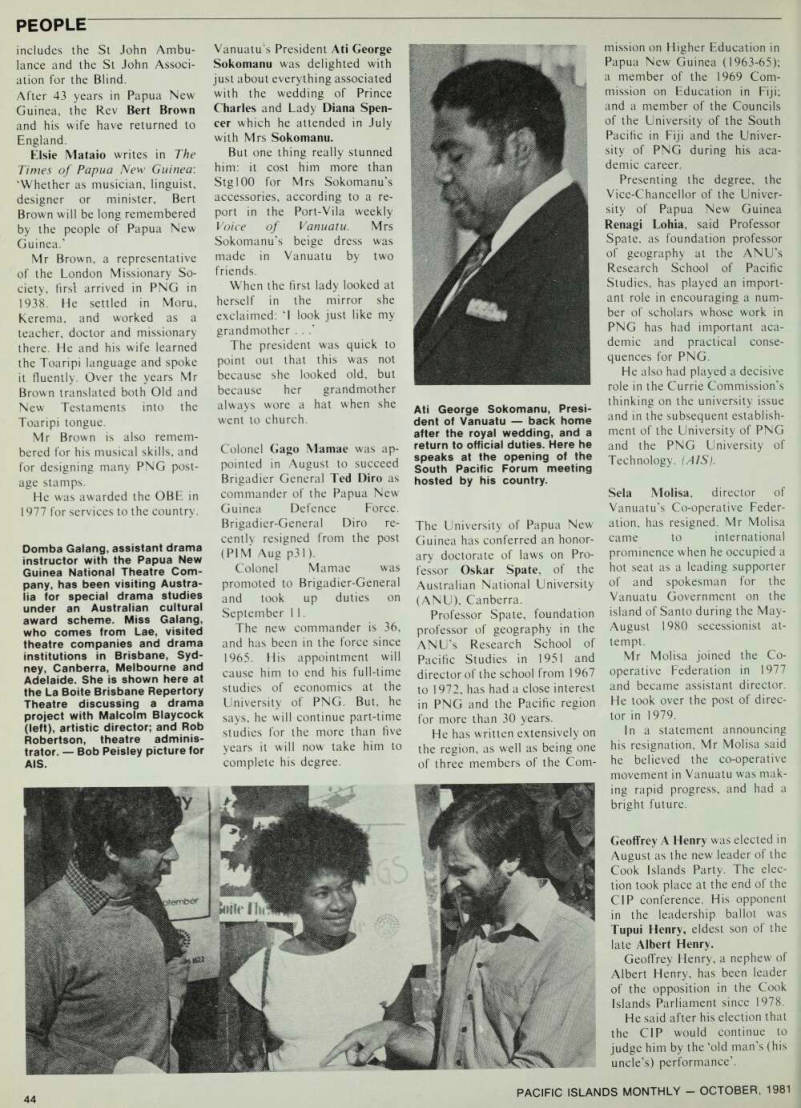
Domba Galang, assistant drama instructor with the Papua New Guinea National Theatre Com pany, has been visiting Austra lia for special drama studies under an Australian cultural award scheme. Miss Galang, who comes from Lae, visited theatre companies and drama institutions in Brisbane, Syd ney, Canberra, Melbourne and Adelaide. She is shown here at the La Boite Brisbane Repertory Theatre discussing a drama
project with Malcolm Blaycock
(left), artistic director; and Rob Robertson, theatre adminis trator.-Bob Peisley picture for
Ais.
Ati George Sokomanu, Presi dent of Vanuatu back home after the royal wedding, and a return to official duties. Here he speaks at the opening of the South Pacific Forum meeting hosted by his country.
he hopes his knowledge will be useful to the police and the hospitals.
The newly appointed Mexican Ambassador to Papua New Guinea, Juan Manuel Ramirez Gomez, has presented his ere
‘Because of this I have to work harder than ever before, as there is no person alive today who can do as much as the old man did,’ Mr Henry said.
He added that his major plan for the CIP is to strengthen it in preparation for the next elec tions, but he wasn’t going to ‘tell everybody’ how he would be going about strengthening the party.
A young Samoan who is helping to give Samoa a better image in the United States is 22-year-old Ropati Savelio of Ululoloa, Western Samoa.
Mr Savelio, who is doing a paramedic course at Harbor View Medical Center, Los Angeles, has recently received an Award of Merit from the institution for outstanding ser vice to patients and staff.
Doctors at the centre said they were deeply impressed with Mr Savelio’s calm manner in handling heart attack cases, cases of gunshot wounds, and other emergencies.
After completing his train ing, Ropati Savelio plans to return to Western Samoa where
dentials to Governor-General Sir Tore Lokoloko. He relayed a message from President of Mexico, Lopez Portillo, propos ing a search for peace to the very limits drawn by the prin ciples of non-intervention and free will of nations, and suggest ing that all misunderstandings should be solved peacefully.
In accepting Mr Gomez’s credentials, Sir Tore said PNG was deeply committed to a nuclear-free zone in the Pacific, and supported other countries in the region calling for such a declaration. Sir Tore also ex pressed the hope that PNG would be able to accredit an ambassador to Mexico in the near future.
Sister Agnes Helgenberger was appointed head of Ponape High School, effective August 13.
She replaces Noriwo Übedei, who resigned to take up the position of student services co ordinator for the College of Micronesia.
A graduate of St Mary Col lege in Kansas, USA, with a BA in history, Sister Helgenberger attended Our Lady of Mercy on Ponape for eight years, and Mount Carmel High School on Saipan for four years.
As president and founder of the Ponape Women’s Associ ation, she has been instrumental in the organisation of various women s interest programmes in Ponape.
Sister Helgenberger said that her immediate plan is to de velop harmonious working re lationships and attitudes among the Ponape Island Central
School teachers in order to ctTeclively assist the students to achieve their goals and objec tives. When asked whether her decisions could be affected by her being in the Mercederian Order, Sister Helgenberger said that it would depend on the responsibilities of her office and that she expects and would welcome advice and support from anyone.
Raymond C. Anderson, Canadian high commissioner to Vanuatu, in August officially opened a new SASO 000 fisheries and Marine School in Port-Vila which was paid for by the Canadian Government. The school is situated at the former French Wharf.
Speaking at the ceremony, Vanuatu’s Minister for Agricul ture. Fisheries and Forestry, Sethy Regemanu said the re public had a land area of 14 250 square kilometres. When the country s 200-miles exclusive economic zone came into force, its total area would become 24 500 nautical square miles.
Of this area, 80% is water.
We depend on water as much as we depend on land for our food, and this will continue to be so in the future,’ he said.
The minister pointed out that before the introduction of air travel, Ni-Vanuatu were sea farers, and seafaring would continue to be their main means of travel.
The new school would help the government to maintain a high standard of seafaring skills, through proper training, the minister said.
Geoffrey A. Henry, newly
confirmed leader of the Cook Islands Party and since 1978 leader of the opposition. His target: To do as much as ‘the old man’ did. A. Cogan picture.
Weights and measures inspec tors from eight countries have been taking part in a training course in Australia arranged by the Australian National Stan dards Commission. Three Solomon Islanders who are among the trainees are shown in Sydney with Bruce Digby (second from left), the course leader. They are (from left) Patson Basia, Davinia Mesepitu and Arnold Pania. Robert Maccoll picture for AIS.