from Papeete
pp. 31-33 · Read in the full issue
Political Currents
For Australia, a few home truths from Papeete
Christine Bourne is a formi dable French lady who wields a lot of editorial clout in the offices of the Papeete daily. La Depeche de Tahiti.
In that paper’s issue of August 8 she seized the oc casion of the meeting of the South Pacific Forum in Port- Vila which was then in the offing to let the world know what she thought of Australian policies in the South Pacific.
Entitled ‘Australia’s Lessons’, her short article amounts to a classic exposition of how Australia is seen by virtually every member of the French Establishment in the Pacific and by not a few in Paris as well. As such, it is well worth an airing. Mme Bourne wrote: ‘At a moment when starving Poland is crying out for food in a 20th-century Europe which since the last war has lost all taste for famine, when the mullahs’ Iran has found a new vent for its fanaticism and calls endlessly for “blood”, when around the world the old certi tudes are crumbling, crisis spreading, values collapsing, and when Polynesia, this tiny island of peace and the good life, is preparing to celebrate the “historic” occasion of the opening of its new Paofai Prot estant temple, close by, in Vanuatu, Australia is preparing a great get-together of the “jealous ones” of the South Pacific. ‘The day after Defence Min ister Charles Flernu’s press con ference (in Papeete), Tony Street, Australian minister for foreign affairs, saw fit to criti cise the French minister’s straightforward and clear pro nouncements. They must have sounded almost like a chal lenge. ‘Australia and this is abundantly clear is finding it harder and harder to abide the French “wart” which clings on through thick and thin in this Anglo-Presbyterian part of the
world where governments are politically independent but de pendent economically upon Australia. Nevertheless, the anachronistic character of its policies remains. ‘Australia, in fact, has set itself the task of destabilising the French Pacific, but still cheerfully sells uranium to France (uranium required for nuclear power generation). It is not at all mean about granting landing facilities at Darwin to American 852 bombers armed with nuclear weapons, and it doesn’t ask the American navy too many questions when It grants port facilities to its battle fleet, including nuclear powered ships. Australia, with its horror of tactical and stra tegic nuclear armouries, still takes part in manoeuvres in the Indian Ocean with an American task force made up of vessels equipped with nuclear weapons systems. And why does it grumble about French tests when it doesn’t bat an eyelid at very much bigger American ones? ‘Despite all this, one must unhappily note that the govern ment of this magnificent country feeds the fires of fanati cism in the countries around the French territories, embroiling them in ideological discourse in which it sets itself up as the great exponent of Truth and Virtue. Australia, with brazen hypocrisy, is making use of simpletons in its bid to conquer the Pacific. For the truth is that, once they became independent, the French territories would have no option but to turn to Australia for their trade. ‘lt is quite understandable that a few extremists, who poll a minority of votes at every election, should want to get together in Port-Vila to pro pound their ideology. What is more surprising is that Austra lia and New Zealand should be part of their act ... All the more so since Australia has formidable problems of its own
with the true inhabitants of the Australian land, the Aborigi nes, who have been despoiled and herded into reserves by these Anglo-Saxons come from afar. France is not out to offer Australia any lessons in hu manity, even if Australia keeps its moralising for those who think they’re free but whose feet in fact are in irons.’
Banabans appeal
to Forum
Banaba’s Council of Leaders used the meeting of the South Pacific Forum in Port-Vila in August to circularise Islands leaders with a statement of their case for what they call a Compact of Free Association with Kiribati. The statement said; The Banaban people are ap pealing to the South Pacific Forum to support moves for an arrangement under which Banaba would accept a Com pact of Free Association with the Republic of Kiribati as a self-governing country.
The plan for the compact has been rejected by Kiribati. It is insisting on keeping complete political control of Banaba and its resources, and in return is offering the Banabans only re stricted local government rights
in the island that is their ancestral home.
Influential members of Britain’s House of Commons are supporting the Banaban cause, as they did when the islanders sued Britain for a bigger share of Banaba’s phos phate revenues.
The Council of Leaders at Rabi, in Fiji, where most Banabans now live, is preparing a vigorous international cam paign for acceptance of the compact proposal as the time draws near for a promised independent review of Banaba’s political status . . .
The Rev Kaitangare Kaburoro, chairman of the Council of Leaders, said the Forum was an influential group ing of island states with experi ence of colonial exploitation.
We are now a colony of Kiri bati. Britain handed our island over to Kiribati in a final act of betrayal, he said.
Mr Kaburoro said the Banabans welcomed the news that the Forum might send a delegation to France to press for independence for French Pacific colonies. ‘We earnestly
hope that it will take up our case as well. We have as much right to self-government as Tahiti and New Caledonia.’
At the 1978 London consti tutional conference at which Britain and Kiribati agreed, despite strong Banaban pro tests, to make Banaba (also known as Ocean Island) an integral part of the new repub lic, Kiribati undertook to in quire into Banaba’s status three years after its own indepen dence from Britain. Mr Kaburoro said that his people are dismayed by Kiribati’s re fusal to respond sympatheti cally to their overwhelming desire for self-government.
Since a meeting between the council and the Kiribati Gov ernment held in Suva in May 1979 under the chairmanship of the Prime Minister of Fiji Ratu Sir Kamisese Mara, no progress has been made. ‘As history clearly shows, we were never part of Kiribati until Britain lumped us together for the sake of colonial administrative con venience,’ he said. ‘Despite our right to be entirely independent, we have dropped this claim and we are ready to enter an agreement giving Kiribati responsibility for our defence and a share of whatever revenue can be ob tained from the remnants of Banaba’s phosphate deposits.’
Kiribati had rejected this proposal out of hand and had replied with an offer that would relegate the Council of Leaders’ role in Banaba to the level of a small town council. ‘Kiribati’s plan is entirely unacceptable and we are now preparing to press our viewpoint internationally with assistance, we hope, from such agencies as the South Pacific Forum,’ Mr Kaburoro said.
The Compact of Free Associ ation envisages Banaba as a self-governing country with res ponsibility for its own foreign affairs, and, with the support of Kiribati, the right to apply for membership of regional and international organisations. The Cook Islands and Niue have similar arrangements with New Zealand, Mr Kaburoro said.
Banaba would have full con trol of its natural resources, including marine resources, in its 200-mile economic zone. In
recognition of Kiribati’s de fence responsibilities Banaba would consult with it in con ducting foreign affairs, and Kiribati would have the right to veto any form of military access to the island by any other country.
Banaba would have complete responsibility for running financial, economic, trade, banking, postal, civil aviation, radio broadcasting and aid mat ters, but would surrender its right to apply to Kiribati for financial grants.
Kiribati citizens would have residential rights in Banaba and both countries would exchange official resident representatives.
Banaba would adopt the laws and currency of Kiribati. Dis putes between the two govern ments would be settled by arbitration as a final resort.
The Banabans propose that the compact would be guaran teed by Britain, Australia, New Zealand and Fiji, but Kiribati has rejected this.
The compact would have a life of 10 years and would then be open to review and renewal by mutual consent.
Call for more
autonomy
Landowners and village leaders from the inland west of the Papua New Guinea mainland are threatening to disrupt the establishment there of the Ok Tedi gold and copper mine unless they are granted their own provincial government.
The threat is coming from the central and northern reaches of the Fly River in an area which at present is inside the bound aries of the Western Provincial Government. The Western Province has the biggest land area of any province in PNG and the groups calling for their own provincial government say the area is far too large to give them the degree of local auton omy which they require. They also claim that the development of the mine is creating a need for provincial autonomy in the immediate and surrounding areas.
The Kiunga and Lake Murray Development Com mittee, which is one of the factions in the move, earlier forced a three-day stoppage at the mine site in support of the
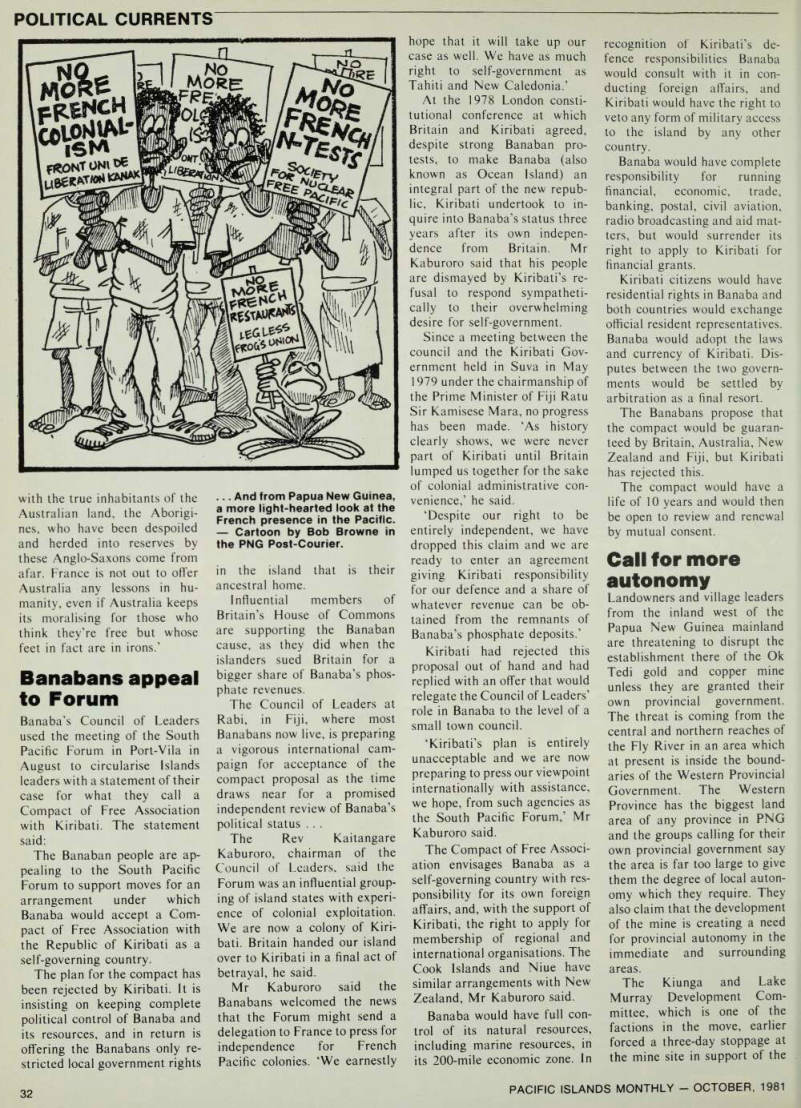
...And from Papua New Guinea, a more light-hearted look at the French presence in the Pacific.
Cartoon by Bob Browne in the PNG Post-Courier.
demand. Some groups are threatening to form what they call a ‘bow and arrow army’ to halt work at the mine site if provincial government is not granted.
In another move for provin cial status the Motu Koitabu people from the Port Moresby area barricaded roads on the outskirts of the city and claimed that national politics there were submerging their own voice as a community group. Riot police and a bulldozer had to be used to move one of the barricades.
Later the people set up what they claimed was a de facto provincial government. The central government refused to recognise the action taken by the people, but undertook to examine their claims for greater autonomy.