Solomon Islands
p. 33 · Read in the full issue
New government in Solomon Islands
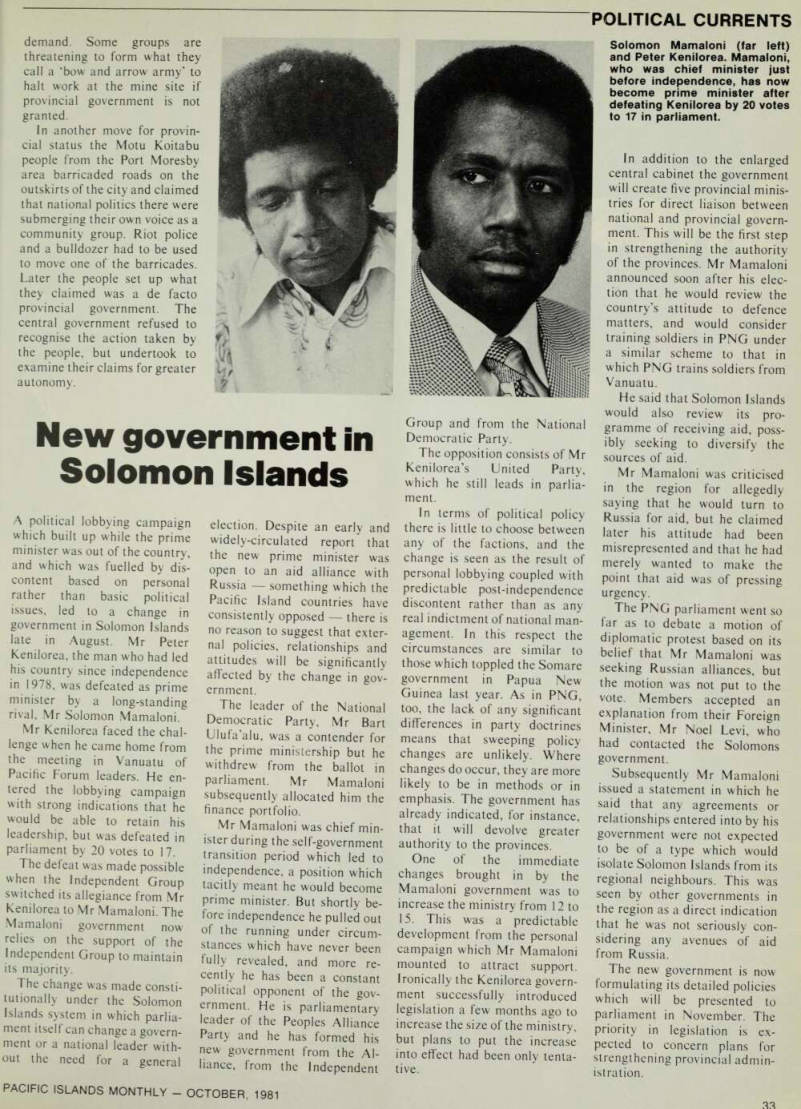
A political lobbying campaign which built up while the prime minister was out of the country, and which was fuelled by dis content based on personal rather than basic political issues, led to a change in government in Solomon Islands late in August. Mr Peter Kenilorea, the man who had led his country since independence in 1978, was defeated as prime minister by a long-standing rival, Mr Solomon Mamaloni.
Mr Kenilorea faced the chal lenge when he came home from the meeting in Vanuatu of Pacific Forum leaders. He en tered the lobbying campaign with strong indications that he would be able to retain his leadership, but was defeated in parliament by 20 votes to 17.
The defeat was made possible when the Independent Group switched its allegiance from Mr Kenilorea to Mr Mamaloni. The Mamaloni government now relies on the support of the Independent Group to maintain its majority.
The change was made consti tutionally under the Solomon Islands system in which parlia ment itself can change a govern ment or a national leader with out the need for a general
election. Despite an early and widely-circulated report that the new prime minister was open to an aid alliance with Russia something which the Pacific Island countries have consistently opposed there is no reason to suggest that exter nal policies, relationships and attitudes will be significantly affected by the change in gov ernment.
The leader of the National Democratic Party, Mr Bart Ulufa’alu, was a contender for the prime ministership but he withdrew from the ballot in parliament. Mr Mamaloni subsequently allocated him the finance portfolio.
Mr Mamaloni was chief min ister during the self-government transition period which led to independence, a position which tacitly meant he would become prime minister. But shortly be fore independence he pulled out of the running under circum stances which have never been fully revealed, and more re cently he has been a constant political opponent of the gov ernment. He is parliamentary leader of the Peoples Alliance Party and he has formed his new government from the Al liance, from the Independent
Group and from the National Democratic Party.
The opposition consists of Mr Kenilorea’s United Party, which he still leads in parlia ment.
In terms of political policy there is little to choose between any of the factions, and the change is seen as the result of personal lobbying coupled with predictable post-independence discontent rather than as any real indictment of national man agement. In this respect the circumstances are similar to those which toppled the Somare government in Papua New Guinea last year. As in PNG, too, the lack of any significant differences in party doctrines means that sweeping policy changes are unlikely. Where changes do occur, they are more likely to be in methods or in emphasis. The government has already indicated, for instance, that it will devolve greater authority to the provinces.
One of the immediate changes brought in by the Mamaloni government was to increase the ministry from 12 to 15. This was a predictable development from the personal campaign which Mr Mamaloni mounted to attract support.
Ironically the Kenilorea govern ment successfully introduced legislation a few months ago to increase the size of the ministry, but plans to put the increase into effect had been only tenta tive.
In addition to the enlarged central cabinet the government will create five provincial minis tries for direct liaison between national and provincial govern ment. This will be the first step in strengthening the authority of the provinces. Mr Mamaloni announced soon after his elec tion that he would review the country’s attitude to defence matters, and would consider training soldiers in PNG under a similar scheme to that in which PNG trains soldiers from Vanuatu.
He said that Solomon Islands would also review its pro gramme of receiving aid, poss ibly seeking to diversify the sources of aid.
Mr Mamaloni was criticised in the region for allegedly saying that he would turn to Russia for aid, but he claimed later his attitude had been misrepresented and that he had merely wanted to make the point that aid was of pressing urgency.
The PNG parliament went so far as to debate a motion of diplomatic protest based on its belief that Mr Mamaloni was seeking Russian alliances, but the motion was not put to the vote. Members accepted an explanation from their Foreign Minister, Mr Noel Levi, who had contacted the Solomons government.
Subsequently Mr Mamaloni issued a statement in which he said that any agreements or relationships entered into by his government were not expected to be of a type which would isolate Solomon Islands from its regional neighbours. This was seen by other governments in the region as a direct indication that he was not seriously con sidering any avenues of aid from Russia.
The new government is now formulating its detailed policies which will be presented to parliament in November. The priority in legislation is ex pected to concern plans for strengthening provincial admin istration.
Solomon Mamaloni (far left) and Peter Kenilorea. Mamaloni, who was chief minister just before independence, has now become prime minister after defeating Kenilorea by 20 votes to 17 in parliament.