May policies always
pp. 29-31 · Read in the full issue

Study off US attitudes to the Islands May policies always follow precepts like these
Political
Currents
The abundance and quality of objective analysis of US foreign relations that can be found in the United Slates is always surprising in view of the history of significant errors in that area made by successive US admin istrations.
Vietnam and Iran are two examples where there was a wealth of objective and accu rate information available to the US Government about the real slate of affairs, yet admin istrations persisted in pursuing actions which ended in disaster.
John Dorrance’s 92-page booklet*, which is No 80-6 in the National Security Affairs Monograph Series published by the Research Directorate of the National Defense University, Washington DC, is an illus tration of the sort of clear sighted observations which ought to be an invaluable aid to the makers of US policy on the Pacific Islands. But whether they will refer to it when next there is an important decision to be made is another matter.
John Dorrance has had exten sive experience in the South Seas as a US Foreign Service officer probably more than most in an area where US Government personnel are in clined to be moved on before they have time to absorb the real smell of the islands. I knew him as a tall, thin and rather serious diplomat, who in conver sation was given to analysing every new twist of local politics in a rather academic fashion, and seeking your opinion on it.
But obviously his methods were to good effect, because this monograph could have been
‘Oceania and the United States: An analysis of US interests and policies in the South Pacific. By John C. Dorrance. Published by the National Defense Uni versity Research Directorate, Washington, DC.
written only by somebody who has done more than study the literature. It is so self-assured that it clearly also depends on astute personal observation, and participation in a thousand con versations.
With economical use of words, Dorrance manages to present a fair summary of the whole Pacific Islands political environment, both from an Islands point of view and that of the Rim countries, and to dis cuss policies and problems of the US, Australia and New Zealand. It adds up to an invaluable little handbook.
As examples, firstly, Dorrance on decolonisation: Until recently decolonisation pressures directed at US Pacific territories by South Pacific states were confined to general ised statements of principle, with Fiji and Papua New Guinea offering voices of mod eration in the UN, he says. By contrast, the French were re garded as something like ‘politi cal pariahs’ within the Pacific.
Now, however, South Pacific leaders’ attacks on French colonialism have tended to em brace ‘US colonialism’, and some South Pacific leaders probably view the US as ‘an unreconstructed colonial power different from France only in its level of hypocritical rhetoric’, and this perception importantly colours US bilateral relations with some Island states. Most leaders who accept that there is little sentiment for indepen dence or looser relationships with the US in Guam or American Samoa also believe that US policies discourage such sentiment, and that the US would never permit these territories to opt for indepen dence. He says it is important for the US to break the linkage and identification with France’s position in the Pacific.
Dorrance takes a look at US attitudes to its territories being
involved in regional affairs with other states. In this connection, he says US policy has been ambivalent.
The US has favoured non political co-operation between US territories and the rest of the Pacific on technical matters, and at the same time ‘opposed or barely tolerated’ territorial initiatives smacking of govern ment-to-government relation ships. He adds; ‘Until the recent past we have been reluctant to accept changes in the South Pacific Commission charter which permit dependent territories to maintain a fully independent and equal rep resentation and thus conceiv ably adopt positions in contra vention to US policy. Yet the territories, especially American Samoa, are determined to play a more active international role in pursuit of what they perceive as their special territorial inter ests. The Trust Territory, and to a lesser extent Guam, have developed wide-ranging infor mal and even quasi-official pol itical and economic links with Japan in both the public and private sectors, while American Samoa cultivates similar links with its Island state neigh bours.’
Dorrance has a clear grasp of the main features of Island society. He says conservative traditional values, a consensus approach to decision-making, a strong sense of communal social obligation and cultural re straints on conflict and confron tation encourage political mod eration and pragmatism, and
resistance to radical change and ideologies. These tendencies are reinforced by the strong church orientation of Island societies.
Political parties are non existent in most areas, and where they do exist, ‘they tend to be shifting coalitions based on personal alliances to political leaders and have little ideologi cal content. Exceptions include parties in the French territories which focus on the issue of their future political status, and in Fiji where party alliances are essentially racial.’
Discussing the involvement of China in Islands affairs, Dorrance says the People’s Re public has actively cultivated governments and leaders for the past several years, with modest assistance programmes and visits of Islands leaders to Peking, and visits of high-level officials to the area. He says PRC objectives appear to be, in order of priority, ‘pre-emption of a Soviet presence and influence, cultivation of support from the emerging South Pacific bloc within the Third World context, and replace ment of Taiwanese influence.
PRC diplomats have been care ful to maintain a low profile, avoid internal political proselytization, and offer quiet encouragement not only to Aus tralia’s and New Zealand’s lead roles in the area, but also to increased US presence again
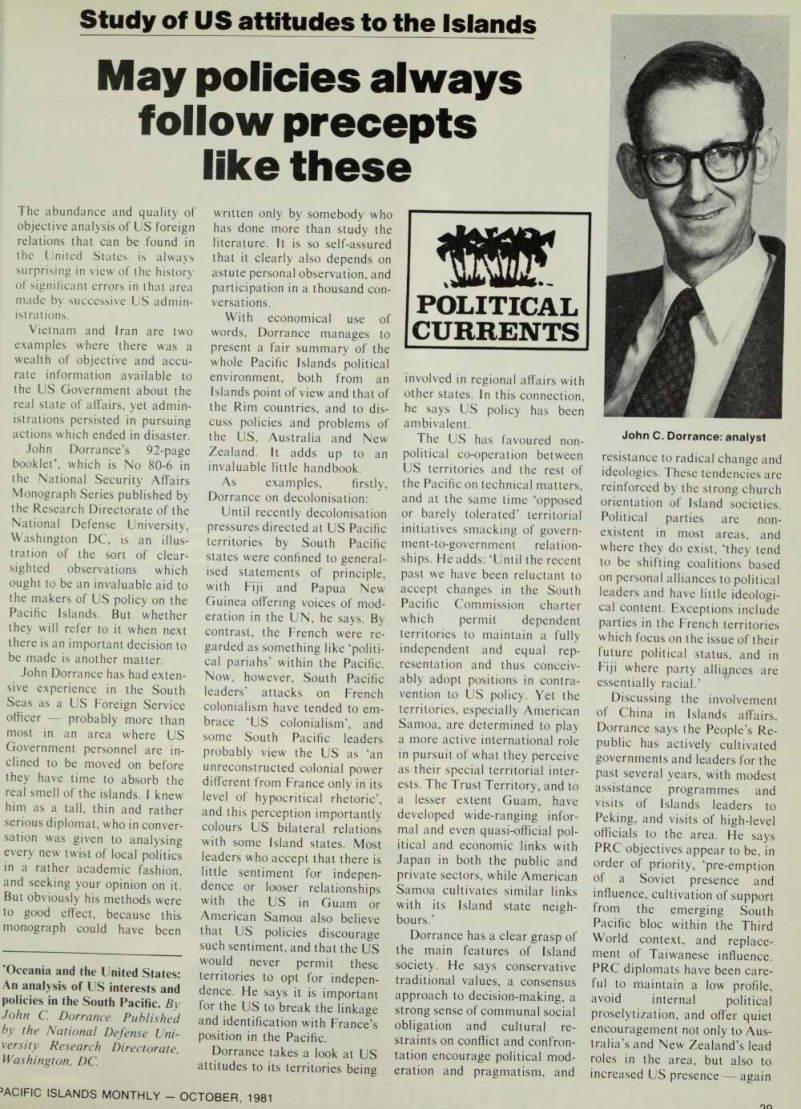
John C. Dorrance: analyst
as part of its anti-Soviet strat egy. Its economic interests are minimal, other than procure ment of about 40% of its copper import requirements from
Png’.
Dorrance is not greatly con cerned about the likelihood of real Soviet expansion into the Pacific, although he says expan sion is inevitable and ‘will undoubtedly be successful to some degree’. The likely emerg ence in the region in the 1980 s of less conservative political leadership will establish a more receptive climate, he thinks.
He comments: The percep tion in 1976 of the possibility of a major Soviet presence in the area caused considerable con cern in Wellington and Canberra, and was the catalyst in expansion of their aid pro grammes and diplomatic pres ence in the region, and prompted the Australian and New Zealand governments to press the US to expand its own presence in and assistance to the area.’
Dorrance sees Australia’s and New Zealand’s primary
Some Pacific leaders are not quite sure how to cope with our presence ... We must not allow the rhetoric of good intentions to outstrip our ability to perform
concerns in the South Pacific in’ these terms: ‘(a) the possibility that a radical and adventuristic government in Jakarta could revive Sukarno-era territorial and political ambitions directed at PNG; (b) centripetal forces could lead to political insta bility in PNG and threaten Australian economic and politi cal interests in that country; (c) French intransigence ac companied by violence in New Caledonia could prompt the emergence of “Australia’s Cuba” in that territory; and (d) shortfalls in necessary external assistance flows to the area could assure instability, island state acceptance of Soviet blan dishments, and consequent es tablishment of a Soviet pres ence in the region. For all of these reasons Australia and New Zealand press the US to play a more active role in the South Pacific.’
The problem still arises as to the best way the US can be accepted as a South Pacific regional partner, and Dorrance
sees the programme as one requiring patience, gradualism, consultation, and modest expan sion of the official presence.
Fie says: ‘Some leaders are not quite sure how to cope with our presence and are uncertain about our motivations. Though our respective interests and objectives need not be in conflict, it will take time and patience to overcome unease, uncertainty and some suspicion . . . Our credibility is to some degree in question. We must not allow the rhetoric of good intentions to outstrip our ability to perform and apply resources to the region. We must avoid generating the frustrations and ill-will that inevitably will ac company inflated and unfilled expectations. The South Pacific is not the place, given suspicion of and resistance to sudden change, for policy spectaculars . . . More so than in any other region, personal relationships with and between political leaders affect governmental at titudes and decisions. Our am bassadors to island states should be selected with particular at
tention to their ability to relate to proud but usually extremely informal leaders. Patience, in formality, straight-forwardness, a sense of humour, and mastery of soft-sell techniques are essen tial ambassadorial traits.’
Stuart Inder. * * * The US Embassy in Canberra advises: Copies of the above booklet may be purchased from the Superintendent of Docu ments, US Government Print ing Office, Washington, DC, 20402. When ordering, its full title should be quoted, plus its date which is June 1980, and its Stock Number which is S/N 008-020-00822-2. Its price is SUS4.7O. Payment must be included with the order and one quarter of the cost of the publication should be added to the remittance, to cover surface mailing to Australia. Payment up to the value of 20 Australian dollars may be made by Inter national Money Order obtain able from any Australian Post Office.