priorities
p. 26 · Read in the full issue
Mr Emmanuelli outlines the new priorities
His visit had been eagerly awaited. He came to listen and to see for himself. In five days in August the French Secretary of State for Over seas Departments and Terr itories Henri Emmanuelli crisscrossed the country from north to south, visited three islands, and delivered a 45-minute address before the Territorial Assembly.
New Caledonians heard the ministerial verdict: abolition of social inequalities (read: more land for Melanesians), and establishment of a sys tem of income tax which will be more rigorous and bring in more revenue than the taxes levied at present, which the minister con sidered far too light.
Mr Emmanuelli appeared to find the economic and social situation far more important than the political aspect. This view contrasts sharply with the demands of the pro-independence groups who called for Kanak social ist independence in every interview or speech given by their leaders.
At Mare or Lifou, Hienghene or Kone, Mr Emmanuelli heard the same demands from Melanesian leaders, but he also heard speeches from other Melan esians in which they de clared they did not want independence. At Lifou, for example, the high chiefs and the mayor gave Mr Emman uelli a warm welcome. The same happened at the Isle of Pines, where not a single pro independence figure showed up. At Mare, six of the seven high chiefs (Mr Naisseline being the exception) wel comed the minister, al though Territorial Council lor Yevene Yevene made a particularly forceful state ment: ‘Take back the French flag that is blotting out my
sun.’ The mayor of Mare left carrying the key to the town hall, after hauling down the French flag.
Mr Emmanuelli did not fail to note that up to now political problems have been taking precedence over the economic and social situ ation, on which the French Government is looking for the most rapid remedial ac tion from the local govern ment in New Caledonia.
Addressing Mr Dick Ukeiwe, the incumbent vice president of the Council of Government as ‘Monsieur le President’, the minister slated: ‘lt would not be normal for the decentralis ation measures which will give greater powers to the executives of the metropoli tan departments not to be applied to Overseas Terr itories which already enjoy a statute of autonomy.’
It seems that the noises emanating from the South Pacific Forum, which was meeting in Port-Vila during the minister’s visit, aroused not the slightest echo in Noumea. They seemed so untimely. The local press saw them as interference in New Caledonia’s internal affairs.
Unfavourable opinions formed about New Cale-
donia by South Pacific countries are often flawed by a poor understanding of the Caledonian political chess board. They very often for get that this country is free to make its own choice as to its political status. Quite contrary to opinions which often astound residents of New Caledonia, the major ity of Melanesians who have rallied to leaders who preach independence, represent only 65% of the Melanesian population, still less in cer tain islands like the Isle of Pines. The rest of the New Caledonian population is made up of descendants of Europeans, some of whom are fifth-generation residents in the territory. There are also Asians who were born in New Caledonia, and Polynesians whose children were born here. Over the last three years 4130 persons have quit the territory be cause of poor economic con ditions. This gives the lie to claims such as that made by the Pacific Council of Churches (PIM Jul p 6) ac cording to which new emi grants are continuing to ar rive in the territory. It is a long time since anyone has given credence to claims that military personnel vote in polls held in New Cale donia: it is constitutionally impossible. Even if they had their wish, those who believe that persons with fewer than 10 years residence in the territory should not be al lowed the vote would most likely find that this would not change the voting trend regularly observed in recent elections: two-thirds of the voters reject the adventure of independence.
Mr Emmanuelli spent two
days on Wallis and Futuna where he was delighted with the warmth of the welcome he received from the popu lation.
It is likely that from now into next year there will be discussions with the local political groupings aimed at an expansion of the present autonomy, leading to a re striction of the powers of the High Commissioner. In some Centrist political circles there is a desire for autonomous status on the Cook Islands model.
Mr Emmanuelli made it clear that the financial con tributions of the French State will be maintained, but redirected into the social and economic sectors. France’s present expenditure in all fields in New Caledonia is the equivalent of SAISO million. Military spending accounts for only 5% of this, and this includes mercy flights by helicopters of the gendarmerie or army. Thirty per cent of the army is made up of local recruits doing their national service.
Others choose to go to France where they are trained in various trades.
The local press didn’t seem to have appreciated the attitudes of the South Pacific Forum, which to some New Caledonians ac tually appeared quite shock ing. Minister Emmanuelli met the press during his visit. Questioned on the pos ition taken up by Australia’s Deputy Prime Minister Anthony at the Port-Vila meeting in support of inde pendence for New Cale donia, Mr Emmanuelli said ‘such statements are binding only on Mr Anthony him self.
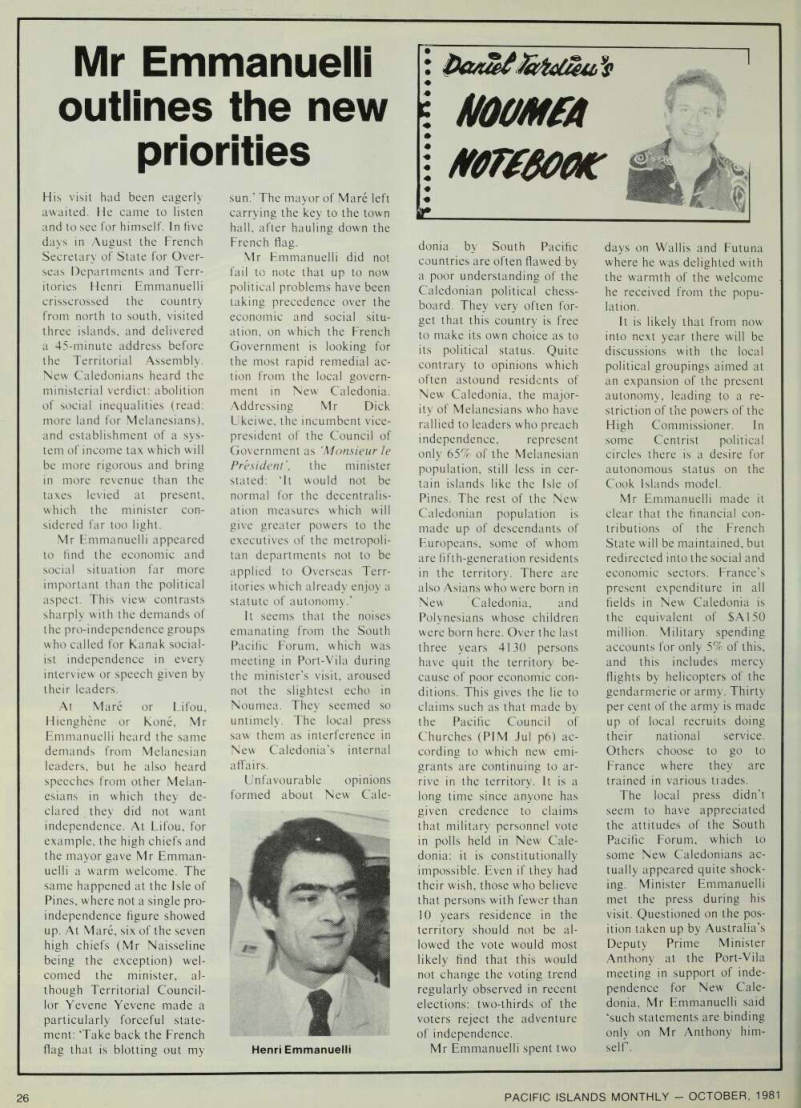
Henri Emmanuelli