whisper
pp. 22-23 · Read in the full issue
With a bang and a whisper
If the mass media had not told us, nobody would have believed that the suave gentleman in the dark, double-breasted suit who stepped out of a French Special Air Force DC-8 at Papeete airport on July 31 was a representative of the new socialist government swept to power on a radical programme of far reaching social and economic reforms. But in fact he was the new French Minister for Defence Charles Hernu, come out to inspect the nuclear base at Moruroa.
Except for the fact that he sported a thin beard, he and the numerous Gaullist ministers who had preceded him were as alike as two peas in a pod. The local reception committee, too, looked very familiar for the very good reason that it consisted of the same old guard of politicians and businessmen who have always prospered under the existing colonial and capitalist system. Incidentally, most of them had less than two months before ardently supported Mitterrand’s right-wing opponents, Chirac and Giscard, in the presidential elections. But here they were again on the tarmac, seemingly very little embarrassed by their 180-degree turn-around. As for the dancers, musicians and beauty queens, supposedly symbolising the friendly aroha spirit of the islands, they smiled as happily as they always do when they are paid well for their services.
Not unexpectedly, the new defence minister also spoke like his Gaullist predecessors, although in a somewhat more rambling and befuddled manner. Thus, at a special press conference, he lost no time in announcing that the nuclear tests were to continue. At Moruroa. Indefinitely. When a reporter asked whether there was any truth in the persistent rumour that the Kerguelen islands in the Indian Ocean were being
considered as a more suitable testing ground than the much battered atoll, Hernu literally exploded, declaring that the rumour was so silly that it was not worth answering the question.
Everybody is perfectly happy with Moruroa, he added. ‘Even the Polynesian people?’ asked an incredulous reporter. Hernu took a deep breath and dropped an even bigger bomb, for he said and these were his exact words; The people of Polynesia have already expressed their approval in what amounts virtually to a popular referendum, for since I took over as defence minister, 1 have received thousands of letters from French Polynesia, all in favour of continued nuclear testing at Moruroa.’
This was, of course, impossible to believe. Polynesians never write to their ministers, and the few letters they do send to the local newspapers are as a rule strongly critical of the nuclear tests. One of the authors of this article, Marie-Therese, publicly challenged Hernu to produce these pro-nuclear letters, or at least to provide some more information about this unique ‘mail order referendum’. Were the letter-writers really all Polynesians? Or were they perchance mostly French expatri ates, making a lot of money out of the bomb? Or were they simply reactionary Frenchmen back home who equate French honour and glory with the bomb? The only answer Hernu cared to furnish was extemely evasive. He claimed that letters received by his ministry were ‘confidential documents’.
It should perhaps be recalled that the number of voters in French Polynesia is more than 18 000. So even in the unlikely event that a few thousand Polynesians, in an unprecedented burst of partriotic fervour, did write to the minister for defence, this can hardly be considered a scientifically and democratically valid method of assessing public opinion.
The radioactive pollution of the Pacific islands and islanders resulting from the dozen or so tests made every year since 1966 (with one exception, 1969), was, of course, too burning a subject not to be touched upon. Hernu revealed that several local political and civic leaders had expressed concern about the terrible accidents which occurred at Moruroa in 1979 (PIM May 1980 p2B) and which resulted in 1) the death or serious injury of half a dozen technicians, 2) the release of vast amounts of plutonium, whose deadly poisonous effect will be felt for the next 24 000 years, and 3) the prying loose of such an enormous chunk of the outer wall of the atoll that it caused a tidal wave capable of destroying buildings on islands hundreds of kilometres from Moruroa.
As soon as the 30 members of the Territorial Assembly of French Polynesia learnt from unofficial sources what had happened, they unanimously adopted a resolution, on August 18, 1979, asking for 1) the setting up of a local commission of inquiry to look into this and other accidents, and 2) the immediate despatch of a group of impartial French and foreign civilian scientists to study the radioactive pollution of man and environment in French Polynesia. The government of Giscard d’Estaing never took any action to comply with these requests.
This was definitely a matter, said Hernu, before flying off to
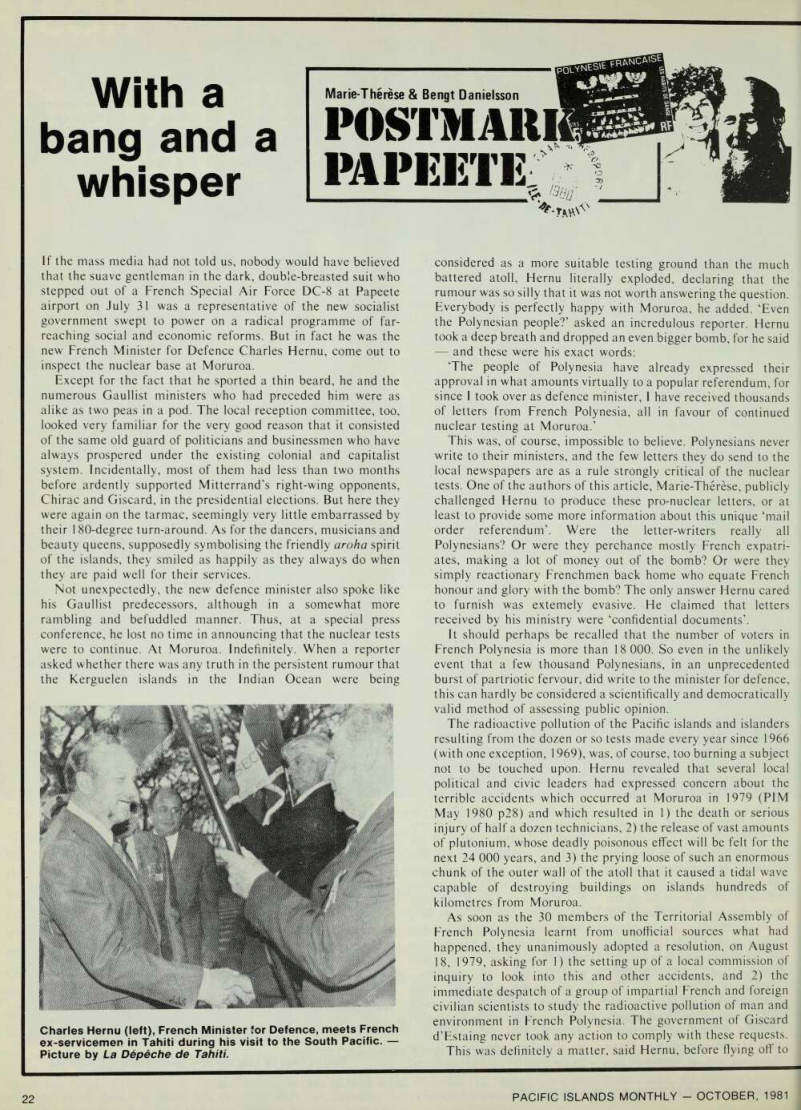
Charles Hernu (left), French Minister for Defence, meets French ex-servicemen in Tahiti during his visit to the South Pacific.
Picture by La Depeche de Tahiti.
Moruroa, on which the new government of France was going to act in a completely different, open and frank manner. To use his own words: The press must be informed about security problems. If there is an accident, it is better to let the truth be known than to let all sorts of rumours spread. Nothing must be hidden that affects the health of the population.’ He even added: ‘When New Zealand and Australia ask us for information about these problems, we shall supply it.’ For those who wish to take the minister up on this humane and generous offer, the address is; Ministere de la Defense, 14, rue Saint-Dominique, Paris 75007.
Less than a week after minister Hernu had flown home in the grand style of an Arab oil sheik, the commanding CEP admiral in French Polynesia faithfully carried out his new instructions.
We were certainly not the only ones who were jolted when we read in our morning paper the following pioneering efforts in the field of military-civilian public relations: ‘Due to strong westerly winds experienced at Moruroa, some of the nuclear waste left by the atmospheric explosions made before 1975, may have crossed the lagoon to the eastern side of the atoll. In order to avoid all risks, access to the beach in the inhabited area has temporarily been forbidden, while the necessary checks are being made.’
Of course, the communique raised more questions than it answered. In the first place, the existence of nuclear waste in any form at Moruroa has always been vehemently denied by the organisers of the tests, at present headed by the admiral who issued the communique. If now nuclear waste has suddenly been discovered, we would like to hear what the proofs are that it actually dates from the pre-1975 period. And how did the waste cross the lagoon, since it cannot float? It seems most likely that what is labelled pre-1975 waste has been confused with the plutonium waste from the 1979 accident which, according to the minutes of the debate that took place in the territorial assembly at the time, was actually mixed with all sorts of debris and could therefore very well have floated across the lagoon from the western portion of the reef where it was dumped. When questions like this were asked in the past, they were consistently ignored. So it is certainly a great relief to know that with the new regime frank answers will be quickly forthcoming.
An equally important subject upon which Hernu touched only very lightly during his stay in the islands, were the ‘studies and experiments’ carried out with a view to a French neutron bomb.
These have been going on over the past three years, presumably quite often at Moruroa. All he was willing to say was that the research was to be continued. But admittedly, after the American decision, on Hiroshima Day, to mass-produce this weapon, it was certainly the wrong time to evoke the whole ugly subject.
Will the firm determination of the new French president to keep Moruroa as a nuclear testing ground make a sham of the promises made before, during and after his election campaign, to apply to the last French overseas territories the noble principle of auto-determination ? The man supposed to know the answer to this question is, of course, the minister for these territories, Henri Emmanuelli, who arrived only a week after Henru’s departure, as an ordinary passenger on a regular flight from Fiji. He, too, had the polished look of all his Gaullist predecessors and was therefore quickly clasped to the bosom of the same old guard reception committee, by now even more warmly pro-socialist. His ministry, after all, has the ultimate say m all money matters affecting French Polynesia. The only new lace to appear was that of an expatriate Frenchman, surrounded by a few local friends, who had all suddenly discovered that they had always been socialists at heart. To Emmanuelli’s credit it must be said that he quite rudely told them that he did not need any generals without troops.
It soon became evident that the minister’s very sensible
attitude was: I shall wait and see. Or rather, I shall see the sights first and then wait for the outcome of the territorial elections to be held early next year which in all likelihood will sweep out the old guard. Consequently, Emmanuelli undertook a gruelling but perfectly futile trip that in six days took him around Tahiti and then to the Leeward and the Tuamotu islands, with countless stops at various schools, dispensaries, town halls, museums, solar installations, factories, slums, markets and hotels, solely in order to listen to speeches, complaints and requests, and to watch dances, eat meals and see canoe races. The only noticeable innovation was the total absence of the popular ‘flower girls’ who, during ministerial visits in the past, used to embellish most o ffi cial receptions, and who, to tell the sad truth, often templed elderly and portly civil servants and politicians to behave in a most undignified fashion.
Throughout his ordeal, Emmanuelli kept smiling in the most engaging manner and rarely talked for more than five minutes at a lime, in a pleasantly uninteresting manner. Not even when, on the last day of his stay, he made his only full-length political speech, in the packed Territorial Assembly (behind a socialist red bouquet of roses, thoughtfully provided by the House) did he have much to say. His greatest achievement was, in fact, that he almost scared some of his hosts out of their wits by casually suggesting that it was time to introduce income tax, instead of going on forever begging the mother country for money. But what it all boiled down to in the end was a renewed promise to apply the noble principle of auto-determination in a much toned down form: a special committee of local politicians and French officials will, over the next four or five months, study at a leisurely pace the need for a revision of the present constitution governing French Polynesia.
Still today nobody is quite sure how Mitterrand’s victory will affect our lives. But an indication that the changes may be few and slow appeared perhaps during Emmanuelli’s visit, even if it was not much noticed. We refer to the quite extraordinary fact that the leaders of the only genuine popular, socialist party in the islands, la mana te nunaa, shunned the minister like the plague, and in turn were totally ignored by him. Marie- Therese and Bengt Danielsson.
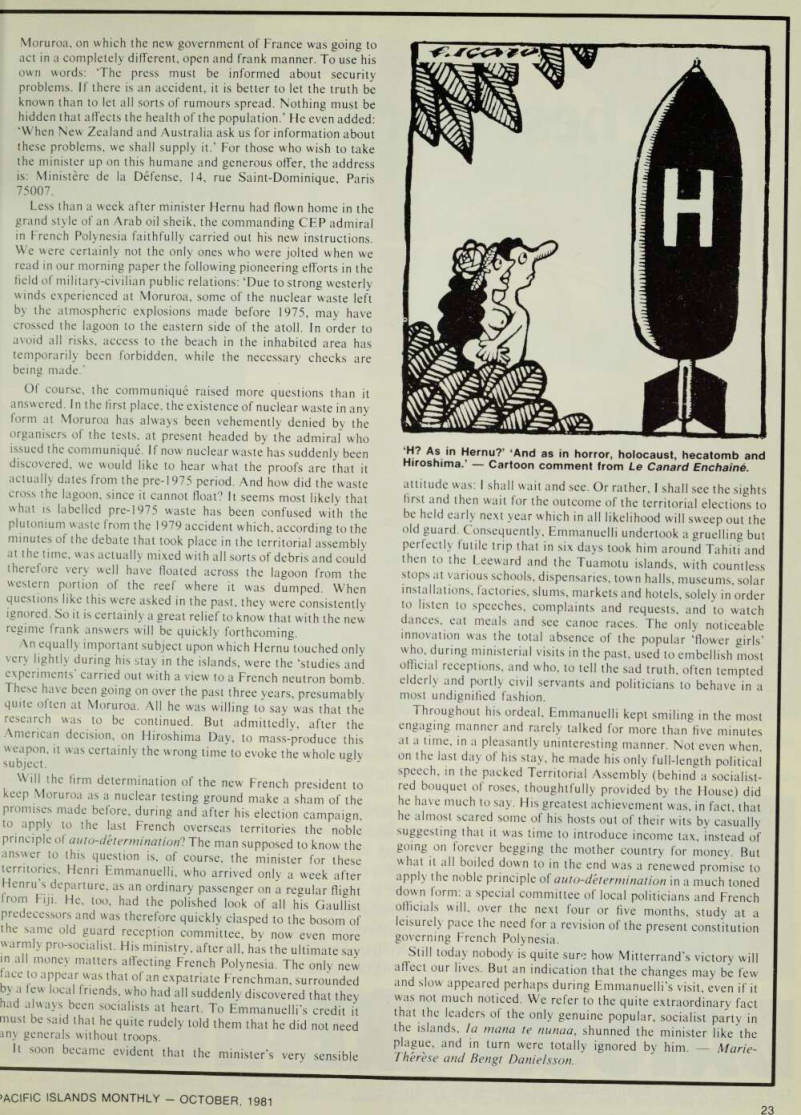
'H? As in Hernu?’ ‘And as in horror, holocaust, hecatomb and Hiroshima.'-Cartoon comment from Le Canard Enchaîné.