and they’re moving
pp. 33-36 · Read in the full issue

Ties are growing, and they’re moving Fiji’s way
Fifty thousand Japanese tour ists a year that’s the target which Mahendra Patel, chair man of the Fiji Visitors Bureau, would like the organisation to set for itself.
If achieved, it would increase total tourist traffic to Fiji by 25% on the present figure, which has flattened out at just under 200 000, and swell tour ism industry earnings by at least in extra SF2O million to SF3O nillion a year.
But other members of the r VB board are not so enthusi istic about the prospect; anguage and food difficulties, ind special requirements, make he Japanese difficult people to ater for, and, they feel, an asier way to build tourism /ould be to concentate on ttracting more of the more amiliar and easier-to-handle ustomers, like the Americans nd Canadians.
The FVB has not yet made up s mind what to do about its otentially huge Japanese mar et, but it looks as if it is going ) have its mind made up for it.
Japan Air Lines began long waited scheduled flights to Fiji i May 1980, after several years ' experimental charter trips, he once-a-week flight to Nadi id on to Auckland soon be ime twice weekly, and now a ird flight has been added to e service, which, unlike the 'O others, terminates at Nadi.
In 1980 Japanese tourist traffic, which a few years earlier had been only a trickle, jumped by 26% over the 1979 figure to 7141 visitors.
JAL is fairly cagey about what it thinks about the future of its Fiji service and is said to be thinking of a two-year trial before really beginning to push it. But barring unforeseen econ omic factors it looks as if Fiji is now firmly on the map for Japanese travellers, and likely to remain so.
Just how many will make it to Fiji each year is something that Fiji will have to decide. In doing so it will quite probably plump
for a rationing of such guests, so that its islands don’t become overrun by them.
Tourism is only one of the areas in which relations be tween Fiji and Japan have recently begun to blossom, after a decade and a half of mainly one-way dealings in Japan’s favour. After years of taking token amounts of shell, fruit and occasional small shipments of sugar, while supplying a steady 10% to 15% of all of Fiji’s imports, Japan last year became a serious buyer of sugar.
It look quantities valued at about $2O million. This year it will buy $4O to $5O millions’ worth, and is in the market for a number of up-and-coming products such as timber, fruit and ginger.
For the first time Fiji, which in 1979 took Japanese products to the value of $56 million, while selling back less than $3 millions’ worth, is able to think in terms of achieving what for it would be a favourable balance of trade with its third largest supplier of imports.
There are also hopes for major Japanese investment in the country.
Several Japanese companies have been established in Fiji
fairly inactively for a number of years.
In the past 12 months several big corporations have sent in scouts on prospect-hunting missions, and in July Fiji’s newly established Economic Development Board, created especially to angle for foreign investment, was vigorously courting Sumitomo. lan Thomson, the board’s chairman, is talking confidently of landing something big in the way of Japanese investment in the near future.
Present activity is limited to fishing and tourism. New comers, if the government has anything to do with it, will be channelled into timber and agri cultural and marine product processing ventures.
The first significant Japanese entry into Fiji occurred in the early 1960 s when C. Itoh and Co Ltd of Osaka, and Nichiryo Ld of Tokyo, opened a freezing factory in Levuka for the transhipment of tuna landed there by Japanese and other Asian fishing craft.
Six years ago the Fiji Govern ment became a 25% partner in their Fiji subsidiary, the Pacific Fishing Company, a cannery was added to the freezing works, and in the last three years exports of canned fish have leapt from nothing to a business worth around $l5 million annually.
The cannery is partly sup plied by ships of the government-owned Ika Corpor ation, which lands skipjack tuna caught with Japanese-built vessels manned by local crews.
The fishing venture is doing well and has received equip ment and advice from the Japanese Government, includ ing one large modern catcher.
At Pacific Harbour, 56 km from Suva, the giant Taisei construction group has an inter est with Canadian-controlled Southern Pacific Properties Ltd in the developed 445-ha first stage of a hotel/villa/ condominium resort and a half share in SPP-Taisei Ltd, which owns 2500 ha of swampy adjoin ing land.
Taisei is very cautious about its undeveloped real estate hold ings, saying it takes a very long term view of them.
But it hints that it will begin
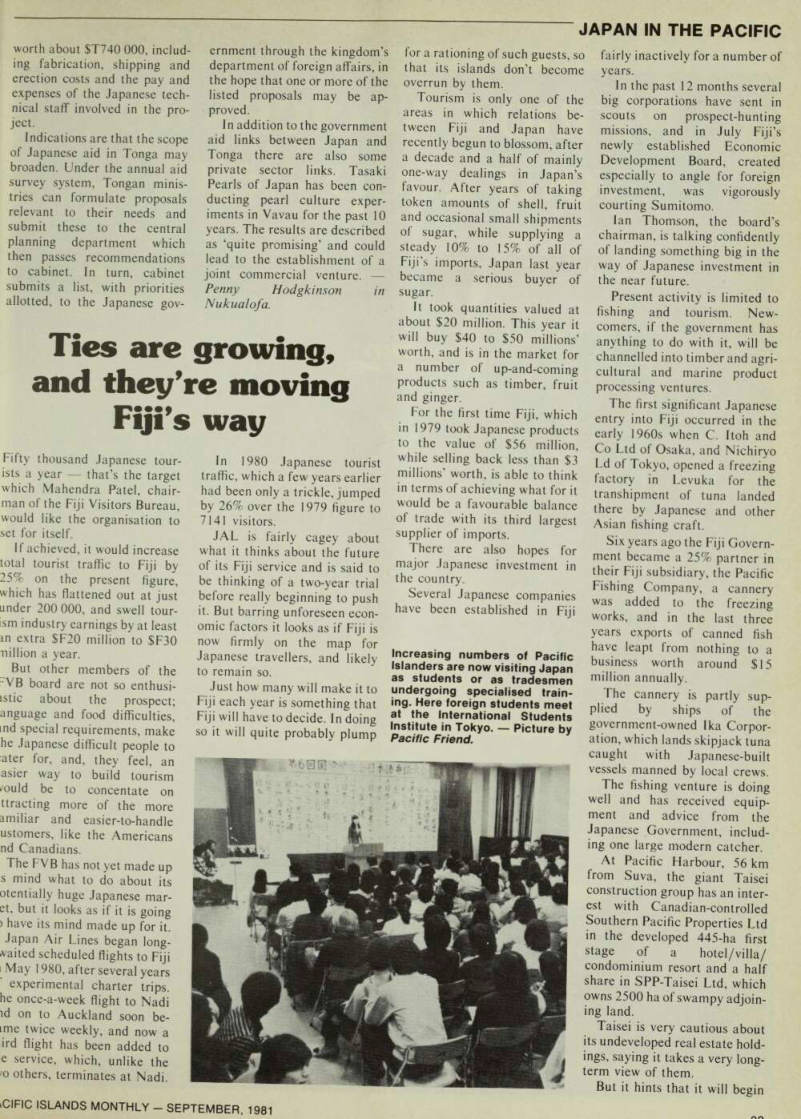
Increasing numbers of Pacific Islanders are now visiting Japan as students or as tradesmen undergoing specialised train ing. Here foreign students meet at the International Students Institute in Tokyo.-Picture by Pacific Friend.
to move when it is convinced that JAL has become a perma nent part of Fiji tourism.
At Denarau Island, near Nadi Airport, Fuji Kon Fiji Ltd has held a 10-ha lease for a number of years and is expected to put a major resort hotel on it when a $6O million government water supply project for the whole of the Nadi area is completed in 1983, and severe problems in supplying hotels with water are overcome.
Todeco (Fiji) Ltd, represent ing a number of Japanese cor porations, has owned and oper ated the Mana Island resort hotel off western Viti Levu for a number of years, and in the past has spoken of eventually mak ing other investments in Fiji.
Political relations between the two countries have become closer.
Japan established an em bassy in Suva in 1979 and in April this year (1981) Fiji opened a small embassy in Tokyo, mainly with the idea of using it as a base for canvassing for investment, not only from Japanese corporations, but from businessmen in Hong Kong and South Korea as well.
In May 1980 the Prime Minister of Fiji, Ratu Sir Kamisese Mara, made an official visit to Japan and was given red carpet treatment by hosts anxious to enlarge their influence and prestige in the South Pacific, and wishing to win support for the concept of some sort of Pacific co operative club of nations which is being promoted by the Japanese.
The opening of the Suva embassy has been accompanied by the launching of a Japanese economic and technical aid programme now worth several million dollars a year to Fiji.
Fishing, agriculture, forestry, training for engineering and electronics technicians, and the supply of a complete system of earthquake monitoring stations, are some of the aid areas in which the Japanese are active.
The arrival of the first contingent of Japanese volun tary service workers is likely in the near future.
The only cloud on the horizon is Japan’s desire to use parts of the North Pacific as a dumping ground for nuclear wastes. In
common with its South Pacific neighbours, Fiji is not at all keen on that idea.
Otherwise it seems certain that Japan’s involvement with Fiji is going to grow in direc tions that will be distinctly to Fiji’s advantage. The only doubts about growth are those being expressed at meetings of the Fiji Visitors Bureau.
At least 50 000 trippers out of Tokyo each year are what’s needed, asserts Mahendra Patel and it’s quite likely that, with JAL’s jets backing him up,
he’ll have his way.
Robert
Keith-Reid in Suva.