Tongan economy
pp. 32-33 · Read in the full issue
getting big Japanese support
In the 11 years since Japan and Tonga established diplomatic relations, Japanese aid and ex pertise particularly in fisheries development has become a significant part of the Tongan economy.
Historically the Japanese link with Tonga goes back much earlier. For about 20 years between the two world wars Japanese traders were firmly established there, taking over the involvement of the early German and American traders.
But the Japanese attack on Pearl Harbor on December 7, 1941, turned the Tonga Japanese into prisoners of war overnight. They were interned on an outer island for some months and were then trans ferred to New Zealand for the duration of the war.
Only one of them, J M Nakao, was permitted to return to the kingdom in 1945, thanks to his prewar marriage to a Tongan. Today, the entrepren eurial drive of his son, Mr Tsutomu Nakao, is making it self increasingly felt across the spectrum of local business ac tivities. Building contracting, manufacturing, food, soft drinks, tourism you name it, Tom Nakao’s into it.
Japanese re-involvement in Tonga began fairly quietly in 1960 with the appointment of a fisheries technical officer. The position still exists and is now held by Mr Susumu Kawakami.
For the past 14 years Mr Kawakami has been helping Tonga overcome the many problems of developing an enor mous fishing potential.
In 1970 Japan established official diplomatic links with Tonga through its embassy in Wellington (re-routed through Suva since 1980) and in 1974 began sending volunteers for two-year terms to act as fisheries support staff. Four of these well-qualified young men are now attached to the fisheries division a marine engineer, a marine biologist, a refrigeration engineer and a specialist in fishing gear and methodology.
Over the past three years a Japanese expert on skipjack tuna has been attached to the development team, and in the past seven years eight Tongans have been sent to Japan for training in coastal fishing, mar ine engineering and associated trades.
Since 1970 Japan has also supplied the fisheries sector with substantial hardware sup port, including many kinds of fishing gear, three auxiliary craft with engines, and a wide range of heavy machine equip ment. In 1978 Japan built the Tonga Mariculture Centre which is now the headquarters for all fisheries activity, and at the same time presented Tonga with a 35-metre longline train ing vessel and all associated equipment a gift valued at STI.6 million.
Another STBOO 000 bonanza arrived the following year, in the shape of a massive shipment of high-grade canned tuna, which was distributed to every household in the kingdom.
Before the end of this year, under the Tonga-Japan techni cal co-operation programme, the kingdom will receive three vessels designed for Tongan crews and Tongan fishing con ditions. The first of these will be a 12-metre purse-seine type which will be used for trial catching of small open-sea fish, such as sardines and mackerel, as an extra protein source for the local population and for longline bait.
The other ships will be a 135 gross-tonne, 3-metre deep-sea longliner for commercial tuna fishing, with navy satellite navi gation system, radar, fish detec tor, and automatic casting and hauling equipment; and a 15-metre mini-longliner for ex periments in coastal tuna fish ing.
Two Tongan engineers, a fishing master and a radio operator are now in Japan undergoing intensive training on the sophisticated equipment before joining the delivery crew which will sail the larger vessel to Tonga with the smaller one as deck cargo. The combined value of the three new vessels is STI.B million.
In a totally different sphere, Japanese largesse is also provid ing two Tongatapu villages with handsome new prefabricated primary schools, said to be
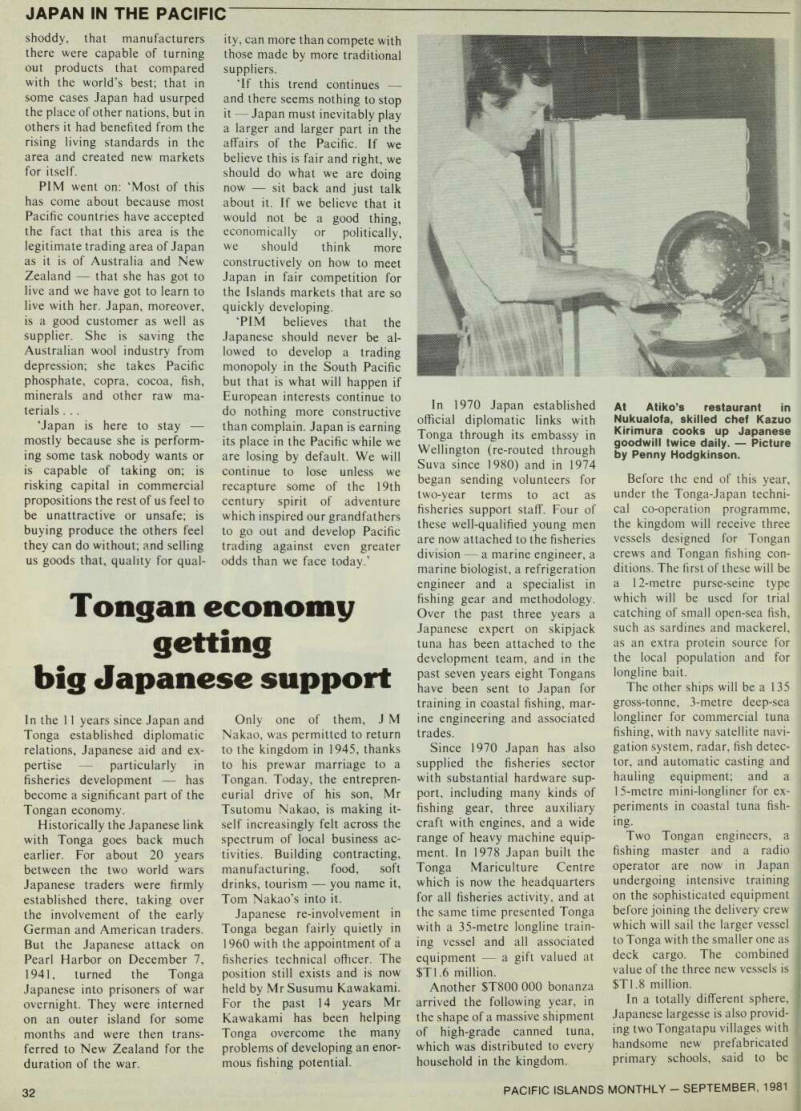
At Atiko’s restaurant in Nukualofa, skilled chef Kazuo Kirimura cooks up Japanese goodwill twice daily.-Picture by Penny Hodgkinson.
worth about ST74O 000, includ ing fabrication, shipping and erection costs and the pay and expenses of the Japanese tech nical staff involved in the pro ject.
Indications are that the scope of Japanese aid in Tonga may broaden. Under the annual aid survey system, Tongan minis tries can formulate proposals relevant to their needs and submit these to the central planning department which then passes recommendations to cabinet. In turn, cabinet submits a list, with priorities allotted, to the Japanese gov
ernment through the kingdom’s department of foreign affairs, in the hope that one or more of the listed proposals may be ap proved.
In addition to the government aid links between Japan and Tonga there are also some private sector links. Tasaki Pearls of Japan has been con ducting pearl culture exper iments in Vavau for the past 10 years. The results are described as ‘quite promising’ and could lead to the establishment of a joint commercial venture.
Penny Hodgkinson in Nukualofa.