Japan’s Pacific market growth
pp. 29-32 · Read in the full issue


How PIM examined the start of Japan’s Pacific market growth
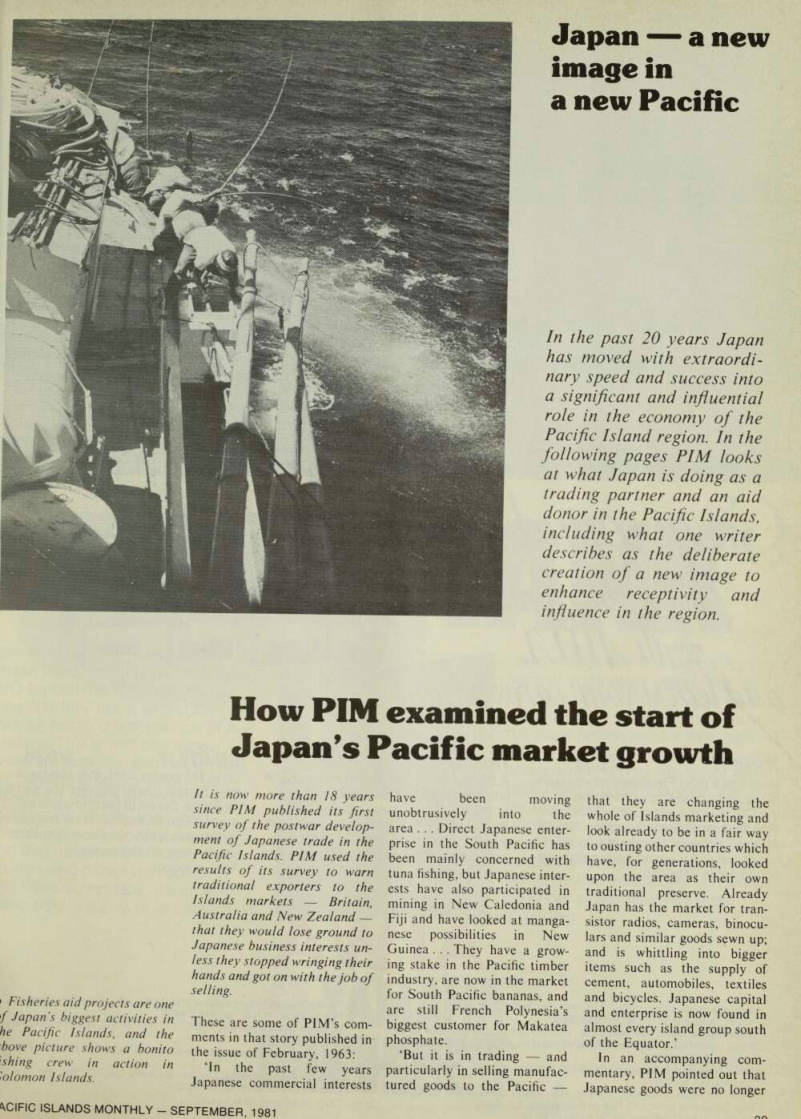
' Fisheries aid projects are one •f Japans biggest activities in he Pacific Islands, and the ove picture shows a bonito shing crew in action in o omon Islands.
It is now more than 18 years since PIM published its first survey of the postwar develop ment of Japanese trade in the Pacific Islands. PIM used the results of its survey to warn traditional exporters to the Islands markets Britain, Australia and New Zealand that they would lose ground to Japanese business interests un less they stopped wringing their hands and got on with the job of selling.
These are some of PlM’s com ments in that story published in the issue of February, 1963: ‘ln the past few years Japanese commercial interests
have been moving unobtrusively into the area . . . Direct Japanese enterprise in the South Pacific has been mainly concerned with tuna fishing, but Japanese interests have also participated in mining in New Caledonia and Fiji and have looked at manganese possibilities in New Guinea . .. They have a growing stake in the Pacific timber industry, are now in the market for South Pacific bananas, and are still French Polynesia’s biggest customer for Makatea phosphate.
But it is in trading and particularly in selling manufactured goods to the Pacific
that they are changing the whole of Islands marketing and look already to be in a fair way to ousting other countries which have, for generations, looked upon the area as their own traditional preserve. Already Japan has the market for tran sistor radios, cameras, binocu lars and similar goods sewn up; and is whittling into bigger items such as the supply of cement, automobiles, textiles and bicycles. Japanese capital and enterprise is now found in almost every island group south 0 f the Equator.’
In an accompanying com mentary, PIM pointed out that Japanese goods were no longer
Japan In The Pacific
shoddy, that manufacturers there were capable of turning out products that compared with the world’s best; that in some cases Japan had usurped the place of other nations, but in others it had benefited from the rising living standards in the area and created new markets for itself.
PIM went on: ‘Most of this has come about because most Pacific countries have accepted the fact that this area is the legitimate trading area of Japan as it is of Australia and New Zealand that she has got to live and we have got to learn to live with her. Japan, moreover, is a good customer as well as supplier. She is saving the Australian wool industry from depression; she takes Pacific phosphate, copra, cocoa, fish, minerals and other raw ma terials . . . ‘Japan is here to stay mostly because she is perform ing some task nobody wants or is capable of taking on; is risking capital in commercial propositions the rest of us feel to be unattractive or unsafe; is buying produce the others feel they can do without; and selling us goods that, quality for qual
ity, can more than compete with those made by more traditional suppliers.
Tf this trend continues and there seems nothing to stop it Japan must inevitably play a larger and larger part in the affairs of the Pacific. If we believe this is fair and right, we should do what we are doing now sit back and just talk about it. If we believe that it would not be a good thing, economically or politically, we should think more constructively on how to meet Japan in fair competition for the Islands markets that are so
quickly developing.
‘PIM believes that the Japanese should never be al lowed to develop a trading monopoly in the South Pacific but that is what will happen if European interests continue to do nothing more constructive than complain. Japan is earning its place in the Pacific while we are losing by default. We will continue to lose unless we recapture some of the 19th century spirit of adventure which inspired our grandfathers to go out and develop Pacific trading against even greater odds than we face today.’