grisly box
pp. 23-26 · Read in the full issue

Tropicalities
New light on
Palmyra’s
grisly box
A report in the Sydney, Austra lia, newspaper Sunday Tele graph on July 19 sheds much new light on the discovery on Palmyra Island by Canadian yachting couple Rob and Sharon Jordan of an aluminium box containing a skull, bones and a burned wristwatch (PIM Aug p 65).
As PIM yachting correspon dent Joan D. Pease reported from Papeete, the remains had been identified as those of Laverne Graham, 40, a Californian housewife who dis appeared during a Pacific cruise with her husband, Malcolm, 43, in 1974. Their yacht, Sea Wind, later turned up in Hawaii and the couple on board had been charged with its theft. That is the story as far as it was known to PIM up to our last issue.
But Sunday Telegraph journalist lain Walker, report ing from New York, has since provided many fresh details.
Walker wrote: Fhe million-to-one find led de ;ectives to re-open the files on he case.
In October, attractive Stephanie Stearns, 34, who has dready served one prison term is a result of events on Palmyra sland, will be tried in Honolulu or murder.
Also named in the indictment s her former lover, Buck Duane Walker, 44, who has been on the un since escaping from a US
-ederal penitentiary two years
igo.
The couple sailed to Palmyra sland with three dogs and very ittle food in a leaky sailing >oat.
Walker, a handsome charmer vho has served long prison entences, was wanted for a Irugs offence and needed to lear out of Hawaii fast.
The couple were close to
starvation when the Grahams sailed into the rarely-visited atoll on their luxury yacht Sea Wind several months later.
According to detectives, they quickly hatched a plot to kill the Grahams and steal their boat.
But unknown to Walker, Mr Graham, a wealthy Californian businessman, was suspicious.
He alerted a friend, fellow yachtsman Curtis Shoemaker, by shortwave radio.
The two agreed to talk every Monday and Wednesday at 7pm in case there was trouble.
The last call was on the night of August 28, 1974. Shoemaker was later to testify in court that Graham talked about bad feel ings with his fellow Americans on the lonely island.
But he ended up: T guess they are going to declare a truce. They are bringing a cake over tonight.’
The Grahams were never seen again. But three months later Walker and Stearns sailed into Honolulu in the Sea Wind which had been repainted and renamed.
Walker boasted in dockside bars that he had won the yacht in a chess game with a friendly millionaire.
But the Sea Wind had been
recognised, and the police acted. They arrested Stearns in the yacht, as Walker was drink ing in a nearby bar.
When he saw what was hap pening, he fled. Police later discovered him using a false name in a rundown hotel on another part of the island.
Under interrogation, Stearns and Walker denied murdering the Grahams. They claimed when they arrived at the Sea Wind for dinner the yacht had been empty.
They searched for and found the yacht’s inflatable rubber dinghy, upside down and aban doned.
Walker said he had brought the boat back to Hawaii to save it from being destroyed by the weather.
But a jury did not believe the story. Walker was sentenced to 13 years for theft and an earlier drug offence. He escaped from McNeil Island Penitentiary in Washington State three years later and is still at large.
Stephanie Stearns was sen tenced to two years and has since been released.
Her trial, which was expected to start this month, has now been delayed until October.
Police are still hunting for Walker.
Tongatapu’s new
tornado fear
The people of Tonga’s main island of Tongatapu are becom ing alarmed at the increasing frequency of tornadoes four in the last 12 months, including the worst experienced in Nukualofa in living memory, which struck the capital on May 28 (PIM Jul p 6).
The great wind tore in from the sea at more than 300 kmh and departed seaward three minutes later, leaving behind damage unofficially estimated at SAIOO 000 in its wake.
Traditionally tornadoes have tended to occur in the country’s more northerly island groups, leaving Tongatapu gratefully (and perhaps a little smugly) untouched. ‘What,’ people ask, ‘has hap pened to the charmed ring of immunity which has always protected us in the past, except at the rarest of widely spaced intervals?’
And back through the coco-
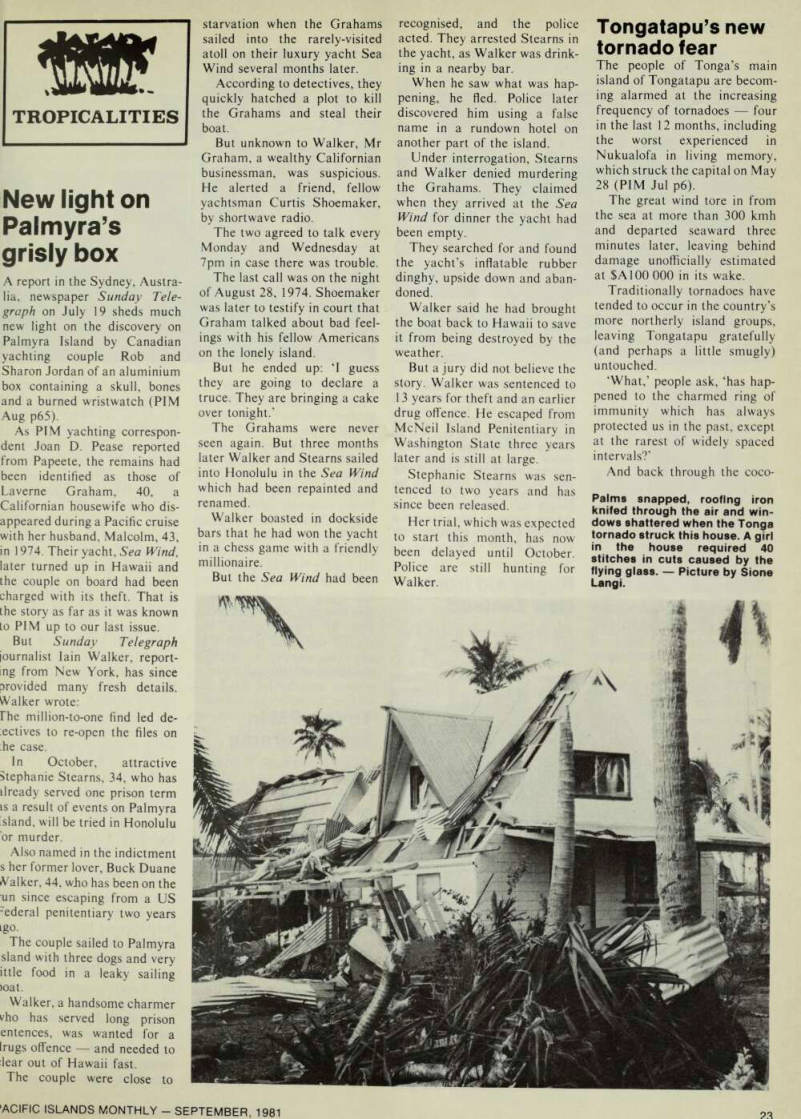
Palms snapped, roofing iron knifed through the air and win dows shattered when the Tonga tornado struck this house. A girl in the house required 40 stitches in cuts caused by the
flying glass.-Picture by Sione
Langi.
nut wireless comes the answer: ‘lt must be that mysterious “dish” beside the Cable and Wireless earth station, sending out signals that call the tor nadoes in from the sea to wreak their violence upon us.’
This ingenious explanation may be more remarkable for imagination than logic, but the damage caused by May’s rogue tornado is certainly shattered and shattering fact. Those who experienced the three-minute horror still feel a sense of shock and are somewhat surprised to be still alive.
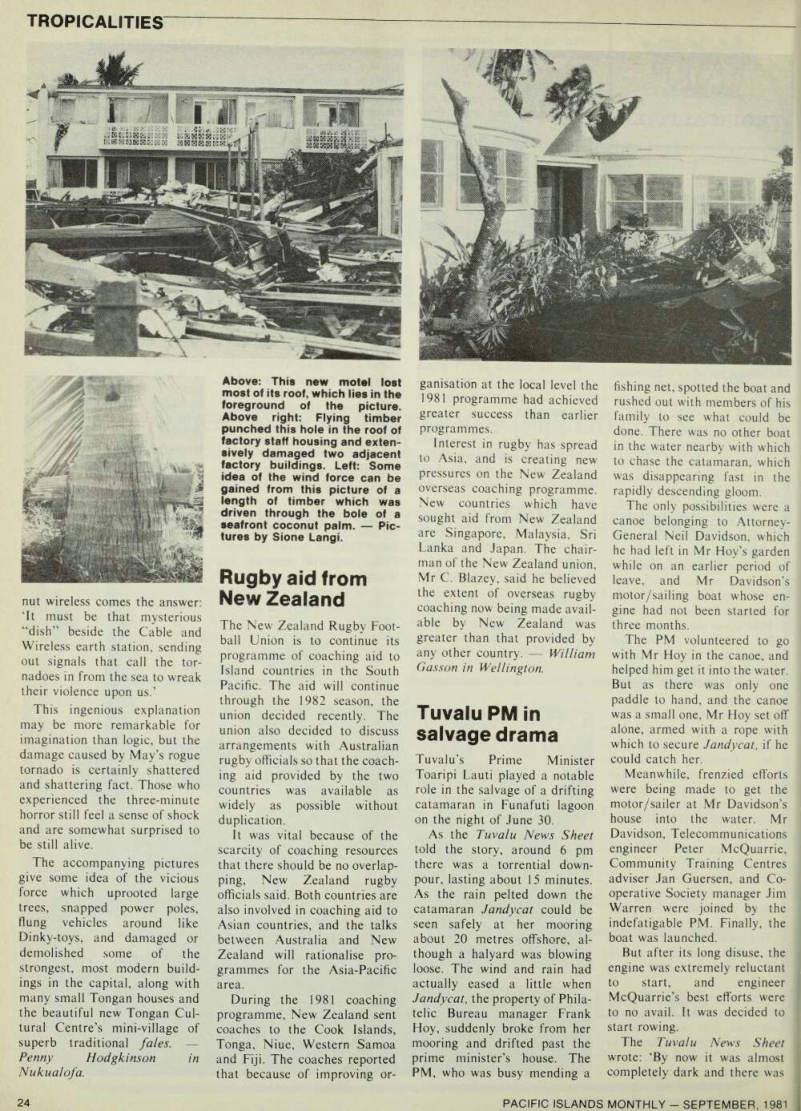
The accompanying pictures give some idea of the vicious force which uprooted large trees, snapped power poles, flung vehicles around like Dinky-toys, and damaged or demolished some of the strongest, most modern build ings in the capital, along with many small Tongan houses and the beautiful new Tongan Cul tural Centre’s mini-village of superb traditional fales.
Penny Hodgkinson in Nukualofa.
Rugby aid from
New Zealand
The New Zealand Rugby Foot ball Union is to continue its programme of coaching aid to Island countries in the South Pacific. The aid will continue through the 1982 season, the union decided recently. The union also decided to discuss arrangements with Australian rugby officials so that the coach ing aid provided by the two countries was available as widely as possible without duplication.
It was vital because of the scarcity of coaching resources that there should be no overlap ping, New Zealand rugby officials said. Both countries are also involved in coaching aid to Asian countries, and the talks between Australia and New Zealand will rationalise pro grammes for the Asia-Pacific area.
During the 1981 coaching programme, New Zealand sent coaches to the Cook Islands, Tonga, Niue, Western Samoa and Fiji. The coaches reported that because of improving or-
ganisation at the local level the 1981 programme had achieved greater success than earlier programmes.
Interest in rugby has spread to Asia, and is creating new pressures on the New Zealand overseas coaching programme.
New countries which have sought aid from New Zealand are Singapore, Malaysia, Sri Lanka and Japan. The chair man of the New Zealand union, Mr C. Blazey, said he believed the extent of overseas rugby coaching now being made avail able by New Zealand was greater than that provided by any other country. William Gas son in Wellington.
Tuvalu PM in
salvage drama
Tuvalu’s Prime Minister Toaripi Lauti played a notable role in the salvage of a drifting catamaran in Funafuti lagoon on the night of June 30.
As the Tuvalu News Sheet told the story, around 6 pm there was a torrential down pour, lasting about 15 minutes.
As the rain pelted down the catamaran Jandycat could be seen safely at her mooring about 20 metres offshore, al though a halyard was blowing loose. The wind and rain had actually eased a little when Jandycat, the property of Phila telic Bureau manager Frank Hoy, suddenly broke from her mooring and drifted past the prime minister’s house. The PM, who was busy mending a
fishing net, spotted the boat and rushed out with members of his family to see what could be done. There was no other boat in the water nearby with which to chase the catamaran, which was disappearing fast in the rapidly descending gloom.
The only possibilities were a canoe belonging to Attorney- General Neil Davidson, which he had left in Mr Hoy’s garden while on an earlier period of leave, and Mr Davidson’s motor/sailing boat whose en gine had not been started for three months.
The PM volunteered to go with Mr Hoy in the canoe, and helped him get it into the water.
But as there was only one paddle to hand, and the canoe was a small one, Mr Hoy set off alone, armed with a rope with which to secure Jandycat, if he could catch her.
Meanwhile, frenzied efforts were being made to get the motor/sailer at Mr Davidson’s house into the water. Mr Davidson, Telecommunications engineer Peter McQuarrie, Community Training Centres adviser Jan Guersen, and Co operative Society manager Jim Warren were joined by the indefatigable PM. Finally, the boat was launched.
But after its long disuse, the engine was extremely reluctant to start, and engineer McQuarrie’s best efforts were to no avail. It was decided to start rowing.
The Tuvalu News Sheet wrote: ‘By now it was almost completely dark and there was
Above: This new motel lost most of its roof, which lies in the foreground of the picture.
Above right: Flying timber punched this hole in the roof of factory staff housing and exten sively damaged two adjacent factory buildings. Left: Some idea of the wind force can be gained from this picture of a length of timber which was driven through the bole of a seafront coconut palm.-Pic tures by Sione Langi.
no sign of the canoe or the catamaran, so those on shore were treated to the unforget table spectacle of three valiant men embarking on an unusual adventure. Messrs Davidson and Guersen were each pulling on an oar, and Mr McQuarrie was doing his best to coax the engine into life. After some initial confusion as to the direc tion in which they should head, the trio disappeared into the night.’
Mr Warren, back on land, took his vehicle down beyond the end of the runway to try with his headlights to illuminate the rescue efforts.
Mr Hoy had in fact managed to catch Jandycat and secure her to the.canoe. But he could make no headway against the kvind, though he was managing ;o guide the boats towards the >hore. He was up to his neck in -vater, doing his best to stop the Doats knocking against the coral •ocks, when the rescuers •cached him. They had rowed ill the kilometre or so from vhere Jandycat had been moored.
Then, moments after they irrived, the engine suddenly fluttered into life, and the notor/sailer was able to take he other two craft in tow back Jong the lagoon.
The PM was waiting to greet he four bedraggled heroes on heir return, and helped them ;et the canoe out of the water.
The Tuvalu News Sheet con luded its account of the dra natic events with the words: From all appearances, little lamage had been done to any of he craft. So, after an hour or so f hectic activity, those in olved were able to resume /hat they had been doing when he alarm had been raised.’
The clear implication is that Time Minister Lauti calmly /ent back to mending his fish ig net .. .
Jrych-Cooks link
joes for good
he final link between the Cook slands and the controversial
ancer therapist Milan Brych
as ended. Acting in July under aecial legislation from parlia ment, the Cook Islands High ourt dissolved Brych’s
Rarotonga Research Trust, wrote off alleged debts to the trust of $36 000 and ordered the dumping at sea of out-of-date drugs once valued at more than
$5Ooo.
Milan Brych, who now lives in USA, developed a method of cancer treatment while working in New Zealand. He was not registered to practise in New Zealand, and went to the Cook Islands where he established a clinic with the blessing of the then premier, the late Albert Henry. Australians and New Zealanders some of whom died and were buried in the Cook Islands were among his patients. When the Davis gov ernment came to office in the Cook Islands Brych was barred from practice and was declared a prohibited immigrant.
He became involved in a controversial and unsuccessful move to establish himself in Australia, and later went to USA where he now faces a number of charges related to the unregistered practice of medicine. Earlier this year Brych made an unsuccessful application to revisit the Cook Islands to obtain evidence for his defence in the US charges.
Commenting on the refusal Prime Minister Sir Thomas Davis said that ‘this man will never be allowed back into the country’.
Since Brych’s departure from the Cook Islands the govern ment has been involved in a long process to wind up the affairs of the Rarotonga Research Trust, established in 1977 as an offshoot of the Brych clinic. In January parliament passed legislation to sort out the financial situation involved and to terminate the trust. J. C.
Ditchburn was appointed ad ministrator and his applications have been handled in the High Court. In July the court granted an application by Mr Ditchburn to write off debts claimed to total nearly $36 000 and to dump the out-of-date drugs at sea because they had no realisable value.
Mr Ditchburn’s application said that the debts extracted from the books of the trust were said to be owed by former patients of the Brych clinic.
Inquiries had indicated how ever that many of the patients
had died, and an auditor’s report added that there was insufficient evidence to substan tiate the debts.
Mr Ditchburn said that neither the Cook Islands nor New Zealand health authorities wanted the stored drugs which appeared to have come from ‘an obscure Hungarian source’, and had been kept in a garage for more than three years.
Mr Ditchburn reported that tangible assets belonging to the trust had been sold for slightly less than $2O 000. They in cluded motor vehicles, equip ment and office furniture.
Under the terms of the legis lation which wound up the trust, the money will be used to build a chapel at Rarotonga Hospital.
Preliminary work to build the chapel has already begun.
Amazing Maika
Waqala Brown
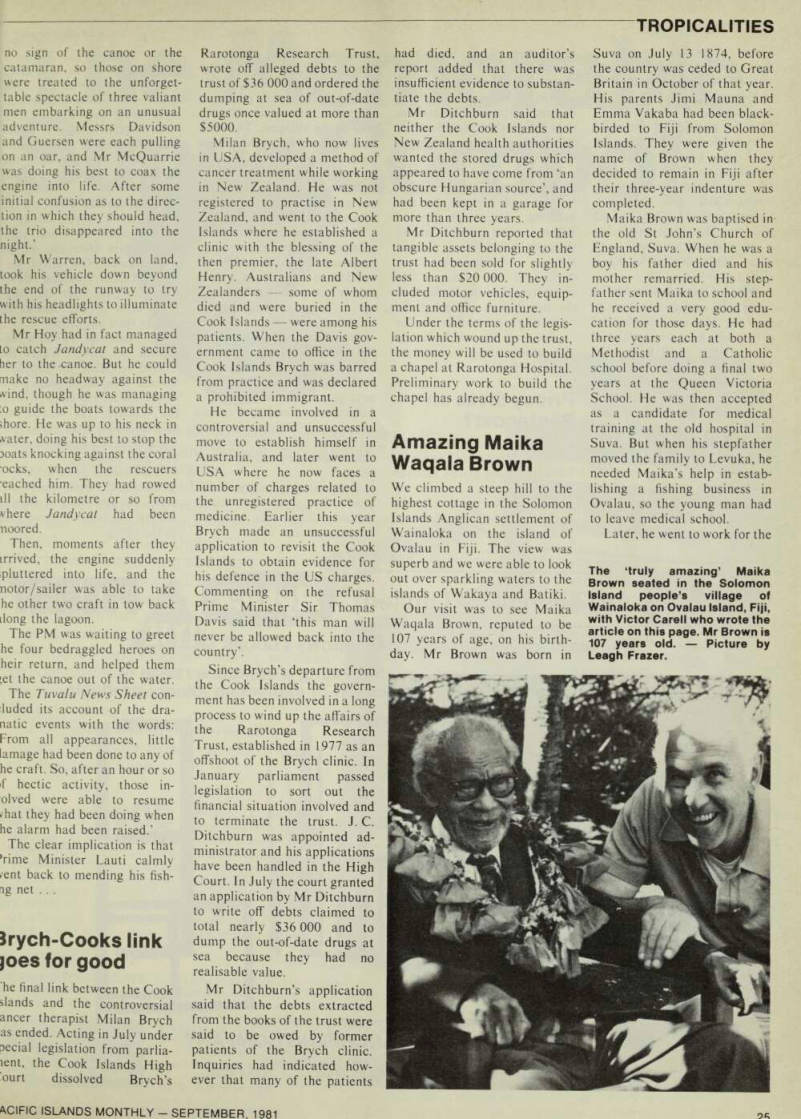
We climbed a steep hill to the highest cottage in the Solomon Islands Anglican settlement of Wainaloka on the island of Ovalau in Fiji. The view was superb and we were able to look out over sparkling waters to the islands of Wakaya and Batiki.
Our visit was to see Maika Waqala Brown, reputed to be 107 years of age, on his birth day. Mr Brown was born in
Suva on July 13 1874, before the country was ceded to Great Britain in October of that year.
His parents Jimi Mauna and Emma Vakaba had been black birded to Fiji from Solomon Islands. They were given the name of Brown when they decided to remain in Fiji after their three-year indenture was completed.
Maika Brown was baptised in the old St John’s Church of England, Suva. When he was a boy his father died and his mother remarried. His step father sent Maika to school and he received a very good edu cation for those days. He had three years each at both a Methodist and a Catholic school before doing a final two years at the Queen Victoria School. He was then accepted as a candidate for medical training at the old hospital in Suva. But when his stepfather moved the family to Levuka, he needed Maika’s help in estab lishing a fishing business in Ovalau, so the young man had to leave medical school.
Later, he went to work for the
The ‘truly amazing’ Maika Brown seated in the Solomon Island people's village of Wainaloka on Ovalau Island, Fiji, with Victor Carell who wrote the article on this page. Mr Brown is 107 years old. - Picture by Leagh Frazer.
Morris Hedstrom company in their store in Levuka. He stayed with this company for the rest of his working life. At first he was working in Levuka but in 1916 he transferred for eight years to the firm’s branch store in Loma Loma village on Vanuabalavu. That same year he met and married a Vanuabalavu girl, Merelita.
She was only 16. They had 13 children. The oldest now living is 64, and the youngest, with whom Maika lives, is Joe Kaua Brown who is now 40.
While in Vanuabalavu Maika helped the lone doctor there to care for the vast number of people who became ill with the ’flu epidemic of 1918. In 1923 Maika and his wife returned to Levuka where he again worked with the Morris Hedstrom store. On retirement he was granted a small monthly pen sion. This was wound up in 1980 with the payment of a lump sum.
Mr Brown is truly amazing.
He was a lay reader and preacher with the Church of England in Levuka for 64 years.
His command of English is exceptional, and his memory sharp. He can quote long sec tions of the Bible and delights in reciting one psalm after another to be followed by excerpts from the Book of Moses, with no hesitation whatever.
When we were leaving this kindly old man with his wonder ful sense of humour, he was bubbling with high spirits.
When I asked how he felt he shouted; ‘I feel fine ... I feel strong ... I can even do a dance. He did only a few small steps, kicking his heels to the side before accepting the reassuring support of his son Joe • • • But then, after all, he is only
107 years young.
Victor
Corel I in Levuka.
Pricey dives on
Pentecost?
Is a visit to the famous land dives on the island of Pentecost, Vanuatu, being priced through the roof?
The question is posed by the weekly Voice of Vanuatu, which wrote of the late-May
event: ‘To visit the villages of Pentecost at the time of the land-dives isn’t cheap. But about half the money (this year VTI6 000, or about SAI6O) goes to the villagers. This one time-a-year event is the largest source of income for the vil lagers. ‘But having paid the charge, no one seems to be dissatisfied with the weekend spectacle. ‘While some think that if the villagers are prepared to stage the event for outsiders they are entitled to the money, others believe the price has been put up to keep the number of visitors down.’
Dives took place this year at Wali and Bunlap. But Pentecost sources say that these two villages may have competition next year from the villagers of Point Cross. Voice of Vanuatu commented: ‘This could bring an end to the price increases, which have been rapid in recent years.’
A significant feature of this year’s dives was that tourist accommodation was available in some places.
The Port-Vila weekly summed up; ‘lf the land-dives were to coincide with a walking holiday of Pentecost, general
sight-seeing and enjoying the
local hospitality, then it would make the holiday price reason able. And it seems that the villagers are encouraging this to happen.’
At the Bunlap dives, on the first of the 15 dives, the diver landed with only one rope holding him after the second had snapped. One diver was hurt. Another backed down from jumping. But the final jump drew greater shrieks of delight than any other.
As Voice of Vanuatu de scribed it: ‘Diver Watas Bu needed no stick to help him balance from the highest point of the tower. He chanted with the dancers. He waved his outstretched arms, clapped, slapped his thighs and made the dive still chanting. ’He chanted as he landed.
Then in true traditional style, the Big Men of Bunlap invited spectators to have food in the village.’