Seminar on
pp. 20-21 · Read in the full issue
a circular track
It speaks volumes for the precarious situation of the South Pacific Commission that it had to go begging for the necessary funds to stage a seminar for Pacific women in Papeete at the end of July. What saved the conference was the unexpected generosity of such remote lands of the cold antipodes as Holland and Sweden, which each contributed $lO 000. Various US church bodies gave another $4500, the International Labour Organisation $5OOO, the Commonwealth Foundation $2OOO, the Australian Freedom from Hunger Campaign set aside $lO 000 of its precious funds, and the Australian Development Assistance Bureau came up with $5OOO. The total collected was thus about $5O 000. Added to the $4O 000 which was all the SPC had in its own coffers, this was eventually enough to pay all expenses.
It was clear from the beginning what a terrible waste it was to spend such a huge amount of money on an old-fashioned seminar of this type. At least half a dozen similar meetings have been held over the past five years. All have clearly shown that the women of the Pacific have their own unique problems in addition to those they share with the men and that they are perfectly capable of analysing them and putting forward workable solutions.
For example, the group of resolutions adopted in Suva during the meeting sponsored by the Economic and Social Commission for Asia and the Pacific (October 23-November 3 1980) constitutes an excellent programme for concrete action, full of good sense (PIM Jan pplB-19). So why start all over again? A second good reason for funnelling the money into other, more useful channels is the fact that well-established satellite hook up systems exist in most Pacific islands. These surely represent a cheaper and more efficient method of holding an international meeting than what went on in Papeete.
The only possible explanation for this absurd waste of time and money is that the SPC train is still puffing around in a circle on the old track laid down by the colonial powers in 1947, and
that it will go on doing so until the new Pacific nations cease supplying fuel for its operations.
It is therefore really not surprising that we often have an irresistible sense of d'eja vu at SPC-run events. For example, the opening ceremony of the Papeete seminar was identical, down to the smallest detail, to pictures we find in back numbers of the fine SPC Bulletin. There, on the podium of the lecture hall of the Territorial Assembly, sat a half-dozen solemn-looking government officials all in a row. In their suits and ties they looked for all the world like an all-male trial jury in any European court. The first rows of seats were, of course, likewise filled with similar male father figures, forming a last bastion against the sea of exotic-looking females behind them, representing all Pacific nations except the Northern Marianas, Tuvalu and Wallis/Futuna.
As was to be expected, the first day was entirely lost in the time-honoured but futile exercise of having each and every one of the 19 delegations read aloud a so-called ‘position paper’ describing in glowing terms the remarkable progress made in the social and economic fields in their respective home countries. We humbly submit that if such basic information really has to be supplied to participants at each conference, why not simply distribute copies of the latest edition of the Pacific Islands Year Book?
When, on the second day, the seminar eventually got going, the chasm that regularly opens up between delegates from the French possessions and those from independent Pacific countries was immediately apparent. It will in all probability soon be bridged, thanks to the liberal reform policies which the new Socialist government in France has promised to introduce in the overseas territories. Unfortunately, however, the Papeete meeting occurred too soon after Mitterrand’s landslide victory (PIM Jul plO-11), and his new government had not yet had time to sweep out the old guard. As a result, the head of the delegation representing French Polynesia was a left-over i
Below: Pacific women at the talks. Below right: SPC programme director William T. Brown who ‘swooped down like a hawk when the conference doves dared to squeak a little’.
Giscard appointee, Mrs Flora Devatine, who, as usual, was backed up by docile government employees.
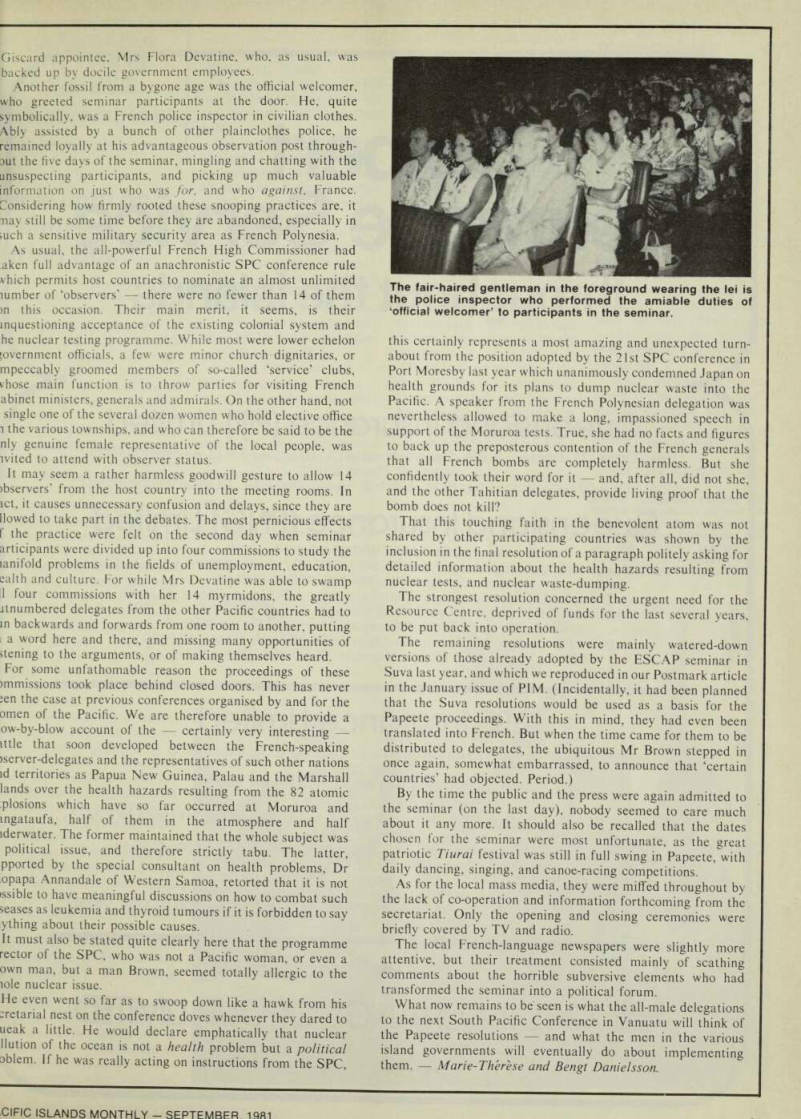
Another fossil from a bygone age was the official welcomer, who greeted seminar participants at the door. He, quite symbolically, was a French police inspector in civilian clothes.
Ably assisted by a bunch of other plainclothes police, he remained loyally at his advantageous observation post through 3ut the five days of the seminar, mingling and chatting with the unsuspecting participants, and picking up much valuable information on just who was for, and who against, France.
Considering how firmly rooted these snooping practices are, it nay still be some time before they are abandoned, especially in ;uch a sensitive military security area as French Polynesia.
As usual, the all-powerful French High Commissioner had aken full advantage of an anachronistic SPC conference rule vhich permits host countries to nominate an almost unlimited lumber of ‘observers’ there were no fewer than 14 of them in this occasion. Their main merit, it seems, is their inquestioning acceptance of the existing colonial system and he nuclear testing programme. While most were lower echelon ;overnment officials, a few were minor church dignitaries, or mpeccably groomed members of so-called ‘service’ clubs, vhose main function is to throw parties for visiting French abinet ministers, generals and admirals. On the other hand, not single one of the several dozen women who hold elective office i the various townships, and who can therefore be said to be the nly genuine female representative of the local people, was ivited to attend with observer status.
It may seem a rather harmless goodwill gesture to allow 14 ibservers’ from the host country into the meeting rooms. In ict, it causes unnecessary confusion and delays, since they are flowed to take part in the debates. The most pernicious effects f the practice were felt on the second day when seminar articipants were divided up into four commissions to study the lanifold problems in the fields of unemployment, education, ealth and culture. For while Mrs Devatine was able to swamp 1 four commissions with her 14 myrmidons, the greatly Jtnumbered delegates from the other Pacific countries had to in backwards and forwards from one room to another, putting i a word here and there, and missing many opportunities of Jtening to the arguments, or of making themselves heard.
For some unfathomable reason the proceedings of these immissions took place behind closed doors. This has never Jen the case at previous conferences organised by and for the omen of the Pacific. We are therefore unable to provide a ow-by-blow account of the certainly very interesting ittle that soon developed between the French-speaking iserver-delegates and the representatives of such other nations id territories as Papua New Guinea, Palau and the Marshall lands over the health hazards resulting from the 82 atomic plosions which have so far occurred at Moruroa and mgataufa, half of them in the atmosphere and half iderwater. The former maintained that the whole subject was political issue, and therefore strictly tabu. The latter, pported by the special consultant on health problems, Dr opapa Annandale of Western Samoa, retorted that it is not issible to have meaningful discussions on how to combat such seases as leukemia and thyroid tumours if it is forbidden to say ything about their possible causes.
It must also be stated quite clearly here that the programme rector of the SPC, who was not a Pacific woman, or even a own man, but a man Brown, seemed totally allergic to the lole nuclear issue.
He even went so far as to swoop down like a hawk from his :retarial nest on the conference doves whenever they dared to ueak a little. He would declare emphatically that nuclear Hution of the ocean is not a health problem but a political ablem. If he was really acting on instructions from the SPC,
this certainly represents a most amazing and unexpected turn about from the position adopted by the 21st SPC conference in Port Moresby last year which unanimously condemned Japan on health grounds for its plans to dump nuclear waste into the Pacific. A speaker from the French Polynesian delegation was nevertheless allowed to make a long, impassioned speech in support of the Moruroa tests. True, she had no facts and figures to back up the preposterous contention of the French generals that all French bombs are completely harmless. But she confidently took their word for it and, after all, did not she, and the other Tahitian delegates, provide living proof that the bomb does not kill?
That this touching faith in the benevolent atom was not shared by other participating countries was shown by the inclusion in the final resolution of a paragraph politely asking for detailed information about the health hazards resulting from nuclear tests, and nuclear waste-dumping.
The strongest resolution concerned the urgent need for the Resource Centre, deprived of funds for the last several years, to be put back into operation.
The remaining resolutions were mainly watered-down versions of those already adopted by the ESCAP seminar in Suva last year, and which we reproduced in our Postmark article in the January issue of PIM. (Incidentally, it had been planned that the Suva resolutions would be used as a basis for the Papeete proceedings. With this in mind, they had even been translated into French. But when the time came for them to be distributed to delegates, the übiquitous Mr Brown stepped in once again, somewhat embarrassed, to announce that ‘certain countries’ had objected. Period.) By the time the public and the press were again admitted to the seminar (on the last day), nobody seemed to care much about it any more. It should also be recalled that the dates chosen for the seminar were most unfortunate, as the great patriotic Tiurai festival was still in full swing in Papeete, with daily dancing, singing, and canoe-racing competitions.
As for the local mass media, they were miffed throughout by the lack of co-operation and information forthcoming from the secretariat. Only the opening and closing ceremonies were briefly covered by TV and radio.
The local French-language newspapers were slightly more attentive, but their treatment consisted mainly of scathing comments about the horrible subversive elements who had transformed the seminar into a political forum.
What now remains to be seen is what the all-male delegations to the next South Pacific Conference in Vanuatu will think of the Papeete resolutions and what the men in the various island governments will eventually do about implementing
them.
Marie-Therese and Bengt Danielsson.
The fair-haired gentleman in the foreground wearing the lei is the police inspector who performed the amiable duties of ‘official welcomer’ to participants in the seminar.