difficult problem
p. 19 · Read in the full issue
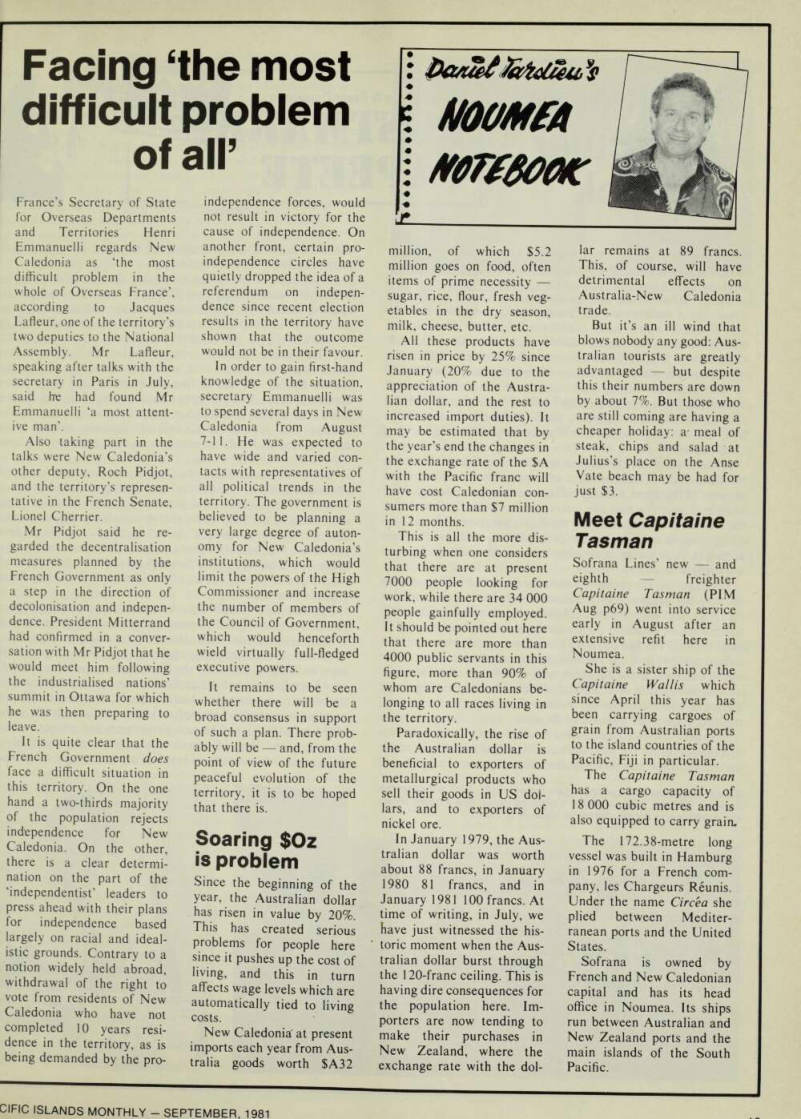
Facing ‘the most difficult problem of all’
France’s Secretary of State for Overseas Departments and Territories Henri Emmanuelli regards New Caledonia as ‘the most difficult problem in the whole of Overseas France’, according to Jacques Lafleur, one of the territory’s two deputies to the National Assembly. Mr Lafleur, speaking after talks with the secretary in Paris in July, said Ire had found Mr Emmanuelli ‘a most attent ive man’.
Also taking part in the talks were New Caledonia’s other deputy, Roch Pidjot, and the territory’s represen tative in the French Senate, Lionel Cherrier.
Mr Pidjot said he re garded the decentralisation measures planned by the French Government as only a step in the direction of decolonisation and indepen dence. President Mitterrand had confirmed in a conver sation with Mr Pidjot that he would meet him following the industrialised nations’ summit in Ottawa for which he was then preparing to leave.
It is quite clear that the French Government does face a difficult situation in this territory. On the one hand a two-thirds majority of the population rejects independence for New Caledonia. On the other, there is a clear determi nation on the part of the ‘independentist’ leaders to press ahead with their plans for independence based largely on racial and ideal istic grounds. Contrary to a notion widely held abroad, withdrawal of the right to vote from residents of New Caledonia who have not completed 10 years resi dence in the territory, as is being demanded by the pro
independence forces, would not result in victory for the cause of independence. On another front, certain pro independence circles have quietly dropped the idea of a referendum on indepen dence since recent election results in the territory have shown that the outcome would not be in their favour.
In order to gain first-hand knowledge of the situation, secretary Emmanuelli was to spend several days in New Caledonia from August 7-11. He was expected to have wide and varied con tacts with representatives of all political trends in the territory. The government is believed to be planning a very large degree of auton omy for New Caledonia’s institutions, which would limit the powers of the High Commissioner and increase the number of members of the Council of Government, which would henceforth wield virtually full-fledged executive powers.
It remains to be seen whether there will be a broad consensus in support of such a plan. There prob ably will be and, from the point of view of the future peaceful evolution of the territory, it is to be hoped that there is.
Soaring sOz
is problem
Since the beginning of the year, the Australian dollar has risen in value by 20%.
This has created serious problems for people here since it pushes up the cost of living, and this in turn affects wage levels which are
automatically tied to living
costs.
New Caledonia' at present imports each year from Aus tralia goods worth SA32
million, of which $5.2 million goes on food, often items of prime necessity sugar, rice, flour, fresh veg etables in the dry season, milk, cheese, butter, etc.
All these products have risen in price by 25% since January (20% due to the appreciation of the Austra lian dollar, and the rest to increased import duties). It may be estimated that by the year’s end the changes in the exchange rate of the $A with the Pacific franc will have cost Caledonian con sumers more than $7 million in 12 months.
This is all the more dis turbing when one considers that there are at present 7000 people looking for work, while there are 34 000 people gainfully employed.
It should be pointed out here that there are more than 4000 public servants in this figure, more than 90% of whom are Caledonians be longing to all races living in the territory.
Paradoxically, the rise of the Australian dollar is beneficial to exporters of metallurgical products who sell their goods in US dol lars, and to exporters of nickel ore.
In January 1979, the Aus tralian dollar was worth about 88 francs, in January 1980 81 francs, and in January 1981 100 francs. At time of writing, in July, we have just witnessed the his toric moment when the Aus tralian dollar burst through the 120-franc ceiling. This is having dire consequences for the population here. Im porters are now tending to make their purchases in New Zealand, where the exchange rate with the dol
lar remains at 89 francs.
This, of course, will have detrimental effects on Australia-New Caledonia trade.
But it’s an ill wind that blows nobody any good: Aus tralian tourists are greatly advantaged but despite this their numbers are down by about 7%. But those who are still coming are having a cheaper holiday; a' meal of steak, chips and salad at Julius’s place on the Anse Vate beach may be had for just $3.
Meet Capit
Tasman
Sofrana Lines’ new and eighth freighter Capitaine Tasman (PIM Aug p 69) went into service early in August after an extensive refit here in Noumea.
She is a sister ship of the Capitaine Wallis which since April this year has been carrying cargoes of grain from Australian ports to the island countries of the Pacific, Fiji in particular.
The Capitaine Tasman has a cargo capacity of 18 000 cubic metres and is also equipped to carry grain.
The 172.38-metre long vessel was built in Hamburg in 1976 for a French com pany, les Chargeurs Reunis.
Under the name Circea she plied between Mediter ranean ports and the United States.
Sofrana is owned by French and New Caledonian capital and has its head office in Noumea. Its ships run between Australian and New Zealand ports and the main islands of the South Pacific.