Japan creates
pp. 36-37 · Read in the full issue
new image, authors say
Japan, with the help of time, has changed its adverse postwar image in the Western Pacific, say the authors of a new book on Japanese relationships in the area.
Japan’s economic power, they say, ‘has been adroitly and aggressively utilised to engen der a high degree of receptivity among the people of the area. In the last 10 years, Japanese officials and businessmen have shown impressive tact and have even evidenced a propensity for compromise which has created a new climate for Japanese influence in the Western Pacific. ‘Japan has done so by preserving its reputation for hard work and discipline while showing less of the abrasiveness which affected some of Japan’s earliest programmes in the area. The increase in Japanese tourism, trade and aid to the Western Pacific has enhanced Japan’s influence in the region.’
These comments are made in The United States and Japan in the Western Pacific: Micronesia and Papua New Guinea , edited by Grant K.
Goodman and Felix Moos, re cently published by Westview Press, 5500 Central Avenue, Boulder, Colorado, at SUS2O.
Goodman and Moos are, re spectively, professor of history and professor of anthropology and East Asian languages at the University of Kansas. Contribu ting authors are from a variety
of disciplines, all at the Univer sity of Kansas, and the work is the result of field study in Japan and the Western Pacific.
In a discussion of Japanese policies in Micronesia and Papua New Guinea, the book says that Japan, after ‘a hiatus of concern for the Pacific Islands for well over two dec ades, has shown a resurgence of attention to the economic, pol itical and strategic importance to Japan of the area.’ This has been the result of greater in volvement of two groups: first, those who before or during the war had long and intimate association with Micronesia and PNG; and second, a new gener ation ‘imbued with enthusiasm for Japan’s new-found status as
a major power and greatly attracted to the seemingly unrealised potential of Micronesia and Papua New Guinea.’
The authors go on: ‘More over, growing unease in Japan with total reliance on security arrangements with the US has impelled many thoughtful and influential Japanese to consider the likelihood that Japan will need to give greater heed to its own security, especially in terms of defending its vital sea lanes in the Pacific.’
They say that Japan’s role in the area has become more active as America’s role has been declining because of ‘lack of prior experience, frequently ineffective and inconsistent
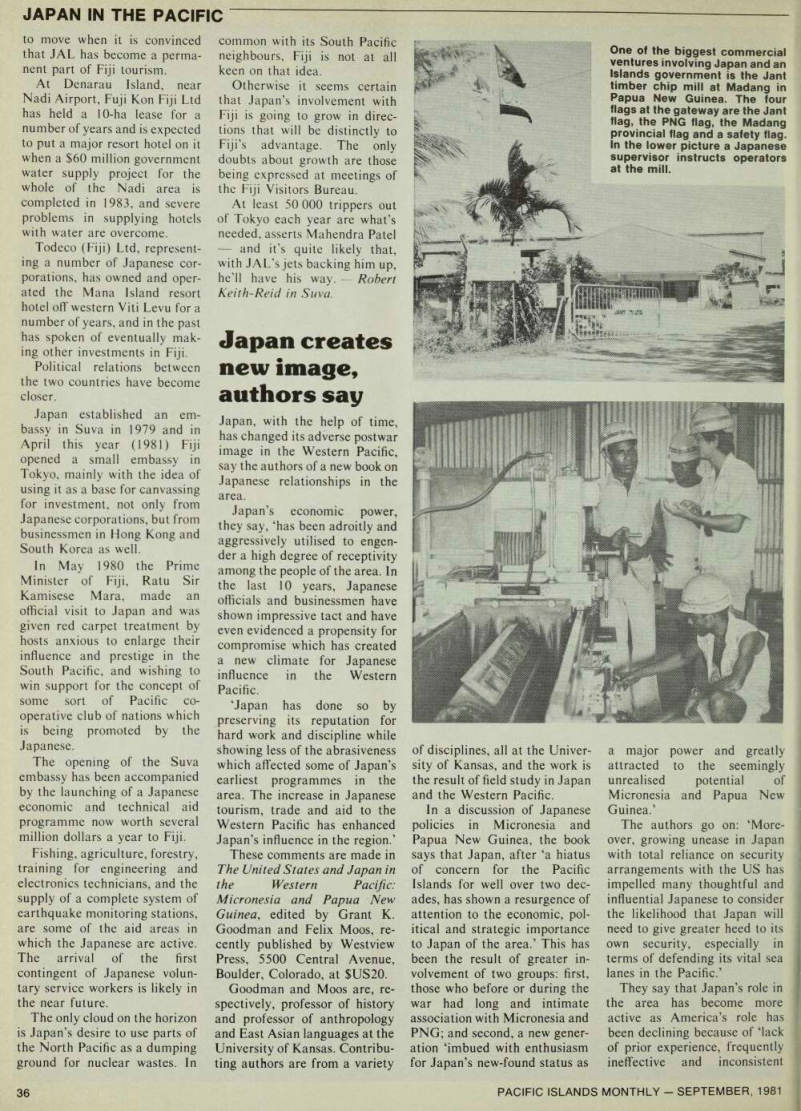
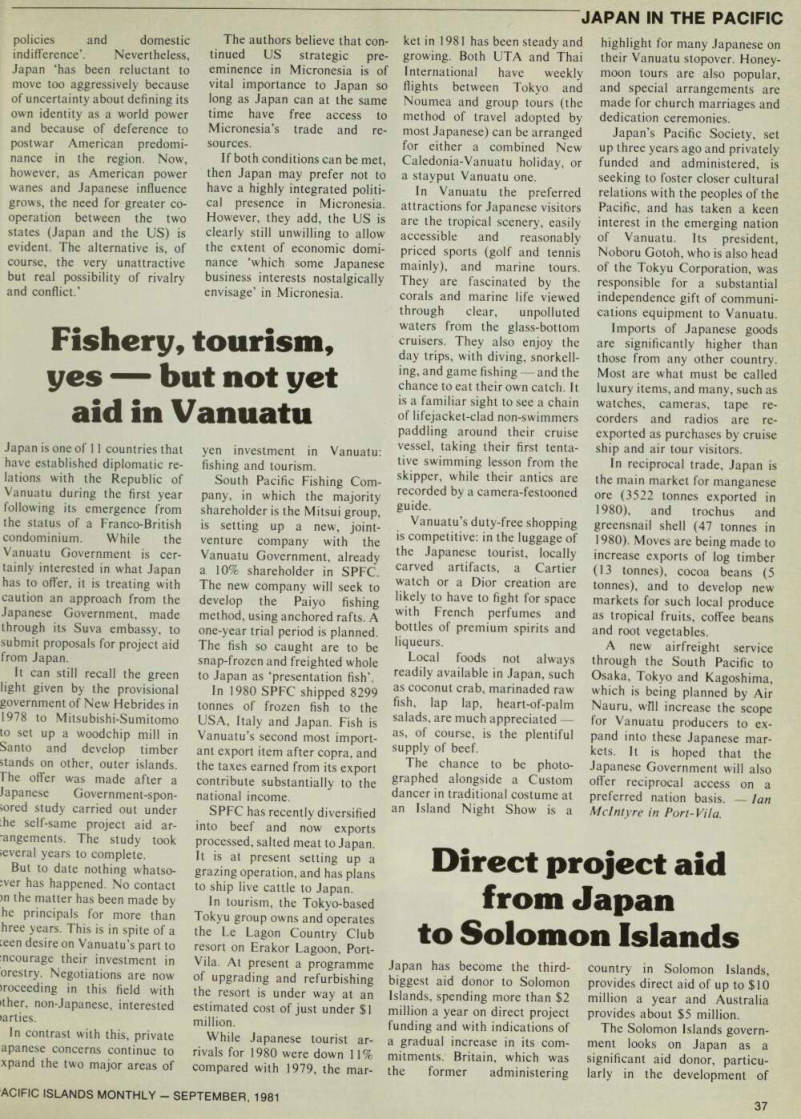
One of the biggest commercial ventures involving Japan and an Islands government is the Jant timber chip mill at Madang in Papua New Guinea. The four flags at the gateway are the Jant flag, the PNG flag, the Madang provincial flag and a safety flag.
In the lower picture a Japanese supervisor instructs operators at the mill.
policies and domestic indifference’. Nevertheless, Japan ‘has been reluctant to move too aggressively because of uncertainty about defining its own identity as a world power and because of deference to postwar American predomi nance in the region. Now, however, as American power wanes and Japanese influence grows, the need for greater co operation between the two states (Japan and the US) is evident. The alternative is, of course, the very unattractive but real possibility of rivalry and conflict.’
The authors believe that con tinued US strategic pre eminence in Micronesia is of vital importance to Japan so long as Japan can at the same time have free access to Micronesia’s trade and re sources.
If both conditions can be met, then Japan may prefer not to have a highly integrated politi cal presence in Micronesia.
However, they add, the US is clearly still unwilling to allow the extent of economic domi nance ‘which some Japanese business interests nostalgically envisage’ in Micronesia.