Yachts
pp. 61-65 · Read in the full issue
Dom Travers
reports from Tubuai,
Austral Islands, French
Polynesia:
Six yachts called at Tubuai during the month of May a record, I believe. Five of them were on passage from New Zealand to Tahiti. They were: » ANTIGONE. Referred to in PIM Vlay p 67, this 14 m ketch-rigged 3 iver trimaran was built in Cali ornia by Harry and Maradee \bbott. With their two daughters, "arleen, 13, and Simone, 10, they lave been cruising the Pacific since 973, visiting Panama, a large lumber of South Pacific islands, nd Australia. They were on their /ay to Hawaii and perhaps Cali ornia by way of Tahiti. 1 SEA SWAN. Again no stranger d readers of PIM she was tentioned Apr p 65 this 14 m :hooner was designed and built
igle-handedly and entirely of >od during eight years of toil in ;w York State by owner/skipper iles Conner. She arrived with >t mate Beth Manchester and 'w Erin Mcßae and Barry Lewis, iles has been sailing Sea Swan ce 1970, with six years spent in J Caribbean, then Panama, South cific islands, and Australia. Dur ; the voyage from New Zealand Tubuai they encountered the
worst storm Miles has ever experi enced. Miles and Beth hope for an extended stay in Tahiti.
• Polaris. A Ct-41, 12M
fibreglass ketch, with John and Nancy Alexander, Polaris is on her way back to Seattle via Tahiti and Hawaii after a Pacific cruise which began in August 1978, and included California, South Pacific islands, and New Zealand (twice). • KIWI. A 13 m Atkins Little Ranger ketch (USA), with Dick and Sherre Lenz on passage from New Zealand to Tahiti via Tubuai. • ROSCOP. A beautiful, 14 m fibreglass ketch homebuilt in Belgium by Rein and Marie-Louise Moitier. They have cruised the Atlantic, Caribbean, Panama, South Pacific islands to Australia, and are now heading for Tahiti for a hoped-for extended stay.
The sixth yacht to call at Tubuai in May arrived from Tahiti. It was: • ETREOM. A 10 m aluminium sloop with single-hander Frenchman Belin Rene. He left the French Atlantic coast in September 1979 with crew for the Caribbean, with stops in Spain, the Canaries and the Azores. He has sailed solo from the West Indies through Panama to the Marquesas, Fakarava and Tahiti-Moorea. He is spending six weeks visiting friends here at Tubuai before continuing a planned one-year tour of French Polynesia, including the Tuamotus, Marquesas, Gambiers, Rapa, Aus trals and the Society Islands.
Peter Mcquarrie
reports from Funafuti,
Tuvalu:
• ERENA ROE. A 12 m motor sailer catamaran called at Funafuti on her way from Kiribati. The yacht was designed and built on Tarawa by John Thurston and is sailed by John and two I-Kiribati crew, Kuaua Kaoma and Tawaia Takara.
The yacht is in Tuvalu to visit the Baha’i faith communities. She was expected to head south for Fiji in July.
Jam E Deridder
reports from Kerikeri,
Mew Zealand:
• CHUKLYN. The Vancouver 'Brandlmyer 41’ Chuklyn was one of several overseas yachts to survive the flash flood in the Kerikeri River in Northland, New Zealand in mid- March more or less unscathed.
Other cruising yachts which suffered only minor damage were Canadian yachts Zephyr V and Magic Dragon, California yachts Xiphias and Bokonon, Montana yacht Mintaka, and British yacht Glayva.
Carl (Chuck) and Lynne Turnau had anchored in the Kerikeri Stone Store Basin seeking a tranquil spot to paint deck and topsides and get
squared away for the next leg of their Pacific voyaging. The severe electrical storm which dumped 350 mm of rain overnight on the parched water catchment area caused the river to rise suddenly to unprecedented levels. Dozens of yachts were swept out of the river and onto the shoals along with cars, trees, houses, hundreds of sheep and all manner of debris. Chuklyn with a line around her propeller and a broken steering quadrant was dashed over rocks, steel beacons and pilings, narrowly missing still moored yachts. The 13 m ketch tvas finally cast at an awkward angle high on to the mud flats opposite the Waipapa River junction. Lorna Hunkin of the • Vancouver Brandlmyer 41 Zephyr V says it
[?]les Cortner and Beth [?]anchester on board Sea Swan [?] Tubuai.
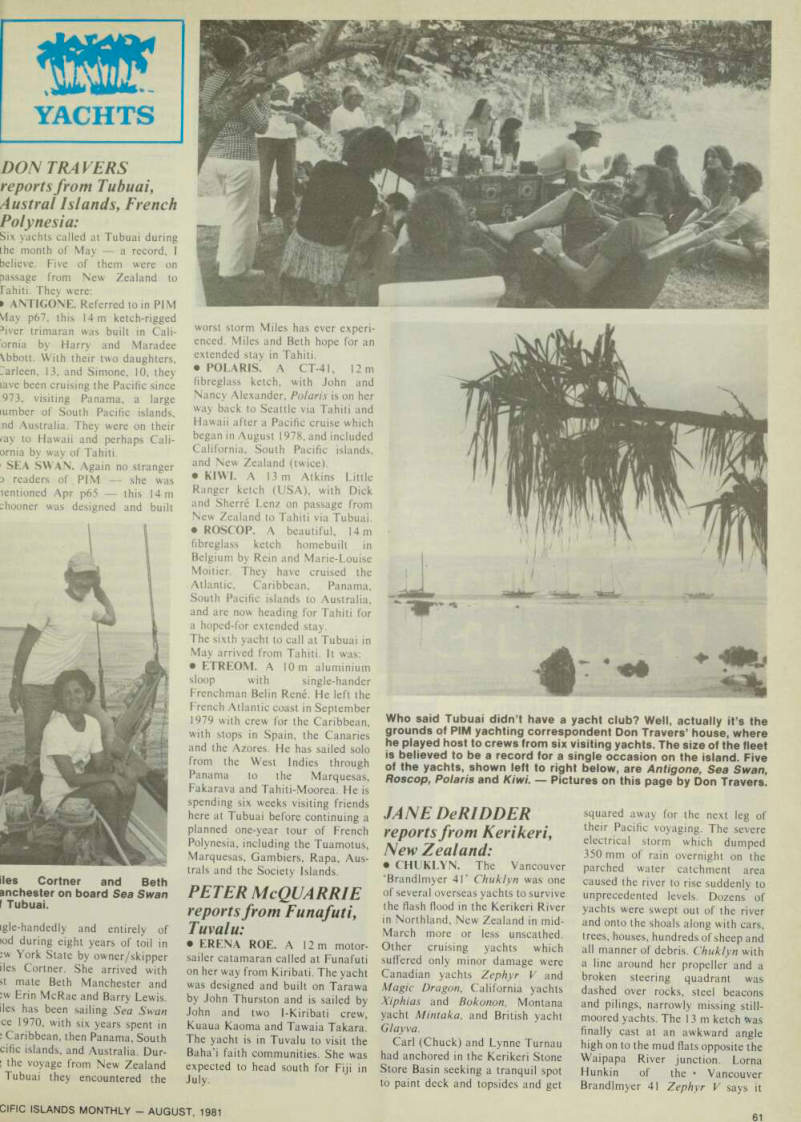
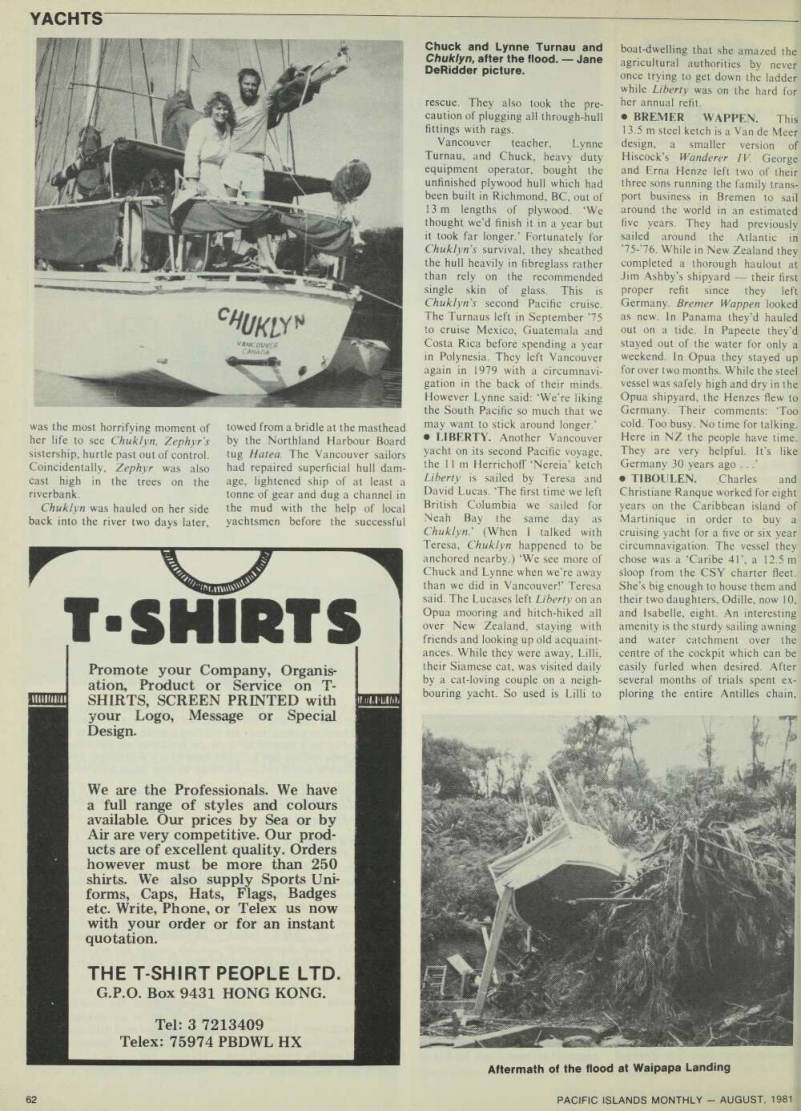
Who said Tubuai didn’t have a yacht club? Well, actually it’s the grounds of PIM yachting correspondent Don Travers’ house, where he played host to crews from six visiting yachts. The size of the fleet is believed to be a record for a single occasion on the island. Five of the yachts, shown left to right below, are Antigone, Sea Swan, Roscop, Polaris and Kiwi. - Pictures on this page by Don Travers.
was the most horrifying moment of her life to see Chuklyn, Zephyr’s sistership, hurtle past out of control.
Coincidentally, Zephyr was also
cast high in the trees on the riverbank.
Chuklyn was hauled on her side back into the river two days later.
towed from a bridle at the masthead by the Northland Harbour Board tug Hatea. The Vancouver sailors had repaired superficial hull dam age, lightened ship of at least a tonne of gear and dug a channel in the mud with the help of local yachtsmen before the successful
rescue. They also took the pre caution of plugging all through-hull fittings with rags.
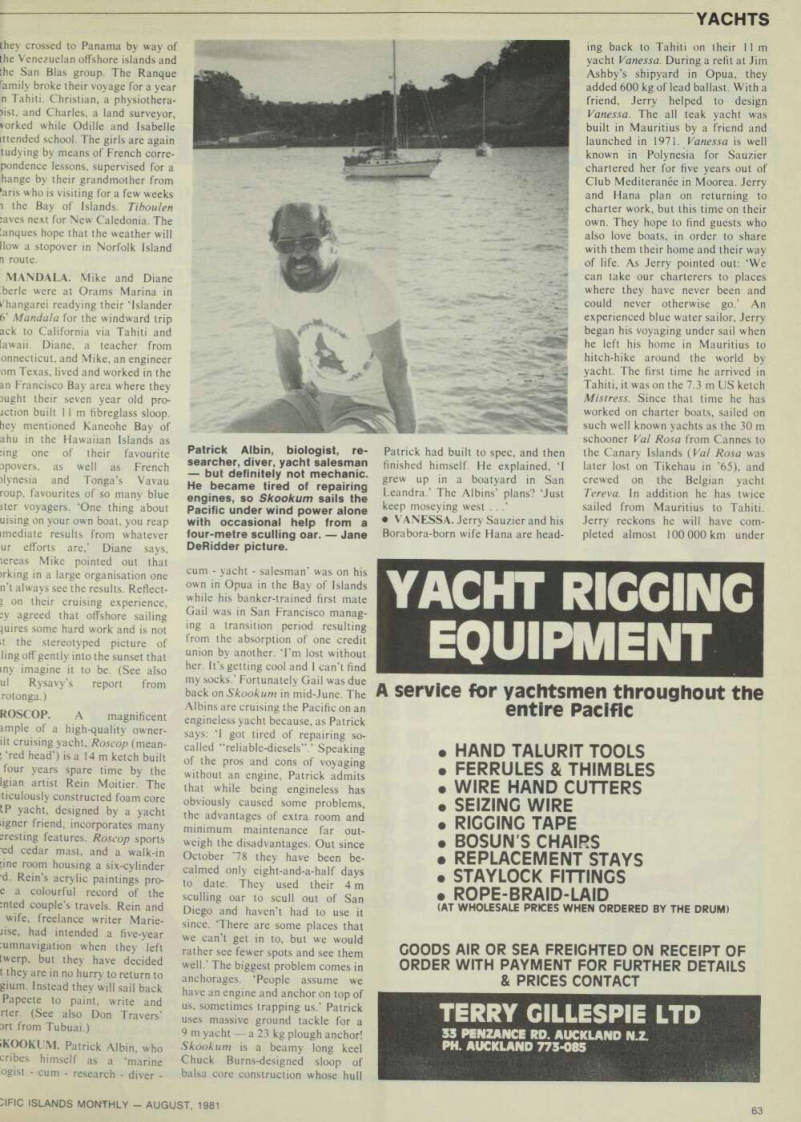
Vancouver teacher, Lynne Turnau, and Chuck, heavy duty equipment operator, bought the unfinished plywood hull which had been built in Richmond, BC, out of 13 m lengths of plywood. ‘We thought we’d finish it in a year but it took far longer.’ Fortunately for Chuklyn’s survival, they sheathed the hull heavily in fibreglass rather than rely on the recommended single skin of glass. This is Chuklyn’s second Pacific cruise.
The Turnaus left in September ’75 to cruise Mexico, Guatemala and Costa Rica before spending a year in Polynesia. They left Vancouver again in 1979 with a circumnavi gation in the back of their minds.
However Lynne said: ‘We’re liking the South Pacific so much that we may want to stick around longer.’ • LIBERTY. Another Vancouver yacht on its second Pacific voyage, the 11 m Herrichoff ‘Nereia’ ketch Liberty is sailed by Teresa and David Lucas. ‘The first time we left British Columbia we sailed for Neah Bay the same day as Chuklyn.' (When I talked with Teresa, Chuklyn happened to be anchored nearby.) ‘We see more of Chuck and Lynne when we’re away than we did in Vancouver!’ Teresa said. The Lucases left Liberty on an Opua mooring and hitch-hiked all over New Zealand, staying with friends and looking up old acquaint ances. While they were away, Lilli, their Siamese cat, was visited daily by a cat-loving couple on a neigh bouring yacht. So used is Lilli to
boat-dwelling that she amazed the agricultural authorities by never once trying to get down the ladder while Liberty was on the hard for her annual refit.
• Bremer Wappen. This
13.5 m steel ketch is a Van de Meer design, a smaller version of Hiscock’s Wanderer IV. George and Erna Henze left two of their three sons running the family trans port business in Bremen to sail around the world in an estimated five years. They had previously sailed around the Atlantic in 'l5-16. While in New Zealand they completed a thorough haulout at Jim Ashby’s shipyard their first proper refit since they left Germany. Bremer Wappen looked as new. In Panama they’d hauled out on a tide. In Papeete they’d stayed out of the water for only a weekend. In Opua they stayed up for over two months. While the steel vessel was safely high and dry in the Opua shipyard, the Henzes flew to Germany. Their comments: Too cold. Too busy. No time for talking.
Here in NZ the people have time.
They are very helpful. It’s like Germany 30 years ago . . .’ • TIBOULEN. Charles and Christiane Ranque worked for eight years on the Caribbean island of Martinique in order to buy a cruising yacht for a five or six year circumnavigation. The vessel they chose was a ‘Caribe 41’, a 12.5 m sloop from the CSV charter fleet.
She’s big enough to house them and their two daughters, Odille, now 10, and Isabelle, eight. An interesting amenity is the sturdy sailing awning and water catchment over the centre of the cockpit which can be easily furled when desired. After several months of trials spent ex ploring the entire Antilles chain,
Aftermath of the flood at Waipapa Landing
Chuck and Lynne Turnau and Chuklyn, after the flood. - Jane DeRidder picture.
they crossed to Panama by way of the Venezuelan offshore islands and the San Bias group. The Ranque r amily broke their voyage for a year n Tahiti. Christian, a physiothera )ist, and Charles, a land surveyor, vorked while Odille and Isabelle ittended school. The girls are again tudying by means of French corre pondence lessons, supervised for a hange by their grandmother from *aris who is visiting for a few weeks i the Bay of Islands. Tiboulen ;aves next for New Caledonia. The tanques hope that the weather will How a stopover in Norfolk Island n route.
MANDALA. Mike and Diane !berle were at Grams Marina in
/hangarei readying their ‘lslander
6’ Mandala for the windward trip ack to California via Tahiti and lawaii. Diane, a teacher from onnecticut, and Mike, an engineer om Texas, lived and worked in the an Francisco Bay area where they aught their seven year old pro
iction built 11 m fibreglass sloop,
hey mentioned Kaneohe Bay of ahu in the Hawaiian Islands as :ing one of their favourite apovers, as well as French ilynesia and Tonga’s Vavau roup, favourites of so many blue iter voyagers. ‘One thing about uising on your own boat, you reap imediate results from whatever ur efforts are,’ Diane says, lereas Mike pointed out that >rking in a large organisation one n’t always see the results. Reflect l on their cruising experience, iy agreed that offshore sailing quires some hard work and is not ;t the stereotyped picture of ling off gently into the sunset that my imagine it to be. (See also
ul Rysavy’s report from
rotonga.) ROSCOP. A magnificent imple of a high-quality owner ilt cruising yacht, Roscop (mean -1 ‘red head’) is a 14 m ketch built four years spare time by the Igian artist Rein Moitier. The ticulously constructed foam core tP yacht, designed by a yacht
ligner friend, incorporates many
cresting features. Roscop sports
ed cedar mast, and a walk-in
;ine room housing a six-cylinder
d. Rein’s acrylic paintings pro e a colourful record of the mted couple’s travels. Rein and wife, freelance writer Marie iise, had intended a five-year
:umnavigation when they left
twerp, but they have decided t they are in no hurry to return to gium. Instead they will sail back Papeete to paint, write and rter. (See also Don Travers’ art from Tubuai.) •KOOKUM. Patrick Albin, who cribes himself as a ‘marine ogist - cum - research - diver -
cum - yacht - salesman’ was on his own in Opua in the Bay of Islands while his banker-trained first mate Gail was in San Francisco manag ing a transition period resulting from the absorption of one credit union by another. ‘l’m lost without her. It’s getting cool and I can’t find my socks.’ Fortunately Gail was due back on Skookum in mid-June. The Albins are cruising the Pacific on an engineless yacht because, as Patrick says: ‘1 got tired of repairing so called “reliable-diesels”.’ Speaking of the pros and cons of voyaging without an engine, Patrick admits that while being engineless has obviously caused some problems, the advantages of extra room and minimum maintenance far out weigh the disadvantages. Out since October ’7B they have been be
calmed only eight-and-a-half days
to date. They used their 4 m sculling oar to scull out of San Diego and haven’t had to use it since. ‘There are some places that we can’t get in to, but we would rather see fewer spots and see them well.’ The biggest problem comes in
anchorages. ‘People assume we
have an engine and anchor on top of us, sometimes trapping us.’ Patrick uses massive ground tackle for a 9 m yacht a 23 kg plough anchor!
Skookum is a beamy long keel
Chuck Burns-designed sloop of
balsa core construction whose hull
Patrick had built to spec, and then finished himself. He explained, ‘I grew up in a boatyard in San Leandra.’ The Albins’ plans? ‘Just keep moseying west . . .’ • VANESSA. Jerry Sauzier and his Borabora-born wife Hana are head
ing back to Tahiti on their 11 m yacht Vanessa. During a refit at Jim
Ashby’s shipyard in Opua, they
added 600 kg of lead ballast. With a friend, Jerry helped to design Vanessa. The all teak yacht was built in Mauritius by a friend and launched in 1971. Vanessa is well known in Polynesia for Sauzier chartered her for five years out of Club Mediteranee in Moorea. Jerry and Hana plan on returning to charter work, but this time on their own. They hope to find guests who also love boats, in order to share with them their home and their way of life. As Jerry pointed out: ‘We can take our charterers to places where they have never been and could never otherwise go.’ An experienced blue water sailor, Jerry began his voyaging under sail when he left his home in Mauritius to hitch-hike around the world by yacht. The first time he arrived in Tahiti, it was on the 7.3 m US ketch Mistress. Since that time he has worked on charter boats, sailed on such well known yachts as the 30 m schooner Val Rosa from Cannes to the Canary Islands ( Val Rosa was later lost on Tikehau in ’65), and crewed on the Belgian yacht Tereva. In addition he has twice sailed from Mauritius to Tahiti.
Jerry reckons he will have com pleted almost 100 000 km under
Patrick Albin, biologist, re searcher, diver, yacht salesman - but definitely not mechanic.
He became tired of repairing engines, so Skookum sails the Pacific under wind power alone with occasional help from a
four-metre sculling oar. - Jane
DeRidder picture.
sail by the time Vanessa reaches Tahiti. • BECAUSE. Because of Victoria arrived in Honolulu on April 2 . . . ‘to be met with swarms of jets, a million city lights, gale force winds and cultural shock,’ after a 51-day crossing from Rabaul. Dick Fhuillier’s cruising sloop is a nodified Ray Richards ‘Warrior’ lull with raised freeboard and centre cockpit. Dick built her him ;elf, having previously constructed lis own amphibious aircraft, fhuillier has sailed several legs of lis Pacific wanderings solo. He was oined in Noumea by Ros, an xperienced blue water voyager /ho at one time cruised the Pacific n her own yacht, then sailed for ver two years on the ‘Golden Hind’ loop Atria. With Thuillier, Ros ailed through the Loyalties to Port rila for the Vanuatu independence
elebrations, thence through the
anks and Santa Cruz Islands to olomon Islands in company with
achls Papillon and Sarabande.
*ick and Ros spent the hurricane :ason in Rabaul where Thuillier inverted the forestay of Because to roller reefing system modelled on lat of John Wood’s Kerikeri yacht 'oodwind . ‘We ran for days with /o reefs in the main and rolled the a from full out in 20-knot winds to II in at 45 knots, reports Thuillier. /orked like a charm!’ But they ere hard on the wind for the latter irt of the trip. Ros baked fresh ead all the way even when shing to windward.
Oand. Pease
sports from Papeete ,
rench Polynesia:
JOLIE BRISE. The name is ench for ‘fair breeze’, and she is 11.2 m cutter from Vancouver, itish Columbia, now calling at
chorages in French Polynesia,
rnand Prince built the vessel ich is fibreglass over fir. He and wife Jean left their home port t August and stopped at the Gulf ands, Victoria, Neah Bay, ishington, and Hawaii before ling to Palmyra island where they :nt Christmas with Rob and aron Jordan on Moya , friends m Canada whom they also sailed h in Hawaii. They’re not likely to gel Palmyra because during the nth-long stay at the atoll, Sharon dan found a large aluminium c containing a skull, bones and •ned wristwatch which were ntified as the remains of a Mrs iham, who, with her husband, I been missing since 1974. Sea nd, the Grahams’ ketch, was :overed in Hawaii in the pos >ion of a young couple who were rged with its theft. The missing sons had made their final radio tact from Palmyra, and al-
though they were presumed dead, their bodies could not be found. We had read newspaper articles about the Grahams because a current history is kept on the island, so we were fairly certain of the identity of the remains even before the authorities arrived, Jean said.
PAUL RYSA VYreports
from Rarotonga , Cook
Islands:
• MANDALA. Americans Mike and Diane Eberle spent two weeks in Avatiu harbour in Rarotonga before departing for Borabora. The couple, who are sailing their ‘lslander 36’ sloop, began their voyage from San Francisco in April 1979. The ports of call to date have been Hawaii, the Marquesas, the Societies (where their parents and friends came to visit them briefly), American and Western Samoa, Tonga, Fiji, and finally New Zea land for the last hurricane season.
Rarotonga was the first stop on their return trip, and after Borabora Mandala will probably sail directly back to San Francisco. The only unpleasantness the Eberles have encountered was in American
Samoa, where some items were stolen from the yacht, and where the couple were ‘disturbed with the way American aid money is being used to fill the pockets of a select few’. • OMATAKO. A South African registered, 1 1 m Berkemeyer sloop, called in at Rarotonga in mid-June.
On board were Namibian (South west African) residents Wolfgang Dekant, the skipper, and Barbara Ebrecht. Omatako, which means a ‘a woman’s bum’ in the Herero language of Namibia, left Africa in 1977. Owner Gdtz Kldn was only able to join the boat at brief intervals as business obligations in Namibia demanded most of his time. In the five years since it left South-west Africa, the sloop has visited Brazil, St Helena, the Caribbean, Panama, the Marquesas, the Tuamotus, Tahiti and Rarotonga. Gdtz flew to Rarotonga to join the vessel, and after several weeks here, Omatako set sail for the Fiji group, where it
will remain until the next hurricane season is over. • APHRODITE VI. Canadian Larry Woolcox and Australian Helen Graham are cruising the Pacific on Aphrodite VI, a Taiwan built 15 m staysail clipper ketch.
The Vancouver-registered yacht has logged approximately 32 000 km with Larry since it was launched three years ago. In that time, Larry has explored the China Sea area, the Philippines, the Carolines, Australasia and now Polynesia. Larry and Helen (who came aboard in Sydney) plan to visit French Polynesia ‘indefinitely’, after they leave Rarotonga. • BRIGADOON. An eight-year-old Van de Staat yawl, Brigadoon was another visitor to Avatiu harbour in Rarotonga. The Christchurch registered yacht has a chequered history, as it was involved in the Mr Asia drug smuggling runs. The present owner is Jeremy Hall who is travelling with his wife and family, and crew member Peter Archibald.
The Halls have owned the craft for only nine months, and this is their first ocean voyage. They left New Zealand in mid-May, and from Rarotonga will sail to Tahiti and Fiji before returning to New Zea land in late October. • KORAL 11. Also visiting Rarotonga briefly was Koral 11. a British Columbia-registered sloop owned and sailed by Marec and Jola Jarecki and their 14-year-old son, Tom. The 10 m steel sloop was built in Holland five years ago, and the Jareckis have owned it for three.
They began this voyage in July last year, and set out from Victoria, British Columbia, directly for the Marquesas. From there, Koral II made various stops in the Tuamotus and Society Islands. On the trip to Rarotonga a large wave smashed the self-steering system and Koral II has been here several weeks undergoing repairs. On June 4, the sloop left with anticipated stops at Tonga, Fiji and New Zealand. • VIBEGGE. On a circumnavi gation is Vibegge , a 17-year-old Dutch steel-hulled ketch owned and sailed by Hans and Vibeke Munch.
They, and their crew of Erik Westh and Anne Christensen left Holland two years ago, immediately after Hans bought Vibegge , to sail around the world. Highlights of their trip so far were Spain, Dominica and the San Bias Islands. The nadir was Columbia, where they were mugged, and ‘half the boat was stolen’. After several weeks here, Vibegge continued its tour of Polynesia and headed for Tonga.
Future stops will include Fiji, New Caledonia and Australia, where further plans will be made.
The Little Ranger ketch Kiwi under sail between New Zea land and Tubuai. (See report
p6l) - Jane DeRidder picture.