NZ shipping man in
pp. 67-69 · Read in the full issue
Ships
NZ shipping man in bid to save Forum
Writing from Auckland JAMES TULLY tells about New Zealander Harry Julian, a shipping man with a record of success who now faces the task of putting some life into the controversial Pacific Forum Shipping Line.
Harry Julian, 55, is a fifth generation New Zealander who is determined to steer the troubled Pacific Forum Ship ping Line out of its present difficulties and on the way to an economically secure future. In Vovember last year he was ippointed the New Zealand lirector on the board of the line, md now he has been appointed chairman with the strong back ng of the prime minister of Vestern Samoa, Tupuola Efi, md with a direct responsibility 0 get the line out of trouble. He [escribes himself as ‘an ardent ree enterpriser’ and his suc essful record includes the de elopment of a well-established larine business on Waitemata larbour, Auckland.
Within a short time of taking p his association with the brum Line Mr Julian an ouneed his targets. They were ) halve the line’s $9 million loss lis year and to break even iside two years. He says mem er countries assured him they ould finance the line and give im sufficient time to reverse its »ss record.
By April he was saying ‘We ave already turned the corner 1 one or two areas.’ Unaudited gures for the four months inuary to April indicated the ae was on target for halving its ss in 1981.
Mr Julian said ‘We would ive done better but for indus ial stoppages in Sydney. One :ssel would have sailed from /dney with a record load but ) containers had to be left ;hind because of a strike, bat’s revenue down the drain.’
Mr Julian says the line is indling 15% of the total move ent of cargo into Forum land countries and 90% of ter-island shipping trade.
With the ship Forum Samoa owing modest profits on re nt voyages and Forum New ?aland getting plenty of cargo d cutting its losses, Mr Julian ‘cautiously optimistic’ that
the line will become economi cally viable. He’d like to see more southbound cargo and will trim what he sees as unnecess ary expenses. ‘You don’t get paid for carrying air. We want to reduce the number of days our ships are at New Zealand ports. That would save $lO 000 a day,’ he said.
Mr Julian wants the line’s administration to be centralised in Auckland. He said it was handicapped because the gen eral manager was in Apia, the financial secretary in Wellington and the chairman in Auckland. He said there was no way of totally overcoming the line’s problems until there was centralised control. It was an unnecessary expense to fly Mr George Fulcher, the general manager, up and down from Samoa. Mr Julian said Tupuola Efi had assured him he was considering the request to relocate the general manager in Auckland.
Fiji’s attitude in not contribu ting funds to the Forum Line this year was seen by Mr Julian as a setback to his salvage plans.
Fiji has claimed that the line would not be in difficulties if it
could carry Fiji bulk sugar to New Zealand. Commenting on the Fiji statement Mr Julian said it would be impractical at present to carry bulk sugar. The line did not have suitable ships, and because sugar was a seasonal cargo the cost of inter mittent charters would exceed the earnings. He conceded how ever that there was merit in the idea if other bulk cargoes, possibly phosphate, could be carried. In the meantime, he said, the line was bidding for bagged sugar cargoes.
Commenting on Fiji’s stand in the controversy, Mr Julian said he was satisfied there was no anti-Forum attitude. Fiji was taking a definite attitude based on its assessment of the situ ation. He praised the Fiji prime minister, Ratu Sir Kamisese Mara, for his attempts to get the European Economic Com munity to finance the cost of cargo containers.
Mr Julian said that within the Pacific Forum Line, firm measures had been taken to reduce container expenditures.
The line had already reduced its leasing of containers by 800 units to 2400.
Mr Julian’s own business background is in shipping ser vices and marine towing. He is managing director of the Auck land Launch and Towboat Company, and earlier he oper ated the Cook Islands Shipping Company which operated the Lorena between Auckland and Rarotonga. He is deputy chair man of the New Zealand Ship ping Corporation, a member of
the Auckland Harbour Board and president of the New Zea land Yachting Federation.
Columbus-Bank
joint service
The Bank Line of London and the Columbus Line of Hamburg have combined their shipping services operating between Europe and South Pacific ports.
The new combined service, which will continue to serve existing ports of call, will be
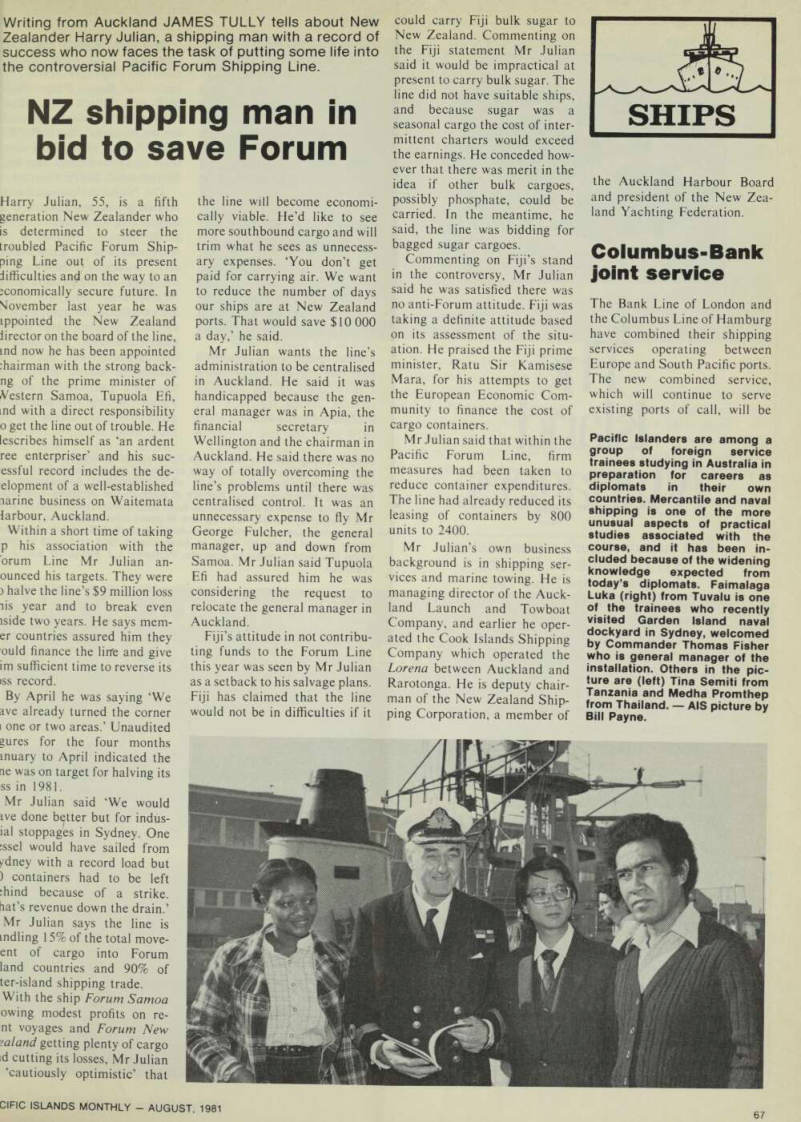
Pacific Islanders are among a group of foreign service trainees studying in Australia in preparation for careers as diplomats in their own countries. Mercantile and naval shipping is one of the more unusual aspects of practical studies associated with the course, and it has been in cluded because of the widening knowledge expected from today’s diplomats. Faimalaga Luka (right) from Tuvalu is one of the trainees who recently visited Garden Island naval dockyard in Sydney, welcomed by Commander Thomas Fisher who is general manager of the installation. Others in the pic ture are (left) Tina Semiti from Tanzania and Medha Promthep
from Thailand. - AIS picture by
Bill Payne.
operated by four Bank Line and two Columbus Line ships. They will provide a 24-day service.
The lines will operate on a common tariff and each will retain its existing agency ar rangements. A statement from the companies described the move as a rationalisation of services linking Europe and the South Pacific.
Book on ships
of Burns Philp
A book titled The Main Line Fleet of Burns Philp has been published in Australia on the ships which once operated for one of the best-known shipping lines in the South Pacific.
For 74 years the Burns Philp main line fleet of ships provided a major part of the shipping services linking Australia and the South Pacific Islands. Until 1970 when the line ceased to
operate because of changing conditions including the de cline of passenger travel by sea the Burns Philp ships with their black and white chequered funnels were well known in many South Pacific ports. A total of 38 ships were used by the company over the 74 years that the line existed.
The Nautical Association of Australia has now published a book giving the history of all 38 of the ships, written by B. A.
Wilkinson and R. K. Willson.
At a launching ceremony for the book Mr Wilkinson said 'We hope the book will bring back memories for many people of the days when ships really looked like ships.’ The launch ing ceremony was hosted in Sydney by Burns, Philp and Company Ltd, the big South Pacific trading and industrial group which owned the Burns Philp line.
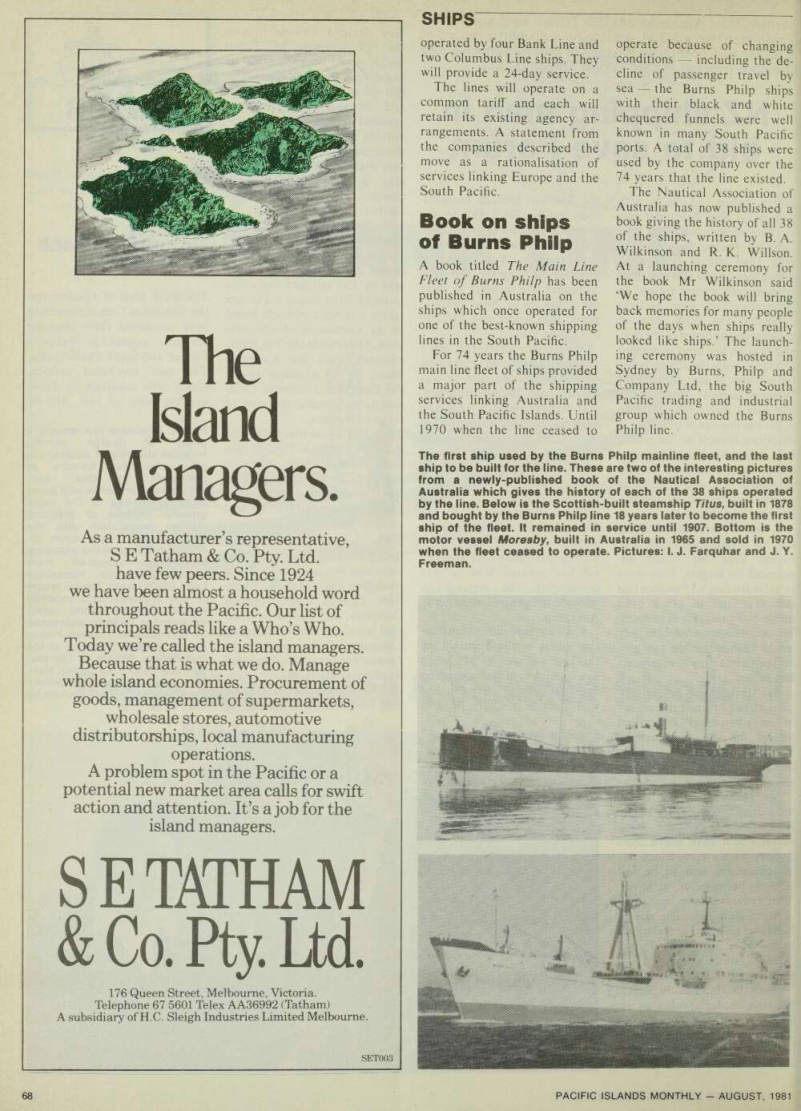
The first ship used by the Burns Philp mainline fleet, and the last ship to be built for the line. These are two of the interesting pictures from a newly-published book of the Nautical Association of Australia which gives the history of each of the 38 ships operated by the line. Below is the Scottish-built steamship Titus, built in 1878 and bought by the Burns Philp line 18 years later to become the first ship of the fleet. It remained in service until 1907. Bottom is the motor vessel Moresby, built in Australia in 1965 and sold in 1970 when the fleet ceased to operate. Pictures: I. J. Farquhar and J. Y.
Freeman.
New service to
Solomons, PNG
Capitaine Tasman , a modern cargo ship recently delivered from Europe, has been added to the fleet of Sofrana-Unilines and is to operate a new service linking the Australian east coast with Papua New Guinea and Solomon Islands.
The ship is operating its first service out of Sydney on August 7, calling at Brisbane northbound, and making for Port Moresby August 17, Lae August 21, Rabaul August 27, Kieta August 29 and Honiara August 31. This will be the pattern for a five-weekly service with a load capacity of more than 100 containers, general cargo and freezer and cooler cargoes. Australian grain for flour milling in PNG will be one 3f the ship’s regular cargoes.
This will be carried in the lower bolds under a contract entered nto with Associate Mills, an iffiliate of the Fielders Gillespie
Sroup. Sofrana has already
established a good record in
grain deliveries for flour mills in Fiji.
The new ship is of 13 600 deadweight tonnage and has six holds with an upper and lower tween deck. The general cargo space in the tween decks is
10 000 cubic metres and the refrigerated and cooler lockers provide 200 cubic metres. A total of 104 standard containers can be carried on deck.
Sofrana is already well known as an operator into PNG from its New Zealand service, and PNG and Solomon Islands ports are regularly visited by Capitaine Cook, Capitaine
Kermadec and Capitaine Laperouse.
In charge of the new PNG and Solomon Islands service in Australia is Mr J Barda, who was recently appointed to the board of Sofrana-Unilines (Aus tralia) Pty Ltd as development director. Mr Barda has been involved in shipping services in the South Pacific for 20 years.
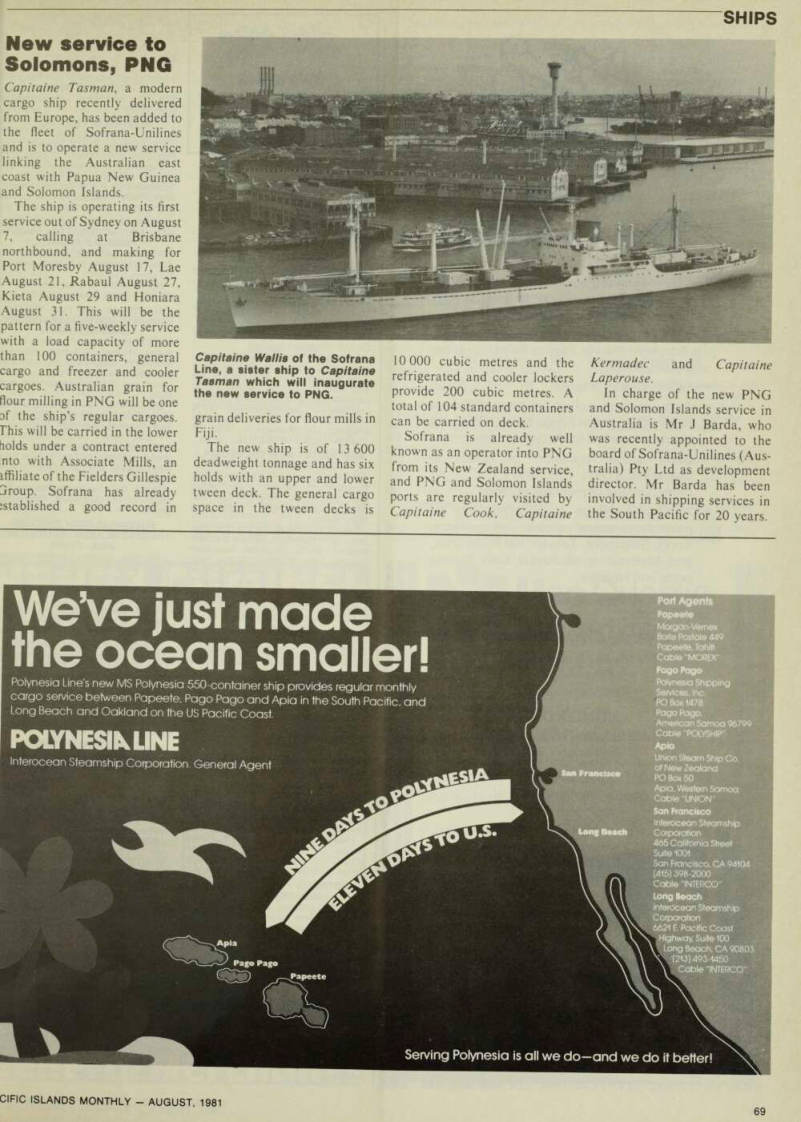
Capitaine Wallis of the Sofrana Line, a sister ship to Capitaine Tasman which will inaugurate the new service to PNG.