Deputy PM Okuk on
pp. 58-60 · Read in the full issue
Trade
Winds
Deputy PM Okuk on PNG drive for funds
A recent visitor to Australia on an investment promotion mission was lambakey Okuk, deputy prime minister of Papua New Guinea and one of his country’s most controversial politicians. ANGUS SMALES writes here about the man and his visit.
lambakey Okuk, the man who is often painted as the ogre of Papua New Guinea politics, played out a new role recently in the never-ending interplay of politics and commerce which continues to link Australia and
Png.
The significance of his 10-day visit to the Australian eastern states is easy to overlook be cause superficially it repeated what many of his fellow-leaders have done before. Michael Somare when he was prime minister, Sir Julius Chan when he was finance minister and more recently prime minister, Ebia Olewale and Sir Maori Kiki when they were foreign ministers and Barry Holloway when he was finance minister have all performed well on the Australian circuit. Each was well received, and each in his own way did much to cement the special relationship which the two countries have estab lished since PNG indepen dence. But Mr Okuk is a man of different reputation. He has long worried many Australians with employment or investment interests in PNG, and he has long worried many of his own countrymen sharing govern ment with him. This is equally true of the days when he was a minister in the Somare govern ment (Mr Somare eventually sacked him) and of his present membership of the Chan gov ernment. The two most frequent allegations made against him are that he is a one-man-band who will plunge into action without consulting cabinet and that once he gets an idea in his head no amount of discussion or opposing advice will modify his thinking. Coupled with this he has frequently been accused of being anti-Australian, although in fairness to him this has never been demonstrated in practice.
An element of anti-Australian feeling cannot be avoided in PNG politics despite today’s
relationship. Mr Okuk’s offence may be no more than honesty untempered by tact.
Against this background Mr Okuk, who is now deputy prime minister and transport minister, flew to the Australian eastern states to lay down the rules for Australian investment in his country and to assure business leaders and politicians that he still wanted Australian invest ment of specified types.
It would be stretching the truth to say that the business men who came to his meetings in Sydney, Melbourne and Bris bane spent the time eating out of his hand. They didn’t. But they met him in an atmosphere of respect and mutual co operation and many of them came away with fewer misgiv ings about PNG political atti tudes to Australian investment money. His own approach to the meetings was typical of his pragmatism. He said he would be less than honest if he claimed that he saw Australia as an ideal and major partner in the PNG economy. No new nation liked to say that about a developed country, least of all one that had once been a ‘colonial boss’. But the simple fact remained, he said, that PNG was short of investment capital and short of expertise ‘and it is far better that we talk business with the devil we know rather than the devil we don’t’.
Among the business leaders he met were the chairman of Australia’s biggest company BHP, Sir James McNeill, and the chairman of the big mining group CRA, Sir Roderick Car negie. Both companies are in volved through subsidiaries in the PNG economy. BHP is the managing partner in the consor tium which is planning the big Ok Tedi copper and gold mine and CRA is the principal part ner in PNG’s biggest export earner, the Bougainville copper mine.
Mr Okuk also spoke with representatives of the Austra lian base of Carpenters and Burns Philp, companies which are heavily involved in PNG service industries, trading, agri culture, retailing, transport and manufacturing. His principal message was that PNG wanted to keep for itself all the business that its own nationals could capitalise and operate, but the rest of the field was wide open ‘and we will be fair to you if you are fair to us’.
He reconfirmed the long standing PNG policy that where heavy capital investment or high-level expertise was needed for specific projects PNG would welcome involve ment from outside on nego tiated terms, and would guaran tee the investment and the investment agreement. But he also gave indications of new flexibility in the type of invest ment which his country was willing to accept.
He suggested that the gov ernment might be prepared to liberalise some of its hard-line policies on smaller investment and equity sharing in circum stances where investment pro posals generated a significant volume of local employment.
His attitude appears to be a direct reaction to urban unem ployment, which has become a major problem in PNG.
Mr Okuk said the type of investment proposals in mind were small to medium sized manufacturing ventures, typified by furniture making, clothing, food processing, mechanical and vehicle assemb ling, simple tool-making, com mercial and domestic fasteners of all types and school materials and equipment. He believed operations of this type could be particularly attractive to medium-sized manufacturers in countries, such as Australia, which were experiencing financial problems from high wage levels. PNG could provide the labour at an economical price, he said, and existing material supplies and markets would be unaffected. Relo cation in PNG could possibly enlarge markets, he said and be better for PNG, which was trying to reduce its imports.
He said he was considering the possibility of establishing industrial estates of the type which had attracted Australian
manufacturers to Indonesia and Tonga. ‘We give you the space, the building, the electricity and the water and to hell with the red tape which has so often got in the way’, he said.
Mr Okuk said he had spoken to representatives of major Aus tralian firms with significant operations in PNG including Burns Philp and Carpenters and had told them to sell out their interests in food bars, taverns, picture theatres and little shops, and to concentrate on manufacturing and related services. ‘We can handle the little food bars, and they can do something constructive in manufacturing’, he said. The reaction had been favourable, he added.
Mr Okuk confirmed his inter est in buying a coalburning electricity plant from Australia and in negotiating supplies of Australian coal ‘at a favourable price’. But he stressed this was only a projection at present, prompted by electricity supply problems in PNG.
Mr Okuk said he was con cerned at the deterioration of reliability in electricity supplies in PNG. He was seriously looking at alternative ways of achieving efficiency and re liability. Power supplies in PNG are at present the respons ibility of the PNG Electricity Commission, a statutory body responsible to the government.
Mr Okuk said that if the situation did not improve he would not hesitate to suggest that the whole responsibility should be taken from the elec tricity commission and given to a private enterprise venture with a good record.
In a press interview with PIM Mr Okuk conceded that he ‘was not always popular as a poli tician’ and he was aware that he did not find favour with many Australians who were in a position to contribute capital and expertise to PNG. He said: ‘But it’s a matter of accepting
Tradewinds
me and the policies I believe in.
I’m honest and I’m aggressive because I believe these qualities are necessary. I don’t necess arily want people to love me, and that may be my weakness.
I’ve come up the hard way nuch harder than many other S NG leaders and this may ae reflected in the way I go ibout things. But I believe I lave made all these points clear n my talks in Australia and I lelieve that the men who can lelp us in capital and expertise and who can help themselves it the same time understand vhat I am getting at.’ (See also Political Currents n this issue.)
Vanuatu flying
n September
anuatu has become the newest f the Pacific Island countries ) establish a national airline, nd its newly-formed Air anuatu will begin operations i September under an agree lent negotiated with the Aus alian company Ansett Trans it Industries Ltd. Initially the rline will fly a weekly each ay service between Vanuatu id Australia, using Sydney irport as the Australian ter inal. Later the service will lerate twice weekly with the ;tra flights using Melbourne as e Australian terminal.
Ansett Airlines, a member impany of the Ansett group, ill operate the new airline on ;half of the Vanuatu govern ent and Ansetts will have a
inority shareholding in the
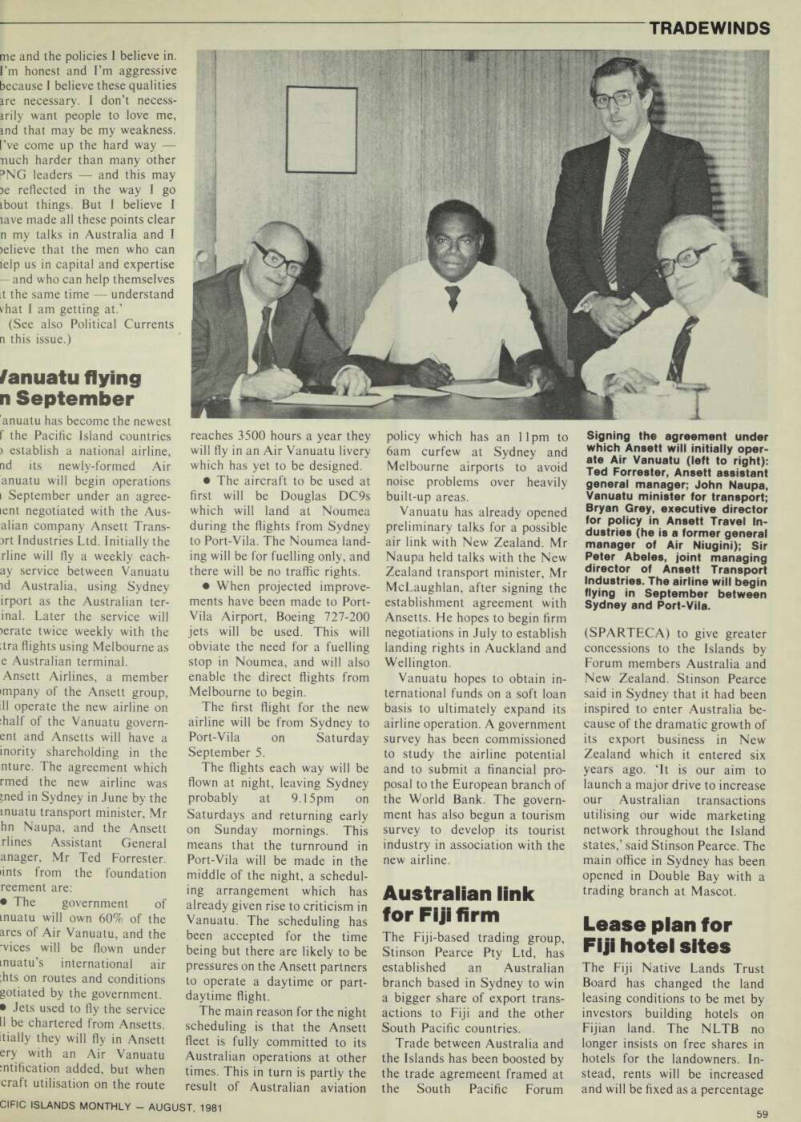
nture. The agreement which rmed the new airline was >ned in Sydney in June by the muatu transport minister, Mr hn Naupa, and the Ansett rlines Assistant General anager, Mr Ted Forrester, •ints from the foundation reement are: • The government of muatu will own 60% of the ares of Air Vanuatu, and the ■vices will be flown under muatu’s international air ;hts on routes and conditions gotiated by the government. • Jets used to fly the service 11 be chartered from Ansetts. itially they will fly in Ansett ery with an Air Vanuatu mtification added, but when craft utilisation on the route
reaches 3500 hours a year they will fly in an Air Vanuatu livery which has yet to be designed. • The aircraft to be used at first will be Douglas DC9s which will land at Noumea during the flights from Sydney to Port-Vila. The Noumea land ing will be for fuelling only, and there will be no traffic rights. • When projected improve ments have been made to Port- Vila Airport, Boeing 727-200 jets will be used. This will obviate the need for a fuelling stop in Noumea, and will also enable the direct flights from Melbourne to begin.
The first flight for the new airline will be from Sydney to Port-Vila on Saturday September 5.
The flights each way will be flown at night, leaving Sydney probably at 9.15 pm on Saturdays and returning early on Sunday mornings. This means that the turnround in Port-Vila will be made in the middle of the night, a schedul ing arrangement which has already given rise to criticism in Vanuatu. The scheduling has been accepted for the time being but there are likely to be pressures on the Ansett partners to operate a daytime or part daytime flight.
The main reason for the night scheduling is that the Ansett fleet is fully committed to its Australian operations at other times. This in turn is partly the result of Australian aviation
policy which has an 11pm to 6am curfew at Sydney and Melbourne airports to avoid noise problems over heavily built-up areas.
Vanuatu has already opened preliminary talks for a possible air link with New Zealand. Mr Naupa held talks with the New Zealand transport minister, Mr McLaughlan, after signing the establishment agreement with Ansetts. He hopes to begin firm negotiations in July to establish landing rights in Auckland and Wellington.
Vanuatu hopes to obtain in ternational funds on a soft loan basis to ultimately expand its airline operation. A government survey has been commissioned to study the airline potential and to submit a financial pro posal to the European branch of the World Bank. The govern ment has also begun a tourism survey to develop its tourist industry in association with the new airline.
Australian link
for Fiji firm
The Fiji-based trading group, Stinson Pearce Pty Ltd, has established an Australian branch based in Sydney to win a bigger share of export trans actions to Fiji and the other South Pacific countries.
Trade between Australia and the Islands has been boosted by the trade agremeent framed at the South Pacific Forum
(SPARTECA) to give greater concessions to the Islands by Forum members Australia and New Zealand. Stinson Pearce said in Sydney that it had been inspired to enter Australia be cause of the dramatic growth of its export business in New Zealand which it entered six years ago. ‘lt is our aim to launch a major drive to increase our Australian transactions utilising our wide marketing network throughout the Island states,’ said Stinson Pearce. The main office in Sydney has been opened in Double Bay with a trading branch at Mascot.
Lease plan for
Fiji hotel sites
The Fiji Native Lands Trust Board has changed the land leasing conditions to be met by investors building hotels on Fijian land. The NLTB no longer insists on free shares in hotels for the landowners. In stead, rents will be increased and will be fixed as a percentage
Signing the agreement under which Ansett will initially oper ate Air Vanuatu (left to right): Ted Forrester, Ansett assistant general manager; John Naupa, Vanuatu minister for transport; Bryan Grey, executive director for policy in Ansett Travel In dustries (he is a former general manager of Air Niugini); Sir Peter Abeles, joint managing director of Ansett Transport Industries. The airline will begin flying in September between Sydney and Port-Vila.
of gross hotel receipts, ranging from 2.5% to 4%. In the early years, rent will be kept low to help the project, the maximum period to be fixed at four years.
Hotel leases will be for 60 to 99 years depending on the type of lease negotiated.
Major resort leases will be restricted to the established tourist resort centres on Viti Levu, but other leases will be granted for small guesthouse type hotels in other areas.
Leases will not be approved for holiday houses except in areas designated for them.
Direct lease negotiations be tween a developer and the landowners will be banned, and resort sites will be marketed by the board.
Monopoly
moves
in insurance
Kiribati has set up a government-owned insurance monopoly, Tonga is on the way to doing the same thing and there are indications that some other Island governments may follow the trend.
Companies based in Austra lia and New Zealand are at present major insurance oper ators in the Pacific Islands, but under the monopoly arrange ment introduced by Kiribati and planned by Tonga new direct business must cease.
Some significant links are likely to be maintained however by using major overseas companies as underwriters and re insurance sources for the Island monopolies.
Under the Kiribati scheme heavy fines are provided for any company which sells new in surance business and for any client buying new business. The basic fine is $lOOO, with con tinuing penalties of up to $5OO a day while illegal policies remain in force. All new insurance business must be channelled by law through the new government-owned Kiribati In surance Corporation.
Penny Hodgkinson in Nukualofa provides the follow ing report on the Tongan in surance proposals: A special ordinance, already gazetted, has given the Tongan government powers to establish
a government insurance corpor ation on a date to be fixed. The government’s initial planning hopes to fix the date for September. The ordinance gives the proposed corporation monopoly rights over all forms of Tongan insurance business, inside and outside the kingdom, with the exception of existing life policies and reinsurance business. It provides for a grace period of 365 days from the date of issue or renewal of other types of existing policies and for substantial fines which may be imposed on insurers or clients who continue to transact busi ness beyond the time limits laid down by the corporation.
Indications are that the mon opoly clauses are unlikely to be fully invoked until the corpor ation is well established. The corporation will be governed by a seven-member board ap pointed by the minister of finance and will transact in surance business involving em ployer liability, fire, life, marine and motor vehicle. The corpor ation will also insure against loss situations arising from natural disaster, deviations from normal social behaviour, mechanical and technical de fects, the use of hazardous goods and processes, death, disease and injury.
The corporation’s board, its actuary and its external auditor will be required to submit annual reports to the finance minister and the Legislative Assembly. The government it self will guarantee borrowings and payouts, making payments if necessary from public rev enue as well as from accumu lated reserves. A management staff will administer the corpor ation’s business.
The two major overseas com panies which have been carry ing Tongan insurance for many years are the New Zealand Insurance Company and the QBE Insurance Group. They are not mentioned in the ordi nance and there has been no announcement of their future position. There are indications however that both companies will continue to have a role in Tonga insurance business, and will also be the obvious com panies to accept re-insurance business from the government corporation.