Rediscovering ‘H.J.M.' Samoa’s
pp. 51-57 · Read in the full issue


Yesterday
Rediscovering ‘H.J.M.' Samoa’s ‘unconquerable’ Harry Moors
In the first of two articles, American Samoa-based writer JOSEPH THEROUX tells the story of HARRY JAY MOORS, one of the most remarkable expatriates active in Western Samoa in the last quarter of the 19th century and the first quarter of the 20th. Theroux certainly makes good his claim that ‘H.J.M.’ deserves better than his present position in writings on Samoa, which is described in the article below as one of being ‘largely mentioned in footnotes’.
He appeared to be a mass of contradictions. In 1888 he re fused to pay his taxes for political reasons. But by 1907 he was ‘the largest individual taxpayer in Samoa’. He was once under house arrest, and was several times invited to Join the government.
He was a trader, import agent, politician, amateur show man, boatbuilder, blackbirding agent, mechanic, planter, spy.
He built a theatre, and was the first to show films in Apia, the first to put on wrestling matches in the town, and to import into it a whole drugstore, :omplete with soda fountain.
He could discuss, with equal
authority, literature and navi gation. He eventually built 41 shops all of which carried his local name, Misimoa, a Samoan rendering of ‘Mister Moors’. He built the Tivoli Hotel, owned hundreds of acres of land, and employed up to 120 workers.
Somehow, he also found time to write, in Samoan, a pamphlet on crop production. He also wrote two novels, short stories, poems, articles and the memoir.
With Stevenson in Samoa. Be cause of his frank though not unkind portrayal of Fanny Stevenson in the book, she became alarmed and dismissed him as ‘the village grocer of Apia’. Many writers seem to accept this view, for Moors is largely mentioned in footnotes.
Harry Jay Moors was born in Detroit, Michigan, in 1854. His grandfather’s portrait still hangs in the Masonic temple there. Later, the family moved to San Francisco where Harry graduated from high school in 1870 at the age of 16. For five years he worked at the Union Iron Works as a mechanic. It seemed a decent enough way to make a living for the next 40 or so years. But Harry had set his sights higher. Whalers were still calling into San Francisco har bour with stories of the islands and their charms. The Union Iron Works was on the wharf and Harry listened to the stories. The phrase ‘the South Seas’ had a magical ring to it. In 1875, at the age of 21, he visited Samoa and was enchanted.
Those were the days of the height of the blackbirding trade, or, as it was euphemistically called, ‘the labour trade’. Involving the recruitment of islanders from their homes in the Gilberts, Solomons and Micronesia, the trade soon developed cancerous abuses and horrors that rivalled the African slave trade. It was this brutal business that eventu ally depopulated Easter Island, obliterating its culture and his tory.
To combat the abuses, the Australian and Hawaiian gov ernments appointed agents to oversee the recruitment of labourers, and guard against kidnappings and cruelties.
After doing agricultural work in Samoa for a time, Moors applied to the Hawaiian Board of Immigration for a position as agent, and for several years
worked on ships recruiting labourers in the Gilbert and Wallis Islands. He learned the languages, picked up stories and later wrote two novels about blackbirding: Tapu, and The Tokanoa, or the Wizard Doctor of Marakei.
Once, shipwrecked on Wallis Island, he was attacked and nearly killed b> ihe natives.
Struck in the middle of the forehead, he carried a scar for the rest of his life. In pure Pocahontas fashion, his life was saved by the king’s daughter.
They had an affair and a son, Kane, resulted.
Living in Apia, he had another son by Epenesa Enari, called Mark. As with his legit imate children, Mark and Kane were educated in the States.
These affairs occurred beU Moors was married, for he apparently was faithful to his legal wife, to whom he was devoted for over 40 years.
But they do shed light on Henry Adams’ remark in his Letters : ‘Moors .. . has had various wives to say nothing of inciden tal feminine resources . . .’
In the early 1880 s, he settled down at Apia and became partners with the trader E.A.
Grevsmuhl. With an instinctive business sense, Moors soon caught on, but after two years he dissolved his partnership with Grevsmuhl. Perhaps he found out, as Stevenson later wrote, that ‘Grossmiihl (sic) (was) the most infamous trader in these waters, the man who is accused of paying natives with whist counters’.
During his partnership with Grevsmuhl, Moors was looked
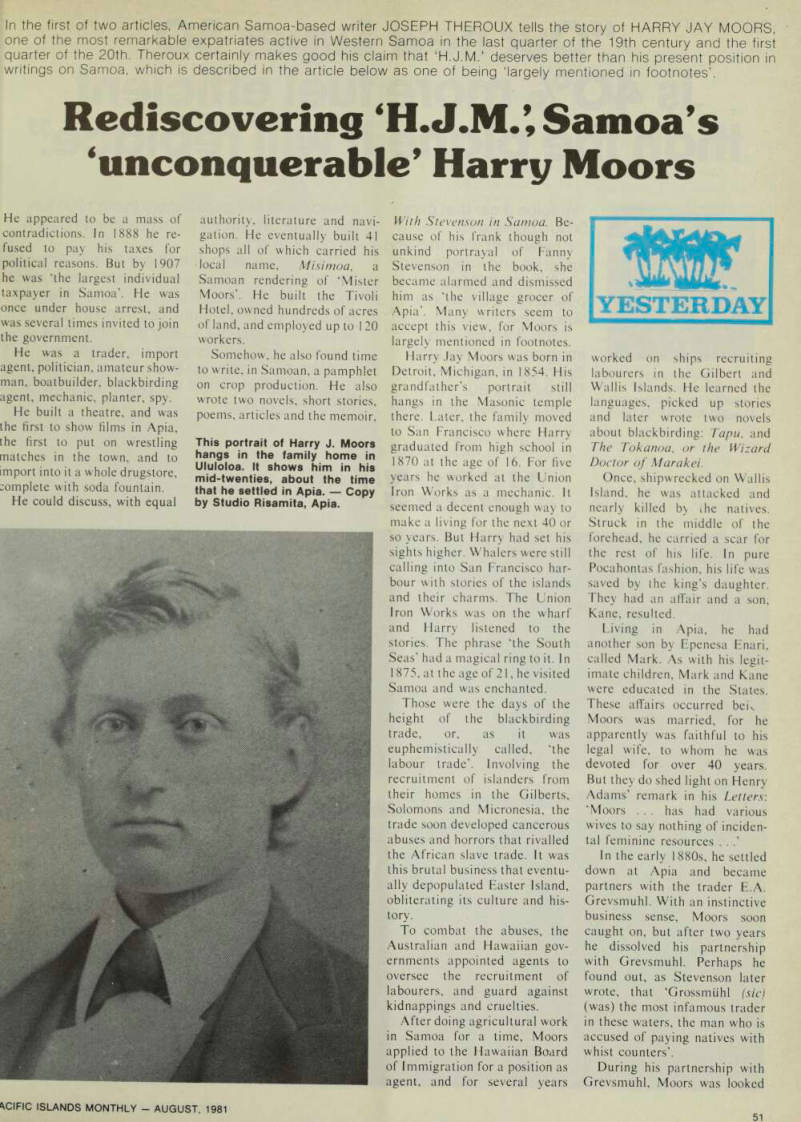
This portrait of Harry J. Moors hangs in the family home in Ululoloa. It shows him in his mid-twenties, about the time that he settled in Apia. - Copy by Studio Risamita, Apia.
upon as a promising young businessman. One man who saw him as such was a Scotsman by the name of Johnson. After having married a local girl, lohnson had returned to Scotland for five years, taking vith him his wife’s niece, r a’animonimo, of the village of fanugamanono, just outside \pia, of the family of Asibno.
Back in Apia, Johnson grew veary of beating hopeful suitors iway from the door. He decided o go in for a bit of match naking. A tea was arranged at he American Consulate in Fa’animonimo, who has >een described as a statuesque, ne-figured woman, appeared midst the men in their tropical whites, those Chinese shirts and uck trousers. She was intro uced as ‘Nimo’.
Moors was smitten at once ith her looks and recently cquired Scottish brogue. She as undoubtedly attracted to im, his sturdy physique, his lack hair and blue eyes, his mse of fun and drama. After a of teas, Moors, in his
forthright American way, ex ploded, ‘Marry me, Nimo! I love you. You will never regret it.’
Confused, Nimo replied in her brogue. ‘Yes, yes! No, no!
Uncle, what do I do?’
Marry him,’ said Johnson.
And she did, on July 10, 1883, at the consulate. She was 20 years old. Moors 29. * ★ ★ In December 1889, Robert Louis Stevenson sailed into Apia harbour and later wrote to Charles Baxter that he had met the ‘ablest, wealthiest, and best informed trader in Samoa’.
In the years since his mar riage, Moors’ business had
flourished. His general store carried garden tools, canned goods, vegetables and fruit from his gardens, and clothing.
He bought copra from the traders on Savaii, a rough lot known in those days as the Savaii Squires which included such notables as Crooked-Neck Bill (so-called because he had survived a hanging in England and looked as if he had), Spanish Mike, Monkey Jack Stowers and Petelo Dick. He made his calls in his own boat, sailing into the lagoons on much more agreeable errands than in the Gilbertese days. It was Moors, in love with Samoa, who convinced Stevenson to buy property there.
Even if he hadn’t been a voracious reader. Moors would certainly have heard of the most successful novelist of his day.
Moors had been asked by Joe Strong (Stevenson’s stepson-in law whom Moors had met in Hawaii) to make Stevenson's stay pleasant. But Moors was at first pul off by what Henry Adams described as ‘a man so thin and emaciated that he looked like a bundle of sticks in a bag’. Stevenson, on the other hand, was also suspicious of ‘his round blue eyes ... and the repulsion was mutual. However we both got over it, and grew to like each other; and it’s my belief he won’t cheat me. He’s highly intelligent; tells a story well and from a veracious understanding ... He is mar ried to a Samoan, whom he treats kindly, and his oldest girl is in the States at school. You may wonder I should become at all intimate with a man of a past so doubtful, but in the South Seas, any exclusiveness be comes impossible; they are all in the same boat . . . and it was perhaps chiefly as a choice of evils that I left my power of attorney with H.J.M. At the same time, he is a man of so strong understanding, and is so well to do, that personally I am not the least alarmed.’ ‘A past so doubtful’ refers to Moors’ relations with Grevsmuhl and the fact that Stevenson was under the im pression that Moors had been a supercargo in the labour trade something altogether different from being an agent.
Stevenson gained his infor
mation, along with the misspell ing of Grevsmuhrs name, on his first visit to Apia. And if Apia’s gossip was anything like it is today, it was as colourful as it was unreliable.
The fact is, Stevenson found in Moors a financial adviser, real estate agent, house builder, confidant. They shared tastes in literature, politics and a love of the islands. Their separate ex periences in the Gilberts gave them grounds for comparing notes, memories and mutual friends. Many evenings it was . back to Moors”, Stevenson wrote, ‘where we yarned of the islands, being both wide wan derers, till bed time’. With Nimo, Stevenson would recall Scotland, his homeland that still obsessed him. Years later.
Moors wrote in With Stevenson in Samoa : ‘We had many long talks, many confidences, many escapades . . .’ In an unpub lished essay. Moors wrote: ‘. . . evening after evening we lay side by side in lounge chairs, a bottle of whiskey between us, and we discussed British and American literature from its earliest beginnings with Field ing and Smollett . . They were still young men, full of energy and imagination: Moors was 35, Stevenson 39.
Often Moors would ride his horse up to Vailima (which means ‘water in the hand’, not ‘five streams’ as it is translated in the biographies) to visit them in what Henry Adams called the ‘two-storey Irish shanty with steps outside to the upper floor and a galvanised iron roof.
They would reminisce and Fanny would make ‘a panful of American soda biscuits remem bering that Mr Moors was fond of them’.
And there would be parties at Moors’. Fanny, still friendly with Moors at this time, wrote in her diary: ‘As usual, the entertainment was delightful.
None of us know what it is about the Moors’ parties that make them so enjoyable, but enjoyable they always are . . .’
There would be songs, dances, poetic recitals, Stevenson on the flute, stories. Fanny writes: ‘Louis and Joe (Strong) were asked to play upon their pipes.
By some mistake Louis had a wrong pipe, but all the same they played away; at least
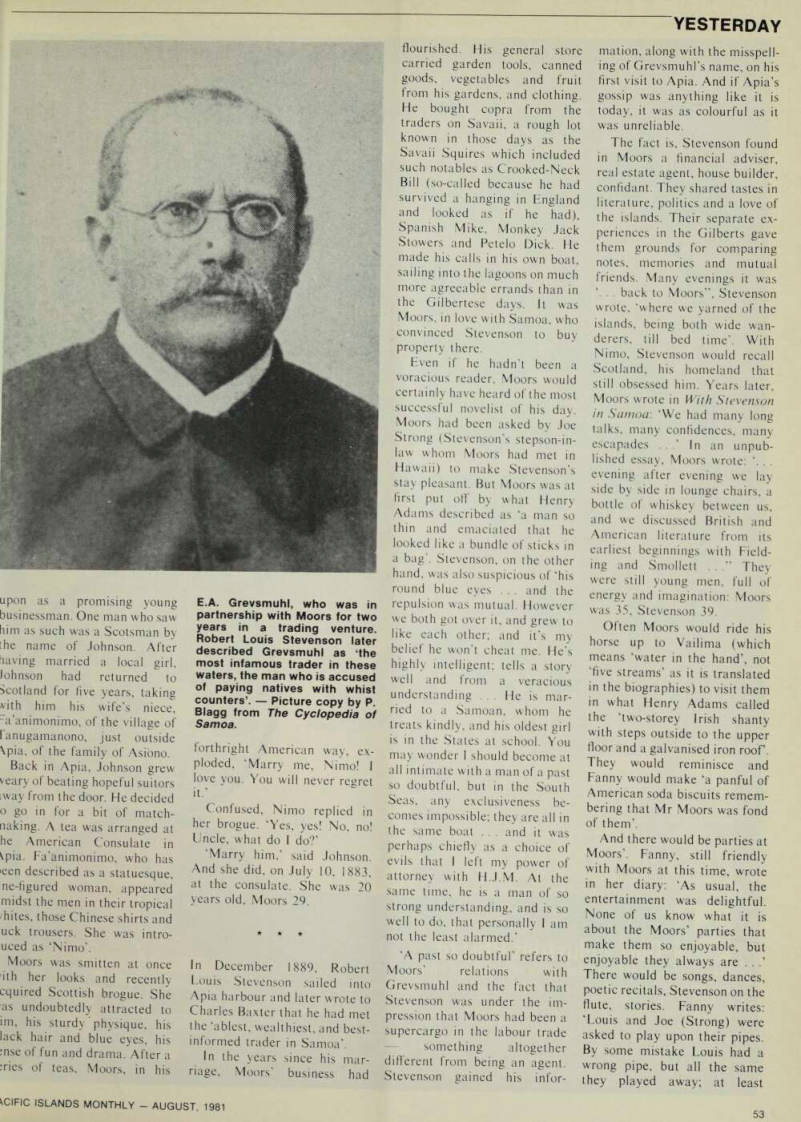
E.A. Grevsmuhl, who was in partnership with Moors for two years in a trading venture.
Robert Louis Stevenson later described Grevsmuhl as ‘the most infamous trader in these waters, the man who is accused of paying natives with whist
counters’. - Picture copy by P.
Blagg from The Cyclopedia of Samoa.
sometimes one did, sometimes the other, and occasionally by some chance they played together. For such a feeble performance I never heard any thing worse. Then Belle (Strong’s wife), being pressed for a recitation, repeated a few verses of Louis’s. Miss Moors recited really very well, Louis’s Christmas at Sea . . . There was pretty dancing by Miranda Moors ‘Many a day and night,’
Moors wrote later, ‘when Stevenson felt played out or written out ... he would come down to be cheered up ... I fancy the women folk were »iven to coddling him too much it home.’ Whenever he got a :hance, Stevenson would ride lown to Apia for a visit, even hough the ride would weaken lis already frail body and it vould take him a day to re :over. It was during these visits hat Moors told Stevenson ibout his secret involvement in he tribal battles of the ’Bos that ipped Samoa apart. ★ ★ ★ Tom the late ’6os to the end of he century, the three powers, Britain, the United States and jermany, had backed three ifferent claimants to Samoan ule, Malietoa, Mata’afa and 'amasese. For years there was poradic fighting, the Germans eing the first to introduce rmaments on a large scale.
Warships were brought in and it sems clear that the three owers egged on historic local ivalries in a spirit of divide and onquer.
The majority of Samoans jpported Mata’afa, as did loors and Stevenson, and lata’afa, who called Moors ny son’, was three times lected ali’i sili, a title which oes not exist now but which leans ‘highest chief. In 1888 le ‘one dissident, the uncon uerable Moors’ paid a diplo latic mission to Washington ‘to ;ason with the authorities’, as tevenson wrote.
In an unpublished manu ript Moors wrote: ‘The erman forces still controlled pia and patrolled its streets. ‘Brandeis (Captain Eugen, ho called himself Premier and a fit of Anglophobia once
banned cricket) collected all taxes regularly except mine and the Samoans all over the country were talking of re bellion, and all were preparing for it.’
After meeting a vacillating and indecisive Secretary of State in Washington, Thomas F. Bayard, Moors summed up their interview; ‘ “Very well sir, I am going back to the islands and I hope that something decisive will be done for the relief of the natives who are patiently waiting. If I cannot take back some reassur ance to the Chiefs I fear they will overthrow the Tamasese Brandeis machine soon after my return.’’ ‘“You take great responsi bilities Sir,’’ he said looking keenly at me as if saying he felt sure that I would probably inspire and assist any insurrec tion. ‘ “Perhaps Sir,” said I as I turned and left the room.’
And assist the insurrection is just what Moors did. In the same manuscript he tells how primers were smuggled in under the noses of the Germans. ‘We found that if we could get the right kind of primers, we could reload many of our dis charged smaller cartridges as we had powder and enough lead.
T was able to arrange with
the supercargo of the Richmond to buy these primers for me in New Zealand and to bring them to our Harbour, I guaranteeing to see to the landing.’
However, the Germans were on the lookout, as ‘all cargo for me was specially inspected’.
Cement casks, crates of po tatoes, salt-beef tins, and paint kegs were opened. He had once smuggled in guns concealed in bolts of cloth. Through some misunderstanding T can never understand how it came about’ the steamer’s mani fest read ‘One parcel Caps Marked H.J.M.’. The thought of percussion caps on board increased the Germans’ desire
to catch Moors in an act of smuggling.
As the Germans continued to search, an American officer in league with Moors simply strolled on board and asked for
Top: The H.J. Moors store in Apia about the turn of the century, with railway line down to the waterfront and the family home upstairs. Above: The scene today. The original store (now complete with TV antenna pointed to American Samoa) is on the right and the other building is a duplicate built by Moors. The family no longer
owns the buildings. - Copy at
top by P. Blagg from Furnas’
Anatomy of Paradise; today’s picture by Studio Risamita, Apia.
‘some late papers, and the supercargo handed him a big bundle which contained most of the needed primers . . . Another officer got aboard and carried the balance away in his half closed umbrella’. In all there were 75 000 primers. A very neat and businesslike job, but Moors was not yet content. He made up a mysterious package and had it labelled ‘H.J.M.
Caps’ and smuggled it on to the Richmond. It was soon found by the Germans who triumphantly opened it only to find a collec tion of headgear. ‘No one could imagine,’ Moors wrote later, why I was importing such a lot }f old well worn Caps of Ancient Vintage.’ One can ilmost hear Harry’s chuckle as ie wrote that line. * * * n May 1892, Stevenson sat lown in Moors’ house to write A footnote to History, Eight Years of Trouble in Samoa. He luestioned Moors for back ground, and the manuscript fom which the above quo ations were taken may have >een written for Stevenson’s nformation.
After discussing a battle that iccurred several years before, n December 1888, Stevenson old of Moors’ spying activities luring those violent days. At hat time it was common prac ice for Samoan warriors to take leads in battle and pile them up n mats as trophies for their hiefs. For the first time, how ver, women’s heads were also aken. Stevenson wrote: Near Matafagatele (outside Apia), he Moors) met a Manono chief, whom he sked if there were any German dead. ‘1 think there are about 30 of them nocked over,’ said he. ‘Have you taken their heads?’ asked toors. ‘Yes,’ said the chief. ‘Some foolish eople did it, but I have stopped them.
We ought not to cut off their heads when they do not cut off ours.’
He asked what had been done with the heads.
Two have gone to Mata’afa,’ he replied, ‘and one is buried right under where your horse is standing, in a basket
wrapped in tapa.’ . . .
Moors then asked the Manono man how he came to be going away. ‘The man of war is throwing shells,’ said he. ‘When they stopped firing out of the house, we stopped firing also; so it was well to scatter when the shells began.
We could have killed all the white men.
I wish they had been Tamaseses.’
As Moors drew nearer to Vailele, he began to meet Samoans with hats, guns and even shirts taken from the German sailors. With one of these who had a hat and a gun, he stopped and spoke. The hat was handed up for him to look at: it had the late owner’s name on the inside. ‘Where is he?’ asked Moors. ‘He is dead; I cut his head off.’ ‘You shot him?’ asked Moors. ‘No, somebody else shot him in the hip. When I came he put up his hands, and cried: ‘Don’t kill me; I am a Malietoa man.’ I did not believe him and I cut his head off.’ ‘Have you any ammunition to fit that gun?’ ‘I do not know.’ ‘What has become of the cartridge belt?’ ‘Another fellow grabbed that and the cartridges, and he won’t give them to me.’
No doubt it was difficult at
times to ‘inspire insurrection’.
★ ★ ★ The fighting reached a climax of sorts when the three powers sent in warships. As they were
assembled in the harbour,
poised for fighting, the great
Hurricane of 1889 struck. The Vaisigano River swept into the harbour and washed out the sand. With their anchors drag ging on the coral, the seven
ships were caught in a seething
cauldron, from which only the British ship escaped. Of the six
remaining ships, five were de
stroyed and scores of men lost their lives. Along with the consulates, Moors’ store was used as a temporary hospital.
Moors tended the shaken and injured men for days.
But the fighting went on until 1893. While Moors was in the United States, Mata’afa lost his battles and was deported to Jaluit in the Marshalls where he remained for five years.
Stevenson wrote to Moors in Chicago, breaking the news.
When Mata’afa returned to Samoa in 1898, he was for the third time elected King of Samoa. Though he was a Cath olic, Mata’afa’s supporters were mostly Protestant Samoans.
Anti-Catholic missionaries per suaded the chief justice not to ratify Mata’afa’s election. More fighting broke out. Moors counselled against fighting, for he believed that the American forces, which now supported Mata’afa’s enemies, were act ing against orders from Washington.
They were, but for the time being they were in control and so confined Moors to his house for six weeks. When President McKinley’s orders to desist from fighting arrived. Moors instituted a settlement and urged Samoans to surrender their arms.
Samoa was placed under German rule, in the person of the tough but fair Governor Solf, and Moors notified him that he was withdrawing from Samoan politics.
In 1899 Solf repeatedly asked Moors to be a member of the newly-formed Government Council, but he declined, for ‘many Germans still hated me for my (past) efforts’. Moors never sought political power. In the same year Mata’afa offered Moors the title of Tupuafa’asua, which he also declined.
Next month: Show business in the USA, boatbuilding in Samoa, a battle royal with New Zealand’s Colonel Logan, and linking up with Olaf Frederick Nelson.
The opening lines, in Moors’ hand, of Mr Glover’s Strategy, written about 1892 and dealing with Moors’ diplomatic mission to Washington and smuggling. - P. Blagg picture from the collection of Priscilla Moors Muench.