of Magellan: Trip of a lifetime
pp. 47-49 · Read in the full issue
To the Pacific through the Strait of Magellan: Trip of a lifetime
Travel
Retired US international airline pilot turned travel writer Captain NED AVARY describes a journey through what must be the most dramatic and beautiful of all entry gates to the Pacific, the Strait of Magellan.
Every two weeks a luxurious Delta Line passenger-cargo liner sails from the US West Coast, cruises through the Panama Canal, then winds a wonderful route clockwise around South America and back to the USA.
Highlight of this splendid odyssey is entering the great Pacific through the Strait of Magellan.
If you cannot afford to spend the whole 54 days at sea involved in the full round trip, you can still realise your dream of sailing through the strait by
flying to Rio de Janeiro and joining the ship there.
Churning through the muddy waters of the great Rio de la Plata, you recall that in January 1520 Magellan with his five ship fleet was here too, fruitlessly searching for el paso , ‘the pass’ which would lead them through South America and on to the fabulously rich Spice Islands they were so determined to find. But el paso had to wait . . .
As your Santa skipper picks up his southerly course to the tip of South America, you leave
the Rio de la Plata and enter the clear, cold waters of the South Atlantic.
Three days and more than 1600 km south of Buenos Aires, the excitement has grown in tense. Then comes the an nouncement you have long waited to hear: the ship will reach the entrance of the Strait of Magellan early next morn ing.
But that night you’ll see sights you have relished since your first geography lesson the Tierra del Fuego, the ‘Land of Fire’.
In this wild, windy Antarctically-chilled land of eternally snow-crowned peaks, the ‘Land of Fire’ seems insanely inappropriate as a name. Given to it by Magellan and his men, it recalls their experience as nightly they stared in wonder at the incred ible number of enormous fires illuminating the dark, grim terrain starboard of their tiny ships. Those beautiful blazes were keeping the Patagonian Aborigines warm and alive in the frigid temperatures of their icy homeland. The fiery night time spectacle may still be witnessed today thanks to Argentina’s great oil refineries, blazing away night and day in this Patagonian wilderness.
On October 21, 1520, Ferdinand Magellan, having lost one ship in a hellish storm and with a mutiny-scarred win ter ashore behind him, suddenly stood transfixed. His lookout had just cried: ‘Cape to star board’. El paso, the ‘pass’ to the undiscovered Pacific, was his.
But it would be more than a month before he made his marvellous mark in history by sailing through the strait to discover the great, blue ocean beyond.
October 21, 1520 was the feast day of St Ursula, so Magellan named the promon-
tory The Cape of Eleven Thou sand Virgins’. Today, the place is simply called ‘Cape Virgins’ perhaps the number named in the Magellan version had strained people’s belief!
After a few minutes cruising past Cape Virgins you reach Cape Dungeness, the actual entrance to the Strait of Magellan.
For the next 38 hours you will sail past some 480 km of magnificent, mind-blowing scenery. Wild winds, snow, ice, crazy, swirling currents, narrow fjords, majestic mountains, great glaciers. Here at last, and after all your travels, you might as well give up on adjectives.
Best to settle for one word: awesome.
Two hours after entering the 20 km-wide ‘gateway’ to the strait you pass through the first ‘narrow’, which is just 3 km wide and 13 km long. Right here the surging strait tides change 12 m!
Strange that the water on your entire trip is so smooth.
Somehow you expected nightmarishly rough seas, rather than canal-like cruising.
But this is all dangerously deceptive. Sudden, fierce storms, with hurricane-force winds, have for centuries been turning beautiful ships into scattered skeletons. Straying from the strait’s safe centreline in any weather can easily spell disaster. Several grim-looking, rusty hulls observed along your route remind you that nature is the Superpower here . ..
During your 38 hours in this
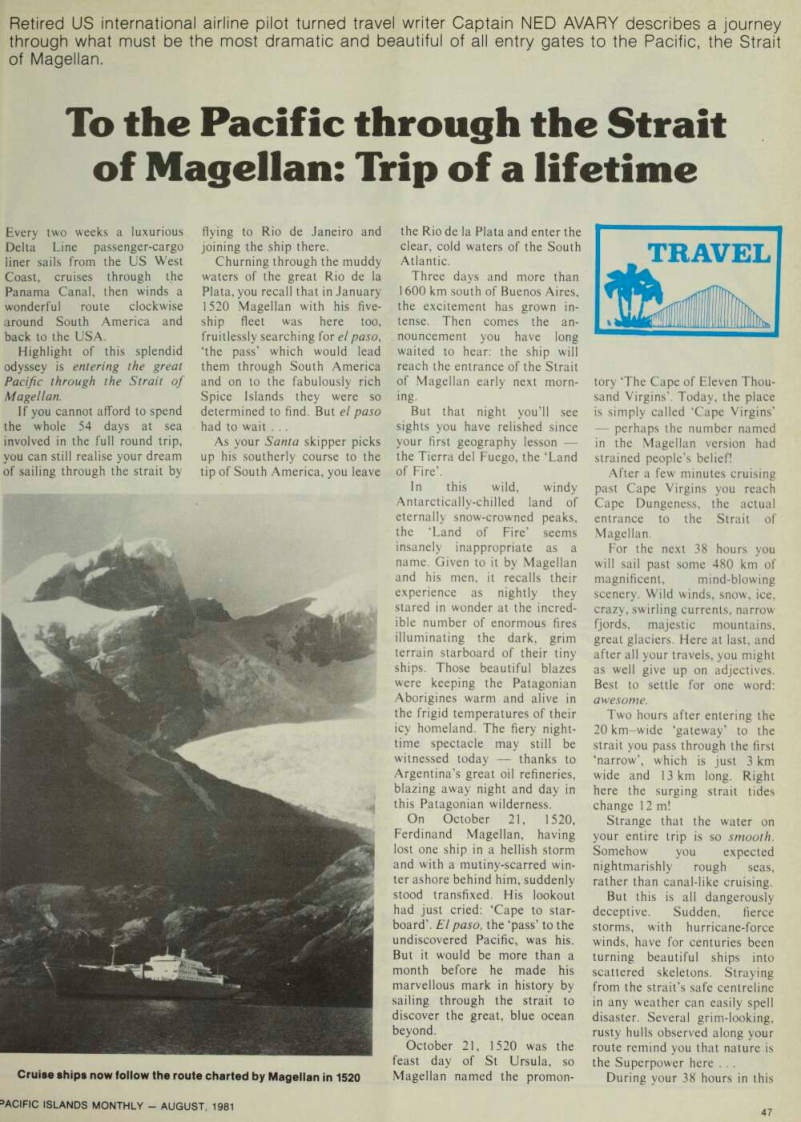
Cruise ships now follow the route charted by Magellan in 1520
wild and wonderful world, ‘just when to sleep’ could present a problem. After years of plan ning this trip of a lifetime it seems an absolute outrage to ‘go below’, and miss a single minute af the transit.
But relax! If ever you leave the deck you will miss nothing af the visual wonders the ship is aassing by. Remember those
luge, tinted, deck-to-ceiling
fining room windows that neant so little to you as you sat iockside in Buenos Aires? Now hey come into their own: you niss nothing of the scenery vhile you dine. The lounges too lave some of the best window visibility in the whole world of >cean cruising. Even in your >wn stateroom, where you neak a little snooze now and hen, there is a huge picture window, not a puny porthole.
Smack in the centre of the Jtrait of Magellan, the ship’s hefs create a triumphal tribute o the occasion, a banquet onsisting of a sensationally uitable Chilean menu for the lest a en el Estrecho de Magellan. All the fabulous fare > deliciously lubricated with ne Chilean wines.
You linger a little over coffee
and brandy. Then you glance at those great dining salon win dows. Your juices jump and so do you!
Into your cabin for a heavy coat then right out on deck.
These precious hours in the strait are so few. Every single minute must be made use of.
The melodramatic ‘mix’ of weather in this wild part of the world enables you to see every thing with Antarctic clarity one minute then suddenly visibility dives to zero. Right now out on deck you can nearly touch the unbelievably bright stars in the clear super-chilled atmosphere.
Your eyes automatically stare south to identify the most beautiful of all southern con stellations, the Southern Cross.
It’s gone! But no: your eyes swiftly climb the star-studded sky, and there is your Southern Cross directly overhead!
Positive proof of your extremely southern spot on the earth’s surface. Just now your ship sails by Cape Froward the southernmost tip of the South American continent. The bridge officer on watch informs you that your position is now 53 degrees 54 minutes south.
Really deep south!
Your mind frequently whips back to Ferdinand Magellan, that brave benefactor who gave you this magnificent southern route linking two mighty oceans. His nautical navigation was so sensationally skilled - 461 years ago that his proven positions, his ‘fixes’ ob tained with the most primitive of instruments, were only one quarter of a degree off in latitude! (Magellan’s ‘chron ometer’, for instance, was an hourglass!) The weather now socks in again, with howling winds and driving rain, which send you scooting into the nearest warm lounge for cover and comfort.
Fully aware of the stark fact that your Santa is in narrow, twisting, fjord-like country, your heart pounds with grati tude for the powerful presence of the two super-skilled Chilean pilots on the bridge right now.
Highly sophisticated naviga tional equipment which you previously took for granted now secures your safety. Sonic depth finders, complex radar systems, numerous radio,
navigational/directional aids and a beautiful little ‘black box’. That ultra-modern, and truly magic, device constantly presents the ship’s position any where on earth through the kind co-operation of a mind-boggling satellite system high in the heavens. All of those fine ‘friends’ are working hard for you now!
You have plenty of wonder ful, wildlife company in the Strait of Magellan. Penguins, of course, unless they’ve all gone north for the season. Hundreds of wild, wheeling Antarctic birds constantly circle over head, while huge whales, flying fish and sleek porpoises race alongside. A fantastic set of photogenic escorts for your vessel. It is deeply reassuring to learn that the Chilean Govern ment keeps safe and sacred this fabulous area, which terribly soon could become one of the world’s greatest game-fishing regions.
With your night vision hap pily adjusted and your heavy coat keeping you comfortably warm, you now see Crooked Reach the 2.5 km-wide ‘narrowest part’ of the Strait of Magellan. Here the 12 m tides of the Atlantic and Pacific Oceans meet in a rushing, surging spectacle which leaves you gaping in awe. Later, if you’re still on deck, and the weather is clear and kind, you will admire the magnificent and much photographed Windham glacier. The following morning about breakfast time you bask in the grandeur of Mount Burney to the starboard side of Santa. Mt Burney is one of the most beautiful of the many peaks peppering this region. It is also the highest mountain (1744 m) in the Patagonian Channels.
Your final hours in this ad venture of a lifetime, which gave you scenery surpassing anything else on earth, are charged with remembrance and respect for Magellan and his men. In just 38 marvellous hours you have duplicated Ferdinand Magellan’s 38-day voyage through the strait which so nobly bears his name.
Magellan lost two ships and many men’s lives on his historic transit. All you’ve ‘lost’ is a couple of hours sleep.
Just before the ship’s supper call, you see Tudor Lighthouse.
This marks the end of Trinidad Channel and you finally meet the Pacific Ocean. As the cur tain of nightfall comes slowly down, terminating one of the greatest sailing shows on earth, you dress for dinner, soon to enjoy another gourmet meal.
Magellan’s arrival here was a bit different. Aboard his flagship the Trinidad, he sig nalled his other two ships the Victoria and Concepcion to sail close. The date; November 18, 1520.
It was a solemn occasion, blessed with bright sunlight.
The crews were paraded on deck as the armada’s senior priest climbed to the flagship’s poop deck. The ship’s com panies knelt in silent prayer as the high priest invoked the grace of Our Lady of Victory.
The men then sang Te Deum their voices small, almost un heard, in the constant howling winds. Finally the ship’s can nonades thundered a mighty broadside and terrified circling sea birds flew off in deep fright.
Before dismissing his men, Magellan unfurled the beauti ful banners of the Lions and Castles of Spanish Castile. His closing history-making words: ‘We are about to stand into a sea where no ship has ever sailed before. May the ocean be always as calm and benevolent as it is today. In this hope I name it the Mar Pacifico. ’
So, with a heartfelt salute to Magellan and his men, you smoothly and safely sail into the greatest of the world’s oceans - Magellan’s and our beauti ful, blue Pacific.
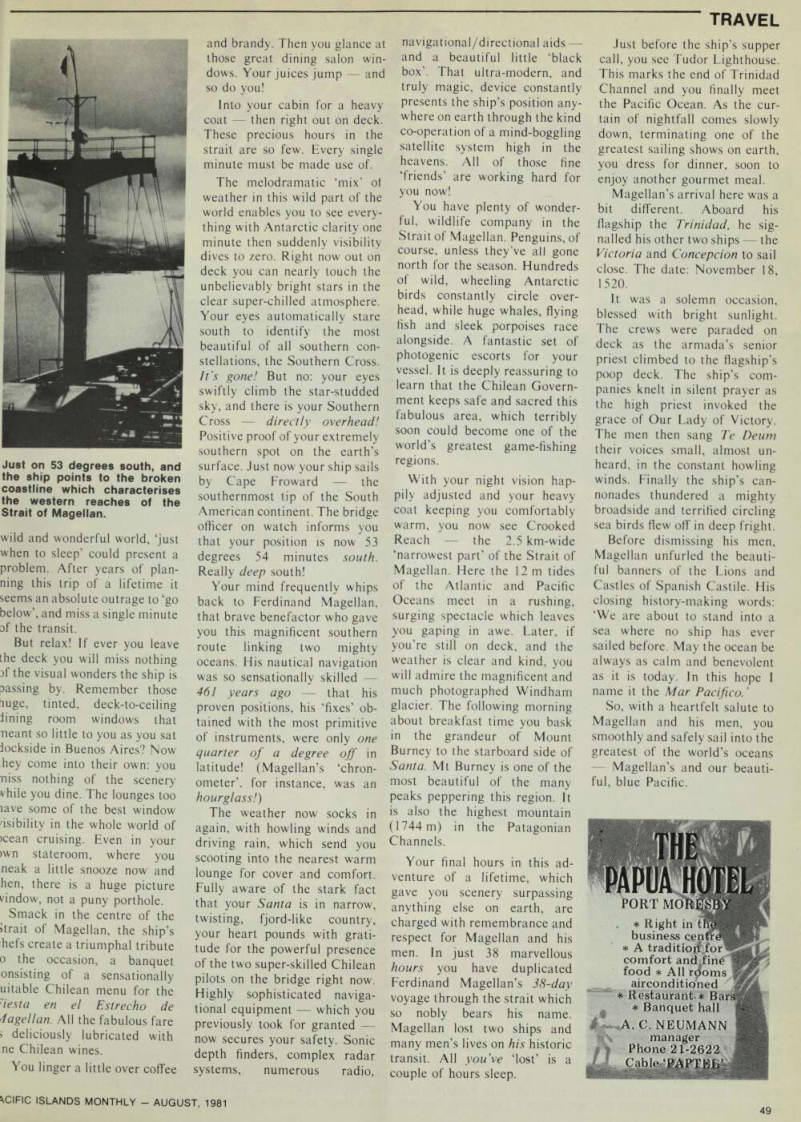
Just on 53 degrees south, and the ship points to the broken coastline which characterises the western reaches of the Strait of Magellan.