People
pp. 35-37 · Read in the full issue
Royal Fiji Military Forces Cap tain Ratu Epeli Ganilau, 29, has been awarded the Military Cross for bravery under fire in Lebanon.
Captain Ganilau was a com pany commander in Lebanon in 1979 in an area next to camps of the Palestine Liberation Organ isation (PLO).
PLO harassment reached serious proportions in August that year and in one confron tation a guerrilla commander was killer by a soldier under Captain Ganilau’s command.
Anticipating a retaliatory at tack against his platoons, Cap tain Ganilau immediately took personal command of his troops.
When the attack came he showed leadership and com mendable coolness under fire in defending threatened positions, the citation said. Because of his leadership and professional skill, the positions were de fended without casualties.
Throughout the action his intense concern for his men, his leadership and his disregard for his own safety inspired his men.
The citation summed up: ‘These personal qualities were repeatedly displayed by Cap tain Ganilau throughout the remainder of his 12 months operational service as com mander of the company.’
Captain Ganilau is a son of Fiji’s Deputy Prime Minister, Ratu Sir Penaia Ganilau.
Other members of Fiji’s UNIFIL contingent who have been honoured were: Lance- Corporal Netani Navutovuto, 24 (Queen’s Gallantry Medal); Second Lieutenant Samuela Saumatua, 33, and Warrant Officer Class 2 Kelevi Vakasavuwaqa, 34 (Mentioned in Despatches).
John Witt has been appointed manager of Solair (Solomon Islands Airways), Honiara. Mr Witt was formerly regional manager in Melbourne for the Papua New Guinea airline Air
Niugini, and had been market ing manager for that airline at head office, Port Moresby.
Earlier, he was a marketing officer with Australia’s Trans- Australia Airlines.
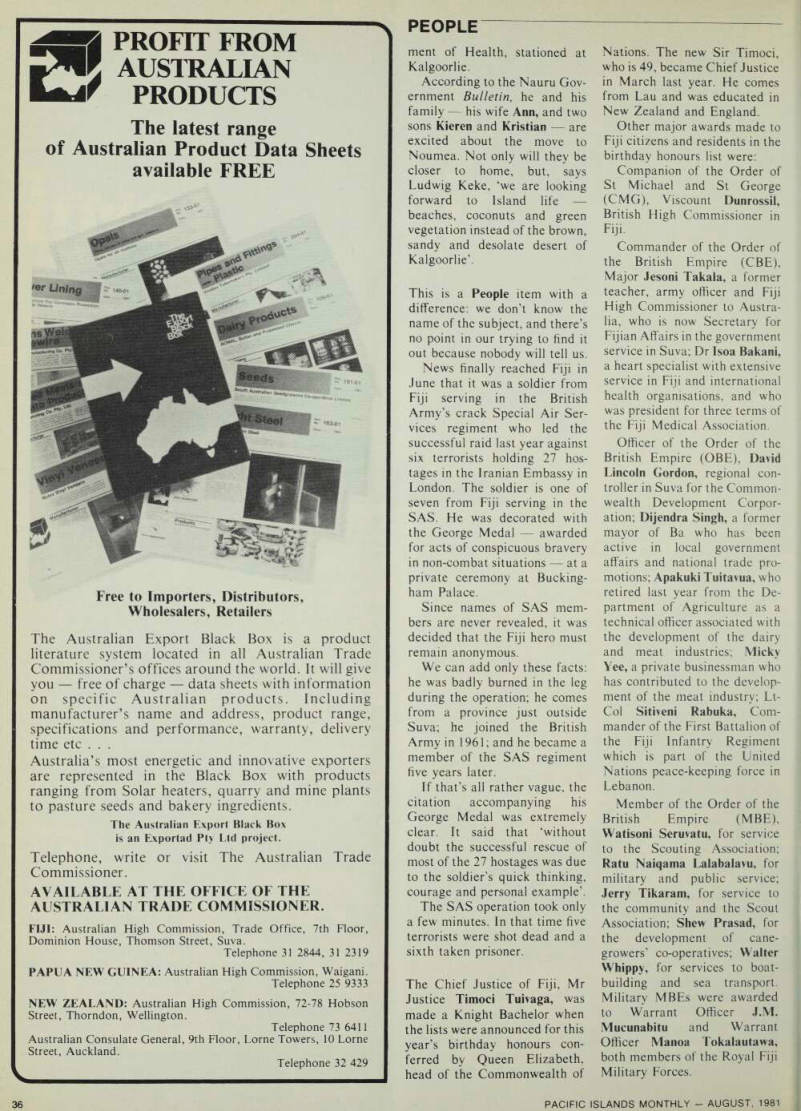
New executive secretary of the United Nations Economic and Social Commission for Asia and the Pacific (ESCAP) is Shah A. M. S. Kibria.
A former foreign secretary of Bangladesh and permanent rep resentative of that country at United Nations headquarters, Mr Kibria succeeds Indonesia’s J. P. B. Maramis.
ESCAP last year underlined its growing interest in the Pacific Island countries by for the first time establishing a Liaison Office for the Pacific in Nauru (PIM Dec 1980 p!7).
Among Mr Kibria’s first official announcements was the appointment of a diplomat educator from Fiji, Paula Sotutu, as Liaison Officer of the Nauru office.
Robert C. Kiste, Director of the Pacific Islands Studies Pro gram, University of Hawaii at Manoa, has kindly brought us up to date on the doings of former Secretary-General of
the South Pacific Commission, Dr Macu Salato.
As reported earlier (PIM Nov 1980 p4O), Dr Salato last year began a period as scholar in-residence with the Pacific Islands Study Program.
Dr Kiste takes up the story: ‘Dr Salato arrived in Honolulu on September 1, 1980. He was joined by his wife Tabua in December, and they left for home in early June, 1981. ‘During his time with us, Dr Salato co-chaired two semester length graduate seminars, gave several public talks, and served as a resource person for students and faculty engaged in Pacific research projects at the university. ‘He also gave lectures and seminars at Hilo College, Hilo, Hawaii, and Alaska Pacific University, Anchorage, Alaska. ‘During his residency in Honolulu, Dr Salato also held a position as Research Fellow with Open Grants, East-West Center, where he served in an advisory capacity for its Pacific Islands Development Project. ‘Dr Salato was also honoured by the Hawaii State Legis
lature. In March, House Resol ution 462 recognised his long service and many contributions to the peoples of the Pacific.’
The first Cook Islander to stand for election to New Zealand’s Parliament is Mrs Dorice Reid, who has won National Party endorsement for the Auckland Central seat.
Mrs Reid, 37, is the daughter of a half-French, half-Spanish father and a Cook Islands mother. She was born on Rarotonga and lived there until she was eight. At 10, she went back for the school holidays but stayed a couple of years with her grandparents. Since then she has lived in Auckland.
Jim Tully, Pacific affairs writer for the Auckland Star, wrote that Mrs Reid’s securing the nomination ‘required a good sales pitch, because she had only joined the party 14 days before and was up against three strong contenders.’.
He added: ‘Party sources say she gave an impressive candi date’s speech and that, together with her Polynesian back ground, gave her the edge.’
Auckland Central is in habited by many Maoris and Pacific Islanders. It is at present a strong Labour seat held by Richard Prebble, a European who is married to a Fijian.
But Mrs Reid, who is a senior sales executive with Air New Zealand, is up and running to start whittling his majority away.
Tully noted that she believes ‘very strongly’ that there is a case for selecting Polynesian candidates in electorates where many Polynesians live.
She said: ‘The needs of those people have got to be heard. I really am interested in Auck land Central. I grew up there.’
Nauru’s Ludwig Keke has been appointed Dental Public Health Officer with the South Pacific Commission, the first Nauruan to hold a post at the SPC.
Mr Keke holds a Bachelor of Dental Surgery from Austra lia’s Queensland University, a Diploma of Dental Surgery from the Fiji School of Medi cine, and a Diploma in Dental Public Health from the Univer sity of Otago, New Zealand.
His most recent post was that of Regional Dental Officer with the Western Australian Depart
The newly-appointed executive secretary for the Economic and Social Commission for Asia and the Pacific, Shah A.M.S. Kibria.
ment of Health, stationed at Kalgoorlie.
According to the Nauru Gov ernment Bulletin, he and his family his wife Ann, and two sons Kieren and Kristian are excited about the move to Noumea. Not only will they be closer to home, but, says Ludwig Keke, ‘we are looking forward to Island life beaches, coconuts and green vegetation instead of the brown, sandy and desolate desert of Kalgoorlie’.
This is a People item with a difference: we don’t know the name of the subject, and there’s no point in our trying to find it out because nobody will tell us.
News finally reached Fiji in June that it was a soldier from Fiji serving in the British Army’s crack Special Air Ser vices regiment who led the successful raid last year against six terrorists holding 27 hos tages in the Iranian Embassy in London. The soldier is one of seven from Fiji serving in the SAS. He was decorated with the George Medal awarded for acts of conspicuous bravery in non-combat situations at a private ceremony at Bucking ham Palace.
Since names of SAS mem bers are never revealed, it was decided that the Fiji hero must remain anonymous.
We can add only these facts: he was badly burned in the leg during the operation; he comes from a province just outside Suva; he joined the British Army in 1961; and he became a member of the SAS regiment five years later.
If that’s all rather vague, the citation accompanying his George Medal was extremely clear. It said that ‘without doubt the successful rescue of most of the 27 hostages was due to the soldier’s quick thinking, courage and personal example’.
The SAS operation took only a few minutes. In that time five terrorists were shot dead and a sixth taken prisoner.
The Chief Justice of Fiji, Mr Justice Timoci Tuivaga, was made a Knight Bachelor when the lists were announced for this year’s birthday honours con ferred by Queen Elizabeth, head of the Commonwealth of
Nations. The new Sir Timoci, who is 49, became Chief Justice in March last year. He comes from Lau and was educated in New Zealand and England.
Other major awards made to Fiji citizens and residents in the birthday honours list were: Companion of the Order of St Michael and St George (CMG), Viscount Dunrossil, British High Commissioner in Fiji.
Commander of the Order of the British Empire (CBE), Major Jesoni Takala, a former teacher, army officer and Fiji High Commissioner to Austra lia, who is now Secretary for Fijian Affairs in the government service in Suva; Dr Isoa Bakani, a heart specialist with extensive service in Fiji and international health organisations, and who was president for three terms of the Fiji Medical Association.
Officer of the Order of the British Empire (OBE), David Lincoln Gordon, regional con troller in Suva for the Common wealth Development Corpor ation; Dijendra Singh, a former mayor of Ba who has been active in local government affairs and national trade pro motions; Apakuki Tuitavua, who retired last year from the De partment of Agriculture as a technical officer associated with the development of the dairy and meat industries; Micky Yee, a private businessman who has contributed to the develop ment of the meat industry; Lt- Col Sitiveni Rabuka, Com mander of the First Battalion of the Fiji Infantry Regiment which is part of the United Nations peace-keeping force in Lebanon.
Member of the Order of the British Empire (MBE), Watisoni Seruvatu, for service to the Scouting Association; Ratu Naiqama Lalabalavu, for military and public service; Jerry Tikaram, for service to the community and the Scout Association; Shew Prasad, for the development of cane growers’ co-operatives; Walter Whippy, for services to boat building and sea transport.
Military MBEs were awarded to Warrant Officer J.M.
Mucunabitu and Warrant Officer Manoa Tokalautawa, both members of the Royal Fiji Military Forces.
As noted earlier (PIM Jun p 6), the many disappointed sup porters of former Tongan MP Mrs Papiloa Foliaki attribute her downfall in the May 1 elections to a false but highly successful whispering cam paign which painted her as solely responsible for steep and unpopular rises in bus fares last year.
In fact, the increases, to compensate for many years of sharply rising costs, were sought by all members of the Tonga Bus Association and were approved by the govern ment’s pricing authority.
Papiloa’s company, however, raised adult fares only, and continued to carry school chil dren at the totally uneconomic old rate of s <t per ride.
She also remained firm on her long-stated intention to stand or fall on the record of her first term in office and her views on national issues, and refused to take part in the traditional Tongan system of handing out vote-wooing goodies in cash or kind.
Keeping her promise to ‘abide gracefully by the voters’ decision’, Mrs Foliaki said cheerfully after the poll that she will now have more time to devote to her varied business interests, ‘but will also keep up active involvement in Tongan
political affairs and perhaps prove more useful on the out side than inside’. Penny Hodgkinson in Nukualofa.
Bernard Helgenberger, who was nominated by Federated States of Micronesia President Tosiwo Nakayama to fill the post of secretary of the Resources and Development Department of the FSM national government, has been confirmed by the FSM Congress.
Executive Director of the College of Micronesia Loren Peterson has confirmed that Mr Helgenberger will continue to serve on the College of Micronesia Board of Regents.
Harold Picton-Smith, who spent several months serving as legislative counsel to the Marshall Islands Nitijela (Par liament), returned home to Fiji in June.
Mr Picton-Smith is a former Fiji Solicitor-General.
In an appreciative farewell news item. The Marshall Islands Journal wrote: 'At 74, Picton-Smith will not go home to Fiji to sit idly around or anything like many retired people normally would do.’
It quoted Mr Picton-Smith saying: ‘l’m a busy man ... so I’m going to be involved in a lot of work.’ He mentioned in particular his interest in the law affecting labour disputes.
The Marshall Islands paper concluded: ‘As a British gentle man, Picton-Smith stands when you go in his office and extends his hand to shake yours. He also stands and extends his hand to
shake yours upon your leaving his office.’
Solomon Islands MP for East Honiara, Bartholomew Ulufa’alu, attended the 1981 May Day celebrations in Moscow as a guest of Soviet trade unions.
Representing the Solomon Islands National Union of Workers, he was one of 3000 delegates from 105 countries at the celebrations.
Mr Ulufa’alu said on his return he felt Solomon Islands could learn much from the Russian way of life.
His visit was criticised by Francis Saemala, special sec retary to Prime Minister Peter Kenilorea, and by Leni Olea, MP for Northwest Malaita.
New General Secretary of the Pacific Conference of Churches is the Rev Baiteke Nabetare. He takes over the work of Mrs Lorine Tevi, who has been PCC general secretary for five years.
Mr Nabetare, 36, is from Kiribati, and is principal of Tangintebu Theological Col lege, Tarawa, and deputy mod erator of the Kiribati Protestant Church.
Meeting in Nukualofa, Tonga, in May, the Fourth Assembly of the PCC also decided to reappoint the chair man and the treasurer for further terms of five years.
Chairman is Bishop Jabez Bryce, from Tonga. He is the Anglican Bishop of Polynesia and is based in Fiji. Treasurer is Alfred Jack. He was born in Rotuma. He has lived in Fiji for
many years and is connected with Wesley Church, Suva, where he is a lay preacher.
Harvey J. Feldman, former US Ambassador to Papua New Guinea and Solomon Islands, has returned to Washington for a new assignment. He arrived in Port Moresby in September, 1979.
Mr Feldman’s wife, Dr Laurie Sherman, who was the PNG director of the US-based Foundation for the Peoples of the South Pacific, has also returned to the US.
During her time in PNG, Dr Sherman travelled widely throughout the country study ing foundation-sponsored devel opment projects at village and district level.
Papua New Guinea is ‘a lucky country’, according to former Australian High Com missioner to PNG Gerry Nutter.
Mr Nutter, who has returned to Canberra, has been replaced in the post by Robert Birch, a career officer with 33 years experience of diplomatic work (PIM Jun p6l).
In his farewell statement, Mr Nutter said PNG’s people were ‘very sound, solid and prag matic’. The country also had a lot of resources which, if used properly, would help it build a solid economy. It was also very lucky in terms of its position in the world.
On Australia-PNG relations, Mr Nutter said the exchange of views between the two countries at prime ministerial and minis terial levels was ‘mature, frank and very constructive’.
Of the dramatic change in government in PNG last year, he said: ‘lt was as smooth a transition as you could see anywhere. I think it’s most satisfactory and very laudable that a young independent country could go through a change of government, after many years with the previous government in power, with no hiccups at all.’
Tonga has appointed its first woman principal of an all-boys secondary school. She is Miss Ana Taufe’ulungaki, 34, who is the new principal of the government-run Tonga College.
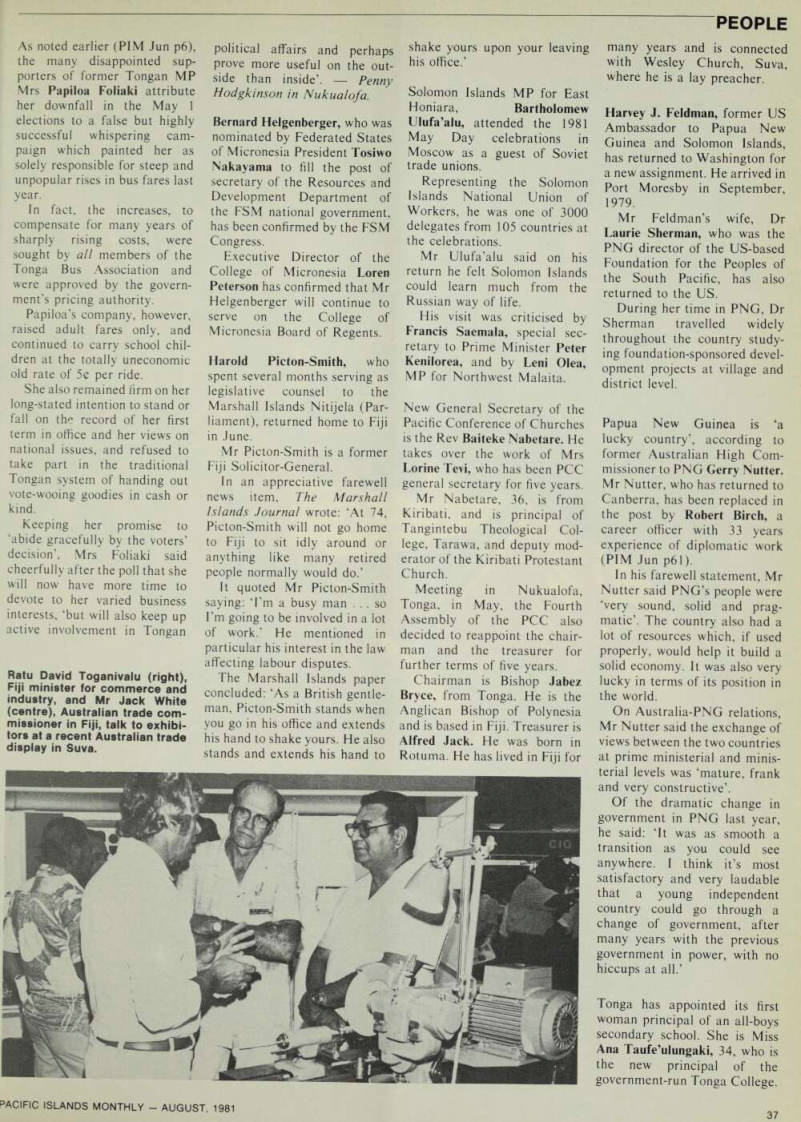
Ratu David Toganivalu (right), Fiji minister for commerce and industry, and Mr Jack White (centre), Australian trade com missioner in Fiji, talk to exhibi tors at a recent Australian trade display in Suva.