French N-policy
pp. 27-33 · Read in the full issue


Political
Currents
Senator on new French N-policy
French Socialist Party Senator Louis Perrein was in French Polynesia in June to prepare the ground for a July visit by the new Minister for Overseas Departments and Territories Henri Emmanuelli. In an inter view with the local magazine Scope, Senator Perrein dis cussed the attitude of the new French Government to the test ing of nuclear weapons at Moruroa, and to nuclear power in general. A translation of the interview follows: Scope: What’s going on at Moruroa?
Senator Perrein: The nuclear testing carried out at Moruroa is not only military in character.
True, the tests are conducted by the army, but scientists have access to the results which are then utilised in the service of ‘peaceful’ nuclear policy. In addition to the testing of weaponry, France’s indepen dence in energy matters is also being determined at Moruroa.
S: The suspension and then the resumption of nuclear testing in the Pacific gave rise in turn to relief (even for those who hide the nuclear issue behind econ omic arguments) and concern.
Did the government have time to conduct an inquiry? 5.P.: The suspension of nu dear tests allowed certain data on them to be checked. Particu ar files were studied, not the overall problem. The nuclear oroblem is a real problem, one of those which people find most oreoccupying. This is mderstandable because little is mown about it. For example, it s said that radio-activity does lot ‘go out’ like a house fire, and his is true. But objectively, vhen we look at the accidents hat have occurred studies of iccidents over a long period not
yet being possible nuclear power is no more dangerous than the railways or the coalmines. I’m not defending nuclear power, I’m simply stat ing a fact. We have a duty to take into account people’s atomic fear after all, the memory of Hiroshima is part of our common experience. But isn’t it sensible now to conduct experiments which will one day lead to the taming of the atom, if one is convinced that future generations will need another source of energy apart from oil or coal? Research must be carried forward with this goal in mind. The whole question is whether the research itself is a source of pollution.
S: If it were, what would happen?
S.P.: The tests would be stopped. This explains the de cision of the minister for de fence: he had to satisfy himself of the complete absence of any danger to the population. The conclusion drawn from the study of the files was that there was no danger.
S: These files were compiled by the former government . ..
S.P.: True, but one can only work with what is available. I am confident that the socialist ministers will study the files, and, if it is found that they do not take all aspects of the problem into account, they will correct the position, even to the extent of compiling new files.
Furthermore, people will have to come out here to examine on the spot whether it is true that the atoll is collapsing, and that the sea is radio-active a long way off the coast, etc. The government must know. While I cannot claim to be its spokes man here, I can tell you that the government is paying very close attention to this whole matter.
S: Will information on the nuclear tests now at last be made public?
S.P.: The population of Polynesia is the first interested party, so it will be informed of the government’s intentions.
Socialist policy is for a demo cratic examination of the nu clear question. So it’s the end of secrecy, except, naturally, in relation to national defence secrets. The Socialist Party intends to inform the popu lations concerned more, it intends to consult them through their elected representatives, their responsible officials, and their organisations.
Niue opens its
first consulate
Niue has opened a consular office in New Zealand. The new office, which is in Auckland, is the first to be established by Niue which is an independent country in free association with New Zealand. At the official opening of the office in June the New Zealand prime minister, Mr Robert Muldoon, spoke highly of the place which Niue was taking in the community of the Pacific under the leadership of its premier, Mr Robert Rex.
Mr Muldoon also drew atten tion to the numbers of Niueans who had become part of the New Zealand community. Re cent estimates indicate that there are now almost twice as many Niueans living in New Zealand as in Niue.
Mr Muldoon said that his visits to Niue had impressed on him the dedication and achieve ment of those who were manag ing and participating in the affairs of their Island home. He said that fluctuations in the world economy had brought inflation and exorbitant costs of imported energy. Developing countries particularly small
Pacific nations dependent on increasingly expensive trans port finks had been among the worst affected, he said. Mr Muldoon added it was fair to say that Niue’s size had posed additional problems of develop ment because the cost per head of providing basic social ser vices such as hospitals, schools and transport finks became extraordinarily high.
The size of these problems had not turned the Niue govern ment to submission, Mr Muldoon said, and in 1979 Niue had produced a development plan indicating where it was going in a changing world.
Development had been defined in terms of ‘moui monuina’ material well-being and non material well-being. Mr Muldoon said this had shown great wisdom, because too often development plans concen trated on material assets. The Niue plan had acknowledged the need for other important things, such as a strong tra ditional heritage.
The consular office estab-
fished by Niue is in the Maota Samoa building in Auckland beside the Western Samoa and
Nauru offices.
William
Gasson in Wellington.
Protesters will
travel by sea
A group of New Zealanders in Auckland is appealing to Island countries in the Pacific to help
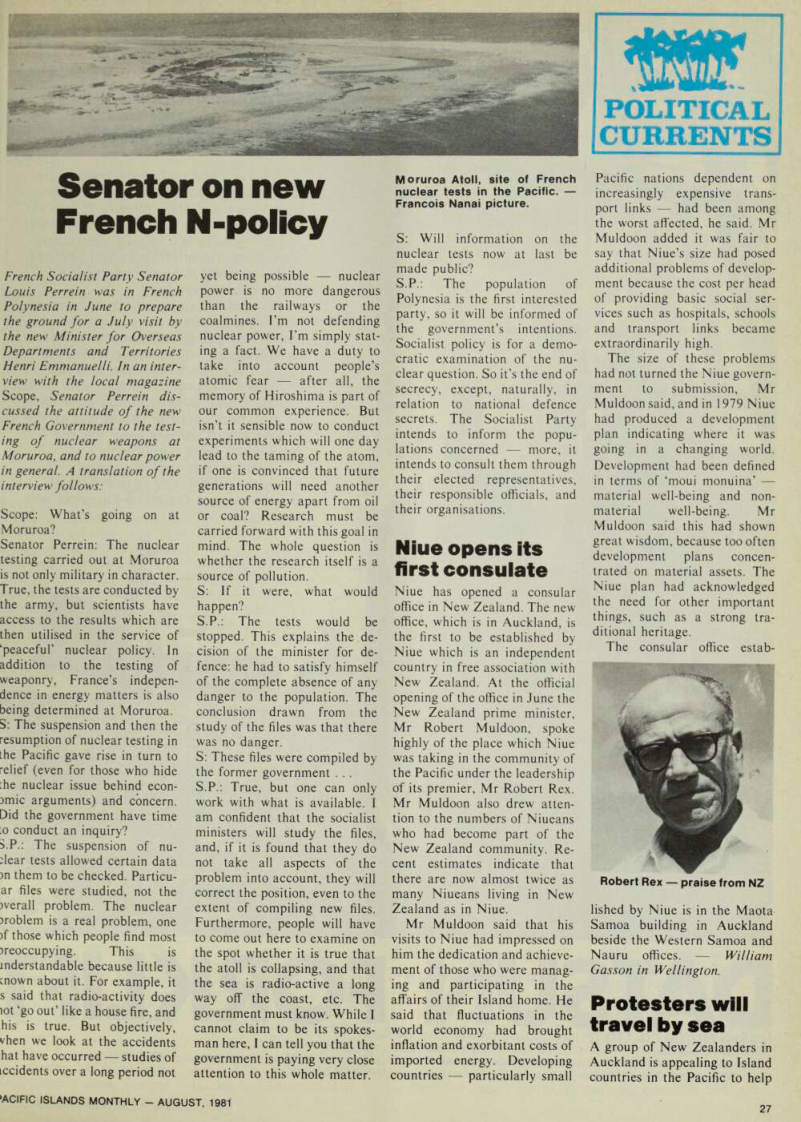
Moruroa Atoll, site of French nuclear tests in the Pacific. - Francois Nanai picture.
Robert Rex - praise from NZ
form a flotilla of boats to sail to the Soviet Union and USA in an anti-nuclear demonstration.
The New Zealanders, from Auckland, have called them selves the Home Base Pacific Pilgrimage and their object is to appeal to the super powers to ensure a nuclear-free Pacific.
One of the organisers, the Rev Dr George Armstrong, said that the seagoing pilgrimage demon stration would coincide with a United Nations special session on disarmament next year.
The Auckland group is look ing for a 13-metre ocean-going yacht to take part in the demonstration and is co ordinating its arrangements with a similar group in Austra lia called Pacific Peacemaker.
The New Zealanders believe a flotilla of boats can be brought together with help from Island countries.
The yachts will sail from the South Pacific to the Russian port of Vladivostok and to the US naval base of Bangor in Puget Sound, Seattle. The pro testers hope that their arrival in USA will coincide with the commissioning of the new Tri dent submarine Ohio.
Dr Armstrong said the move neant that people from all over ;he world ‘and not merely a Dunch of diplomats’ would be discussing the nuclear weapons Droblem and its associated problems. He said that before mailing for Vladivostok his >roup hoped to establish cordial elations with Russia. He said here was a strong peace move nent in Russia, and this encour iged him to believe that the lemonstration would have a
;ood reaction.
William
Gasson in Wellington.
io changes in
iiue ministry
'he premier of Niue, Mr Robert Rex, has appointed his abinet for a new term of the arliamentary executive. The lembership of the cabinet has ot been changed, but there ave been a number of changes i portfolios.
Premier Rex has not changed ie nine portfolios he holds, hey are finance, inland rev nue, customs and trade, trans it, administration, housing,
information services, police, and immigration.
Dr Enetama has lost the education portfolio to Mr F. F.
Lui, and has retained economic development, public works, jus tice, lands and survey, and local affairs.
Mr Lui has retained the portfolios of forestry, post office and telecommunications, tour ism, and education.
Mr Robert Rex Jnr has gained agriculture from Mr Lui, and also retains health, fisheries, and youth, sport and cultural affairs.
Bigger cabinet
for Solomons
The Solomon Islands parlia ment has passed legislation to increase the number of cabinet portfolios from 12 to 14, but the increase is not expected to be implemented until next year.
The prime minister, Mr Kenilorea, is empowered under the legislation to create and name the new ministries and to appoint the ministers.
Mr Kenilorea introduced the legislation on the grounds that his own responsibilities were excessive and were preventing him from fully co-ordinating his work with the work of other ministers.
The prime minister’s bill was criticised in parliament by the opposition. The opposition chief whip, Mr Peter Salaka, claimed the bill had been drawn up to
divert attention from the gov ernment’s ‘drift from reality’.
The deputy opposition leader, Mr Kamilo Teke, said the bill appeared to be the result of pressure from government backbenchers who wanted min isterial positions. Other criti cism came from the parliamen tary leader of the National Democratic Party, Mr Barth olomew Ulufa’alu. He claimed that in the interests of expendi ture and efficiency the number of portfolios should be reduced instead of increased.
Replying to the criticism, Mr Kenilorea said there was no motive for the bill except the need for greater efficiency. T am not afraid to say that present duties are too heavy for me, and I believe the creation of two new ministries will improve services to the country’ he told
parliament.
George
Atkin in Honiara
ANZUS line on
Pacific region
The extent to which South-East Asia is affecting the Pacific and the growth of Pacific regionalism involving the Island nations came under scrutiny in New Zealand late in June at a meeting of the ANZUS
partners Australia, New Zealand and USA.
The foreign affairs heads of the three countries, making up the ANZUS Council, held the talks in closed session and subsequently issued a com munique.
In comments arising from the talks the US Secretary of State, Mr Alexander Haig, said that the contribution which Austra lia and New Zealand were making to the Pacific region through ANZUS commitments was ‘indispensable’. Mr Haig was the US representative at the talks. Australia was rep resented by Foreign Minister Tony Street and New Zealand by Foreign Minister Brian Talboys. In a communique at the end of their meeting, all three expressed satisfaction that the South Pacific remained an area of peace and stability.
They reiterated their commit ment to continue to co-operate with the South Pacific countries in support of a common interest in a secure and peaceful en vironment.
They also agreed that effective regional institutions were important to the region’s progress and acknowledged the importance of the South Pacific Forum, the South Pacific Bu reau for Economic Co operation and the South Pacific Commission. The Council wel comed the steps taken during the past year to afford ad ditional Island governments di rect participation in the activi ties of the Forum and the Commission’, the communique said. ‘Recognising that, despite the achievements of recent years, many of the Pacific Island countries remained vul nerable because of fragile econ omies, the Council members agreed to encourage, where appropriate, public and private sector economic development through aid, trade and invest ment. ‘ln this regard the Council members welcomed the coming into effect of the South Pacific Regional Trade and Economic Cooperation Agreement in January 1981. The ANZUS partners reaffirmed their com mitment to cooperate with the governments of the Island states of the South Pacific in pursuing economic and social
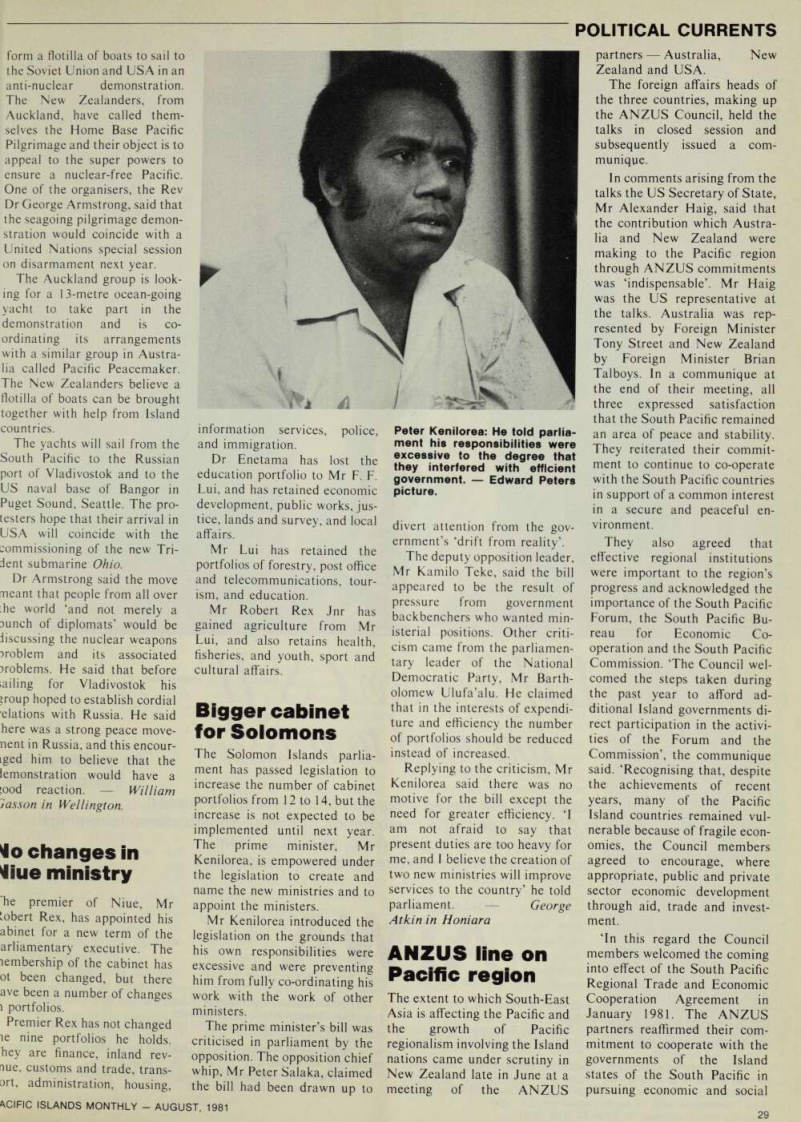
Peter Kenilorea: He told parlia ment his responsibilities were excessive to the degree that they interfered with efficient government. - Edward Peters picture.
development,’ the communique added.
On the law of the sea issue, Australia and New Zealand emphasised the importance of successfully completing the negotiations and hoped the United States would shortly be able to participate in the con cluding negotiations.
The communique added that the United States undertook to consult closely with its ‘friends and allies’ as it determined its position. Law of the sea is one of the most sensitive areas in the Pacific attitudes of ANZUS because of conflicting views between Island countries and USA over some fisheries re sources.
The ANZUS partners also welcomed Japan’s plans to ex pand its development assistance to the Pacific region, and sup ported Japan’s policy of ‘im proving its self-defence capa bility while not seeking a wider regional security role’.
Overall the talks strengthened the commitment of the partners to the important Article Four in the ANZUS treaty which reads: ‘Each party recognises that an armed attack in the Pacific area on any of the parties would be dangerous to its own peace and security and declares that it would act to meet the common danger in accordance with its consti tutional processes.’
The next ANZUS meeting will be in Canberra next
year.
William Gasson in
Wellington.
SI looking at
staff policy
Solomon Islands is investigating the possibility of streamlining its national administration by making use of ministerial staff members appointed from out side the public service. At present only one man falls into this category —Mr Francis Saemala who is special sec retary to the Prime Minister, Mr Peter Kenilorea.
Mr Saemala made an unsuc cessful attempt to enter parlia ment at recent by-elections, and then returned to the position he held with the prime minister. In June at the invitation of the Australian Government he visited the Australian Capital
Territory, New South Wales and Queensland to assess the extent to which ministerial staff were involved in state and federal administration and to determine whether some of the practices adopted were appli cable to his own country. He will report directly to Mr.
Kenilorea.
Papua New Guinea, which is the nearest neighbour of the Solomons, already has an exten sive system of using ministerial staff. This has sometimes cre ated friction with the career public service, but in general the system is working smoothly.
Mr Saemala said during his Australian visit that he believed the use of ministerial staff provided greater flexibility in national administration, but the system had to be weighed against many other factors.
While in Australia he also investigated the structure and operation of political parties.
The party system has only recently become a significant part of Solomon Island politics, but Mr Saemala said that at present it was marked by a lack of discipline and loyalty. The Solomon Island government in principle was committed to a party system, he said, and believed that the presence of too many easily-swayed inde pendents often confused parlia mentary debate on important legislation. He believed that a properly constituted and prop erly disciplined party system would enable much better long range planning for legislation programmes.
Tuvalu holding
Its elections
A controversial call for Nanumea Island to secede from Tuvalu will be one of the campaign issues when the Tuvalu general elections are held on September 8.
One of the candidates from Nanumea, Telavi Faati, is cam paigning for Nanumea indepen dence although there is no indication that he has general support. It is his second bid for election. On his first attempt he polled only 36 votes compared with 175 and 171 for the successful candidates. The call for secession is a new issue since the last elections.
Interest is centred on the re election chances of Prime Min ister Toaripi Lauti, and even if he is re-elected there is con siderable speculation on whether he will be able to form a government. Toaripi Lauti is one of the members represent ing Funafuti, the central elec torate.
For over a year now the 12-member parliament has been split six to five in Toaripi’s favour, the post of speaker being held by the other MP for Funafuti, Elia Tavita. The bal ance of power has been held by Tepepe Papau, one of the two MPs for Niutao, whose col league is the minister for com merce and natural resources, Tomu Sione. There are sugges tions that Tepepe on several occasions would have voted against the government, had it not been for the fact that the electors of Niutao instructed their members to speak with one voice. Such considerations have not bothered the voters of Vaitupu where one member, Taui Finikaso, became minister for social services and the other, Dr Tomasi Puapua, became a leading member of the unofficial opposition. Nanumea, the northernmost island, also had split representation with Maheu Naniseni as minister for works and local government, and Motufoua Feso, a one-time supporter of the government who sided with the opposition.
The man who has been lead ing the unofficial opposition is Henry Faati Naisali from Nukulaelae, and there is con siderable speculation on his
chances of re-election. In the 1977 elections he defeated by only 14 votes Isakala Paeniu who had been a minister in the original Gilbert and Ellice Islands Government. Isakala is opposing him again, and the outcome is by no means certain.
The only certainty about the Nukulaelae seat is that the successful candidate will not be a supporter of Toaripi Lauti.
Henry Naisali from Nukulaelae and Dr Puapua from Vaitupu are both seen as possible successors to the prime ministership if Toaripi Lauti fails to be elected or cannot muster support to form a gov ernment. All three men were candidates for the then position of chief minister in 1977, al though Henry Naisali withdrew before the ballot leaving Toaripi to win by eight votes to four. From a correspondent on Funafuti.
PNG’s military
chief resigns
A radio news report in Papua New Guinea late in June caused widespread interest and reac-
Toaripi Lauti: Can he survive next year’s Tuvalu election?
Brigadier-General Diro: Six years is long enough, he says.
tion with a claim that Brigadier- General Ted Diro, Commander of the PNG Defence Force, was about to resign and enter poli tics. Subsequent reports linked him with the Peoples Progress Party (the party led by the Prime Minister, Sir Julius Chan) and claimed that he hoped to become prime minis ter.
In the reaction which fol lowed Brigadier-General Diro confirmed that he had resigned but expressed anger at what he called ‘speculation’ that he in tended to stand for parliament.
He said it was an insult to suggest that while he was the head of an apolitical organis ation he had entered into politi cal dialogue with the Peoples Progress Party or any party.
Brigadier-General Diro said that he had offered his services to the government in a career capacity because he felt the time had come for a change from his present career duties as head of the defence force.
He said he had tendered his resignation in writing to the Minister for Defence, Mr Pepena. after serving in his present position for six years.
His current term has nearly two years to run.
General Diro continued ‘To suggest that I have had some dialogue with the Peoples Pro gress Party while serving in my present position is an insult to my professional integrity. It’s in the interests of the country that the defence force remain free of and above politics. I have offered to step down under pressure from some senior min isters who feel I can serve the country in another capacity. I think that six years as com mander of the defence force is enough for anybody’.
He also quoted from his letter of resignation to Mr Pepena, which said ‘After a great deal of thinking it is with sadness that I have come to the conclusion that after serving six years as commander 1 should hand over to a new man. It has been the practice within the Common wealth for heads of defence forces to stay in office for between five and six years. I think I have served enough, and should go in order not to create a bottleneck in the senior ranks of the force.’
Brigadier-General Diro is one of the most widely known and highly respected public figures in PNG. There is little doubt, according to many political leaders themselves, that he would be a powerful force if he decided to enter politics. De spite his denials there is still a strong public feeling that he intends ultimately to enter poli tics, and that his current atti tude is largely one of prudence because of the sensitivity of his position. He is 41 years old, and graduated from the Australian officer training school in Portsea, Victoria, in 1962. No date has been given for when the resignation will become effective.
Call for strong
parties in PNG
Papua New Guinea needs a strong political party system in the interests of its national administration, according to the deputy prime minister, Mr lambakey Okuk. In an inter view in Sydney with PIM re cently Mr Okuk said plainly that he considered the present structure of the parties showed lack of discipline, lack of con sistency and a general ineffectiveness. The country would be much better off if its parties were more clearly defined and more strongly man aged and if party loyalties were given a high priority in political behaviour, he said.
Mr Okuk said he planned to tighten up the structure of his own party, the National Party, which is one of a collection of
factions in the coalition govern ment of Sir Julius Chan. Look ing to next year’s general elec tions in PNG Mr Okuk said it was not outside the bounds of possibility that his own party, if properly structured and disci plined, could gain the numbers for government in its own right.
PNG has never yet had any single party with sufficient num bers to govern alone, although the now badly-fragmented United Party once came close to this goal.
Mr Okuk’s remarks about the need for a stronger party system have particular significance be cause few political leaders in PNG have ever firmly and strongly advocated political parties as a system, although they have used them as a means to an end. Even the Pangu Party which led PNG into indepen dence frequently claimed that a ‘parliament of consensus’ might be more suitable for the country than an opposition and govern ment system with political par ties. Pangu formed a party as the most expeditious way to achieve its goal of the day immediate home rule but did not always ac cept that the party system would become established as part of the national political structure.
Mr Okuk now believes that PNG is firmly committed to a party system, but that the system itself requires strength ening.
Mr Okuk also answered re cent criticism of financial man agement in government. He said that PNG was in a much
stronger position than many critics pretended. The country had suffered from world-wide factors, from ‘these depressions which come every 10 years or so’. He said that proper financial controls were still maintained and he believed the economy would take a strong upward turn in 1982.
He said he was aware that the opposition leader, Mr Somare, had spoken of possible World Bank intervention in the man agement of PNG finances, but this had been ‘political talk’ on Mr Somare’s part.
Mr Okuk also denied the presence of any significant fric tions in the coalition govern ment, including allegations of friction between himself and the prime minister. He said that ‘some compromises’ had to be made, but this was part of the operation of any coalition. ‘The main thing is that we under stand each other, and our par ties understand each other’ he said.
Mr Okuk was visiting Austra lia as part of a campaign to assure Australian businessmen of the stability of PNG and to explain its requirements for investment from Australia. (See separate report under Trade winds in this issue).
In Melbourne Mr Okuk dis cussed plans for the Common wealth heads of government meeting to be held there in October. Shown with him are (left) Mr F. W. Milne, deputy head of organisation and Mr A.
McVittie of the Royal Melbourne Exhibition Building where the government heads will meet. - AIS picture by Terry Rowe.