The politics
pp. 21-25 · Read in the full issue
Tropicalities
of the
‘vahines’
‘We’ve only really ever had one resource, one means of defend ing ourselves and that’s been our women.’
This remark, delivered with a sigh by a member of the Council of Government of French Polynesia, is quoted by French writer Jean-Claude Guillebaud in his recent book, Voyage en Oceanic (A Trip to Oceania).
First published as a series of
articles in Le Monde last year, the book is a first-rate work of journalism, and should cer tainly be translated into English.
The French Polynesian gov ernment man’s remark appears in a chapter entitled Tahiti: The Politics of the Vahines’ (Tahitian women). In it, Guillebaud poses the question; ‘By producing and fostering the simplistic idea of the “easy” vahine, wasn’t Polynesia cre ating a weapon for itself the only one available to it with which it could win some small victories over its conquerors?’
He mentions ‘the recent example’ of a senior official from Paris who at the beginning of his term caused conster nation among his subordinates, particularly the Tahitians among them, by the abruptness and harshness of his behaviour.
But, after a few weeks, he began an affair with a Tahitian girl, and his wife was plunged into misery. One evening he ordered his chauffeur to go and fetch his girlfriend for him. To his amazement the chauffeur re plied: ‘You want me to go and get her, but what for?’ He angrily told the chauffeur to be on his way and to stop asking impertinent questions. What he did not know was that the chauffeur was the father of his vahine. She had ‘somehow’ omitted to tell the Frenchman this. The father was not at all upset, but gossiped endlessly about the liaison. Soon all
Tahiti knew. They had ‘got’ the man from Paris. ‘From that moment onwards,’ writes Guillebaud, ‘the rigidities of the rule of the Republic were relax-' ed a little . ..’
He goes on: ‘I saw in this more than just an anecdote of the kind one hears by the thousand in Papeete. It was rather more of a parable, in direct line with an ancient tradition. One knows from prac tically every book on French Polynesia of the ritual “chal lenge” faced by every official gendarme, judge or postman who disembarks at Faaa airport with his European wife. Fifty vahines have eyed off the new comer, sized him up in the minutest detail, and are already in competition to seduce him ... In fact, few are able to resist such determined assaults, and it will not be long before one sees a French lady, distraught and in tears at the Faaa airport ter minal clutching a boarding pass for the next plane to Paris. In telling of this heart-rending tale, which is replayed ad infinitum, emphasis is usually placed on the charming cruelty of these child-women who seek
to prevail on their home ground over a rival from the metropolis who enjoys the advantages of matrimony. People speak of childish competitiveness, truly “feminine” reactions, tender “savagery”, etc ... I wonder if, in doing so, they are not missing the main point. Charming an official from France is never the only thing at stake in these undertakings. It is also, and above all, a matter of ruling over him, despite the fact that he has come, a cog in the wheels of the colonial system, the embodiment of an external power, to do his job of ruling over Tahiti.’
Guillebaud recalls a dinner he had in a private home in Papeete. The husband is a Frenchman from France who is slumped in his armchair. The women are Tahitian: wife, sisters-in-law, cousins. They rule the place, busying them selves around the sitting room, chatting and laughing noisily about the relative merits of their latest conquests. The tone
change of feathers In two stages: The bird of paradise emblem [?]op) which has served Air Niugini for seven years is becoming [?]ore stylised - but not without some incubation problems. Artist [?]om Cooke from the airline's head office in Port Moresby hatched [?]ut a new design (left) but when the first repainted Fokker jet was [?]elivered from contractors in Australia the new bird (right) seemed [?] have lost his aerodynamic lines. ‘He looks like he hit some [?]rbulence and has gone into a stall’ was the comment of one airline [?]fflcial. Result: Back to the paintshop, and the opening of an office [?]e to determine who pays for what happened.
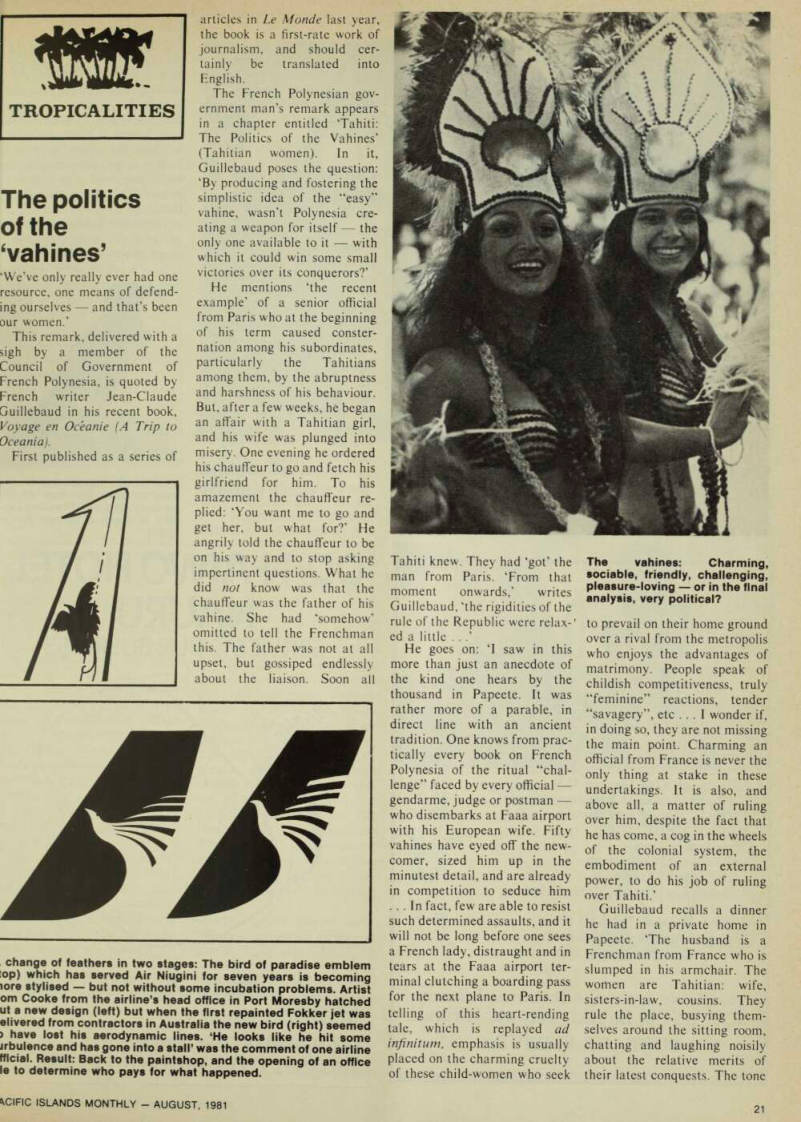
The vahines: Charming, sociable, friendly, challenging, pleasure-loving - or in the final analysis, very political?
is mildly acid about the popaa (Europeans) in general, and more hostile still in relation to the two Frenchwomen present.
I look at the husband ... Of what initial powers has he for so long now been dispossessed?
What dark defeat is he brood ing over as he stares into his whisky? One thing is certain: he doesn’t look happy.’
Guillebaud concludes: ‘Nudges and slightly lewd winks: my last hours in Tahiti were for some reason the oc casion for a welter of accounts of rather off-colour incidents. It
was as if people were trying to make sure that I would not fail to take account of them. There was the story of two senior French officers in thrall to a languid and ravishing vahine who lay on her couch counting, with her bare big toe, the medals on their ceremonial uni forms . . . Then there was the story of the president of the French Republic sitting, with out flinching, through a dance performance so overtly erotic that it scandalised his wife. Was it planned to be that way? .. .’
Guillebaud concludes: ‘Can it be denied that in her relations with the “invader” the vahine represents in the final analysis a very political person? . . . The white man came to Tahiti to establish his order, his morality, and his trading activities. He fought sometimes with can non fire all the weaknesses of the “native” which were incom patible with civilisation. Love of pleasure and gambling, lazi ness, indifference to all lofty sentiments .. . fickleness of heart. But the very things that aroused his ire in the men
fascinated him in the women.
To the point that white men came flocking from everywhere for a furtive taste of this intolerable “barbarism”. And
drowned in it.’
Malcolm
Salmon.
Cooks’ minahs
live on!
The Cook Islands Ministry of Agriculture earlier this year wound up a 12-month campaign to exterminate the minah bird, guilty of inflicting extensive damage on the country’s fruit and vegetable crops. The results were disappointing, to say the least.
Whereas the ministry had earmarked $5OOO to pay the bounties of 10c for a dead minah bird and 5c for an egg, it had to spend only $7.45 of the amount for the 74 dead minahs and one egg produced by the campaign. Largest number of dead birds brought in at any one time was 35 and that hap pened on the last day of the ministry’s financial year.
A spokesman for the ministry
said: ‘We don’t know the reasons why the campaign met with such little support, con sidering how much damage minahs do to crops. It seems that people are reluctant to kill even minahs. Others probably felt that the bounty of 10c a head was too low, bearing in mind how hard it is to catch minahs.’ (Maybe he had a point there.) The ministry has no immedi ate plans for a renewed cam paign against minahs.
The minah, introduced to the Pacific about the turn of the century, and now breeding rap idly in areas of human settle ment.
High adventure
at Salamumu
It hasn’t been all public service strike in Western Samoa in recent limes. It is a pleasure to report that other events, only apparently grim and momen tous, have been going on as well.
The Samoa Times reported in June: For the last seven weeks at Salamumu village on the south coast of Upolu, there has been a lot of action; three shipwrecked boys, one 12 years, struggle ashore from a wooden raft; ugly-looking pirates and fierce natives engage in a bloody war; a dynamite explosion de stroys the village idol; a wicked village chief is liquidated; and the honour of a village maiden is upheld.
These and many other actions are part of the movie Coral Island being filmed at Salamumu village by a tele vision crew from the Australian Broadcasting Commission and Thames Television of London.
The film, five hours long after editing, is to be shown on Australian and European tele vision next year in a 10-episode series. It is based on a novel by adventure writer R.M.
Ballantyne.
Lead local roles are being taken by Pele Rankin, who plays the village maiden, and Uelese Petaia, star of Sons for The Return Home, who plays the wicked village chief.
The three young castaways are played by Nicholas Bond Own, 12, and Richard Gibson from England, and Scott MacGregor from Australia.
Both Gibson and MacGregor are described to be in their twenties.
Three of Australia’s leading actors play the three speaking parts of the pirates.
But without the people of Salamumu village, the movie •vould have amounted to nothi ng. Some of the Salamumu people play lead roles, the rest slay extras, for instance in the :>attle scenes, and in the danc ng and singing ones. ‘The people of Salamumu are riarvellous,’ says producer lirector Ray Alehin. ‘They have given us every issistance possible including he construction of the village 'or the movie.’
Inside Taim
Bilong Mas
Daniel Connell, writer of the item below, is associate pro ducer of the Australian Broad casting Commission’s am bitious radio series, Taim Bilong Masta, which examines the part played by Australians in the history of Papua New Guinea. Earlier, Mr Connell spent a number of years in PNG working in the radio edu cational services operated by the ABC and, after indepen dence in 1975, by PNG’s National Broadcasting Com mission.
Like many others, when I re turned from Papua New Guinea, I felt bored and nostal gic. Part of my solution was to become involved, with Tim Bowden, in the Australian Broadcasting Commission’s epic radio series, Taim Bilong Masta, which is being broad cast in three parts throughout 1981.
TBM is the largest social history documentary series ever produced by the ABC. Its central theme is the lives led by Australians in PNG before in dependence. It covers groups like kiaps, missionaries, miners, medicos, planters, and exam ines the particular problems faced by women and children.
It also deals with the Chinese
community and the mixed-race community. It deals with issues like cargo cults, the legal sys tem and labour relations, and particular events, such as World War 11, the push into the Highlands, volcanic eruptions, and the advent of indepen dence.
The first programme looked at Papua, and in it appeared some of the themes which are basic to the whole series: the harshness and isolation of the life, the enormous satisfaction that came from doing the clear cut, dramatic tasks of early colonisation, and the appropri ateness, or otherwise, of Austra lia’s policies. Initially, the
Lieutenant-Governor and Ad ministrator of Papua, Sir Hubert Murray, appeared far ahead of his time in his atti tudes. But it is the opinion of Dr Hank Nelson, expressed in this programme, that in the end he
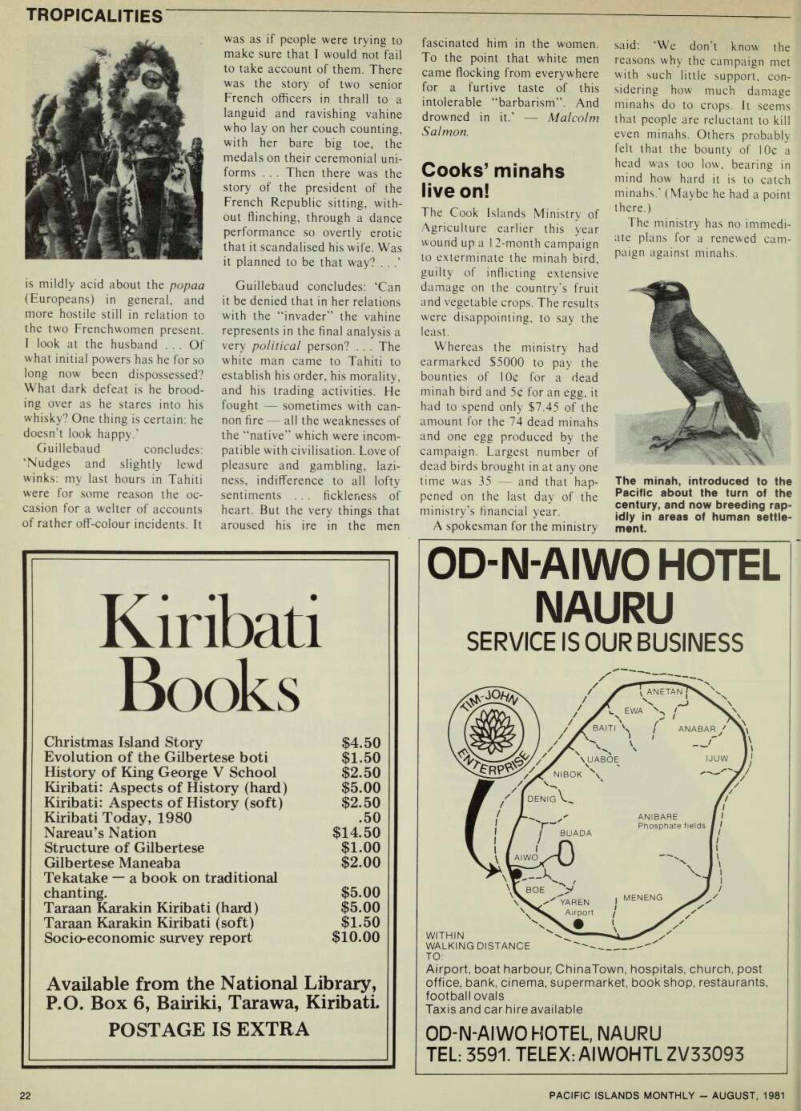
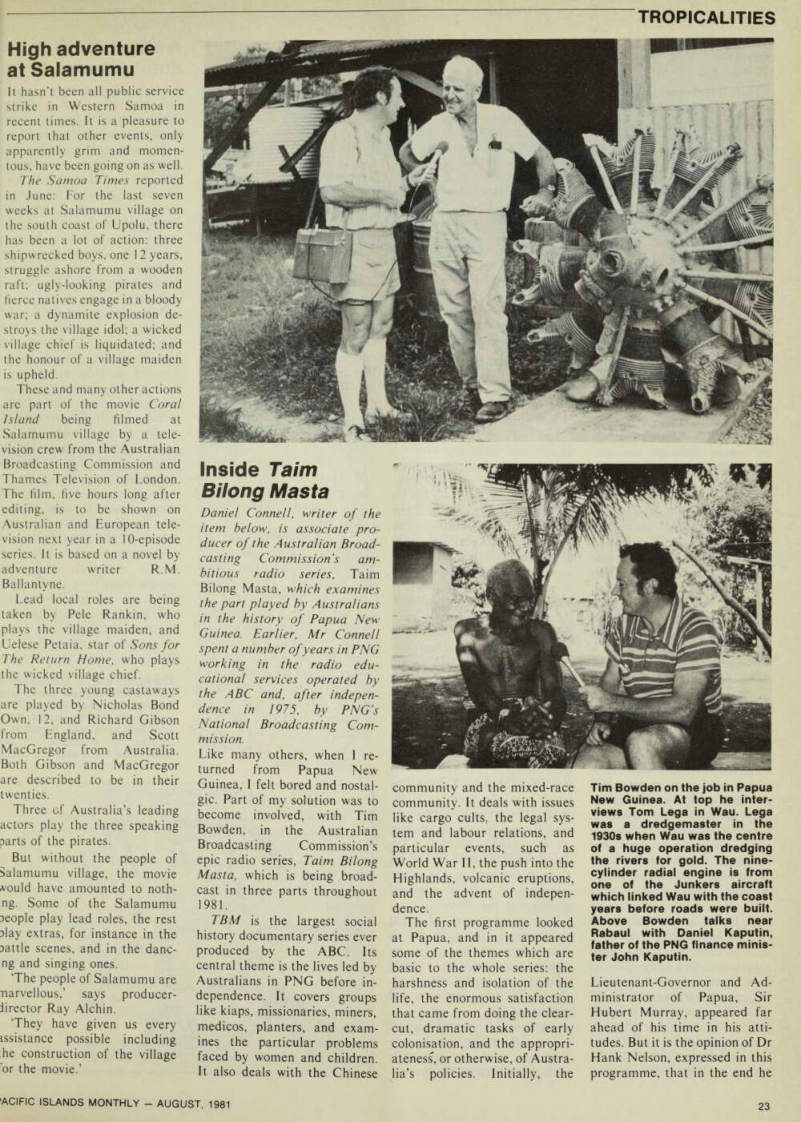
Tim Bowden on the job in Papua New Guinea. At top he inter views Tom Lega in Wau. Lega was a dredgemaster in the 1930s when Wau was the centre
of a huge operation dredging
the rivers for gold. The nine cylinder radial engine is from one of the Junkers aircraft which linked Wau with the coast years before roads were built.
Above Bowden talks near Rabaul with Daniel Kaputin, father of the PNG finance minis ter John Kaputin.
held back Papuan development. (Sir Hubert held office from 1908 to 1940.) This raised the issue that faces all of us who have been involved in PNG’s recent his tory: were we good colonials?
Most people interviewed by us felt that the answer was yes.
One of the most controversial subjects discussed in the first series was that of plantations.
We found that many plantation managers lived on the edge of poverty, squeezed by the large trading companies, far from other Australians and sur rounded by a frequently dissatisfied labour force. A number of people interviewed frankly conceded that in their cases labour relations had an edge of violence to them. But a few spoke of intimate, harmoni ous relations with the labour force, and of a manorial kind of existence. There were enormous differences between the pic tures presented by various for mer planters.
Former District Com missioner David Marsh felt that labour recruiting sometimes caused serious disruption to village life. But former planter Cliff Batt thought plantations such as his were a good training ground for the modern world.
So far we have had two criticisms of the series. It is said by some that we should intro duce each speaker by name, and that there should be more comment from Papua New Guineans. One listener said that her family spent so much time trying to identify speakers that they often missed what was being said. Before we started, we decided not to introduce everybody because the intro ductions would slow down the flow of the programme. The first programme, for example, has 33 speakers, some of whom are heard more than once. It must be said, however, that we are now introducing more people than before, particularly when they make a lengthy comment, or when their name gives added significance to a story.
With regard to the balance between Australian and Papua New Guinean voices, it is im portant to remember that the series is about Australians, and does not attempt to be a general history of PNG. However, we
have used Papua New Guinean comment at key points, particu larly where conflict is involved.
Basically, we feel that the material speaks for itself.
The second series of TBM covered the great volcanic erup tions at Rabaul and Higaturu, gold-mining, women and chil dren, the opening of the High lands, and first contact.
People living in Australia have never experienced civilian disasters on the scale of the eruptions of 1937 and 1951 in PNG. The destruction of Rabaul in 1937 involved many hundreds of deaths, and the Mt Lamington eruption in 1951 killed nearly 4000. As in all programmes, we have used ma terial recorded with those in volved. Their recollections are thoroughly harrowing. Medico Bert Speer compared the scene at Higaturu to Hiroshima.
The story of the Australian women and children, with its descriptions of sickness, iso lation, growing up, and sub sequent alienation from life in Australia, contains some of the most poignant moments in the series. It was occasionally said to us that the arrival of white women brought social rigidity to race relations. But others stressed that their presence, particularly in isolated out posts, usually gave rise to a richer social interaction be tween Australians and Papua New Guineans.
The second series also in cluded the great saga of the last major exploration by Europeans. In the first of two programmes we hear the Cham pion brothers, Ivan and Claude, describe their push from the south into the Central High lands. The second programme, which describes the adventures of the Leahy brothers, Jim Taylor and John Black coming in from the east, makes exten sive use of archival material recorded in the 19605.
The third series of eight programmes, going to air in November, covers race re lations, missionaries, World War 11, cargo culls and magic, the legal system, medicine, and independence.
At time of writing, we are still working on these pro grammes, so I can only write with the raw materials in mind.
Race relations is a theme which has run through all the programmes. Some Australians interviewed looked at their past rather ruefully, and described incidents which, as they were aware, told against themselves.
But the general feeling was that despite things like the White Women’s Protection Ordinance in Papua, Australians did better than other colonial powers such as Britain, France and Belgium.
In retrospect, most of the Australians and Papua New Guineans whom we interviewed regarded the transition to inde pendence as a great Australian achievement.
John Waiko, a Papua New Guinean PhD student at the Australian National University, thought that his people got what he called ‘a briefcase indepen dence’, a strange neat package which they were only able to open after Australia left. In directly, this view is supported by Professor Charles Rowley and others who feel that in its public service PNG received a white elephant which is break ing its back.
We interviewed more than 200 people in PNG and in every State in Australia, except West ern Australia. The complete interviews have all been de posited in the ABC’s archives.
When we phoned people and asked to record the story of their life in PNG, we were aware that we were asking a lot.
We well understood the feeling of the man who said to Tim Bowden: ‘Make sure you tell it properly, because for many of us the memory’s all we’ve got.’
Daniel Connell.
A silent 300th
anniversary
Australia, Papua New Guinea and Antarctica had a 300th anniversary on July 15 and hardly anyone was aware of it.
The anniversary marked the founding in Rome on July 15, 1681, of a mission called Pre fecture Apolostic of Terra Australis Latin for ‘Austra lian Land’, or ‘South Land’, an area embracing modern Austra lia, PNG, Irian Jaya and Antarctica, which were be lieved at the time to be a single continent.
Nine cardinals of the Sacred Congregation for the Evangelisation of Nations, a branch of the Roman Curia founded in 1622 to supervise and direct Roman Catholic missionary work around the world, created this mission and made a 60-year-old Italian Dominican priest, Father Victorio Riccio, OP, its Prefect Apostolic.
Fr Riccio at the time was attached to St Dominic Monas tery in Manila. He had pro posed the mission on the basis of interviews he had had with Dutch explorers, and with people brought to Manila from Terra Australis on Dutch ships.
When submitting his project to church authorities in Rome by letter of June 4, 1676, Fr Riccio volunteered to enter
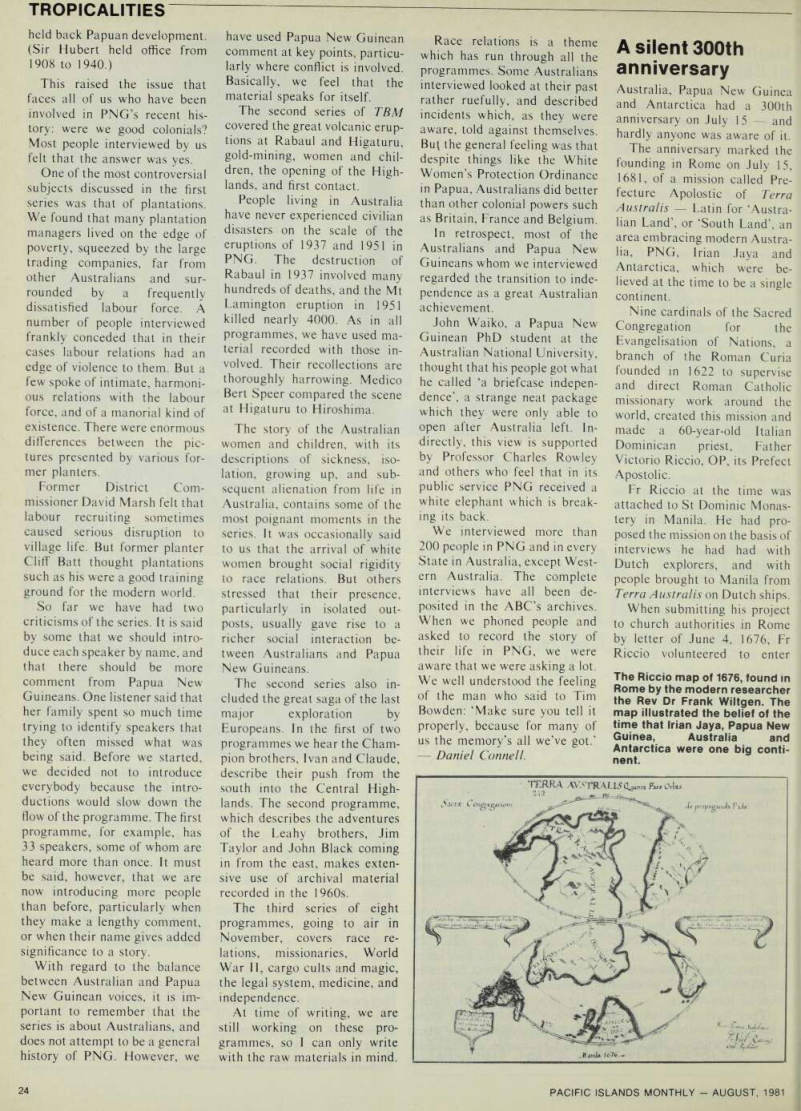
The Riccio map of 1676, found in Rome by the modern researcher the Rev Dr Frank Wiltgen. The map illustrated the belief of the time that Irian Jaya, Papua New Guinea, Australia and Antarctica were one big conti nent.
Terra Australis and begin mission work there with the help of Franciscan priests who had agreed to accompany him from Manila.
To make sure that the cardi nals in Rome would be aware of the location, size and conse quent importance of Terra Australis, Fr Riccio enclosed with his letter a map drawn by hand in colour measuring 30 X 40 cm with many captions in Latin.
Like his letter the map was dated 1676. This was 94 years before Captain James Cook explored the east coast of Aus tralia, 100 years before the American colonies formally de clared their political indepen dence from Great Britain, and 112 years before the British flag was raised over the first European settlement in Austra lia.
A Spanish galleon carried Fr Riccio’s proposal from Manila across the Pacific to Acapulco on Mexico’s west coast. From there it went overland through Mexico City to Veracruz on Mexico’s east coast. Here it was placed aboard another Spanish galleon for the voyage across the Atlantic to Spain.
By the time Fr Riccio’s letter reached Rome five years had elapsed, causing Cardinal Pre fect Paluzio Altieri of the Evangelisation Congregation to make it the first item on the agenda for the General Meeting of July 15, 1681.
The secretary, Archbishop Edoardo Cibo, summarised Fr Riccio’s four-page Spanish let ter for the nine cardinals pres ent, telling them that Terra Australis was so vast ‘that one :an walk through it for more han two years without ever ieeing the sea’, that it was considered to be ‘the fifth pan )f the world', that ‘it has been inknown until now’, and that it contained ‘innumerable king loms and nations’.
The cardinals not only cre ited the Prefecture Apostolic of Terra Australis, as Fr Riccio md wished, but also placed him n charge as Prefect Apostolic md ruled that he was to receive ill ‘opportune faculties’ for his lew task.
But Fr Riccio may never lave learned of his appointment o Terra Australis. If Rome’s
letter to him was en route as long as his letter to Rome, it would have arrived in Manila in 1686. But Fr Riccio died in Manila on February 17, 1685 at the age of 64.
Information on Fr Riccio’s proposal and on the action taken by Rome came to light in a book published in Canberra in December 1979 by the Austra lian National University Press, and now in its second printing.
The 610-page work was re searched and written by Chicago-born Rev Dr Ralph M.
Wiltgen, a priest of the Divine Word Society who lives in Rome, and is called The Found ing of the Roman Catholic Church in Oceania, 1825 to 1850 (reviewed PIM Aug 1980 pl 33).
The book contains facsimiles of Fr Riccio’s map and letter, and also of the minutes of the meeting attended by the nine cardinals. These documents were all discovered by re searcher Wiltgen in two of the more than 4000 volumes of archive material preserved by the Evangelisation Congre gation at its headquarters in Rome.
Fr Wiltgen believes it is unlikely that Fr Riccio ever reached Terra Australis, al though he concedes that ar chive material may still be found in Manila, Spain or Rome to disprove this. ‘What is definite,’ the priest historian said, ‘is that the cardi nals in Rome recognised Fr Riccio’s vision and acted upon it without delay.’ ‘By creating the Prefecture Apostolic of Terra Australis in 1681.' he said, ‘and by preserv ing all documentation related to it, the cardinals have made it necessary for today’s historians to write new pages for inclusion
in their histories of Australia, Papua New Guinea and Antarctica.’
Seaplane gives
up its secret
A World War II US seaplane was found in June in about 18 m of water off Majuro, Marshall Islands, by Matt Holly, the local diving instructor, and his class.
The plane, a Martin PBM-3 Mariner, had apparently crashed, flipped over and sunk not far from the Eastern Gate way Hotel area, in which a seaplane landing ramp was lo cated during the war.
The plane is in poor con dition, with the engines and many other parts torn off.
An identification plate was recovered with the serial num ber 1212-B.
Mr Holly is not revealing the exact site until he has enough pictures for ‘history’. He hopes it will remain unmolested for all to view.
He is also checking the serial number with authorities, as he feels ‘somebody died when it hit’.
New deal for
Samoa’s blind?
Western Samoa’s troubled As sociation of the Blind now appears to have reverted to Association for the Blind with the recent election of four sighted major office holders.
Elected at the April AGM as president was Chief Justice R.
St John, while the other three executive positions also went to foreigners currently resident in Western Samoa.
Former president and foun der, Roderick (Liki) Crichton,
was chosen as one of the three council members. The other two councillors are also Samoan.
However, in the seven top positions. Mr Crichton is the only blind person.
Mr Crichton founded the Association of the Blind in the mid-19605. The aim was to have blind persons conducting all their own affairs. Increasing difficulties in administration and finance forced Mr Crichton’s first resignation, and a sighted medical man took over, Dr Asi Faletoese.
Disillusionment on the part of blind persons led to a vigorous campaign by the Observer newspaper to ascertain where funds for the association had gone. Mr Crichton’s own paper, Samoa Weekly also asked perti nent questions on the subject.
Alafumuo School for the Blind closed down, and soon after wards, in early 1980. Mr Crichton was re-elected presi dent. The school was reopened last year.
The Samoa Weekly, issue of May 1, 1981, commented on the 1981 AGM: ‘The Western Samoan Association of the Blind whose past financial man agement has been subject to criticism, has made some dras tic changes in the composition of its executive committee . . .
The new president intimated that he wishes the council to meet ... to consider ways and means to improve the associ ation’s facilities and financial position.’ -- W. Sharpe-Dunn.
A Martin Mariner of the type discovered on the seabed off Majuro. This picture, taken nearly 40 years ago, shows a Mariner of the Royal Australian Air Force. Australian and US crews used Mariners in World War II as transport links with Pacific Island outposts which did not have landplane access.