Polynesia
pp. 18-19 · Read in the full issue
votes - yet again
We wrote last month (PIM Jul plO) about a few of the absurdities inherent in the old-fashioned colonial rule still practised in what are known as France’s overseas territories.
Another good or bad example of the same kind of thing came in June, barely a month after the events we described, when President Mitterrand called new general elections in the hope that the popular groundswell of support he enjoyed in the presidential election would deliver to his party the majority in the National Assembly required to carry out his mildly socialistic programme of reforms. As is now common knowledge, he succeeded beyond his wildest dreams, capturing 112 seats from the Gaullist and Giscardian parties to give his party an absolute majority in parliament.
So far so good. But this meant that French Polynesia too had to go through the turmoil of yet another pointless election. The plain fact is that however knowledgeable, skilled and clever the two local deputies who represent the territory in Paris may be, they are up against an impossible system which doesn’t give them a chance. For even if they work in harmony with the other 13 overseas deputies (which is seldom the case), they can achieve nothing in an assembly of 491, dominated by the 476 metropolitan deputies, who have totally different problems and preoccupations. Generally speaking, therefore, the overseas deputies have the good sense to keep away from Paris most of the time, and make the trip only when they can act like ambassadors, and engage in direct talks with the French president, cabinet ministers and high government officials.
Mitterrand has promised to undertake administrative reforms with a view to transferring considerable powers to the provinces and overseas territories, and the government that has just been sworn in therefore includes a ‘minister for decentralisation’ who is none other than Gaston Defferre, one of the two authors of the famous 1956 decolonisation bill which put France’s
African colonies on the road to independence. Incidentally, the other prime mover was the then Minister for Justice Francis Mitterrand. But, naturally, no changes could be introduced in the brief time between the presidential and the parliamentary elections. The latter, therefore, took place in accordance with the same archaic rules as in 1978. This meant among other things that the incumbent Gaullist deputy, Gaston Flosse, enjoyed the advantage of running again in a constituency that had been tailor-made for him by the previous Gaullist majority in the French parliament. The job was easily done by limiting the constituency to an area containing 26 000 voters who are overwhelmingly Catholic (and therefore Gaullist), and throwing together the remaining 52 000 voters (mainly Protestants and Autonomists) to form the second constituency.
The only significant departure from previous practice in the 1981 parliamentary elections was the sudden decision of the new Minister for Overseas Departments and Territories Henri Emmanuelli to allow the candidates campaign time on radio and TV. This probably doesn’t sound terribly revolutionary to most citizens of democratic countries, but in Tahiti, where the French Government has always banned its political opponents from the strictly controlled and censored mass media, it was a most welcome breath of fresh air.
Those who grasped most eagerly this wonderful opportunity to make themselves heard effectively throughout the territory were the leaders of the small pro-independence parties, who in the past have always been hampered by lack of funds to travel to the outer islands as the candidates of the big parties were able to do quite regularly.
At close of nominations, no fewer than eight candidates favouring complete independence had entered the lists.
Needless to say, they were all also opposed to the continuation of nuclear tests in French Polynesia.
They could hardly believe their ears when they were told they could each speak for seven minutes, and in Tahitian at that. To appreciate fully this radical change in government policies it should be recalled that not long ago, during Giscard d’Estaing’s visit to Tahiti, several of these same candidates were thrown into gaol, for the sole reason that they tried to unfurl a protest banner in his presence (PIM Nov 1979 p 22).
All seemed set for the smooth re-election of the incumbent deputies, Flosse in the Eastern constituency and Jean Juventin in the Western. Then one of the latter’s allies, Emile Vernaudon, secretary-general of Francis Sanford’s Ea api party, suddenly announced his own candidacy. Vernaudon’s greatest achieve ment so far is to have dressed up the policemen in the township of Mahine (where he is the elected mayor) as American sheriffs, and to launch them on a ruthless campaign to stamp out crime.
True, most of his municipal electorate applauded this, but it seemed far from certain that his strictly local fame as an upholder of law and order would help him much in an island wide election. The one to benefit most from this unwanted rivalry in the Autonomist camp was the Gaullist candidate Alexandre Leontieff who began his brilliant career as a government economist (he holds a doctor’s degree from a
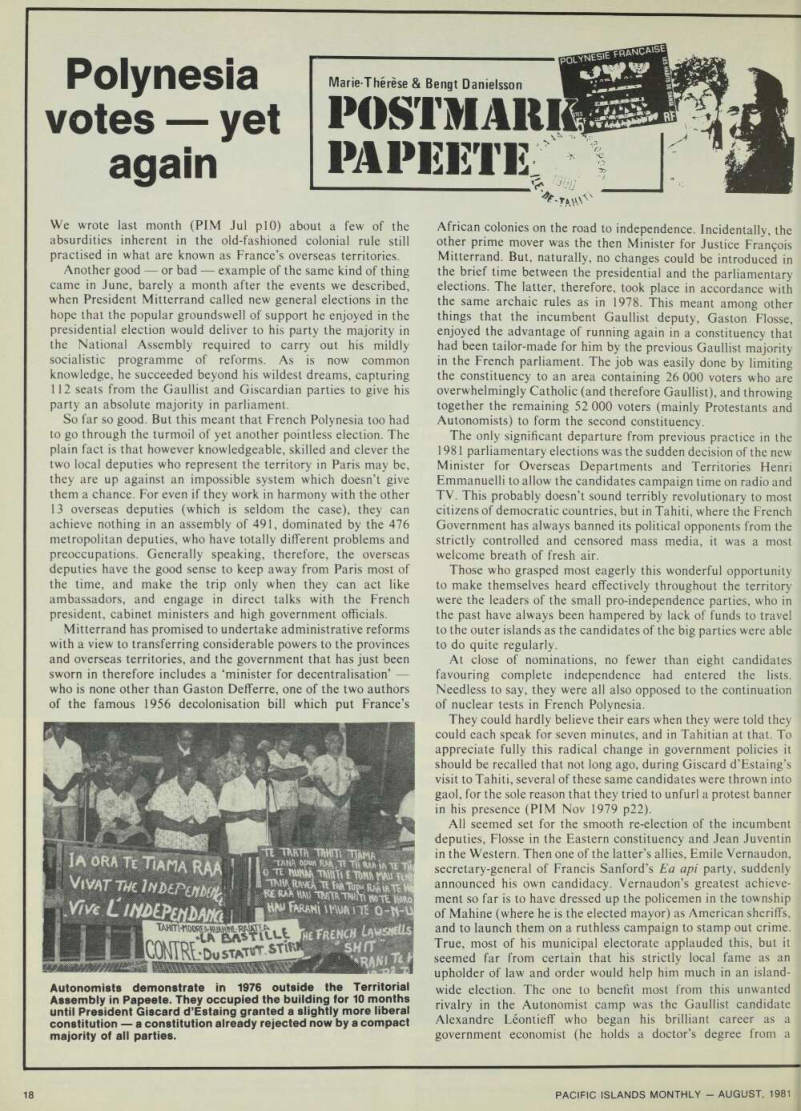
Autonomists demonstrate in 1976 outside the Territorial Assembly in Papeete. They occupied the building for 10 months until President Giscard d’Estaing granted a slightly more liberal constitution - a constitution already rejected now by a compact majority of all parties.
French university), but recently accepted a job as chief executive of Jean Breaud’s octopus-like commercial empire.
When the results were in on June 21, it became even more clear how thoughtless and selfish ‘Sheriff Vernaudon had been.
While he collected no more than 16% of the votes, he succeeded in reducing Juventin’s tally to 28%. (It was 52% in the previous general elections in 1978.) Leontieff got 25%, which left him and Juventin as sole contenders in the second round on July 5.
In the event, little damage was done: a few days after the first round on June 21, the No 1 local politician, Francis Sanford, came to Juventin’s rescue. His earnest entreaties for a closing of ranks in his own Ea api party eventually secured the re-election of the Autonomist candidate on July 5: Juventin 51.5%, Leontieff 48.5%.
In the Eastern constituency, for the reasons already outlined, Gaston Flosse had an easy first-round win with a 56% vote.
Let us only add that the numerous abstentions, which in both constituencies exceeded 40% of the voters, were undoubtedly due to a general ‘battle fatigue’ after two full months of political campaigning.
But the most interesting aspect of these elections, in our opinion, is not that they were repeat performances of past events within a petrified framework which is doomed soon to disappear.
It is the new trends which were discernible in them, and which are pointers to the future.
In the first place, there was a noticeable increase in the number of votes for pro-independence candidates. In the Western constituency, their combined percentage was 20.41%, whereas it was 19.77% in the Eastern. (One cannot resist the temptation here to recall the contemptuous remark made only i few months ago by Paul Dijoud, Giscard d’Estaing’s overseas ;erritories minister [PIM May piB] to the effect that the only ndividuals in French Polynesia in favour of independence were t few douloureux debiles ‘miserable fools’.) The biggest pro ndependence vote-getters were, not unexpectedly, the la mana e nunaa candidates, Jacques Drollet and Peni Atger. This party s now the best organised and most disciplined party in all French Polynesia. Its socialist reform programme, with a strong emphasis on social justice, greatly appeals to young Polynesians, t should be noted that la mana te nunaa is not a local branch )f the French Socialist Party, but entirely independent of it. It icither asks for nor receives help or backing from ‘big brother’ n Paris. This only makes its recent successes the more emarkable.
The second trend is the rapid radicalisation not only of the old Autonomist parties of John Teariki (Pupu here aia), and Francis Sanford (Ea api), but also of Gaston Flosse’s Tahoeraa ■iuiraatira party. All are now strongly in favour of full internal elf-government on the Cook Islands model, with an elected ninisterial government. In the local context this means that heir parties are closer than ever to a pro-independence position.
Most telling in this connection is the pathetically low vote ttracted by the one candidate who expressed himself satisfied vith the present form of government, Maco Tevane, who a few nonths ago broke with his Autonomist allies and formed his own iocial-Democratic Party. Although he is a fine orator in ahitian, and a prominent member of the Government Council where he is in charge of public health and cultural affairs), 'evane’s platform appealed to no more than 3.9% of the voters i the Western constituency. It is quite revealing of the nature f the present set-up that it is this highly unrepresentative olitician who for years has represented France and Polynesia t all South Pacific Commission meetings, UNESCO seminars, nd other international conferences and festivals held in the 'acific Islands.
It is also not without interest to note that the smallest vote of ny candidate was obtained by Marcel Manuel, the only person
seeking election who proclaimed himself a Giscardien, announcing that he was in total agreement with all the policies of the former president. He got 75 of the 15 058 votes cast in the Eastern constituency. Since Giscard d’Estaing secured 37 414 votes (76%) in French Polynesia in the presidential elections, this is quite a comedown.
It seems therefore that we can safely repeat what we said last month; Giscard’s local victory must not be seen as an approval of him and his reactionary policies. It was, rather, a splendid display of the strong determination of those in control of the local political machinery to vote for any candidate they care to designate.
A similar turn-around has by now taken place in practically
all other French overseas departments and territories.
Marie-
Therese and Bengt Danielsso.
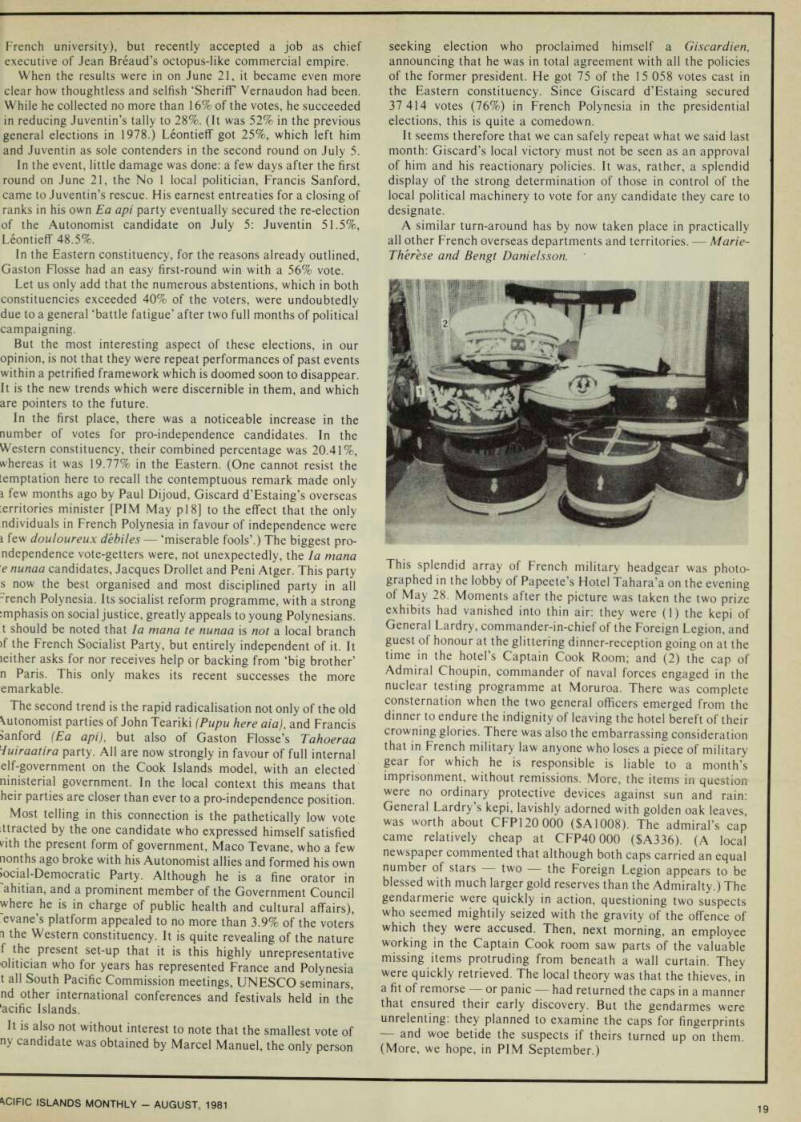
This splendid array of French military headgear was photo graphed in the lobby of Papeete’s Hotel Tahara’a on the evening of May 28. Moments after the picture was taken the two prize exhibits had vanished into thin air: they were (1) the kepi of General Lardry, commander-in-chief of the Foreign Legion, and guest of honour at the glittering dinner-reception going on at the time in the hotel’s Captain Cook Room; and (2) the cap of Admiral Choupin, commander of naval forces engaged in the nuclear testing programme at Moruroa. There was complete consternation when the two general officers emerged from the dinner to endure the indignity of leaving the hotel bereft of their crowning glories. There was also the embarrassing consideration that in French military law anyone who loses a piece of military gear for which he is responsible is liable to a month’s imprisonment, without remissions. More, the items in question were no ordinary protective devices against sun and rain: General Lardry’s kepi, lavishly adorned with golden oak leaves, was worth about CFPI2O 000 (SA1008). The admiral’s cap came relatively cheap at CFP4O 000 (5A336). (A local newspaper commented that although both caps carried an equal number of stars two the Foreign Legion appears to be blessed with much larger gold reserves than the Admiralty.) The gendarmerie were quickly in action, questioning two suspects who seemed mightily seized with the gravity of the offence of which they were accused. Then, next morning, an employee working in the Captain Cook room saw parts of the valuable missing items protruding from beneath a wall curtain. They were quickly retrieved. The local theory was that the thieves, in a fit of remorse or panic had returned the caps in a manner that ensured their early discovery. But the gendarmes were unrelenting: they planned to examine the caps for fingerprints and woe betide the suspects if theirs turned up on them. (More, we hope, in PIM September.)