shaded pink
p. 17 · Read in the full issue
New Caledonia in the new regime, shaded pink
Dariel Tardieu's
Noumea
Notebook
The advent of socialism in France has done nothing to change people’s lives now that the oratorical jousting of the elections is over.
Having endured four elec tions since the beginning of the year, New Caledonians are looking forward to some peace and quiet. The visit of the Tahitian singer Gabilou is arousing more interest among newspaper readers than any political matters.
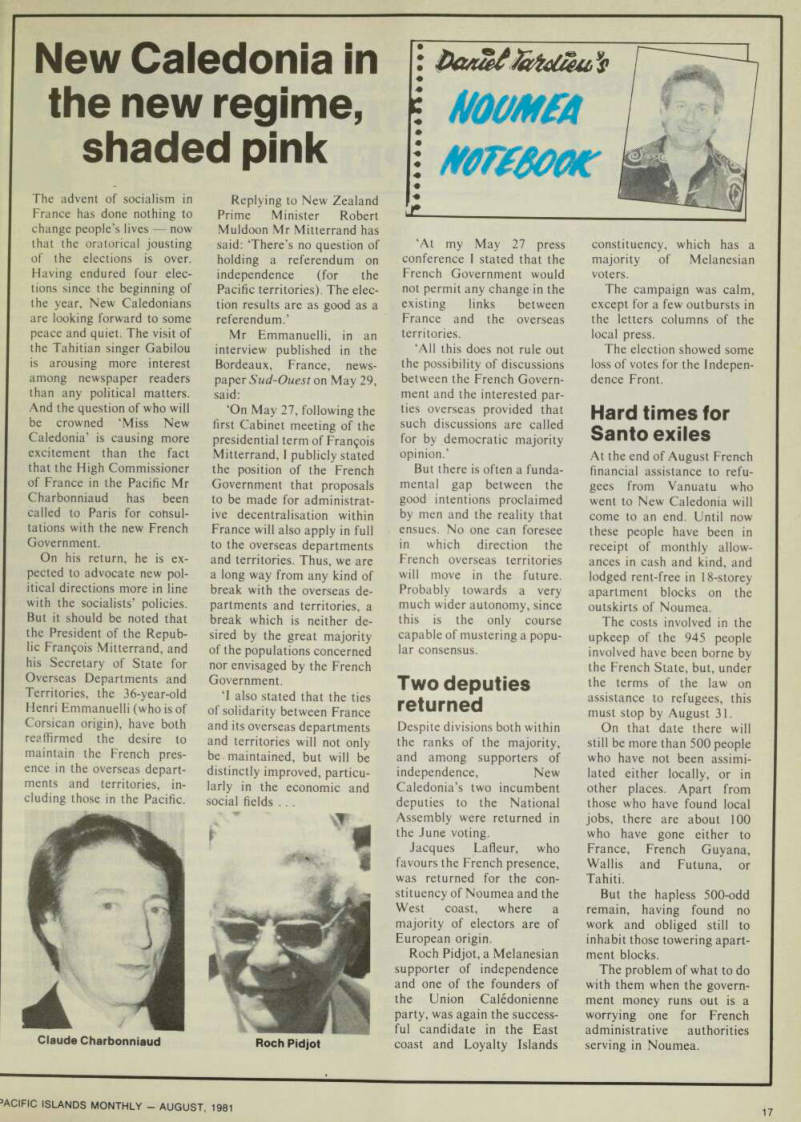
And the question of who will be crowned ‘Miss New Caledonia’ is causing more excitement than the fact that the High Commissioner of France in the Pacific Mr Charbonniaud has been called to Paris for consul tations with the new French Government.
On his return, he is ex pected to advocate new pol itical directions more in line with the socialists’ policies.
But it should be noted that the President of the Repub lic Francis Mitterrand, and his Secretary of State for Overseas Departments and Territories, the 36-year-old Henri Emmanuelli (who is of Corsican origin), have both reaffirmed the desire to maintain the French pres ence in the overseas depart ments and territories, in cluding those in the Pacific.
Replying to New Zealand Prime Minister Robert Muldoon Mr Mitterrand has said: ‘There’s no question of holding a referendum on independence (for the Pacific territories). The elec tion results are as good as a referendum.’
Mr Emmanuelli, in an interview published in the Bordeaux, France, news paper Sud-Ouest on May 29, said: ‘On May 27, following the first Cabinet meeting of the presidential term of Francis Mitterrand, I publicly stated the position of the French Government that proposals to be made for administrat ive decentralisation within France will also apply in full to the overseas departments and territories. Thus, we are a long way from any kind of break with the overseas de partments and territories, a break which is neither de sired by the great majority of the populations concerned nor envisaged by the French Government.
T also stated that the ties of solidarity between France and its overseas departments and territories will not only be. maintained, but will be
distinctly improved, particu
larly in the economic and social fields . . .
‘At my May 27 press conference I stated that the French Government would not permit any change in the existing links between France and the overseas territories. ‘All this does not rule out the possibility of discussions between the French Govern ment and the interested par ties overseas provided that such discussions are called for by democratic majority opinion.’
But there is often a funda mental gap between the good intentions proclaimed by men and the reality that ensues. No one can foresee in which direction the French overseas territories will move in the future.
Probably towards a very much wider autonomy, since this is the only course capable of mustering a popu lar consensus.
Two deputies
returned
Despite divisions both within the ranks of the majority, and among supporters of independence, New Caledonia’s two incumbent deputies to the National Assembly were returned in the June voting.
Jacques Lafleur, who favours the French presence, was returned for the con stituency of Noumea and the West coast, where a majority of electors are of European origin.
Roch Pidjot, a Melanesian supporter of independence and one of the founders of the Union Caledonienne party, was again the success ful candidate in the East coast and Loyalty Islands
constituency, which has a majority of Melanesian voters.
The campaign was calm, except for a few outbursts in the letters columns of the local press.
The election showed some loss of votes for the Indepen dence Front.
Hard times for
Santo exiles
At the end of August French financial assistance to refu gees from Vanuatu who went to New Caledonia will come to an end. Until now these people have been in receipt of monthly allow ances in cash and kind, and lodged rent-free in 18-storey apartment blocks on the outskirts of Noumea.
The costs involved in the upkeep of the 945 people involved have been borne by the French State, but, under the terms of the law on assistance to refugees, this must stop by August 31.
On that date there will still be more than 500 people who have not been assimi lated either locally, or in other places. Apart from those who have found local jobs, there are about 100 who have gone either to France, French Guyana, Wallis and Futuna, or Tahiti.
But the hapless 500-odd remain, having found no work and obliged still to inhabit those towering apart ment blocks.
The problem of what to do with them when the govern ment money runs out is a worrying one for French administrative authorities serving in Noumea.
Claude Charbonniaud
Roch Pidjot