Indenture system
pp. 41-43 · Read in the full issue

Books
Unproven ease on violence in Fiji’s Indenture system
The Violence of Indenture in Fiji. By Vijay Naidu. Fiji Monograph Series No 3. pub lished by the School of Social md Economic Development, University of the South Pacific, Suva. No price or ISBN pro hded.
Vhen, in 1875, Sir Arthur Jordon became the first post session governor of Fiji he nherited many problems, not he least of which was one vhich had bedevilled John lates Thurston, the architect of Session. This was the incessant, ncreasing and often belligerent emand by the owners of plan ations for labour.
Slavery had been abolished dthin the British jurisdiction y 1807, and the ‘blackbirding’ scruitment of Pacific Islanders ar labour in Queensland, amoa, New Caledonia and Fiji ad been suppressed by the British navy in response to dverse public reaction.
In his efforts to maintain the itegrity of the Fijian way of fe, Thurston introduced a sys ;m of taxation which held the ijian to his village. Gordon Jopted this policy and pursued vigorously, with the effect ml planters continued to be mied much of the labour they ;quired.
Both Gordon and his Princi al Medical Officer Dr William IcGregor later knighted, ilonial secretary and surrogate avernor of Fiji had experi ice of migrant Indian labour Mauritius, the Seychelles, id Trinidad, and it seemed to icm an appropriate solution to is pressing problem. More 'er, emigration of Indians ider indenture systems had ready been sanctioned by the ritish Government for labour Ceylon, Natal and the West idies, and by the Dutch and •ench governments for their erseas territories.
Eventually, with the sanction id joint agreement of the *itish, Indian and Fijian Gov nments, the first shipload of imigrants 481 men, women
and children arrived in Fiji in 1879. This system was to continue until it was abolished in 1920. During this period a total of about 60 000 such immigrants arrived in Fiji as indentured labour.
Whatever may have been the ethics of this system, there can be no doubt that the detailed legal regulations and conditions governing recruitment, trans port, employment, remuner ation, housing, medical care, and release from indenture and eventual repatriation as laid down jointly by the govern ments involved, were, on the face of it, fair, just, and reason able. But, as the author points out, trickery in recruitment, greed, cupidity and deliberate non-compliance with the regu lations reduced some immi grants to hardship, misery, and even suicide.
This is not to suggest that they came to Fiji unwillingly.
Indeed the author points out that there was a ‘push-pull’ effect in which the ‘push’ was the greater due to the poverty of their origins. Nor was there any lack of recruits, and as Brij V.
Lai ( Journal of Pacific History, XV 71) has pointed out: ‘.. . they had different motivations; if many desired nothing but a brief sojourn in the colonies;
there were others who made a conscious break with their past; if many had been deceived by recruiters, there were many others who had left their homes in search of a better livelihood elsewhere, before they were registered for emigration; if many had unhappy experiences under indenture, many other found new possibilities for im provement which would have been denied them in India.’
On arrival in Fiji, what was left of their basic culture was submerged in the ‘labour lines’ and whilst the primitive accom modation provided may have satisfied the law, it was a grossly foreign environment to the im migrants in this alien land.
Everything was different the weather, the food, the veg etation, and most of all the nature of the tasks they were expected to perform. Many of the verbatim statements in this monograph emphasise these factors as very significant in respect of their reactions and behaviour in Fiji. In this new milieu the newcomers tended to lose their religions, castes, and former local identities since ‘there was no continuity of tradition, and no one to enforce the values, beliefs and norms of the Indian village community’.
The author quotes Andrews and Pearson (1916) as stating that the suicide rate of Indians in Fiji was 20 times that in India, and the number of con victions for murder, 80 times higher. Perhaps one should ac cept these comparative figures with caution since the criminal and judicial records of the
relatively small number of closely observed indentured mi grants are much more likely to be accurate than statistics emanating from the teeming sub-continent.
This monograph presents the statistics of violence amongst the indentured labour under two main categories: (a) physi cal violence, and (b) sexual offences. Of the former, over the years during which the indenture system operated, there were 387 convictions for non-fatal assaults, and 172 for murder. Whilst violence was exhibited against both Europeans and Indians, by far the greatest incidence was against the sardars who occu pied the powerful but invidious position between employers and employees. Legal procedure against their fellows, overseers and employers was available and used, but intimidation of witnesses often prevented jus tice. In such cases it was not unusual for gangs sometimes
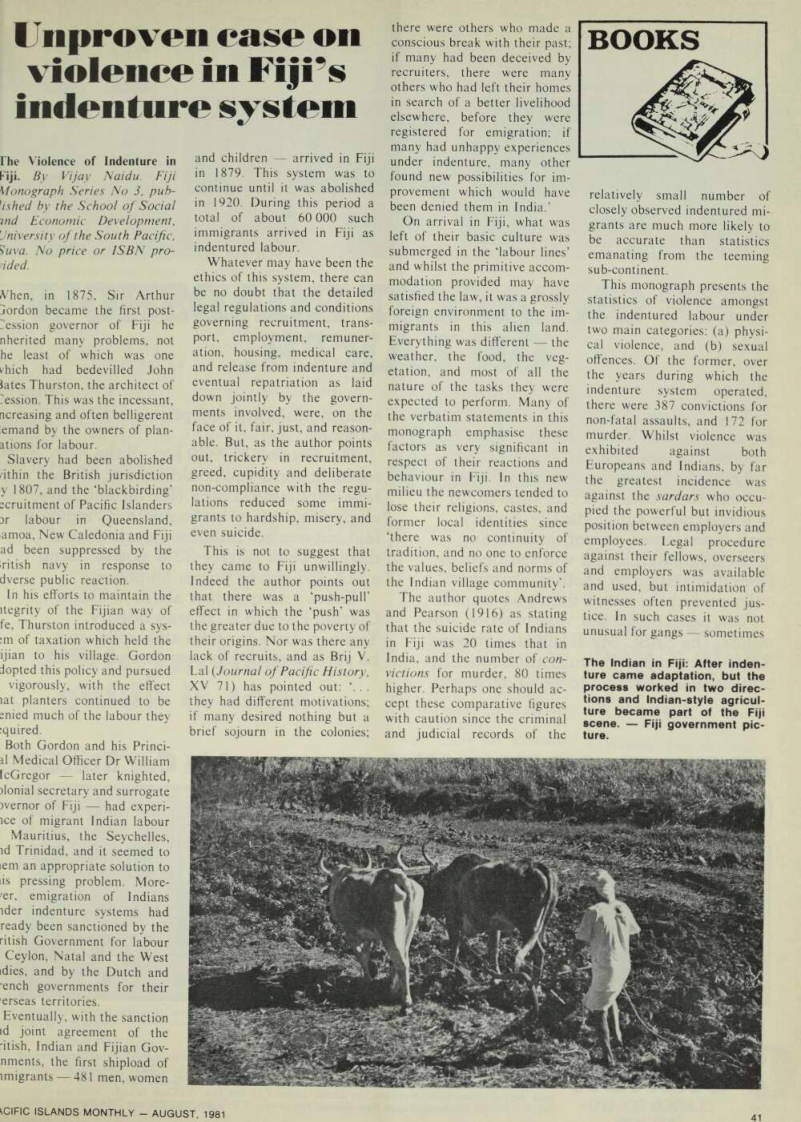
The Indian in Fiji: After inden ture came adaptation, but the process worked in two direc tions and Indian-style agricul ture became part of the Fiji
scene. - Fiji government pic
ture.
of women to obtain retri bution and rough justice by assaulting their oppressors in particularly degrading and re volting ways.
The terms of recruitment required that not fewer than 40 women should accompany each 100 men brought to Fiji. But this proportion seems rarely to have been attained, and this disparity gave rise to polyandry, orostitution, and the violence of ealousy.
During the period of the ndenture system there were ecorded 93 convictions for exual offences, mainly for ape, carnal knowledge, and mnatural offences.
In this monograph the author ►resents a facet of the indenture ystem which seems to have ieen previously under-explored, n so doing he arrives at the onclusion: The violence in the plantations was not due to the ind of people present, but ather to the social and psycho igical disruption caused by the identure system, and the kind f conditions to be found in the lantations.’
This may be very true but it annot be deduced from the gures he presents since the nly tables in which he breaks own the figures to identify
those relating to indentured and free labour separately, are un corrected to take cognisance of the number of individuals in each group. Thus the relative incidence of crime in each group remains undetermined, and therefore the criminalising effect, if any, of indenture cannot be assessed. Similarly the tables for crimes of violence and sexual crime amongst in dentured labour are unac companied by any parallel figures from the free Indian community, so that these tables, however interesting, are of little, if any, statistical value.
It may very well be that if these tables were re-examined and compared with comparable and corrected figures from the free Indians over the same relevant period, the author may be able to substantiate his thesis, but unless and until this is done, the verdict must, on the evidence he adduces, remain ‘not proven’.
This slim monograph in fac simile typescript is presented with a highly emotive cover blood red and depicting the hangman’s noose. The few ac companying photographs have reproduced poorly, and might well have been omitted.
Leonard Goodman.