Confusion on all sides as New
pp. 13-14 · Read in the full issue
Caledonia faces its future
Australian journalist ROBERT MILLIKEN was in New Caledonia in June in the wake of the sweeping victory of Frangois Mitterrand in the French presidential election, which was soon to be followed by the even more spectacular success of his party in parliamentary elections. He found a high degree of uncertainty and confusion, not only among conservatives, but among supporters of full independence for the territory as well.
An air of uncertainty pervades New Caledonia following the election of France’s new social ist president, Francis Mitterrand, and his decisive victory in the more recent National Assembly elections.
For the first time in at least 25 years, New Caledonians are confronted with a French presi dent who is expected to consider seriously the demands for inde pendence from the Front Independantise, the multi racial grouping of five political parties who are calling for an end to French rule in the territory.
Mitterrand has made no com mitment on the independence question, beyond agreeing to meet Roch Pidjot, the 74-year old leader of the Front’s largest party, the Union Caledonienne.
But his silence distinguishes him from his predecessor, Valery Giscard d’Estaing, who sent his Minister for Overseas Territories Paul Dijoud to New Caledonia twice during the campaign to reassert France’s determination to hold on to its Pacific territories.
Dijoud became the focus of a melee that broke out on Mare in the Loyalty Islands when he went there, complete with heli copters and gendarmes, to tell the natives why they should vote for Giscard and remain part of France forever.
He arrived in the middle of a sacred religious ceremony in which one of the independence leaders, Nidoish Naisseline, and his followers were taking part. Dijoud finally had to leave, but not before tear gas was fired by the gendarmes and rocks were thrown at the minis ter’s party by the locals.
Back in Noumea, Dijoud announced; T have come here to
say clearly so that no one may doubt it that New Caledonia is and will remain French. ‘I often hear, with some irritation, one or another independantiste announce that independence will take place in 1982 or later That is absurd.’
In what was later taken to be a well aimed shot at Australia, Vanuatu and Papua New Guinea, Dijoud added: T say this to those about us in the Pacific region: this is the soil of our country, these are French men and women, and we will defend them with all the means at our disposal against every one. Everyone should know this.’
They were comforting words for the 50 000 whites, who are either from families long established in the territory, from metropolitan France, or from former French colonies in Africa and Indochina.
But the comfort has turned to confusion with the Mitterrand victory. And for the indepen dence supporters among the indigenous Melanesians, the
confusion has been compounded by the emergence of a split in Front Independantiste ranks during the recent National Assembly elections.
New Caledonia is represented by two deputies in the assembly in Paris. The first seat, covering white-dominated Noumea and the western half of the island, is held by Jacques Lafleur, a rightwing Gaullist and businesman.
He retained his seat in the first round of voting against a challenge by another conservative, Stanley Camerlynck.
Lafleur has called for even closer ties with France by changing New Caledonia’s status from an overseas territory to a department. This would mean it would lose the small degree of selfadministration it now has through its locally elected assembly, and instead be administered direct from Paris.
Lafleur’s easy victory surprised many observers, and“is seen in some quarters as an indication of the fear and anxiety among the European
population over Mitterrand’s possible intentions, The second seat covers the eastern part of Grande Terre, the main island in the territory, plus the three Loyalty islands, and is the centrepoint for the nationalist movement among the Melanesians, or Kanaks.
Pidjot holds this seat, but he failed to win a majority in the first round of voting under challenge from his Front col league, Naisseline. Pidjot gained a 48% majority of votes in the second round, The split between Pidjot’s Union Caledonienne and the more radical parties in the front appears to centre on the timing and nature of the independence which each side is demanding, Naisseline’s Kanak Liber ation Party trusts Mitterrand no more than Giscard, Pompidou and de Gaulle were trusted by the independence movement in the past.
In an interview in Noumea during the campaign, Naisseline said he was worried that the other independence parties would come to an ac-
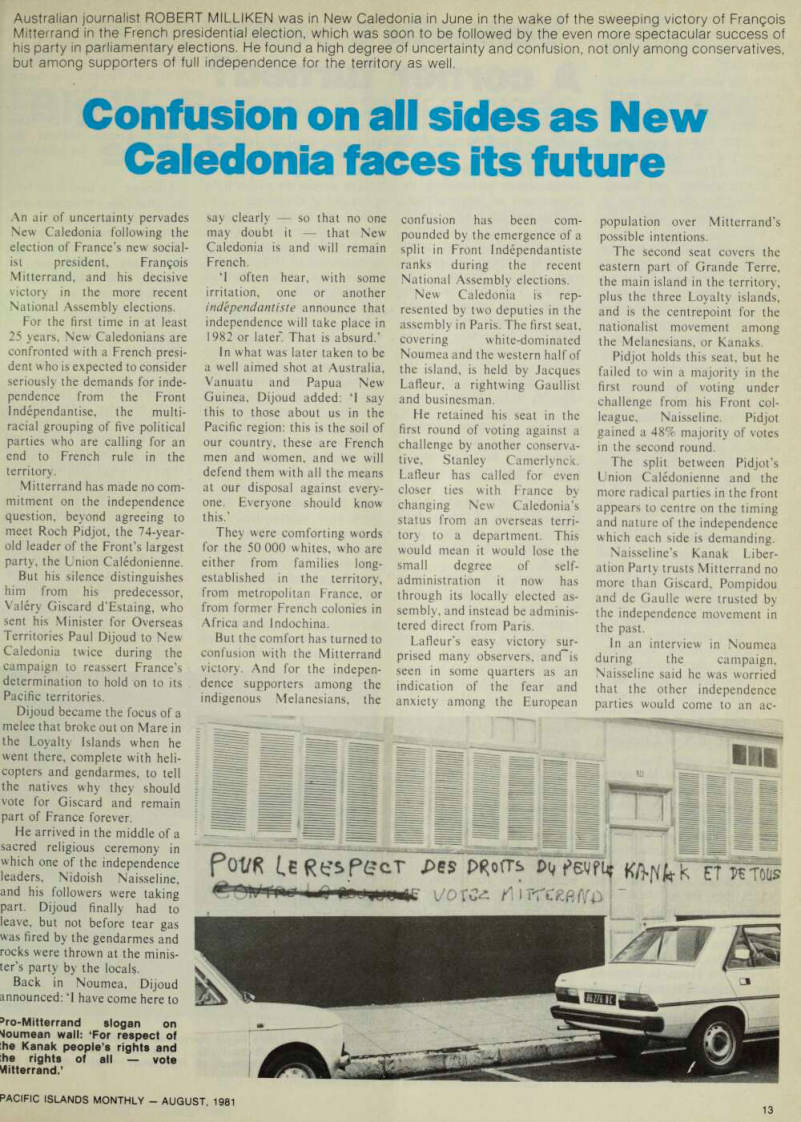
Pro-Mitterrand slogan on Noumean wall: ‘For respect of [?]he Kanak people’s rights and [?]he rights of all - vote Mitterrand.’
commodation with Mitterrand and sacrifice independence for yet another form of ‘neo colonialism’.
On this point, Naisseline ap pears to be supported by one of the leading lights in the inde pendence movement, and the man often talked about as a future New Caledonian leader, Jean-Marie Djiboud. Both want a ‘Kanak republic’ and ‘Kanak socialism’, but they have yet to define precisely what this means.
Naisseline said: ‘We may be further away from indepen dence with Mitterrand than we were with Giscard. Mitterrand will try to please everyone and give us more autonomy under the guise of “decentralisation”.
But decentralisation for whom?
The miners and whites.’
It is too early to say if this split among the independence parties is permanent, but at this stage it does seem as if the Union Caledonienne may be prepared to settle for more local autonomy without full indepen dence if it senses that Mitterrand is prepared to make concessions along these lines. It will also continue to press its claims for reappropriation of land from the Europeans to the traditional owners, the 60 000 Melanesians.
Mitterrand has probably cre ated more problems than he realises by taking a low-key stand on the independence question. While he polled a majority among Melanesian voters in the presidential elec tion, he was beaten by Giscard in the overall New Caledonian vote.
If, as is now clear, Mitterrand wants to continue France’s nu clear test programme in the Pacific he will be under pres sure at home not to move too quickly over the Kanaks’ two key demands on land reform and a change to the voting laws, which they see as the key to winning a majority in the local assembly.
But the presence of four communists in Mitterrand’s cabinet has given the jitters to the entrenched conservative forces in New Caledonia, and this could well spill over into further violence before long unless Mitterrand can achieve what may be almost impossible a multiracial consensus.