A corner turned?
p. 14 · Read in the full issue
Vanuatu's year: A corner turned?
Vanuatu marked its first inde pendence anniversary on July 30.
Inevitably, given the troubled circumstances surrounding its achievement of independence, this first year has been eventful.
Relations with France have been strained to the point where, in February, the govern ment expelled France’s am bassador. There have been con tinuing social tensions as the trials of people accused of offences in connection with the Santo secession of May-August 1980 dragged on through the courts. The country has been afflicted with economic woes due in part at least to the uncertainty of potential foreign investors about new laws the government may introduce, laws on land tenure in particu lar.
But as the country moves into its second year of independent existence there are signs that the corner may have been turned.
Relations with France were back on the rails by March, when the government asked France to appoint a new am bassador. On March 10, an agreement was signed for a French aid package to Vanuatu equivalent to 5A6.9 million in 1981. In April, Minister for Home Affairs Fred Timakata officially closed the book on the Santo secession, saying: ‘As from today, no further charges will be laid against people suspected of acts concerned with the rebellion . . .’ On the economic front, hardly a month has passed in recent times without the announcement of some new project or other which holds the promise of betterment. These include min ing developments, the possi bility of the establishment of an oil refinery, the shipping regis ter scheme, and most recently, announcement of the agree ment reached with the Austra lian airline Ansett to set up the national airline, Air Vanuatu (see p 59). There has also been considerable clarification of the new land policies.
As one long-time resident of
Vanuatu said in Sydney the other day, speaking from the heart rather than aiming at any great originality of expression: ‘I think we can see a little light at the end of the tunnel . . .’
With the benefit of a year’s distance from the turbulent events of May-August ’BO, there is one aspect of them which I believe has been generally underestimated.
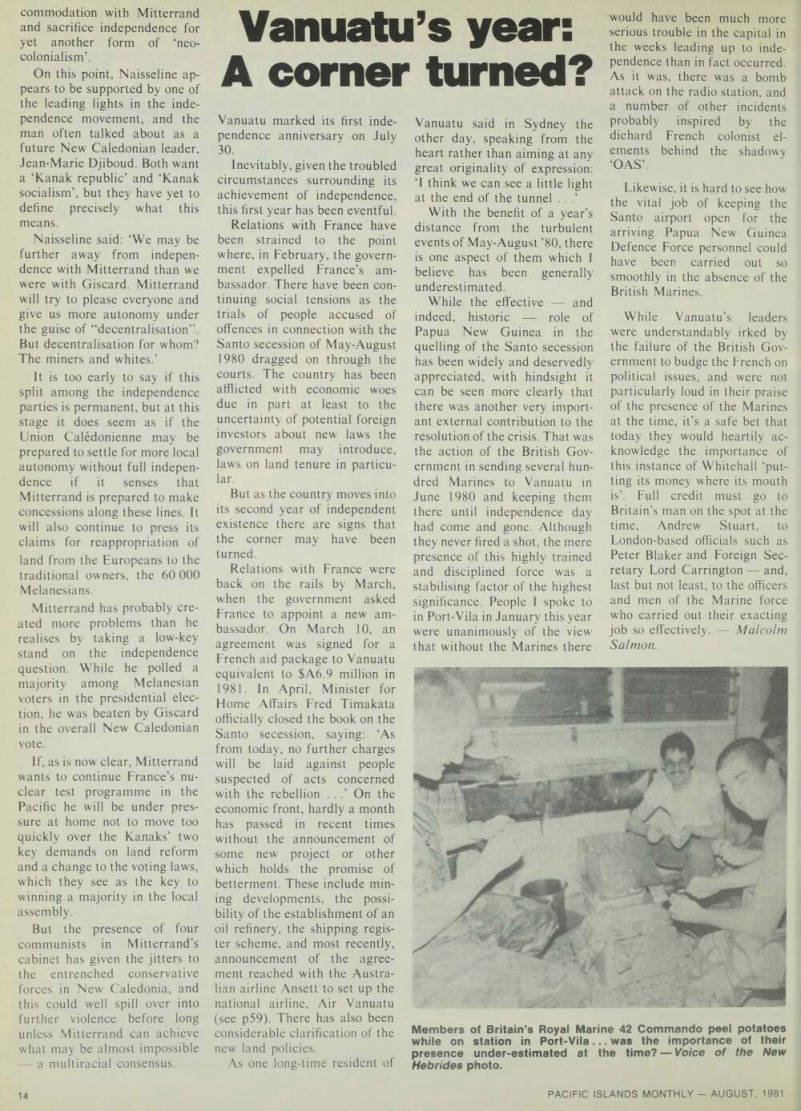
While the effective and indeed, historic role of Papua New Guinea in the quelling of the Santo secession has been widely and deservedly appreciated, with hindsight it can be seen more clearly that there was another very import ant external contribution to the resolution of the crisis. That was the action of the British Gov ernment in sending several hun dred Marines to Vanuatu in June 1980 and keeping them there until independence day had come and gone. Although they never fired a shot, the mere presence of this highly trained and disciplined force was a stabilising factor of the highest significance. People I spoke to in Port-Vila in January this year were unanimously of the view that without the Marines there
would have been much more serious trouble in the capital in the weeks leading up to inde pendence than in fact occurred.
As it was, there was a bomb attack on the radio station, and a number of other incidents probably inspired by the diehard French colonist el ements behind the shadowy
‘Oas’.
Likewise, it is hard to see how the vital job of keeping the Santo airport open for the arriving Papua New Guinea Defence Force personnel could have been carried out so smoothly in the absence of the British Marines.
While Vanuatu’s leaders were understandably irked by the failure of the British Gov ernment to budge the French on political issues, and were not particularly loud in their praise of the presence of the Marines at the time, it’s a safe bet that today they would heartily ac knowledge the importance of this instance of Whitehall ‘put ting its money where its mouth is’. Full credit must go to Britain’s man on the spot at the time, Andrew Stuart, to London-based officials such as Peter Blaker and Foreign Sec retary Lord Carrington and, last but not least, to the officers and men of the Marine force who carried out their exacting
job so effectively. -
Malcolm
Salmon.
Members of Britain’s Royal Marine 42 Commando peel potatoes while on station in Port-Vila... was the importance of their presence under-estimated at the time? - Voice of the New Hebrides photo.