Letters
pp. 7-11 · Read in the full issue

‘lnnocent’
Tahitians
on Santo?
I refer to the letter by Phil Lechat, ‘Human Rights in Vanuatu’ (PIM Feb p 9), and would like to comment on the cases of the Tahitians and others he mentions who were in Santo at the time of the Vemarana secessionist bid last year. a) Roland Teihoarii: The in cident involving this person occurred on the afternoon of Friday, August 29, 1980. A vehicle containing, among others, Eddy Stephens, at tempted to force a roadblock on the approach road to Vanafo manned by members of the Papua New Guinea Defence Force ‘jungle fighters’. In an exchange of fire that took place, Eddy Stephens was fatally shot and Roland Teihoarii was in jured. The details of the inci dent are not in the records of the Vanuatu police, but may well be available from PNGDF records. Roland Teihoarii was declared a prohibited immi grant by the Vanuatu Govern nent and deported on October L 1980, instead of having to 'ace criminal charges. b) Paul Hauata (known as Coco Leroux): On the evening )f August 21, 1980, a standing »uard of about six members of he PNGDF and two officers of he Police Mobile Unit were on iuty at the Santo Water Pump ng Station following rumours hat the Vemarana rebels in ended to poison the water upply.
At about 9 pm two men were een to approach the standing ;uard who challenged them,
fhe PNGDF/PMU guard were
hen fired on with at least four ounds from an Ml .30 carbine ifle. A member of the PNGDF eturned the fire. ‘Coco Leroux’
was then arrested and found to have bullet wounds in the wrist and arm. His companion es caped, but was later arrested.
Hauata was deported and de clared a prohibited immigrant on October 9, 1980.
The only information avail able about Dr F. de Coat parquet relates to the injuries sustained by Inspector John Bill lerongen following an attack on his vehicle by Vemarana rebels led by Yann Cronsteadt on August 12, 1980. Dr de Coatparquet refused to allow the inspector to be transferred to Port-Vila, and refused to allow any British or fellow police officers to visit him.
When the British and French senior officers went to the French Hospital later to ar range his transfer to Port-Vila, the doctor was most abusive and had to be physically restrained by the French army officer.
The information in Mr Lechat’s letter relates to the doctor’s refusal to allow PNGDF/PMU officers inside the French Hospital following the admission of Hauata.
Shortly afterwards, he was or dered to Port-Vila at the request of the Vanuatu Government, and removed from the republic.
He was not arrested at gunpoint in the middle of an operation.
Dr de Coatparquet’s sympathies were entirely with the Vemarana rebels, and this was noted by the French army officer in charge before the arrival of the PNGDF. He was not the subject of a deportation order.
c) Felix Lister: Not identified. No person of this name appears to have been the subject of any Vanuatu police incident report, or was de ported. It is probable that he was one of the many French nationals who left Santo volun tarily after the arrival of the PNGDF troops. d) Faraire Teraimauea: A person of this name was ar rested by the PNGDF/PMU in August 1980. He was removed to Noumea on August 29, 1980, and declared a prohibited immi grant in October 1980. No details are available of his arrest, which was effected by
PNGDF/PMU forces.
e) Paul-Pierre Douyere: This person was arrested on September 6, 1980, charged with ‘unlawful assembly’. He was convicted and sentenced to three months imprisonment, with a further four months suspended sentence. However, he did not serve his full term, being deported on October 21, 1980, and declared a prohibited immigrant.
Mr Lechat, like so many
others, fails to recognise the fact that the Vemarana rebels had a most impressive amount of firepower at their disposal, including about 600 kg of dyna mite.
It was imperative to obtain information as to the where abouts of this, and ‘field in terrogations’ of rebels were car ried out by a team of military personnel.
Ni-Vanuatu
Port-Vila Vanuatu (Name and address supplied.)
‘Extravagance’ in
Solomons ships
It is with interest that we read the report under the heading ‘Posh ships for S.L’ (PIM Apr p6l). It is yet another example of the incredible extravagance prompted and promoted by bad advice from so-called ‘overseas experts’ who have little or no background or experience in the shipping industry.
How many times have we seen developing nations in the Pacific go ahead with projects such as this, without any real thought for the future conse quences, or the actual suit ability of the vessels concerned?
Can we really be convinced that a newly formed nation such as Solomon Islands has the need for ‘canteen milk bars, banks and $4OO reclining seats’ on its vessels?
Does the bank that has lent the $1.5 million-odd for three 26 m vessels really expect them to be able to run as a commer cial venture, and ever repay the loans?
Shipping is the lifeblood of Solomon Islands, but running a Rolls-Royce on a motor bike budget can only lead to fin ancial disaster. Admittedly the bank concerned is a develop ment bank, but unnecessary extravagance in one sector in evitably takes away finance for development in another.
Bruce Allport
Honiara Solomon Islands
‘Nuclear allergy’
in Japan
A news commentary broadcast by Radio Japan on May 19, 1981, told of ‘alarm’ and ‘up roar’ in Japan following the disclosure that American ships
In a letter to PIM published on this page a reader stresses that the Papua New Guinea Defence Force and the Vanuatu Mobile Force were protecting, not sup
pressing, human rights during
their deployment against rebels
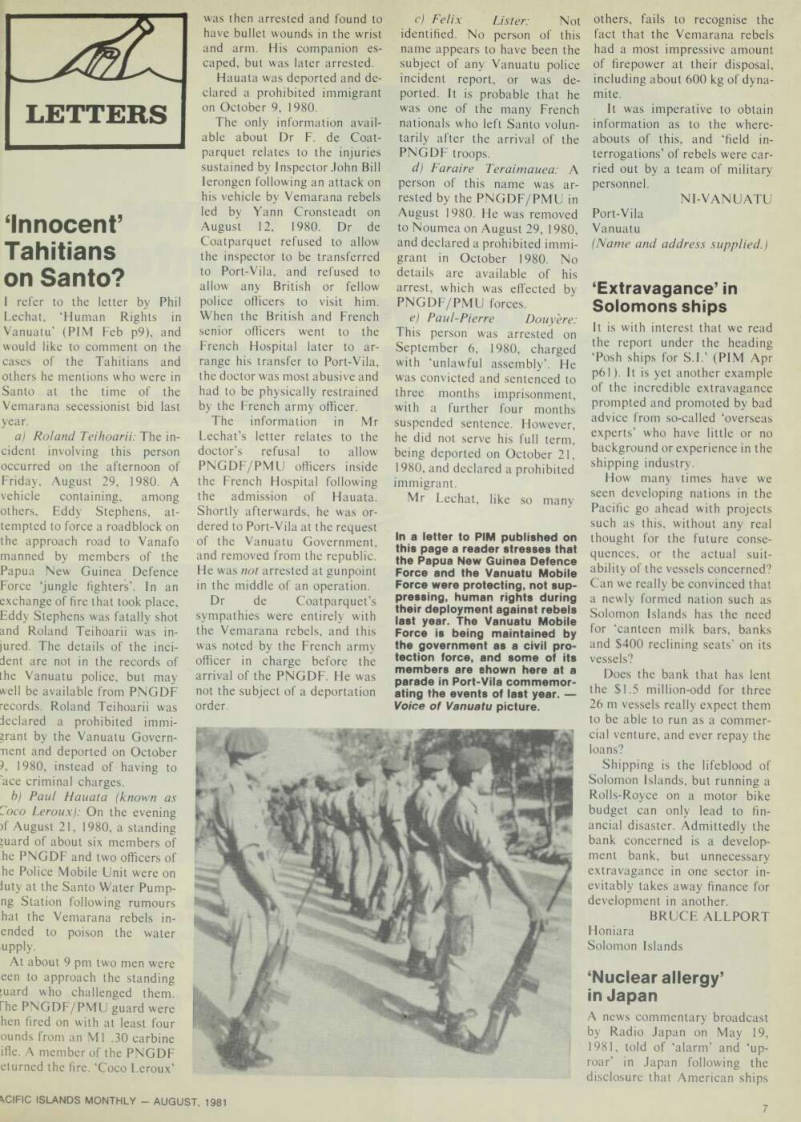
last year. The Vanuatu Mobile Force is being maintained by the government as a civil pro tection force, and some of its members are shown here at a parade in Port-Vila commemor ating the events of last year. - Voice of Vanuatu picture.
and aircraft may have carried nuclear weapons while inside Japanese territorial waters.
The commentary went on to explain that Japanese people had, understandably, a ‘nuclear allergy’ since the cities of Hiroshima and Nagasaki were erased from the map at the end )f the last war. Further, we vere advised that Japan has a hree-point nuclear policy relat ng to weapons, and that lapanese people have strong entiments against nuclear war are equipment.
The news bulletin immedi ately preceding the commen ary carried the interesting in ormation that the Science and 'echnology Agency in Japan iad' bowed to pressure and had igreed not to dump nuclear vaste in the Pacific. The chief if the agency was quoted as aying that this situation would xist ‘.. . as long as other ountries are against the idea’.
Je made his comments after neeting the Government of the Northern Mariana Islands, the >eputy Governor of Guam and ther Pacific leaders in Tokyo.
Governor Carlos Camacho of he Northern Marianas and the ‘aders of many other Pacific ations have been denouncing ie proposed Japanese dumping lans for a considerable period.
I wonder if the people of Japan have a ‘nuclear allergy’ or are ‘alarmed’ or in ‘uproar’ as they contemplate thousands of drums of nuclear waste tum bling into their (and our) Pacific food chain?
It seems that the nations of the Pacific have won the first round in the dumping issue, but it remains to be seen if the Japanese Government would prefer to keep the ‘nuclear (waste) allergy’ away from home rather than face ‘alarm’ and ‘uproar’ within the country.
Martin Hadlow
Honiara Solomon Islands
‘Presumptuous’ to
speak for dead
The Director-General ■of the Commonwealth War Graves Commission, Mr A. K. Pallot, is reported (PIM Mar p 6) as saying the commission refuses requests from governments and wealthy relatives of dead soldiers to repatriate remains.
While this is generally cor rect, there have been excep tions. The first was Maj-Gen Sir W. T. Bridges, who com manded the first Australian Imperial Forces (AIF) at Gallipoli. His body was brought back to Australia after he was killed in action at Gallipoli and buried at Duntroon, where he had been the first commandant.
The second exception was that most of the bodies of the Vietnam war dead were brought back to Australia, al
though some were buried at Terendak in Malaysia.
It is probably true to say that once finally buried the bodies are not relocated. However, at the end of World War 11, bodies were collected from all over the South Pacific area where they had been given field burials, and were collected into the various war cemeteries.
No one can speak on behalf of the dead, which makes it rather presumptuous of Mr Pallot to say ‘if the dead soldiers were to have been asked where they wanted to be buried, they would prefer to have been buried with their comrades-in arms’. No one can pretend to speak therefore on behalf of Fiji war hero Corporal Sefanaia Sukanaivalu.
R. Stocks
Bangkok Thailand
Danielssons’ reply
to critics We are happy to see that our contributions to PIM continue to provoke comment from readers, both from Islanders (mostly favourable) and Europ eans (sometimes critical). In the July issue of PIM, (p 8), two readers take issue with us on different matters: John H. Huon de Navrancourt, of Atherton, Queensland, Australia, and D. L. Johnston, of San Diego, California, USA.
Mr Navrancourt’s letter is a rather rambling affair. It opens with a strange remark about the
opinions expressed in May PIM (pp 7-8) by a French business man and lifelong resident of Tahiti, Mr Henri Lombard, who thinks and we agree with him that French Poly nesia up to now has been on the wrong road. Unfortunately, Mr Navrancourt has missed the main point: Mr Lombard as cribes the economic, social and cultural mess he so vividly describes not to a hasty and ill conceived decolonisation, but on the contrary to the rigid maintenance of old-fashioned colonial rule.
Next, Mr Navrancourt chides us for lacking objec tivity, like so many Europeans who have ‘gone native’. Above all, he thinks, we should keep away from politics. Since his rather grave charges are unsup ported by any evidence what ever, we can only ask him to spell them out in detail. If he will be good enough to do so, perhaps we may be able to dispel a few more of his miscon ceptions.
Then, all of a sudden, Mr Navrancourt takes it upon him self to make a most sweeping political assertion: in the
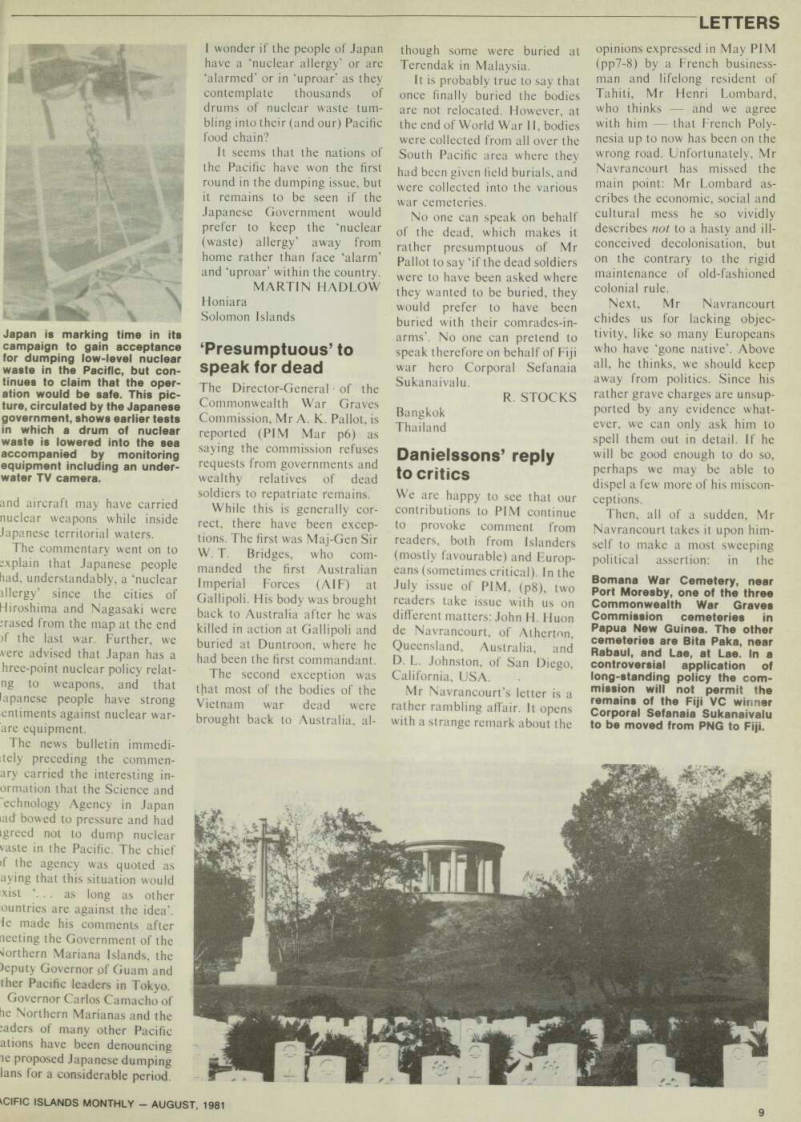
Japan is marking time in its campaign to gain acceptance for dumping low-level nuclear waste in the Pacific, but con tinues to claim that the oper ation would be safe. This pic ture, circulated by the Japanese government, shows earlier tests in which a drum of nuclear waste is lowered into the sea accompanied by monitoring equipment including an under water TV camera.
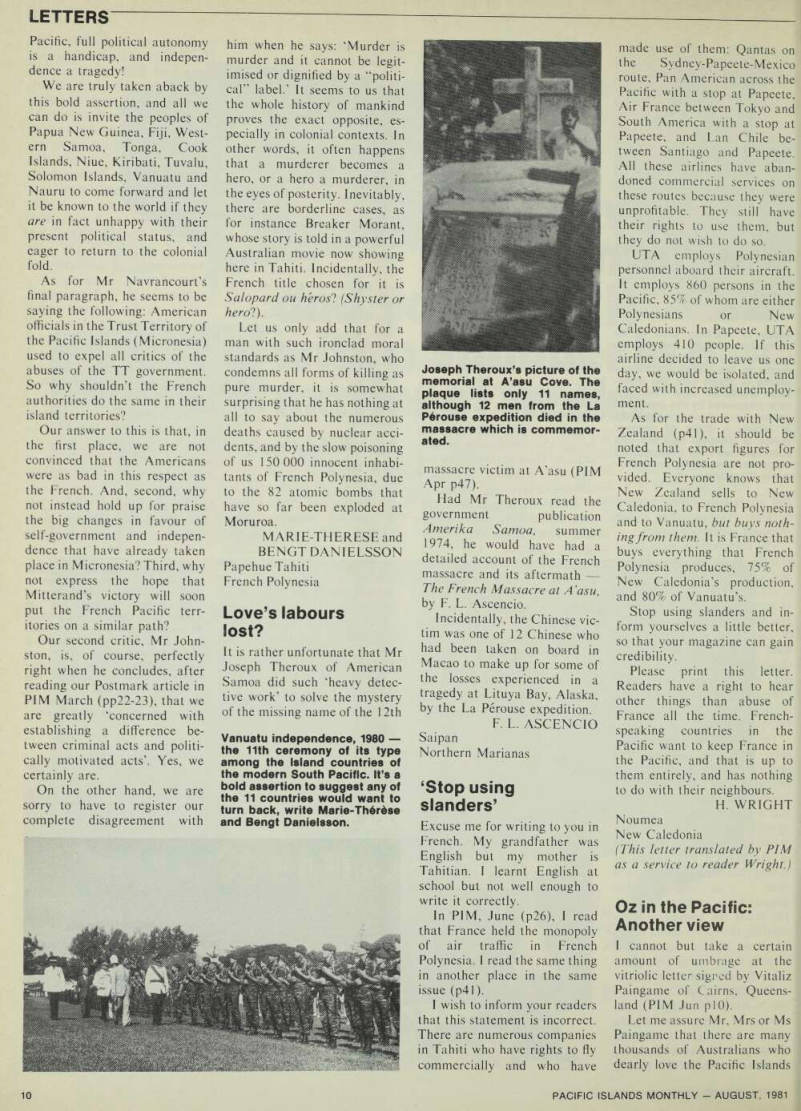
Bomana War Cemetery, near Port Moresby, one of the three Commonwealth War Graves Commission cemeteries in Papua New Guinea. The other cemeteries are Bita Paka, near Rabaul, and Lae, at Lae. In a controversial application of long-standing policy the com mission will not permit the remains of the Fiji VC winner Corporal Sefanaia Sukanaivalu to be moved from PNG to Fiji.
Pacific, full political autonomy is a handicap, and indepen dence a tragedy!
We are truly taken aback by this bold assertion, and all we can do is invite the peoples of Papua New Guinea, Fiji, West ern Samoa, Tonga, Cook Islands, Niue, Kiribati, Tuvalu, Solomon Islands, Vanuatu and Nauru to come forward and let it be known to the world if they are in fact unhappy with their present political status, and eager to return to the colonial fold.
As for Mr Navrancourt’s final paragraph, he seems to be saying the following: American officials in the Trust Territory of the Pacific Islands (Micronesia) used to expel all critics of the abuses of the TT government.
So why shouldn’t the French authorities do the same in their island territories?
Our answer to this is that, in the first place, we are not convinced that the Americans were as bad in this respect as the French. And, second, why not instead hold up for praise the big changes in favour of self-government and indepen dence that have already taken place in Micronesia? Third, why not express the hope that Mitterand’s victory will soon put the French Pacific terr itories on a similar path?
Our second critic, Mr John ston, is, of course, perfectly right when he concludes, after reading our Postmark article in PIM March (pp 22-23), that we are greatly ‘concerned with establishing a difference be tween criminal acts and politi cally motivated acts’. Yes, we certainly are.
On the other hand, we are sorry to have to register our complete disagreement with
him when he says: ‘Murder is murder and it cannot be legit imised or dignified by a “politi cal” label.’ It seems to us that the whole history of mankind proves the exact opposite, es pecially in colonial contexts. In other words, it often happens that a murderer becomes a hero, or a hero a murderer, in the eyes of posterity. Inevitably, there are borderline cases, as for instance Breaker Morant, whose story is told in a powerful Australian movie now showing here in Tahiti. Incidentally, the French title chosen for it is Salopard ou herosl (Shyster or he rod).
Let us only add that for a man with such ironclad moral standards as Mr Johnston, who condemns all forms of killing as pure murder, it is somewhat surprising that he has nothing at all to say about the numerous deaths caused by nuclear acci dents, and by the slow poisoning of us 150 000 innocent inhabi tants of French Polynesia, due to the 82 atomic bombs that have so far been exploded at Moruroa.
Marie-Therese And
Bengt Danielsson
Papehue Tahiti French Polynesia Love’s labours lost?
It is rather unfortunate that Mr Joseph Theroux of American Samoa did such ‘heavy detec tive work’ to solve the mystery of the missing name of the 12th
massacre victim at A’asu (PIM Apr p 47).
Had Mr Theroux read the government publication Amerika Samoa, summer 1974, he would have had a detailed account of the French massacre and its aftermath The French Massacre at A’asu, by F. L. Ascencio.
Incidentally, the Chinese vic tim was one of 12 Chinese who had been taken on board in Macao to make up for some of the losses experienced in a tragedy at Lituya Bay, Alaska, by the La Perouse expedition.
F. L. Ascencio
Saipan Northern Marianas
‘Stop using
slanders’
Excuse me for writing to you in French. My grandfather was English but my mother is Tahitian. I learnt English at school but not well enough to write it correctly.
In PIM, June (p 26), I read that France held the monopoly of air traffic in French Polynesia. I read the same thing in another place in the same issue (p4l).
I wish to inform your readers that this statement is incorrect.
There are numerous companies in Tahiti who have rights to fly commercially and who have
made use of them: Qantas on
the Sydney-Papeete-Mexico
route. Pan American across the Pacific with a stop at Papeete, Air France between Tokyo and South America with a stop at Papeete, and Lan Chile be tween Santiago and Papeete.
All these airlines have aban doned commercial services on these routes because they were unprofitable. They still have their rights to use them, but they do not wish to do so.
UTA employs Polynesian personnel aboard their aircraft.
It employs 860 persons in the Pacific, 85% of whom are either Polynesians or New Caledonians. In Papeete, UTA employs 410 people. If this airline decided to leave us one day, we would be isolated, and faced with increased unemploy ment.
As for the trade with New Zealand (p4l), it should be noted that export figures for French Polynesia are not pro vided. Everyone knows that New Zealand sells to New Caledonia, to French Polynesia and to Vanuatu, but buys noth ing from them. It is France that buys everything that French Polynesia produces, 75% of New Caledonia’s production, and 80% of Vanuatu’s.
Stop using slanders and in form yourselves a little better, so that your magazine can gain credibility.
Please print this letter.
Readers have a right to hear other things than abuse of France all the time. French speaking countries in the Pacific want to keep France in the Pacific, and that is up to them entirely, and has nothing to do with their neighbours.
H. Wright
Noumea New Caledonia (This letter translated by PIM as a service to reader Wright.) Oz in the Pacific: Another view I cannot but take a certain amount of umbrage at the vitriolic letter signed by Vitaliz Paingame of Cairns, Queens land (PIM Jun plO).
Let me assure Mr, Mrs or Ms Paingame that there are many thousands of Australians who dearly love the Pacific Islands
Vanuatu independence, 1980 the 11th ceremony of its type among the Island countries of the modern South Pacific. It’s a bold assertion to suggest any of the 11 countries would want to turn back, write Marie-Therese and Bengt Danielsson.
Joseph Theroux’s picture of the memorial at A’asu Cove. The plaque lists only 11 names, although 12 men from the La Perouse expedition died in the massacre which is commemor ated.
and their peoples. Not all of us run around shooting off our mouths, as our now unemployed politico Gough Whitlam does, preaching that ‘you should do this or that’, and perhaps even advocating slightly revolution ary ideas to normally peace loving people.
A careful examination by your correspondent would in fact reveal that a lot of help from Australia has been given over the years to many of our Pacific neighbours, with no strings attached.
It is interesting to note that all the derogatory statements about Australia made by your correspondent have a surprisingly familiar ring about them, having for some years been the catchcries of Leftwing, and in fact dare I say communist organisations within Australia.
Again I say, many thousands of Australians who like myself have spent a number of years in the Pacific would only want for the people of the area what they themselves strive for, without outside interference, either vo cal or physical.
Athol L. Cottrell
Magill SA Australia
PNG-Oz tangles
on citizenship
Many former Papua New Guinea residents with mixed race children are totally con fused about official Australian policy towards the citizenship of their children. Technically, children who were born in PNG before independence, who had at least two PNG grandparents and who had been registered as Australians, lost their Austra lian citizenship at indepen dence.
A correspondent of ours had three daughters born in PNG before independence. He re turned to Australia in 1972, and while making new passport ar rangements in 1977 he was told that his daughters had ceased to be Australian citizens in 1975 the year of PNG indepen dence. In this instance the aationality of the girls was mbsequently re-established but ;ome other families have ex 3erienced great difficulties with he Australian Immigration De
partment. There have even been threats of expulsion.
Eventually there was a volte face, with Australia apparently deciding that children from mixed families who had been registered as Australians before PNG independence were en titled to remain Australians.
This ruling seems logical, par ticularly as the former attitude appeared to ignore the principle of non-retroactivity.
However, contradictions in official correspondence are still being encountered today. Those who are affected don’t like to see interpretations left to the discretion of any minor immi gration officers.
John H. Huon De
Navrancourt
Atherton, Qld Australia
Mission zeal and
the Gogodala
It was interesting to read (PIM Apr p 29) that Dr Peter Lauer, curator of the Anthropology Museum at the University of Queensland, regarded mission activities as one of the causes of the destruction of the culture of the Gogodala people of Papua New Guinea.
At the same time it is possible that these same activities may have contributed to its revitalisation, which began in 1973.
While the Gogodala culture may have been reduced to ‘mere memories’, there was no doubt when I visited these people about 13 years ago that they were making efforts to preserve and strengthen these memories.
In 1968 Mr Gagore Ibina of Balimo introduced me to a man, Adewo Gabari, who had made paintings of the traditional em blems of the Gogodala people.
It was arranged that copies of these would be made for me to help ensure their preservation.
I supplied paper and colours and subsequently received 43 named designs and the em blems which were once in scribed and painted on the canoes of the clans (udaga) and sub-clans of the Gogodala.
These were accompanied by a list linking them to the names of early clan leaders, and to canoes.
I was also shown, alongside
the boundary of a mission station at Balimo, a carefully tended two-metre depression in the ground, believed to have been imprinted there by the foot of Bani, the legendary first leader of the Asipari clan who strode up the Aramia River from somewhere away to the south.
At Kini village I saw and photographed a stone adze (wagi} with an adjustable angle blade of the type once used in various parts of PNG to finish the inside of canoes. The one at Kini was still in use.
In 1970, at the Gogodala Local Government Council chamber, there had been made and placed above the entrance door on the inside a carved and painted wooden image, about two and a half metres long, of a traditional water creature, the ‘Amesibara’, important in local belief.
The Kubu villagers told me in 1968 that they were mostly pagan (ie, not adherents of any mission), and said that this was because the first missionaries had been insistent on a sudden end to native custom, and in particular had offended an im portant man by objecting to his polygamy.
I do not know whether or not any mission was involved when
the ‘Gogodala people began reviving traditional skills in 1973’, or why this revival commenced then. But in the late ’6os after talking with Gogodala people and hearing of their interest in their past, one was left with a distinct im pression that this strong holding on to tradition was a resistance to what they regarded as excess ive missionary zeal in trying to destroy it that is, that local missionaries were defeating their own purpose.
C. W. Kimmorley
Mt Riverview NSW Australia
C.W. Kimmorley, who writes on this page about the persistence of Gogodala art in Papua New Guinea, has drawn these examples of traditional symbolism representing two extended families (‘canoes’) within the Gogodala community. Above is the hawk totem of the Owala canoe from the Tabama clan in the Paia group.
Below is the bird of paradise totem of the Puwida canoe from the Siboko clan in the Sigela group. Five colours are used. They are black, red and white, made from earth pigments mixed with water; yellow, made from an earth pigment mixed with sap from the omeda plant; and blue, made from an earth pigment mixed with sap from the idede tree.