Islands pilots
pp. 30-31 · Read in the full issue
A NASA to train Islands pilots
Growing numbers of young Pacific Islanders are receiving commercial pilot training at one of Australia’s leading flying schools, the Nationwide Avi ation Space Academy of Aus tralia NASA, for short.
Unlike its famous namesake in the United States, the school has no ambition to shoot people off into outer space. But every thing suggests that it is measur ing up well to its more modest objective of training competent commercial airline pilots.
The school operates out of Cessnock Airport, at the southern end of the Hunter Valley, about 90 km north of Sydney in the State of New South Wales.
The site was chosen for its comparative isolation from the bright city lights an import ant consideration in view of the age and various emotional drives of the trainees. Yet it is not so far from the metropolis that navigational aids are un available, and Sydney Airport itself is close enough to provide NASA trainees with the oppor tunity to fly in, through and out of controlled airspace.
When NASA began oper ations in February 1967 its sights were firmly set on one problem: to produce not only pilots of quality, but also to produce them in the numbers required to meet the rapid expansion and increasing com plexity of Australian aviation.
No real thought was given at the time to training pilots from other countries. But that was to change.
The basic philosophy of the NASA operation was that a better product would result if commercial flying training could be provided on a system atic basis, according to a sylla bus in which flying and ground training were integrated. A requirement of such a project was that training should take place in a contained, disci plined, live-in environment.
Others had tried this before, but had failed, mainly for financial reasons.
Their experience was borne in mind. NASA’s beginnings were modest: three aircraft, five staff, and accommodation and lecture facilities for 12
students. But it very soon be came apparent that the venture would succeed.
By 1972, with assistance in the form of scholarships from the Australian Government, young Papua New Guineans •were enrolled with NASA for training as cadet pilots for eventual employment with Air Niugini. Since 1979, again with Australian Government assist ance, NASA has trained cadets for direct entry into service with the Fiji flag-carrier Air Pacific.
At present a cadet pilot from Air Tungaru, the airline of Kiribati, is under training at the school, with a second to arrive later in the year.
Over the same period cadets have been trained for the Malaysian Airline System and for Indonesia’s Garuda airline.
PIM asked a NASA spokes man about any problems that had been encountered in train ing its foreign students.
He said: Training overseas students has been perhaps the most interesting part of NASA’s development. ‘First, in most cases they have not enjoyed the advantages in mechanical matters which are automatically available to young men raised in a
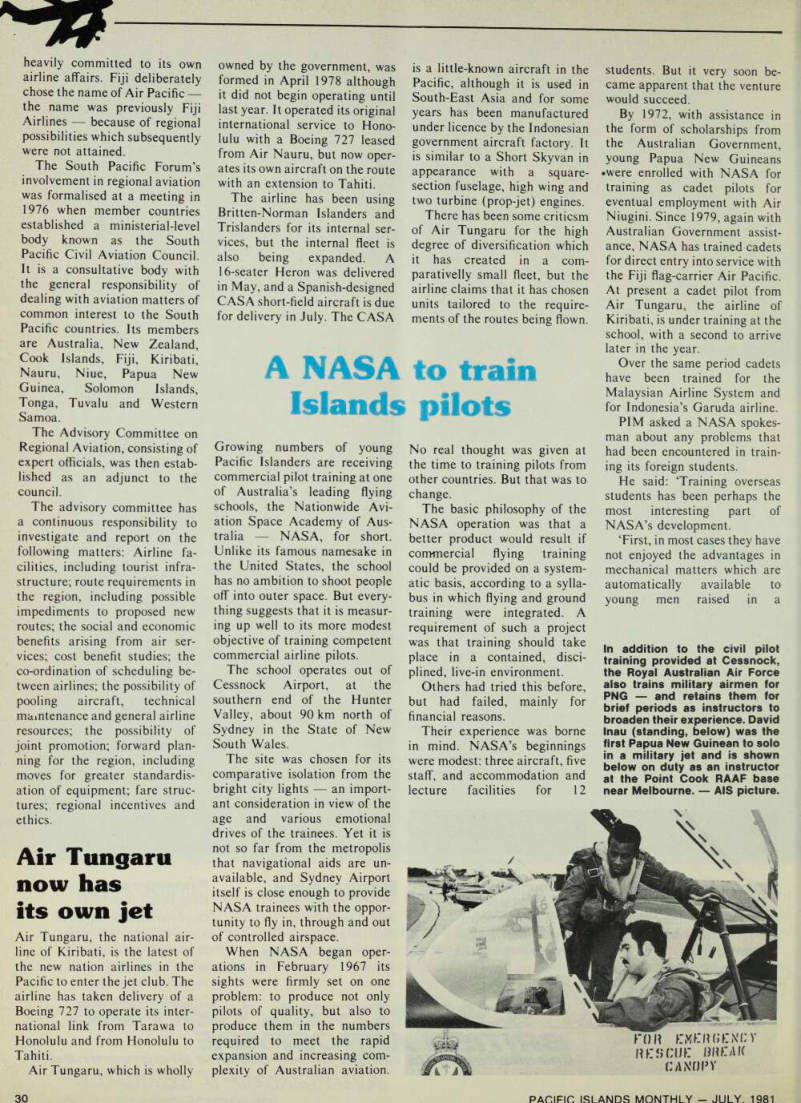
In addition to the civil pilot
training provided at Cessnock,
the Royal Australian Air Force also trains military airmen for PNG and retains them for brief periods as instructors to broaden their experience. David Inau (standing, below) was the first Papua New Guinean to solo in a military jet and is shown below on duty as an instructor at the Point Cook RAAF base near Melbourne. AIS picture.
technologically advanced so ciety. Things to do with ma chines which are as clear as daylight to a young Australian, for example, might be a com pletely closed book to many of our students from less devel oped countries. ‘Second, differences in cul tural background, religious be liefs, language and even diet have provided problems. ‘Third, aviation calls for indi viduals with an even tempera ment and with a character combining responsibility, de votion to duty, versatility and plain commonsense. They must also have the physical manipu lative skills, and be capable of the rational thought processes, which are required to operate aircraft successfully. In view of all this, it is most important in fact imperative that the right sort of individual must be selected for training. In NASA’s experience, this has not always been the case.