‘uniting Pacific
pp. 31-36 · Read in the full issue
Nauru pays heavily for ‘uniting Pacific neighbours'
Air Nauru, the national airline of the Republic of Nauru, is the classic Pacific example of an airline which operates in the interests of a national image.
The official reason for operating equipment and facilities worth $35 million is ‘to end isolation and unite our cousins and neigh bours’, but for all that the airline represents a major flag waving exercise.
Only the rich income which the little republic near the equator earns from its phos phate deposits makes the airline possible. An airline consultant, Mr Juney Dillenbeck, has warned that national flag wav ing will have to be buried if the Island airlines are to be econ omic on international routes (see report in this section). The Nauru situation is politically interesting, however, because the viability of the airline is not at issue or not yet, anyway.
Nauru sees itself as a small
‘However, we believe we’ve made great progress in all the problem areas. We feel we’ve become rather specialised in training student pilots from different countries and cultural backgrounds. ‘lt’s a matter of great pride for us that in the South Pacific and the ASEAN area, our graduates are today flying in command of, and as first officers in, Fokker F 27 and F2B aircraft, and as first officers in DC9s and DC 10s.’
nation which has a good income and which is making ‘a signifi cant contribution towards the goal of bringing the Pacific Island people and their neigh bours closer together’.
The airline represents a capi tal investment of $35 million, and it loses money. It had a turnover of $7.2 million dollars last year but its own costs to the government together with the costs of civil aviation adminis tration and facilities associated with the airline absorbed some thing like $l5 million about a quarter of the national budget. It cannot be argued, either, that the costs involved serve a particular need of the Nauruan nation itself. The op eration is very much a subtle image-builder which at the same time has had a useful spin off for other small, but not so rich, Pacific Island countries.
Whatever may be the ration ale for pouring money into the
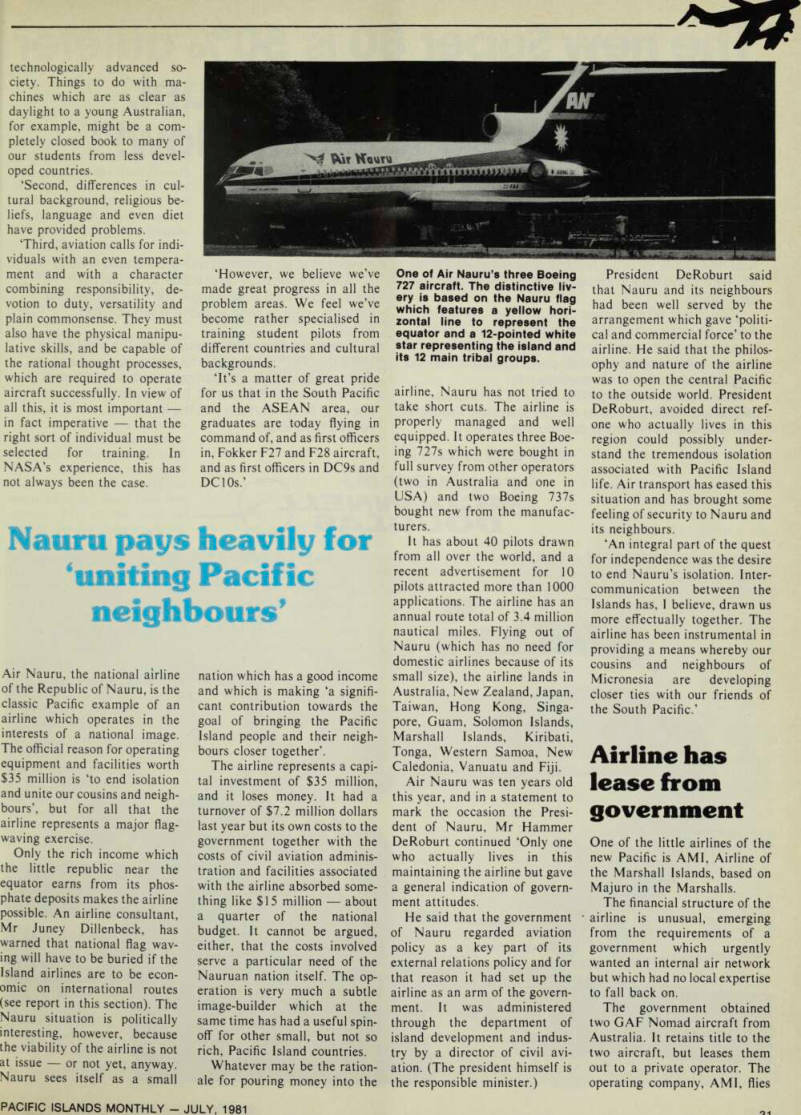
airline, Nauru has not tried to take short cuts. The airline is properly managed and well equipped. It operates three Boe ing 727 s which were bought in full survey from other operators (two in Australia and one in USA) and two Boeing 737 s bought new from the manufac turers.
It has about 40 pilots drawn from all over the world, and a recent advertisement for 10 pilots attracted more than 1000 applications. The airline has an annual route total of 3.4 million nautical miles. Flying out of Nauru (which has no need for domestic airlines because of its small size), the airline lands in Australia, New Zealand, Japan, Taiwan, Hong Kong, Singa pore, Guam, Solomon Islands, Marshall Islands, Kiribati, Tonga, Western Samoa, New Caledonia, Vanuatu and Fiji.
Air Nauru was ten years old this year, and in a statement to mark the occasion the Presi dent of Nauru, Mr Hammer Deßoburt continued ‘Only one who actually lives in this maintaining the airline but gave a general indication of govern ment attitudes.
He said that the government of Nauru regarded aviation policy as a key part of its external relations policy and for that reason it had set up the airline as an arm of the govern ment. It was administered through the department of island development and indus try by a director of civil avi ation. (The president himself is the responsible minister.)
President Deßoburt said that Nauru and its neighbours had been well served by the arrangement which gave ‘politi cal and commercial force’ to the airline. He said that the philos ophy and nature of the airline was to open the central Pacific to the outside world. President Deßoburt, avoided direct ref one who actually lives in this region could possibly under stand the tremendous isolation associated with Pacific Island life. Air transport has eased this situation and has brought some feeling of security to Nauru and its neighbours. ‘An integral part of the quest for independence was the desire to end Nauru’s isolation. Inter communication between the Islands has, I believe, drawn us more effectually together. The airline has been instrumental in providing a means whereby our cousins and neighbours of Micronesia are developing closer ties with our friends of the South Pacific.’
Airline has
lease from
government
One of the little airlines of the new Pacific is AMI, Airline of the Marshall Islands, based on Majuro in the Marshalls.
The financial structure of the airline is unusual, emerging from the requirements of a government which urgently wanted an internal air network but which had no local expertise to fall back on.
The government obtained two GAP Nomad aircraft from Australia. It retains title to the two aircraft, but leases them out to a private operator. The operating company, AMI, flies
One of Air Nauru’s three Boeing 727 aircraft. The distinctive liv ery is based on the Nauru flag which features a yellow hori zontal line to represent the equator and a 12-pointed white star representing the island and its 12 main tribal groups.
under the slogan of ‘The Nation’s Flag Carrier’.
Some early legal difficulties were encountered in operating the two Nomads because of a clash in insurance certification arrangements. This was caused because Australia is the country of origin of the aircraft but USA is the country which retains certain legal responsi bilities in the Marshall Islands.
The airline has now been oper ational since May last year and is providing the first air travel to a number of isolated islands originally served only by sea.
There’s a daily service be tween Majuro and Kwajalein to the north-west, and the airline has already saved several lives by making emergency medical flights.
Three of the island airstrips used by AMI were former Japanese military airstrips es tablished during World War 11.
They had not been used since the war and extensive work was required to put them back into service. Part of the work in cluded clearing dangerously un stable bombs and ammunition left over from the war. The three strips are Maloilap, Wotje and Mili, all of which are now open for regular use. Altogether AMI serves 10 of the 33 main islands in the Marshalls.
AMI is managed by an Aus tralian, Mr Errol Driver, who also established the operation.
Five Australians are involved in the airline three pilots and two engineers. Two Marshallese are being trained as engineers and will probably complete their training in USA.
The establishment of the airline has also led the govern ment to make an investigation into the potential for tourism.
Consideration is being given to the possibility of establishing bungalows for visitors on two of the islands served by the airline.
Flying boat
wreck
at Funafuti
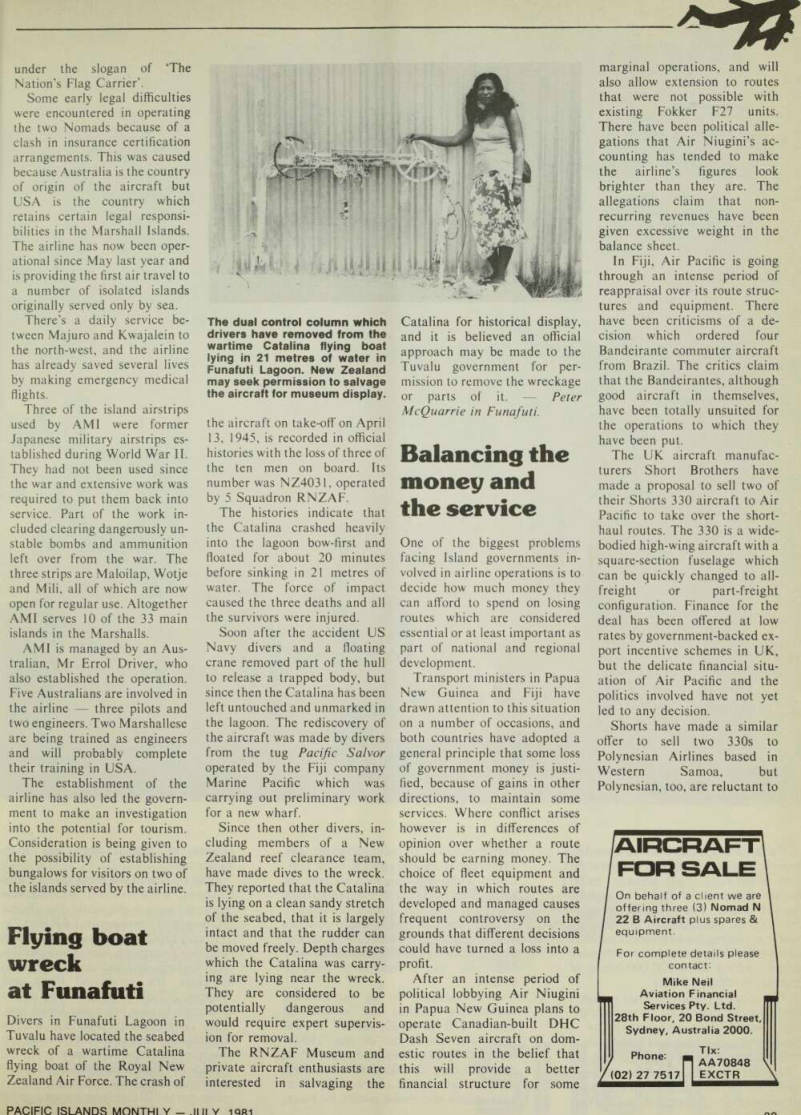
Divers in Funafuti Lagoon in Tuvalu have located the seabed wreck of a wartime Catalina flying boat of the Royal New Zealand Air Force. The crash of
the aircraft on take-off on April 13, 1945, is recorded in official histories with the loss of three of the ten men on board. Its number was NZ4031, operated by 5 Squadron RNZAF.
The histories indicate that the Catalina crashed heavily into the lagoon bow-first and floated for about 20 minutes before sinking in 21 metres of water. The force of impact caused the three deaths and all the survivors were injured.
Soon after the accident US Navy divers and a floating crane removed part of the hull to release a trapped body, but since then the Catalina has been left untouched and unmarked in the lagoon. The rediscovery of the aircraft was made by divers from the tug Pacific Salvor operated by the Fiji company Marine Pacific which was carrying out preliminary work for a new wharf.
Since then other divers, in cluding members of a New Zealand reef clearance team, have made dives to the wreck.
They reported that the Catalina is lying on a clean sandy stretch of the seabed, that it is largely intact and that the rudder can be moved freely. Depth charges which the Catalina was carry ing are lying near the wreck.
They are considered to be potentially dangerous and would require expert supervis ion for removal.
The RNZAF Museum and private aircraft enthusiasts are interested in salvaging the
Catalina for historical display, and it is believed an official approach may be made to the Tuvalu government for per mission to remove the wreckage
or parts of it.
Peter
McQuarrie in Funafuti.
Balancing the
money and
the service
One of the biggest problems facing Island governments in volved in airline operations is to decide how much money they can afford to spend on losing routes which are considered essential or at least important as part of national and regional development.
Transport ministers in Papua New Guinea and Fiji have drawn attention to this situation on a number of occasions, and both countries have adopted a general principle that some loss of government money is justi fied, because of gains in other directions, to maintain some services. Where conflict arises however is in differences of opinion over whether a route should be earning money. The choice of fleet equipment and the way in which routes are developed and managed causes frequent controversy on the grounds that different decisions could have turned a loss into a profit.
After an intense period of political lobbying Air Niugini in Papua New Guinea plans to operate Canadian-built DHC Dash Seven aircraft on dom estic routes in the belief that this will provide a better financial structure for some
marginal operations, and will also allow extension to routes that were not possible with existing Fokker F 27 units.
There have been political alle gations that Air Niugini’s ac counting has tended to make the airline’s figures look brighter than they are. The allegations claim that non recurring revenues have been given excessive weight in the balance sheet.
In Fiji, Air Pacific is going through an intense period of reappraisal over its route struc tures and equipment. There have been criticisms of a de cision which ordered four Bandeirante commuter aircraft from Brazil. The critics claim that the Bandeirantes, although good aircraft in themselves, have been totally unsuited for the operations to which they have been put.
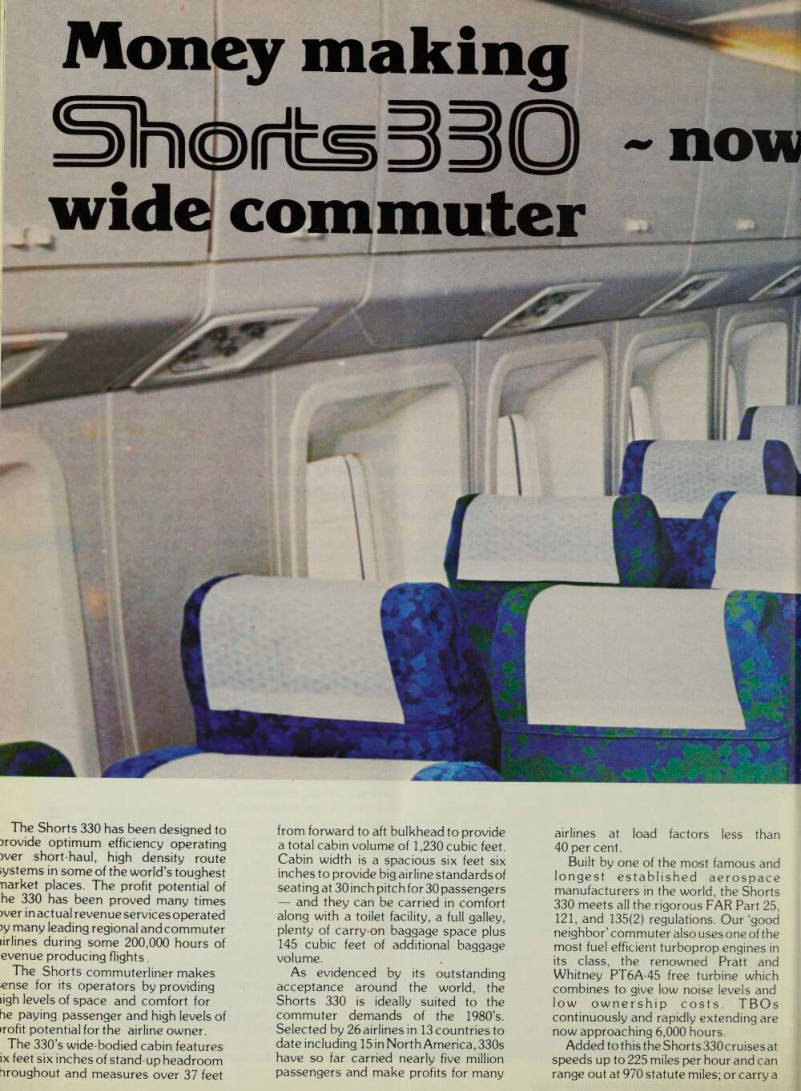
The UK aircraft manufac turers Short Brothers have made a proposal to sell two of their Shorts 330 aircraft to Air Pacific to take over the short haul routes. The 330 is a wide bodied high-wing aircraft with a square-section fuselage which can be quickly changed to all freight or part-freight configuration. Finance for the deal has been offered at low rates by government-backed ex port incentive schemes in UK, but the delicate financial situ ation of Air Pacific and the politics involved have not yet led to any decision.
Shorts have made a similar offer to sell two 330 s to Polynesian Airlines based in Western Samoa, but Polynesian, too, are reluctant to
The dual control column which drivers have removed from the wartime Catalina flying boat lying in 21 metres of water in Funafuti Lagoon. New Zealand may seek permission to salvage the aircraft for museum display.
commit themselves to replacement equipment. Polynesian took delivery only a few weeks ago of a Boeing 737 jet for regional international operation, a move which has heavily committed the airline and which has attracted some criticism on grounds of the revenue which may be generated.
In Fiji recently the Prime Minister, Ratu Sir Kamisese Mara, conceded that Air Pacific was in a‘serious and precarious financial situation’ but he did not enlarge on the reasons which might have led to this situation.
Ratu Mara made his statement when commenting on the responsibilities which governments held to provide transport links within the increasingly unified Pacific region. His comments were based on his government’s refusal to pay a direct subsidy to the Pacific Forum Shipping Line. Such a subsidy was simply not in the national interest, he said, but added that Fiji was not unmindful of regional responsibilities.
Ratu Mara continued: ‘Many critics of Fiji’s position ignore the many sacrifices we have already made in the interests of regional co-operation. Air Pacific, for instance, is in as serious and precarious a financial position as the Pacific Forum Shipping Line. As the majority shareholder in the airline, the people of Fiji have had to carry the burden of supporting Air Pacific in main taining its operation to Island countries such as Tuvalu, Kiri bati, Vanuatu and Solomon Islands. ‘Yet countries which are pressuring us to offer direct cash subsidies to the Pacific Forum Line have made no call or offer for direct support for Air Pacific to help it cover the mounting losses it is having to incur to maintain air services to these Island countries, ‘lf Fiji agreed to give direct subsidy to the Pacific Forum Line, would our regional part ners in the Forum Line and in Air Pacific also agree to do likewise for Air Pacific?’