to co-operate
pp. 26-30 · Read in the full issue
Expert tells airlines to co-operate or fail to survive
An expert consulted by the Association of South Pacific Airlines has conceded it would now be ‘unrealistic’ to expect international airlines in the Islands to form a single regional airline, but he has warned that some method of joining forces is ‘desperately needed’.
Massive co-operation and the
burying of national prestige are now the only answers to ensure survival, he believes.
The comments come from Mr Juney Dillenbeck, vice president of consulting services for the Scandinavian Airlines System. At the invitation of the South Pacific Airlines Associ ation he investigated the history
of how individual airlines developed their international services out of the Island countries, and ot t . , looked at the controversy over whether the Islands would have been better off if they had developed a single regional airi- m;. • 7 line. His investigation was confined to international oper ations, and did not take in domestic or third-level operat,ons - Referring in passing to light aircraft domestic operations,
Mr Dillenbeck said that oper ations of this type ‘are almost always uneconomic, and subject to political and social pressures as directed by governments’. He
The big four Island-owned air lines in the South Pacific region Air Nauru, Air Niugini, Air Pacific and Polynesian Airlines.
A consultant claims that a single face to the world and a burying of some national ident ity is necessary if these and smaller operators are to survive on international routes.
said that in most countries domestic light aircraft oper ations were generally accepted as an essential part of the internal transport system, and accordingly received govern ment subsidies and incentives.
Mr Dillenbeck’s company, SAS, is itself the result of an amalgamation of airlines based in Scandinavia, but in his report to the South Pacific operators he said the Islands situation had now reached a stage where any full regional amalgamation ap peared unacceptable to the countries concerned because of their commitments and their attitudes to national identity.
In his report he said: ‘There is a need to develop a scheme for extended co-operation between the regional airlines of the South Pacific Islands as a systematic long-term project.
Due to the political obstacles and the vast geographic spread it may be unrealistic to aim for a complete one-carrier concept as happened with the Scan dinavian Airlines System. How ever there is much to be gained if at least some close-lying and politically linked islands (say three to five airlines) seek methods of joining forces in order to achieve economic, op erational and large-scale benefits which are so desper ately needed in the present situation. ‘As very amply documented in files from earlier years, the concept of a regional airline has long prevailed, but unfortu nately failed for various reasons. ‘All parties would have fared better if the project had been realised some 10 years ago. But it is never too late, and in my opinion the airlines involved now have no other alternative for survival than entering into a massive co-operation project in all possible fields of activity, and once and for all burying national prestige.’
Mr Dillenbeck then made 14 specific proposals which he said should provide the framework for the long-term introduction of ‘massive co-operation’. His proposals in summary are: 1. Instead of each airline trying to do all its own mainten ance and overhaul, the work should be divided between air-
lines with each concentrating on a specialised basis. 2. A joint approach should be made to the oil companies to bargain for fuel contracts. 3. Airlines should avoid ap pointing their own representa tives in locations where a single sales office could handle all the business. 4. Agreed joint proposals between all airlines should be submitted to all governments when negotiating route and policy arrangments. 5. Airlines should aim for greater standardisation of fleets and equipment and should have joint consultations when buying or selling aircraft. 6. There should be a united front in negotiating traffic rights and routings when deal ing with airlines from outside the ‘Pacific airlines system’. 7. Airlines should avoid ap pointing their own ground hand ling supervisors or duplicating equipment in locations where a single airline could carry out all the ground handling. 8. A joint scheduling com mittee should be formed with full authority to integrate traffic programmes, and the airlines should not compete between themselves when negotiating programmes with outside air lines. 9. The European system of commercial pools should be established on high-density routes to ensure a fair sharing of revenue in relation to capacity. 10. The placing of joint ad vertising and the issue of joint integrated timetables should be investigated.
11. Agreement should be reached, and religiously obeyed, on uniform fares and other conditions of travel. 12. A centrally-located joint training centre should be estab lished preferably with the financial support of the govern ments involved to train and standardise staff in sales work, accounting, administration and general airline station work. 13. A central authority should be developed, possibly the existing Association of South Pacific Airlines, to act as international representative and negotiator in the world airline structure. 14. The general managers of each of the Island regional airlines should form a regional management committee to sort out unforeseen problems.
Mr Dillenbeck made a series of detailed proposals on how to implement his suggestions. He said that although some of his proposals might tend to sub merge national identity, he be lieved that this had to be tolerated in the interests of survival. A united front inter nationally would significantly increase the impact and the bargaining power of the air lines, he said. He suggested, too, that where airlines used their own names they should
add ‘Member of the Pacific Airline Group’ or The Unity of Pacific Airlines’.
Mr Dillenbeck’s proposals are now being discussed among members of the Association of South Pacific Airlines.
Forum looks
at pooling
for airlines
The possibility of pooling air craft and aircraft maintenance facilities in the overall interests of Pacific air services is one of several lines of inquiry being followed by a committee rep resenting Pacific governments.
The committee, known as the Advisory Committee on Re gional Civil Aviation, was spon sored by the South Pacific Forum. The Forum represents 10 independent Island countries together with Australia and New Zealand. Two factors are reported to be handicapping any immediate practical devel opments from the inquiries of the advisory committee. The first concerns the membership in the Forum of Australia and New Zealand. In many regional matters this is welcomed by the Island countries, but they are reluctant to enter any ‘tight’ airline operating links which might submerge their identities under the more powerful airline structures of Australia and New Zealand.
The second factor is the very real desire of the Island countries to establish airlines which are national flag carriers.
As a concept each country wants its own airline rather than a share in a regional operation.
Some of the terms of refer ence of the Advisory Com mittee are more likely to have results, however. These include moves for integrating fare structures, for standardising some equipment and pro cedures, and for inter-airline co operation.
Since the South Pacific Fo rum was established in 1971 civil aviation has been a subject of discussion at every meeting.
In early discussions there was interest in proposals for a single regional airline, but this faded as each country became more
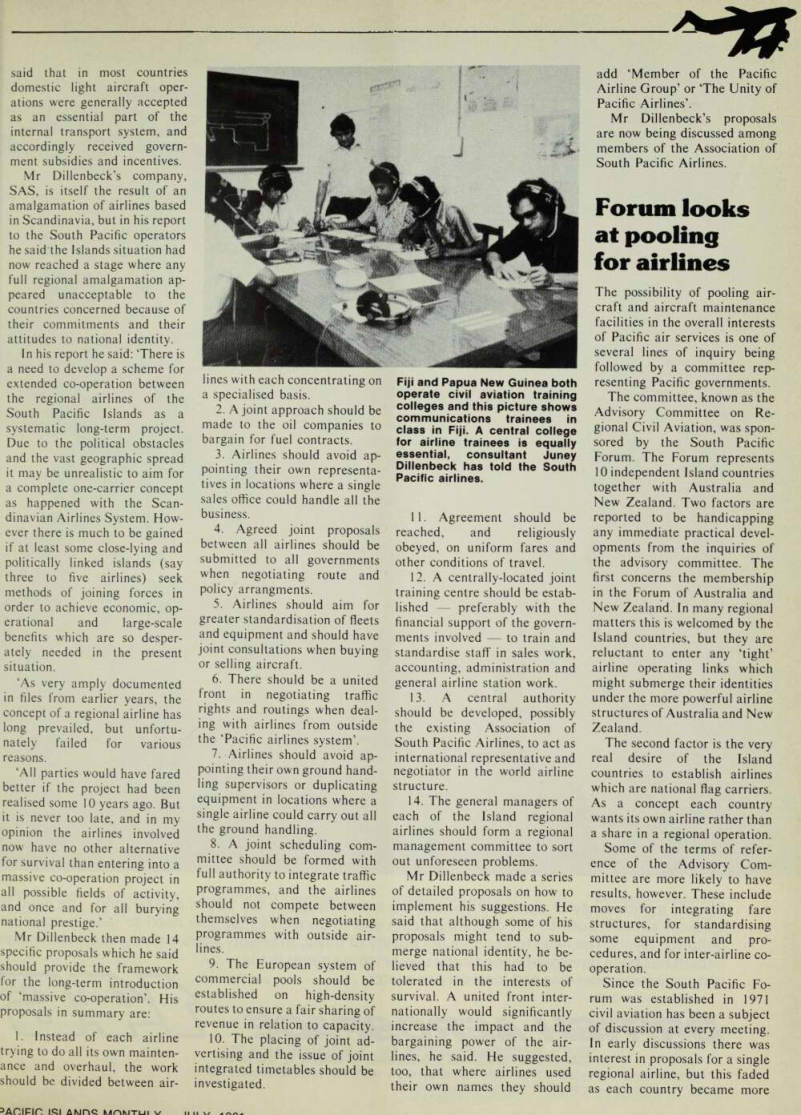
Fiji and Papua New Guinea both operate civil aviation training colleges and this picture shows communications trainees in class in Fiji. A central college for airline trainees is equally essential, consultant Juney Dillenbeck has told the South Pacific airlines.
heavily committed to its own airline affairs. Fiji deliberately chose the name of Air Pacific the name was previously Fiji Airlines because of regional possibilities which subsequently were not attained.
The South Pacific Forum’s involvement in regional aviation was formalised at a meeting in 1976 when member countries established a ministerial-level body known as the South Pacific Civil Aviation Council.
It is a consultative body with the general responsibility of dealing with aviation matters of common interest to the South Pacific countries. Its members are Australia, New Zealand, Cook Islands, Fiji, Kiribati, Nauru, Niue, Papua New Guinea, Solomon Islands, Tonga, Tuvalu and Western Samoa.
The Advisory Committee on Regional Aviation, consisting of expert officials, was then estab lished as an adjunct to the council.
The advisory committee has a continuous responsibility to investigate and report on the following matters: Airline fa cilities, including tourist infra structure; route requirements in the region, including possible impediments to proposed new routes; the social and economic benefits arising from air ser vices; cost benefit studies; the co-ordination of scheduling be tween airlines; the possibility of pooling aircraft, technical maintenance and general airline resources; the possibility of joint promotion; forward plan ning for the region, including moves for greater standardis ation of equipment; fare struc tures; regional incentives and ethics.
Air Tungaru
now has
its own Jet
Air Tungaru, the national air line of Kiribati, is the latest of the new nation airlines in the Pacific to enter the jet club. The airline has taken delivery of a Boeing 727 to operate its inter national link from Tarawa to Honolulu and from Honolulu to Tahiti.
Air Tungaru, which is wholly
owned by the government, was formed in April 1978 although it did not begin operating until last year. It operated its original international service to Hono lulu with a Boeing 727 leased from Air Nauru, but now oper ates its own aircraft on the route with an extension to Tahiti.
The airline has been using Britten-Norman Islanders and Trislanders for its internal ser vices, but the internal fleet is also being expanded. A 16-seater Heron was delivered in May, and a Spanish-designed CASA short-field aircraft is due for delivery in July. The CASA
is a little-known aircraft in the Pacific, although it is used in South-East Asia and for some years has been manufactured under licence by the Indonesian government aircraft factory. It is similar to a Short Skyvan in appearance with a square section fuselage, high wing and two turbine (prop-jet) engines.
There has been some criticsm of Air Tungaru for the high degree of diversification which it has created in a com parativelly small fleet, but the airline claims that it has chosen units tailored to the require ments of the routes being flown.