brought lunch
pp. 14-18 · Read in the full issue

Tropicalities
Unorthodox,
but a seagull
brought lunch
A seagull which had gorged itself on fish was a factor in the salvation of two Ni-Vanuatu men who spent 20 days adrift in a crippled plywood boat in April-May: the bird delivered their lunch when it landed on the boat one day and promptly vomited six small fish out on the deck. Four flying fish also oblig ingly paid for them fatal visits.
The men, Petersen leri and Meli Whitecross, set out from Tanna on April 17 for their home island of Aniwa. Halfway between the two islands the boat’s engine failed.
An air and sea search for the two was called off after a few days. The men saw the search plane on April 19, but seas were rough and the aircraft was flying too high to see their signals.
The men lived mainly on uncooked yam, taro and kumala which they had on the boat.
They drank salt water when their fresh water supply ran out, and look turns in swimming out to retrieve coconuts they sighted bobbing past their boat.
On April 26 they were able to catch rainwater in a plastic container. This lasted them a week.
The two men ran out of food on May 4, but on May 7 they sighted the Korean fishing vessel Sam Song 17. Smoke from a mat which they burnt as a distress signal was seen by Korean fishermen and they were immediately picked up.
Four hundred people were at Port-Vila’s main wharf to wel come them when they arrived on May 13.
At the time of their rescue they were south of San Cristobal in Solomon Islands.
Petersen leri is a former
sailor, trained by the British under the old condominium.
This training stood the two men in good stead during their ordeal. But Mr leri is modest about it. He says his faith in God kept fear at bay. T knew we would be saved,’ he said.
Red faces over
Fiji textbook
‘Who in the Ministry of Edu cation approves the publication of its textbooks? Does the Min ister himself read the textbooks written by his staff at the Curriculum Development Unit?’
So began a reader’s letter in a May issue of The Fiji Times which was to send shockwaves through the country’s education hierarchy.
Correspondent Miss M.
Thomas, of Macgregor Road, Suva, quoted extracts from a new social science textbook.
Making Decisions — Teachers’
Guide, which certainly did not sound as if they had ever been subject to official scrutiny.
She quoted from page 20 of the textbook: ‘The Fiji Islands is a small country with many contrasts. It has a population which comprises native Fijians who lead a primitive livelihood of subsistence farming; and the Indians and Europeans who have a background of advanced technology and literacy. While the natives see their salvation in land. Indians and Europeans take refuge in business enter prise and education as an outlet for their progress.’
Miss Thomas asked rhetorically: ‘ls all this fact or prejudice? Does this describe Fiji? Is this the kind of nonsense the ministry pays its social scientists to come up with?’
Two days later an embar rassed Secretary for Education, Epeli Kacimaiwai, in a state ment appearing on the front page of the Times, said that the book had reached the govern ment printer ‘without the nor mal channels having been fol lowed’. It had therefore been printed ‘without proper author isation’.
Mr Kacimaiwai said of the passage quoted: ‘lt is regretted that there is a serious error of fact in the second paragraph.’
He then gave what many might suspect was a hastily improvised ‘authorised version’ of the passage, saying: ‘lt should have read as follows: “It has a population which com prises Fijians who have emerged from a livelihood of farming and Indians and Europeans who have a back ground of more advanced tech nology and a longer period of literacy.” ’
Mr Kacimaiwai said the paragraph and, if necessary, other parts of the book would be revised.
It seems fair enough to give the last word to Miss Thomas, who, after all, aired the affair in the first place. At one point in her letter she wrote: ‘School textbooks should be factual.
When an author writes about another culture, one that he seems not to understand at all,
he can at least be courteous. It is sad and frustrating to see someone inflicting 19th-century beliefs on our school children, and at the taxpayer’s expense
Fiji honeymoon
for Charles?
American Richard Evanson is a man with ideas about where Prince Charles and Lady Diana Spencer should spend their honeymoon after their July wedding: he has offered them his very own Turtle Island resort in Fiji free of charge for the occasion. (The island, known in Fijian as Nanyalevu, is in the Yasawa group.) The resort has accommo dation for 16 guests. The island also houses the set for both versions of the film. Blue La goon.
Prince Charles is known to
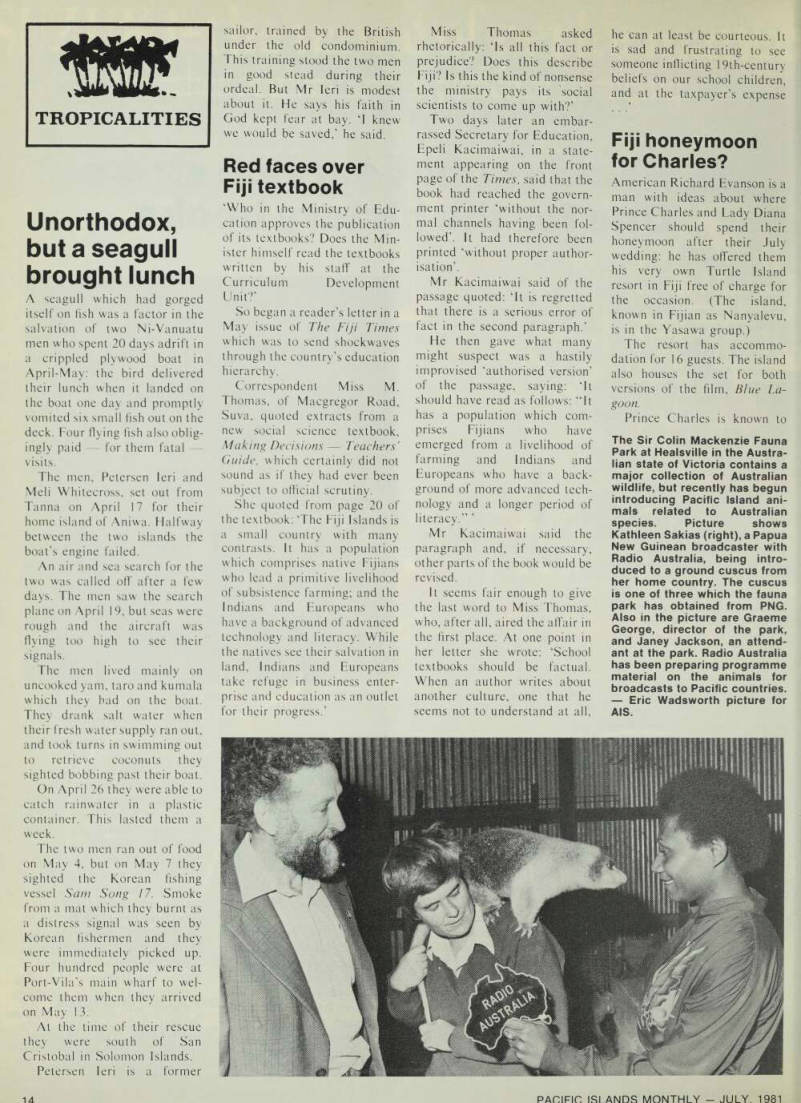
The Sir Colin Mackenzie Fauna Park at Healsville in the Austra lian state of Victoria contains a major collection of Australian wildlife, but recently has begun introducing Pacific island ani mals related to Australian species. Picture shows Kathleen Sakias (right), a Papua New Guinean broadcaster with Radio Australia, being intro duced to a ground cuscus from her home country. The cuscus is one of three which the fauna park has obtained from PNG.
Also in the picture are Graeme George, director of the park, and Janey Jackson, an attend ant at the park. Radio Australia has been preparing programme material on the animals for broadcasts to Pacific countries. -Eric Wadsworth picture for
Ais.
have a soft spot for Fiji, which may be the only country in the world to have a public holiday for his birthday. This honours his position as heir to the throne.
Game fishing
in Hawaii
Hawaii is staging two major big game fishing tournaments in the course of July-August.
They are the Hawaiian
National Championship Billfish
Tournament (from July 17-24), followed by the Hawaiian Inter national Billfish Tournament July 24-August 2).
The former event, now in its Tfth year, was established as a ough qualifying test for the alter, which celebrates its 23rd this (northern) summer.
Ten US mainland states will >e represented by 30 teams in he first tournament. They are Maska, California, Colorado, daho, Nebraska, Nevada, Oregon, South Carolina, Utah nd Washington. (Hawaii as lost is excluded from the con est.) Winners of last year’s
lational championship were the
lan Francisco Golden Caters of California. Under the leader hip of captain Jerry Davia, the lan Francisco team caught a
total of four marlin in the four days of tournament fishing and, with earned bonus points, scored 1325 points to sweep the field of 30 entries. The Californians were later ex tended an invitation to compete in this year’s international tour nament.
The governors of the Hawaiian International Billfish Association (HIBA) have also opened a special foreign section in the national championship.
This section serves as a qualify ing test for foreign-country teams trying to earn a place in the line-up of entries selected by their own country’s officials to go to Hawaii to represent their country in the ‘international’.
Australia this year has four teams appearing in the inter national tournament, with nine others in the foreign section of the national event. The teams competing in the national tour nament hope to win the foreign section competition and, per haps, unseat their fellow Aussies now representing the great southern continent in the international tournament.
It is expected that teams from 20 countries will take part in the ‘international’. From a newsletter of the Hawaiian International Billfish Associ ation.
Palau MPs ban
smokes, betel
In a move that would have the Governor of Yap John A.
Mangefel spluttering in his sleep for days on the one hand, and the US Surgeon-General jumping and kicking his heels in jubilation on the other hand, the House of Delegates of the First Olbiil Era Kelulau (Palau National Congress) has banned cigarette smoking and chewing betelnut in its chamber, reports the OEK public information officer Bonifacio Basilius.
The ban, which was the subject of a heated argument among Palau's delegates, was adopted by the barest of mar gins it took Speaker Carlos Salii himself, the presiding officer in the House of Del egates, to break the tie. Speaker Salii, a non-betelnut chewer but a chain smoker, became the object of intense lobbying from the two groups, and after he sided with those who advoca ted a smoke-and-betelnut-free chamber, many a dire predic tion was made about the immi nent collapse of the betelnut industry in the Republic.
Some say that the calamity might even be more serious, considering the fact that certain national fathers might expire prematurely at their legislative desks if deprived of their betelnut for an extended period of time.
The proponents of the ban claim, however, that the new rule has some beneficial effects aside from clearing the house chamber of smoke and betelnut stains.
They said that because the ban would result in frequent recesses to allow the other half of the house to step outside and take a puff or have a bite of betelnut, the usually lengthy debates would be cut in half, which, in turn, would materially reduce the cost of papers and overtime salaries of house staff, and the republic itself will, in the end, benefit from the ban.
Woe to the unwary who might enter the Olbiil Era
Kelulau house chamber with betelnut in his cheek or a cigarette dangling between his lips. The house sergeant-at arms has been instructed to escort such offenders out of the premises in accordance with the new-found decorum in the Palau house of delegates.
From the Marshall Islands Journal.
Rotuma marks
centenary
Rotuma, Fiji’s ‘split island’, in May celebrated the centenary (PIM Apr plO) of its cession to Britain.
Despite poor weather on the first two days of the three-day festivities, the third and most important day was clear and sunny, and the happy, festive spirit which had earlier been lacking was evident every where.
Fiji’s Governor-General Ratu Sir George Cakobau and Prime Minister Ratu Sir Kamisese Mara took part in the cel ebrations. In a message from the Queen read by the governor general, she said: ‘The decisions taken a century ago by the chiefs of Rotuma to join her destinies with Britain and again by their descendants in 1970, to remain part of the Fiji nation, were both based on trust and confidence. ‘I am glad that in both cases their decisions proved fruitful and have demonstrated their loyalty.’
Of the hundreds of visitors for the occasion, a large per centage were Rotumans who were returning to their island for the first time in many years.
It was not uncommon for visi tors to be treading the soil of their home island for the first time in 30 years.
There was a general ban on sales of the island’s famous orange wine ‘until after the visitors leave’. Except for a Royal Fiji Navy officer who had a bit too much to drink at the prime minister’s cocktail party, there was little in the way of wild revelry.
Transport, always a problem on Rotuma, was even more a problem during the cel ebrations, and people from many of the island’s more remote villages had difficulty in
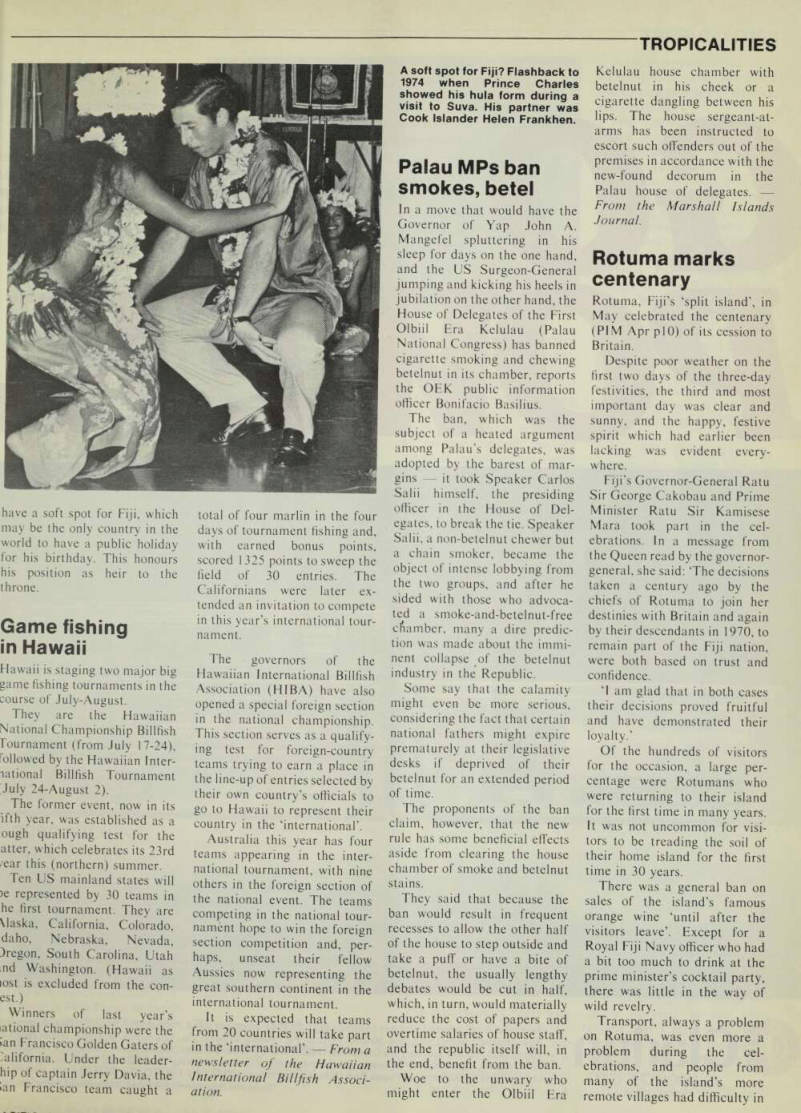
A soft spot for Fiji? Flashback to 1974 when Prince Charles showed his hula form during a visit to Suva. His partner was Cook Islander Helen Frankhen.
reaching Ahau, or returning at the end of the day.
Rotuma’s centenary cel ebrations created problems for others too; more than 1200 canecutters were reported stranded on small islands wait ing to get to Vanua Levu because the ships needed to get them to work were used to carry guests to the Rotuma cel ebrations. As a result, on one day only 800 cutters were available to supply the Labasa mill, which had to close for some time because it was not getting enough cane.
Vanuatu notes
‘the greatest’
Vanuatu’s new currency notes will be the finest in the Pacific, according to the country’s Finance Minister Kalpokor Kalsakau.
He said he’d made a careful study of notes from every Pacific country, and was confident the Vanuatu designs would be superior to any other.
The notes, whose design was still secret when Mr Kalsakau spoke, are being printed in England.
Because he still had some doubts about certain aspects of the designs, Mr Kalsakau had asked general manager of the Central Bank John Howard to go to England to check on them.
Mr Howard had shortly be fore visited Australia where he had discussed the currency change-over with Australian officials. The return to Australia of Australian banknotes at pres ent in use in Vanuatu was also discussed.
Pagan survivor
tells of terror
Residents of Pagan Island, Northern Marianas, survived molten lava and choking gases from a volcanic eruption in May 'PIM Jun p 6) by hiding in bat filled caves.
A Japanese freighter plucked 53 people off the ash-choked sland and transferred them to a US ship. A 54th Pagan resident *vas on another island when the ong-dormant volcano erupted.
The eruption had been sig lalled by ‘bad earthquakes, and he whole island was shaking,’
resident Ben Aldan told a United Press International re porter in Guam.
T grabbed my wife and two children and headed for the beach. We jumped into a canoe and paddled across the bay away from the volcano.’
Mr Aldan said ash rained down and the heat was nearly unbearable. ‘We could see fire coming out of the volcano. The island was still shaking,’ he said. ‘I thought we were all going to die.’
Willi Willi in
big trouble
The big racing yacht Willi Willi was reported in danger of breaking up in May after strik ing a mudbank off Kupiano, a coastal town about 150 km southeast of Port Moresby, Papua New Guinea.
Willi Willi won international fame under her former name Ragamuffin 11. She is said to be worth about SAISO 000.
Shortly before the grounding incident, the yacht had taken out line honours in a race between Cairns (in Queensland, Australia) and Port Moresby.
Her owner-skipper, Joe Goddard, said: ‘We struck mud like quicksand, and it just
swallowed us up.’
Michael
Prain in Port Moresby.
Tuvalu and its
kissing cousins
Tuvalu is amending its mar riage laws.
Supporting the Marriage Amendment Bill in parliament.
Minister for Communications Ilaoa Imo pointed out that marriage in Tuvalu is getting more and more difficult, since nearly everybody is related to one another through the old custom of forbidding marriages as distant as between sixth or seventh cousins.
Part of the purpose of the amendment is to allow mar riages as close as third cousins.
Commenting on the bill, the member for Nui, Lale Seluka, said the new provisions contra dict tradition and custom, but he saw the need for some change.
But, he said, he would be happier if the prohibition on marriage to third cousins were maintained.
Cassowary film
a winner
An Australian Broadcasting Commission film on a tra ditional cassowary exchange ceremony in the Southern High lands of Papua New Guinea has won a major Australian TV award.
The film, Bird of the Thunderwoman, earned a ‘Logie’ for the best single docu mentary shown on Australian TV in 1980.
ABC cameraman and pro ducer David Parer lived with the Wola people near Nipa for five months while shooting the film.
The documentary deals with preparations by the Wola for a cassowary exchange with the Halalinja an event which is part of a much larger ritual which has a 15-year cycle.
In the ceremony filmed, 30 to 40 adult cassowaries are killed and carried in a day of dancing and feasting.
The ‘Logie’ is not the first award for the film. David Parer’s work on it has also won him the Australian Film Insti tute’s award for best film pho tography. His uncle, Damien Parer, was a famous Australian war camera man who won several awards for his work in PNG in World War 11.
David Parer thanked two officers of the PNG Govern ment’s Wildlife Division, Peter Lakamc and Allan Pasisi, who worked as his sound recordists.
He said the film would not have been possible without the active help of the division, and the ‘tremendous assistance’ given by Paul Sillitoc, an anthropol ogist working in the Southern Highlands.
The ABC’s representative/ correspondent in Port Moresby Sean Dorney has presented a 16 mm print of Bird of the Thunderwoman to Director of Wildlife Karol Kisokau for screening and archival pur poses.
The documentary has been sold to the BBC for TV screen ing in Great Britain.
Islanders seek
A-test damages
More than 300 Marshall Islanders have taken legal ac tion against USA claiming damages arising from nuclear tests between 1946 and 1958.
Another 600 claims are ex pected to be lodged in the next few months.
The claims have been lodged in Washington, the US capital, by lawyers representing people on 13 atolls and islands in the Marshalls. The claims allege personal injury, property dam age and ‘cultural disruption’ suffered during the testing of more than 60 nuclear devices in the Marshalls. USA has been administering Marshall Islands as a trusteeship since soon after World War 11.
A spokesman for one of the atolls involved in the legal claims told a press conference in Washington that the people felt they had been neglected and forgotten.
He said that since the tests
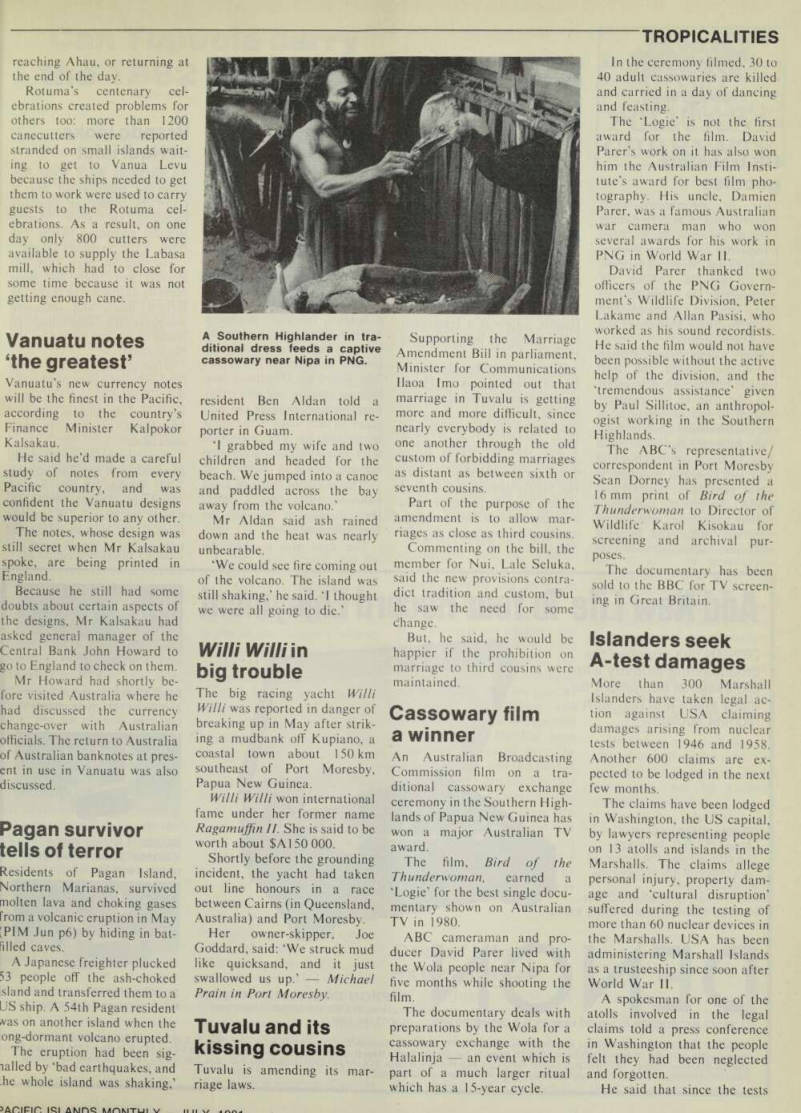
A Southern Highlander in tra ditional dress feeds a captive cassowary near Nipa in PNG.
many of the islanders had suffered from thyroid tumours and vision defects, and there had been a high incidence of deformities at birth.
US transfers
goodies
Title to government-owned property, worth SUS3I million when it was acquired, has been transferred to the new govern ments of the Marshall Islands, the Federated States of Micronesia, the Republic of Belau, and the Commonwealth of the Northern Marianas from the Trust Territory.
High Commissioner Adrian P. Winkel signed the final transfer order in April, transfer ring the title to the property located in the jurisdictions of the constitutional governments.
The transfer included such items as heavy construction and road vehicles and machinery, power generators, hospital and health equipment, communi cations equipment, educational materials, office and business machines, administrative ve
hides, and assorted capital property.
This transfer of property, the first in a series of transfers, is part of the programme of pre paring for the termination of the trusteeship and dividing up the property of the Trust Terri tory government among the new successor governments.
At last, museum
for Marshalls
May 1, 1981, saw the long delayed opening of the Aide Museum at Majuro, Marshall Islands. (Alele is a traditional rolled purse-like bag for storing valuables.) Writing in the Marshall Islands Journal, Akio Heine recalls that the original impetus for the museum arose from the unfortunate death in February 1967 of George Puerschner, assistant director of the Peace Corps for the Marshall Islands.
His family dedicated a sum of money, contributed by various persons, towards the establish ment of a museum in the Marshalls.
Largely through the efforts of such people as Harley C.
Schreck Jr and Peace Corps teacher Lana Boldt, the project moved ahead. A federal aid grant provided for the library, and money for the museum came from contributions from local sources.
Heine writes: ‘ln 1979, elec tions were held for the first Board of Directors and also the Articles of Incorporation were approved. ‘ln 1973 the museum and library building was completed. ‘After that, things lagged for a while. In the meantime Nitijela (Parliament) used the building for offices. And, ac cording to Schreck Jr’s report “the Board (of Directors) then became inactive and no further progress was made on the mu seum. In fact, many of the items assembled for the collection were lost and the corporation actually ceased to function”. ‘That was the situation until February 1980. May 1, 1981, the situation is one of ac complishment.’
The date also marked the
second anniversary of consti tutional government in the Marshalls.
Brando looks
at Nadi islet
An island in Fiji’s Nadi Bay could be transformed into a resort by American interests including the actor Marlon Brando, according to the Tui Nadi, Ralu Napolioni Dawai.
He said in May that Mr Brando had been his guest recently during a stay at the Fiji Regent hotel, and discussed prospects for developing an island in the bay owned by the Nadi people.
After attending a sugar cane farmers’ conference in Mexico, Ratu Napolioni saw the actor again in Los Angeles and was introduced to some business associates. ‘Something very good could come out of it for Fiji,’ he said.
Mr Brando already has an island in French Polynesia which he uses as a private retreat. He has made several trips to Fiji in recent years.