Can Tupuola carry
pp. 19-22 · Read in the full issue
the 1982 election?
Political
Currents
The serious public service strike in Western Samoa (reportpi3) has added to the mounting list of troubles facing the govern ment party in parliament and has strengthened speculation that Tupuola Efi may not sur vive as prime minister after next February’s elections.
In theory Western Samba has a non-party political system, and the term ‘government party’ describes what is essen tially a collection of indepen dents supporting Tupuola as prime minister. But even before the strike added itself to the list of problems facing the govern ment there had been growing movements on party-type lines to campaign for a new govern ment in February.
The opposition, headed by Vaai Kolone and calling itself the Human Rights Protection Party, is now well immersed in a campaign to try for govern ment.
As things now stand Tupuola will most probably be re-elected as a member, but the prime ministership is a different mat ter. He is likely to be elected either from his present constitu ency at Leulumoega and Nofoalii, or from a new con stituency under his Taisi title, generally considered to be more prestigious than his Tupuola title. But his chances of being prime minister next year appear slim because of criticism of the government’s record in hand ling the economy and because of scandals which have troubled his administration. Nonetheless his government will go into the elections with a lot of resources at its disposal and Tupuola’s political machine is also a viable one.
It cannot be denied however that the opposition has a favour able chance of gaining power.
The opposition has the govern ment’s bad record to play on and it offers an attractive alternative to Tupuola’s brand of socialism. It offers a platform which emphasises conservative fiscal policies with emphasis on the private sector instead of the
government playing a major
part in the development of the
economy. And, of course, the opposition will play on the need for change. Tupuola’s govern ment has been in power for two terms, totalling six years, and has probably run out of good ideas for conducting affairs of state.
Critics have argued that the opposition will suffer because its leader, Vaai Kolone, would not make a good prime minister, but this criticism is unfair. Vaai is one of parliament’s longest serving members, has dis tinguished himself in the world of business (he is one of Samoa’s biggest and most suc cessful planters) and his record as a parliamentarian is brilliant especially as a former chairman of the public accounts com mittee. In addition his cabinet would probably include the country’s leading economists and intellectuals the very people the country needs at this time.
Tupuola started off his first term in 1976 in an atmosphere of high optimism to clean government corruption and inefficiency. The rapidity and methods his government used in ridding the public service and other government bodies of its enemies, however, led to trouble and eventually unpopularity. A substantial outcome of this was the formation of the Human Rights Protection Party which had as its first initial major aim the ousting of Tupuola. In the 1979 general elections Tupuola
managed to hold on to power by a single vote.
Then, the economy went from bad to worse mainly as a result of the rising costs of imported fuel, a drastic drop in exports, and over-development.
The result was tighter import controls which affected even basic foodstuffs such as rice, mutton flaps, chicken backs and many other food items. This led to an outcry from merchants and the public.
Export earnings from copra and cocoa have fallen far below projections, although in fairness to the government world price levels have been a contributing factor. But critics blame the government for taking little firm action to offset the situ ation.
The government image was tarnished badly by the dis covery of a systematic misap propriation of funds from the department of health. Two senior public servants and a businessman are facing charges as a result, and a government party politician and other pub lic servants are under investi gation.
Another major source of dis satisfaction with the govern ment is the public service pay situation which led to strike action.
Tupuola Eft’s dedication to his position is not doubled and his motives in the national interest are not questioned. But there is a widespread feeling in the electorate that his policies are simply not working, and that there is a lack of expertise in his cabinet. He has been under intense strain over the last three years, and this too has contributed to speculation that the electorate will want change in the interests of bringing new life into government and the nation. But clearly he will not relinquish his position without a fight, and the fight will be
tough.
Leulu Felise Va’a in
Apia.
Cooks’ latest
extravaganza
The Cook Islands seem to have a flair for political extrava ganza. In 1978, it was the flying-in of voters from New Zealand, and the ultimate de posing of the Cook Islands Party government. This year, it
is the Constitution Amendment (No 9) Bill which, among other changes, increases the maxi mum parliamentary term from four years to five. This change alone has been enough to spark heated debate among the people of the Cooks, and has culminated in a petititon to the Legislative Assembly. By mid- May, the petition had been signed by over 3000 eligible voters.
It is indeed a curious situ ation when a government is able to vote itself an extension of its term of office. However, the Democratic Party government has some good reasons for doing so. Deputy Premier Dr Pupuke Robati told me in an interview that the prime reason for ex tending the parliamentary term was to give the government more time to deal with econ omic problems, and enable it to forget about campaigning and the elections. He added: ‘lf we were going to have elections next year, we’d be wasting our time campaigning. It’s much better to spend our time dealing with our problems, economic problems, rather than trying to win elections.’
Dr Robati also said that the idea of extending the term was proposed at a Democratic Party convention, not by Cabinet members themselves.
He said that a further reason why the present government needed more time was because of the state of disarray in which affairs were left by the previous (Cook Islands Party) govern ment. His final point was that there is nothing illegal about the amendment it is in accordance with the consti tution and the law of the Cook Islands.
The petitioners’ point is, of course, that if the constitution allows a government to do this, then the constitution must be changed to protect the rights of the voters. Indeed, many of those who have signed the
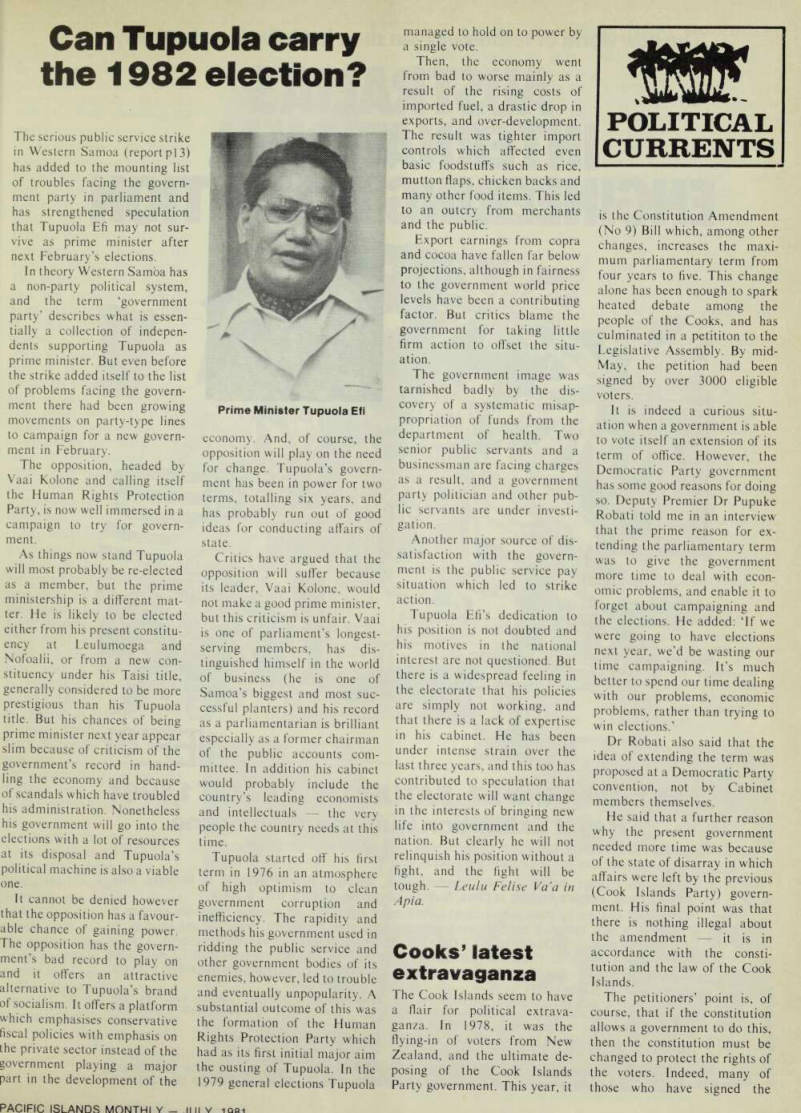
Prime Minister Tupuola Efi
petition do not object in prin ciple to a five-year term, but to the way the Democratic govern ment is pushing this bill through without consulting the voters.
The members of the Petition Action Committee (those who drafted and circulated the pet ition) have shown their determi nation by publishing a ‘news paper’, The Petitioner, which presents their views. The basic message to the people of the Cooks is, ‘Protect Your Rights’.
The publication also suggests that the Democratic govern ment wishes to extend its term of office for purely selfish reasons that an extra year in office will qualify many mem bers of the Legislative As sembly for generous superannu ation benefits. The Petitioner also points out that if the Democratic government has been unable to improve the state of the economy in the three years that they’ve held office, what makes them think that another year will make any difference?
No doubt the Democratic government is surprised by the reaction its bill has inspired.
Interestingly enough, a five year term bill was brought to the Legislative Assembly by the Cook Islands Party in May 1978. Any Constitution Amend ment Bill requires three read ings, with a 90-day period between the second and final reading. The CIP bill never did go through as the government changed hands on July 24, 1978, before the 90-day period was up. At that time, the Democratic Party opposed the five-year term. This year, the 90-day period expired on May 13.
Though this constitutional amendment is controversial, the Democratic government is fol lowing the law, right or wrong, and they are legally entitled under the Cook Islands consti tution, as it stands, to extend the parliamentary term to five years. The effects of the petition remain to be seen.
The Constitution Amend ment (No 9) Bill includes nu merous other changes. Among the more important amend ments are the following. The electoral system will be revised, and electorates will be divided,
so that the Cooks will follow a ‘one man, one vote’ system.
Another change is that the number of members of the Legislative Assembly will be increased from 22 to 23 the 23rd member will be elected by eligible voters living overseas.
Further, in keeping with stan dard Commonwealth termin ology, the Premier will become ‘Prime Minister’ and the Legis lative Assembly will become ‘Parliament’. There are also various changes to the judicial system, including abolition of the Land Court and the transfer of its jurisdiction to the High Court. Other changes deal with public service appointments, and the national ensign and anthem.
Though all these are import
ant amendments to the consti tution of the Cook Islands, none is as politically sensitive as the extension of the parliamentary term. This aspect of the bill will invariably be the focus of public debate for many years to come.
Paul Rysavy in Rarotonga.
Spc’S ‘P&E’
meeting
The South Pacific Com mission’s Planning and Evalu ation Committee met in Noumea in May. The ‘P&E’ meetings, as they are known, are where the commission’s real work is done. The SPC confer ence, on the other hand, is all golf and parties, leavened by a little work for the sake of appearances important, it is true, but not in the same way as the P&E.
Once, you could always be sure that at the P&E meeting the participating governments would increase the previous year’s budget by 10% one year I seem to remember the rise was 15% and some years they did their whole perform ance in public.
But they’ve since gone be hind closed doors and again this year, as in 1980, there has been no budget increase.
By any standards, a frozen budget seems quite ridiculous in this day and age. After all, the 10% rise only barely covered inflation, and didn’t help the works programme much at all. Ten per cent for
Western Samoa is only about $2OOO, and for Australia $lOO 000 - probably about what the government spends on postage stamps in Canberra every week.
The participating govern ments are the five metropolitan powers United States, United Kingdom, France, Aus tralia and New Zealand plus the independent Pacific nations.
All these pay a fixed rate.
Others about a dozen states and territories set in various relationships with metropolitan powers, chiefly the US and France make volun tary contributions.
At this year’s P&E meeting, Solomon Islands and Tuvalu both appealed for these volun tary contributions to be in creased. The dozen or so non independent states get a lot more out of the commission than they put into it (and rightly so), but some of their contri butions are ridiculously small.
Guam and American Samoa, for example, have a much higher standard of living than Tuvalu (which is tied to a fixed rate), and could obviously do more, in spite of President Reagan and his budget hatchet gang.
But perhaps the main culprits
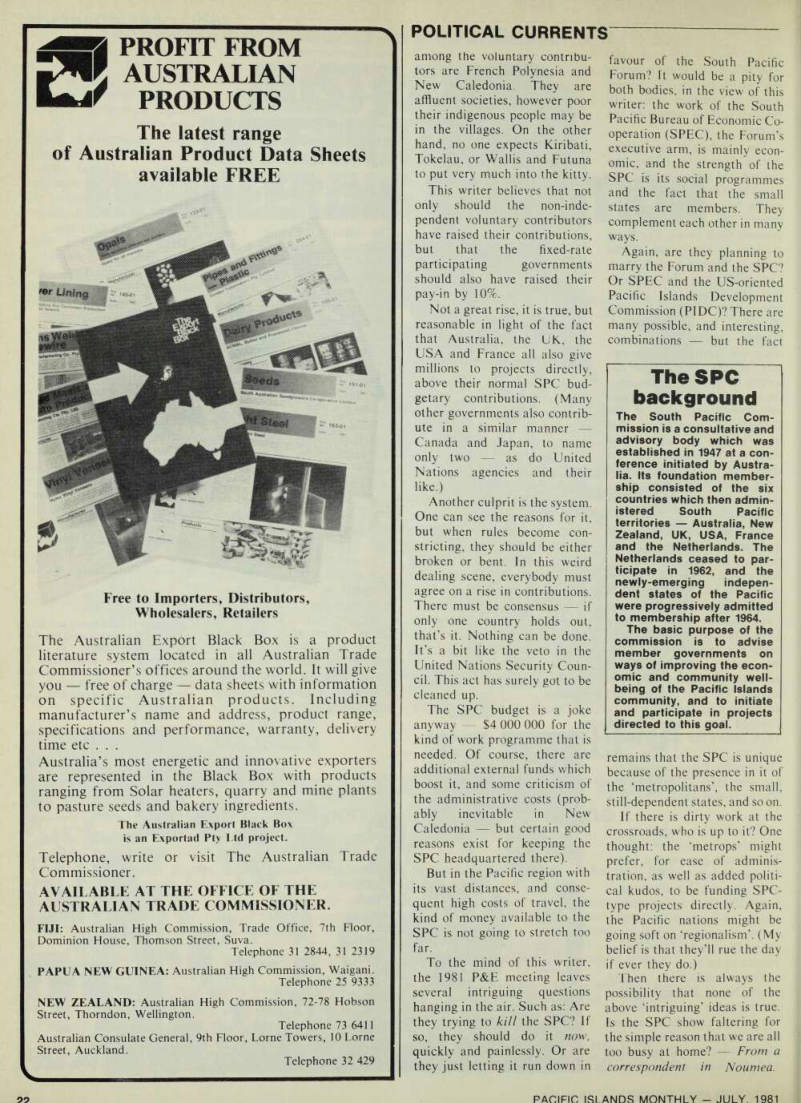
Agricultural extension work is a major SPC activity, and the field day shown here in New Caledonia was sponsored by the SPC. But a PIM special writer suggests the work will wind down unless the SPC gets a bigger budget.
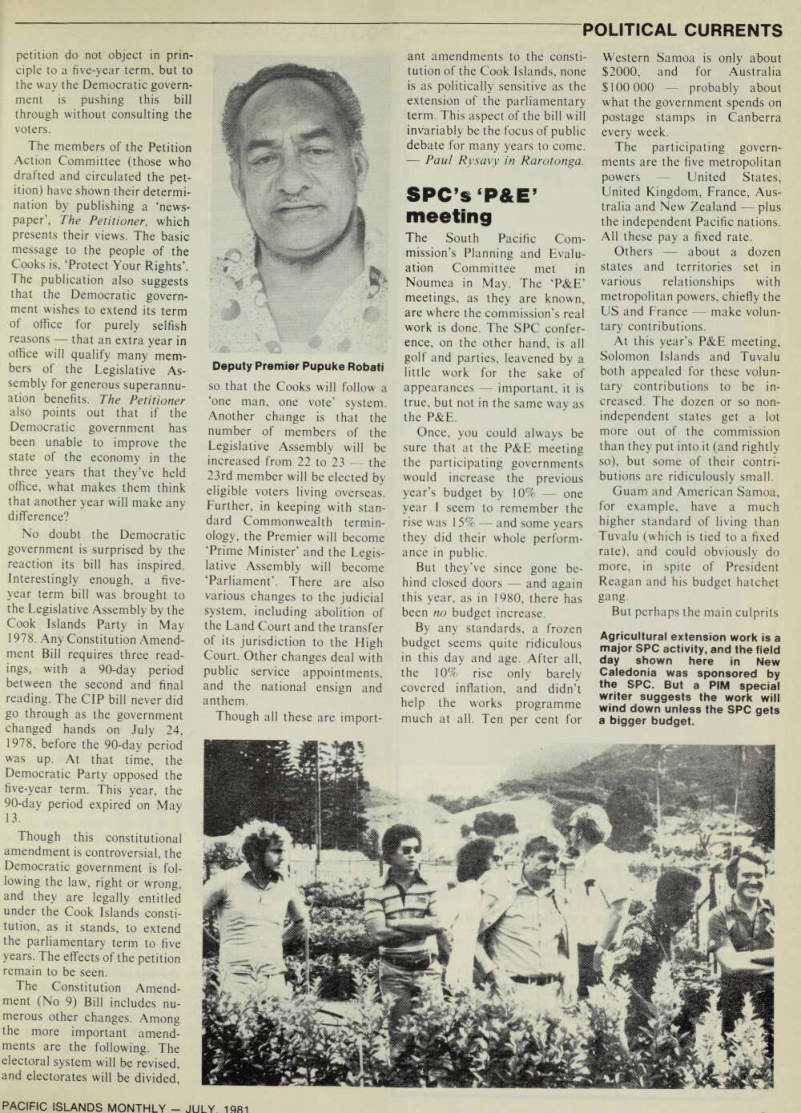
Deputy Premier Pupuke Robati
among the voluntary contribu tors are French Polynesia and New Caledonia. They are affluent societies, however poor their indigenous people may be in the villages. On the other hand, no one expects Kiribati, Tokelau, or Wallis and Futuna to put very much into the kitty.
This writer believes that not only should the non-inde pendent voluntary contributors have raised their contributions, but that the fixed-rate participating governments should also have raised their pay-in by 10%.
Not a great rise, it is true, but reasonable in light of the fact that Australia, the UK, the USA and France all also give millions to projects directly, above their normal SPC bud getary contributions. (Many other governments also contrib ute in a similar manner Canada and Japan, to name only two as do United Nations agencies and their like.) Another culprit is the system.
One can see the reasons for it, but when rules become con stricting, they should be either broken or bent. In this weird dealing scene, everybody must agree on a rise in contributions.
There must be consensus if only one country holds out, that’s it. Nothing can be done.
It’s a bit like the veto in the United Nations Security Coun cil. This act has surely got to be cleaned up.
The SPC budget is a joke anyway $4 000 000 for the kind of work programme that is needed. Of course, there are additional external funds which boost it, and some criticism of the administrative costs (prob ably inevitable in New Caledonia but certain good reasons exist for keeping the SPC headquartered there).
But in the Pacific region with its vast distances, and conse quent high costs of travel, the kind of money available to the SPC is not going to stretch too far.
To the mind of this writer, the 1981 P&E meeting leaves several intriguing questions hanging in the air. Such as: Are they trying to kill the SPC? If so, they should do it now, quickly and painlessly. Or are they just letting it run down in
favour of the South Pacific Forum? It would be a pity for both bodies, in the view of this writer: the work of the South Pacific Bureau of Economic Co operation (SPEC), the Forum’s executive arm, is mainly econ omic, and the strength of the SPC is its social programmes and the fact that the small states are members. They complement each other in many ways.
Again, are they planning to marry the Forum and the SPC?
Or SPEC and the US-oriented Pacific Islands Development Commission (PIDC)? There are many possible, and interesting, combinations but the fact
remains that the SPC is unique because of the presence in it of the ‘metropolitans’, the small, still-dependent states, and so on.
If there is dirty work at the crossroads, who is up to it? One thought: the ‘metrops’ might prefer, for ease of adminis tration, as well as added politi cal kudos, to be funding SPC type projects directly. Again, the Pacific nations might be going soft on ‘regionalism’. (My belief is that they’ll rue the day if ever they do.) Then there is always the possibility that none of the above ‘intriguing’ ideas is true.
Is the SPC show faltering for the simple reason that we are all too busy at home? From a correspondent in Noumea.