One for the history books
pp. 13-68 · Read in the full issue

W. Samoa public service strike: One for the history books
‘lt is true there were strikes before but never at such strength.’ So said Western Samoa’s Prime Minister Tupuola Efi of the marathon strike begun in April by members of the country’s Public Service Association. A New Zealand observer wrote; The first strike by public servants has significant social implications. It represents a major challenge to the mate/-dominated political system.’ (Only matais chiefs can vote and stand for parliament in Western Samoa.) Telecommunications problems both in Australia (where an industrial dispute caused bans on maintenance of equipment), and in Western Samoa, have meant that PIM is able to provide no more than the following skeleton diary of main events of the development and course of the strike. More in PIM August.
Early 1980: To combat inflation (estimated to be running at 38% a year). Western Samoa’s Pub lic Service Association, in nego tiations with the Public Service Commission, sought a 30% pay increase. Agreement was finally reached with the minister re sponsible for the public service, Asi Eikeni, that there would be a 10% increase payable from June 1980, followed by a further increase of 12.5% from January 1, 1981.
December 1980: The 1981 estimates presented to parlia ment revealed that the govern ment had decided to grant public servants only an 8% pay * rise, to be implemented in two stages, with a six-months inter val. Slo reasons were given for the scrapping of the agreement with Asi Eikeni, and the PSA was given no official statement on the matter.
Early 1981: The PSA ap pealed, and nearly 4000 marchers turned up at parlia ment to present a petition supporting a PSA demand for a 15% pay increase. The petition was referred to a committee of mainly government supporters, who rejected it.
March 1981: The PSA de cided to make one last appeal, with the understanding that rejection would be followed by immediate strike action. The appeal fell on stony ground.
April 6: The strike began.
With telecommunications workers out, the country was virtually isolated from the out side world. Airline, postal, ship ping, medical, firefighting and other services were manned by tiny emergency staffs. The gov ernment refused to discuss the strike with the PSA, saying negotiations must be carried on through the proper channels with the PSC. It also said
Western Samoa’s economy could not stand the cost of the proposed increases, estimated to be SWS3 million.
April 24: The Samoa Times reported: The strike’s effects are being felt more and more as the absence of the s'/: million injected into the economy fort nightly through government salaries and wages becomes noticeable. Funds entering by way of transfers through the Post Office are also missing from the economy and have thus aggravated the depressed state.’ The same issue of the paper reported that the PSA had established a relief fund for its 4000 striking members and had already raised more than $3OOO in cash, not counting food and clothing. PSA presi dent leti Tulealo was reported to have gone to Pago ‘to contact overseas PSAs and trade unions for support and advice’. Inter viewed by the Times, parlia mentary Opposition Leader Vaai Kolone criticised the gov ernment’s handling of the strike, saying: ‘Government should have solved the problem at the time of the PSA march to parliament, especially as the public servants were already aware of the huge salary in creases made for the Head of State, Member of the Council of Deputies, Cabinet Ministers and MPs. They were also aware of the separate deal government made with the doctors and nurses. Under such circum stances government should have carefully weighed the effect of those decisions on the morale of the rest of the public service.’ The paper also carried a picture of the third of a series of mass demonstrations and meetings being held regularly by the PSA.
April 29: Prime Minister
Tupuola Efi, reversing his previous stand, announced that henceforth he would assume •day-to-day direction of negotiations with PSA leaders’. The TTiT of the pia wee^ ly The Observer which noted this development, also reported that Western Samoa s Cardinal L . “'i $lOOO to the PSA, not he said, because he supported the strike, but as a gesture to show his recognition of the PSA’s dlfficultles ’
May 8: The Samoa Times frontpage lead story began; ‘Striking members of the PSA will have to return to work by 4pm, Monday, May 11, if they are not to lose the PSC’s offer (to regard the period of the strike as a grant) of special leave. If they do not return by that time, they will lose their
Jobs and have to seek re employment to get back into the service . This was one fth basic decisions made b h Executive Council in a meeting held at Vailima y«erday morning.’ The council also ru , ed that a emission of inquiry Woldd be set . public service salaries, and that no salaries would be paid to PS workers for the period they were on strike. The Executive Council comprises the Head of State, His Highness Malietoa Tanumafili 11, sitting with the Cabinet, and is seen as the highest .decision-making body in the land. The strikers’ re sponse: a march of about 10 000
Continued on Page 68.
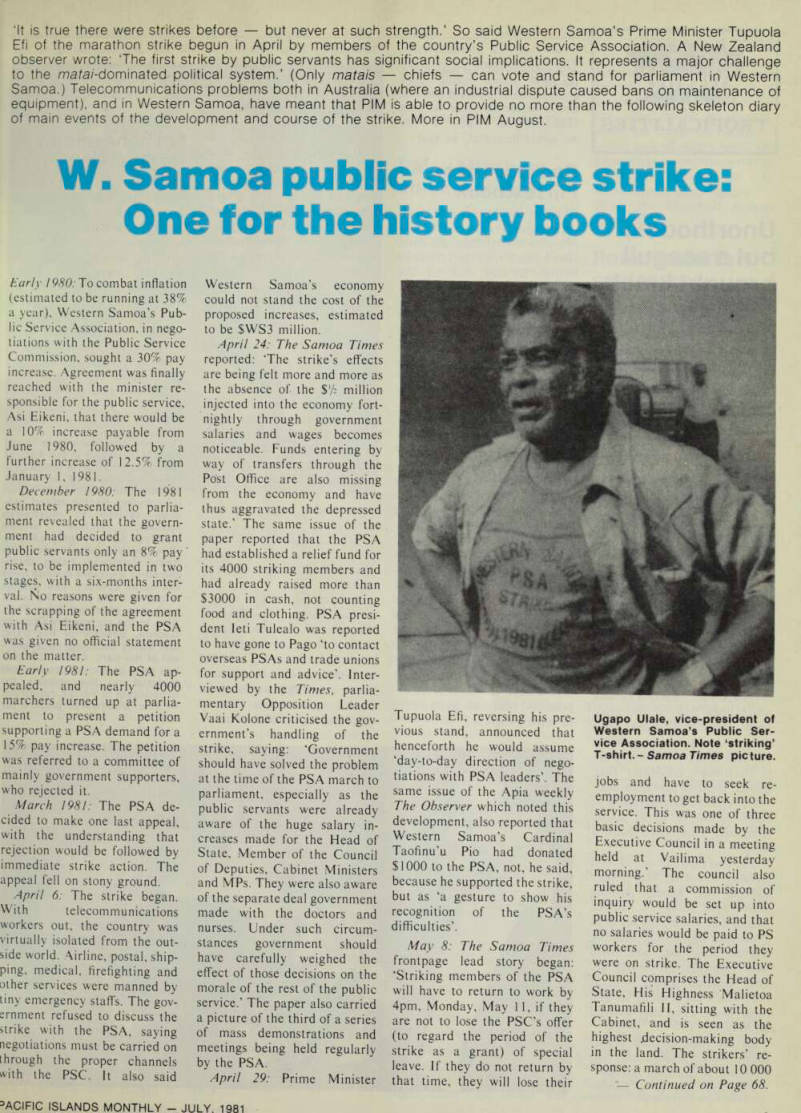
Ugapo Ulale, vice-president of Western Samoa’s Public Ser vice Association. Note ‘striking’
T-shirt. - Samoa Times picture.
people on May 1 1 rejecting the back-to-work direction.
May 14: Tupuloa announced that the May 7 decisions of the Executive Council represented the government’s final position.
May 22: The Samoa Times reported: ‘Sixty per cent of the public servants are still on strike, according to figures re leased by the PSC yesterday.
Of the 4223 salaried public servants only 1468 are back at their desks with 2755 still on strike. Of this total 617 are teachers . . .' May 23-24: A weekend strike by Electric Power Corporation workers in solidarity with the PSA cut electricity supplies. At about this time, Fiji’s Minister for Labour Tomasi Vakatora made a short visit to Apia, accompanied by two top concili ators from his department and from Fiji’s Tripartite Forum, which links government, busi ness and unions. They said they had come to ‘advise, not settle', following expressions of interest by Tupuola in Fiji’s unique methods of industrial concili ation.
June I: The 19th annual celebrations of Western Samoa’s independence reflected the depth of the social divisions caused by recent events. Official celebrations were crammed into one day (Monday June 1) instead of the customary three. They were less well attended than usual.
June 2-3: The PSA ‘took over’ the remaining two days of the traditional independence festivities, with a Tuesday morning protest march of 10 000 along Beach Road, and afternoon festivities. More ac tivities were performed on Wednesday. The Observer of June 5 commented: ‘lf public attendance at the two separate independence celebrations is a criterion indicating in which direction public sympathy and support were bending, then the PSA rally was decidedly the one.' Participation by old people, school children and University of the South Pacific students and staff was a notable feature of a number of PSA activities.
June 5: The Observer re ported: ‘The government has announced that the Executive Council has approved the rec ommendations of the com mission of inquiry on public service salaries established by it on May 7.’ The rises rec ommended would reportedly cost the government $1 559 610. They were to be effective from June 1. At PlM’s press time, it was still unclear whether the PSA would accept them. The PSA, meanwhile, was engaged in a Supreme Court action to determine if their strike action was within the law, a point vital for re instatement prospects. But ac cording to the government newspaper Savali, ‘the Execu tive Council has resolved to recommend to the PSC that in the consideration of appli cations for reinstatement by persons who have been on
strike, the PSC should exercise the powers at its discretion with benevolence'.
International support: Al though scores of messages have been received by the PSA from trade unions in foreign countries, their support has been mainly moral, and to some extent financial. When PSA leader Icti Taulealo appealed tc the conference of the New Zealand Federation of Laboui in May for a ban on all shipping to and from Western Samoa and a ban on Polynesian Air lines flights out of Auckland delegates seemed unprepared tc take such action. FOL president Jim Knox presented the West ern Samoa leader with a cheque for $lOOO, and called for a collection in support of the strike from FOL delegates as individuals.
Tomasi Vakatora To advise, not to settle’.