absurdity, a
pp. 10-11 · Read in the full issue
Presidential Poll
Out of absurdity, a high hope
The two-round presidential elections held in French Polynesia on April 26 and May 10 again demonstrated the absurdity of the old-fashioned colonial system which survives today only in France’s overseas possessions.
It must be noted first of all and with regret that the local outcome of an election of this type hardly matters, since the votes cast by the 78 000 registered voters of French Polynesia (to take only this example) are lumped together with the 36 million French metropolitan votes and can hardly ever, therefore, be expected to change the final result. The recent elections showed this clearly: the local electorate here gave Giscard d’Estaing an overwhelming 76.71% majority, but this didn’t prevent Mitterand from winning the presidency with a comfortable overall majority of a million votes.
There is another anomaly this one tends to reduce the significance of Giscard’s impressive showing in French Polynesia. This is the fact of the heavy participation in the voting of predominantly Righlwing French settlers, government officials and military personnel, who are allowed to vote in all local polls as soon as they step off the plane.
Even more unfair to the Polynesians are the campaign rules.
Faithfully copied from the French model, they are quite unsuited to the island context.
For example, while it is easy in a country like France to reach voters by car, bus, train or plane, the Polynesian voters live on many small, isolated islands, scattered over an ocean area as large as the whole of Europe. The best, and sometimes the only way to wage a campaign in French Polynesia is therefore to use the government-owned radio and TV station in Papeete.
But in this election as in any other for that matter only the official French candidates there were 10 in this election - have ever been accorded this privilege, and they talked, of course, in French, and only about French domestic problems.
Without any local politicians being allowed to explain in Tahitian what the issues were, and what the local implications might be, most voters were left completely in the dark as to what was going on.
On the other hand we are constantly exposed to government propaganda varied on rare occasions with snippets of information about the doings of a few selected opposition figures. All individuals who are, however remotely, suspected of favouring independence are automatically and permanently excluded from the studios despite the fact that the French constitution and the United Nations charter recognise the right of all colonial peoples to become independent.
There are a few minor legal absurdities associated with election procedures which are really more laughable than harmful.
The first is a stipulation that national elections must be held simultaneously in all parts of the republic. Unfortunately, the 12-hour lime lag between Paris and Papeete cannot be abolished by decree, and this results in the awkward situation that when voting begins here, it is already over in France. All one has to do to discover the result in advance is to make a phone call to Paris. This takes no more than a few seconds, due to our ultra modern automatic telephone exchange.
Another absurd election rule provides for the mailing, in advance, of the election programmes of all official candidates to each and every one of the territory’s voters. Since inter-island communications, including mail services, are still very slow and irregular, it is utterly impossible effectively to apply this rule. If voters ever in fact receive their envelope, it is certainly well after the election is over.
These are what might be called statutory absurdities. But there are other more serious ones which arise from the fact that the political situation and popular aspirations are quite different in the overseas territories from those existing in ‘the mother country’.
This time there was total confusion due to the tactical mistake of the old Autonomist parties led by John Teariki and Francis Sanford in deciding to support Giscard d’Estaing. Considering -that their aim has always been as the word ‘Autonomist’ implies to win full internal self-government on the Cook Islands model, their logical choice would have been Mitterand, a political figure who for years has been in favour of auto determination for the overseas territories and departments. This sensible principle simply means that the local populations can decide for themselves what form of government they want even if this might be complete independence.
It was for this reason that Teariki in 1965, and Teariki and Sanford in 1974, supported Mitterand who, as a result, won the vote in French Polynesia but to no avail, as he lost in France.
Having been persuaded early on mainly by insidious government propaganda that Giscard would be re-elected with a huge margin by the French people, the Autonomist leaders decided this time to switch their allegiance to him, in the understandable desire to be on the winning side. Admittedly, they also had some reasons for feeling grateful to the outgoing president: he had at least agreed to deal with them, whereas his predecessors, de Gaulle and Pompidou, had always treated the Autonomist majority as if it were a worthless minority.
Furthermore, Giscard had showered money on the territory, giving everyone the pleasant illusion that the economy was
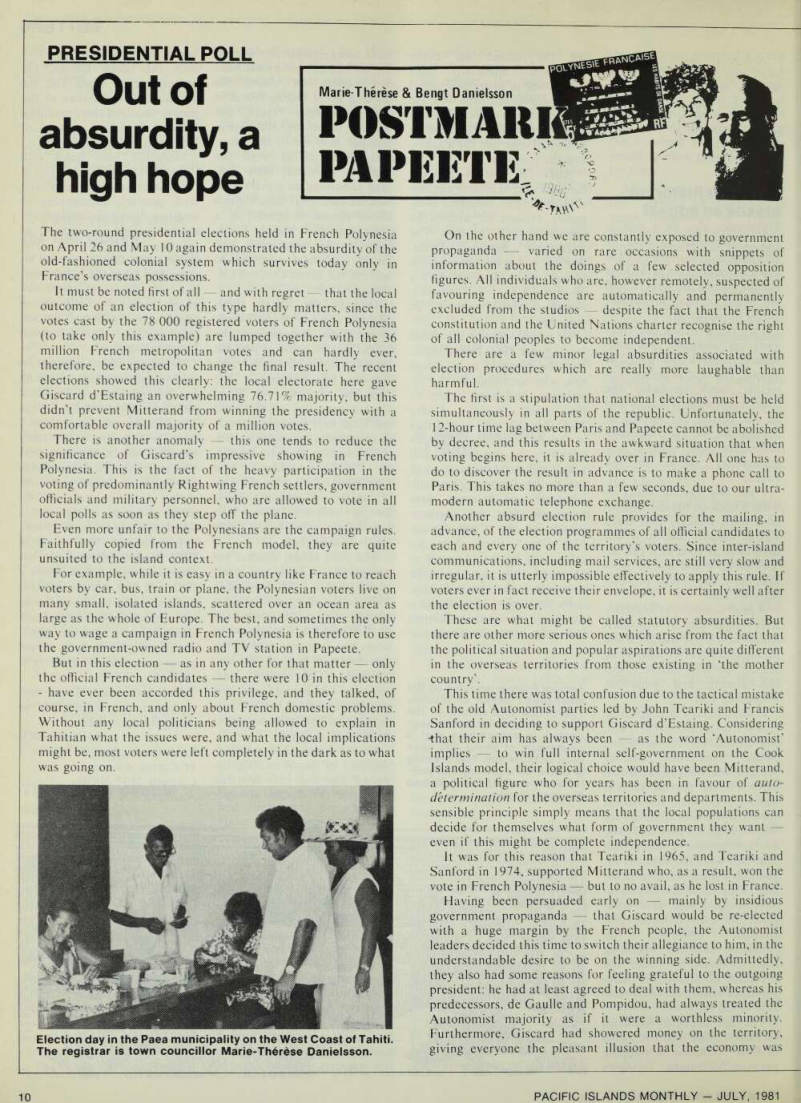
Election day in the Paea municipality on the West Coast of Tahiti.
The registrar is town councillor Marie-Therese Danielsson.
'ecovering. The two leaders of French Polynesia’s Chinese community, Michel Law and Arthur Chung, took the same dand for the same reasons.
As expected, long before the first round of the election on \pril 26 Gaston Flosse, leader of the local Gaullist party lahoeraa Huiraatira, who can usually count on a third of the erritory’s votes, launched a whirlwind campaign in favour of he candidacy of his French boss Jacques Chirac (PIM May )18). Flosse’s main talking point was the open and effective upport given by Chirac to his far-reaching Autonomist reform )rogramme which is aimed, first of all, at economic ndependence for French Polynesia (PIM May 1980 p 27). This esulted in a perfectly absurd situation. Here were the old Autonomists campaigning against Mitterand, who supports the >rinciples they have always fought for, while Flosse, tradition ary the staunchest, most pro-French, supporter of the existing ystem, was championing the Autonomist cause.
All this left the task of carrying the Mitterand banner to the mallest of the well-established parties, la mana te nunaa, which arely musters more than 10% of the vote. It could be said that hey held the banner higher and waved it with greater fervour han was warranted by Mitterand’s public statements, for they epeated endlessly that they were for independence and against he nuclear tests ...
After the first round, which eliminated eight of the 10 andidates, only one thing was certain: the three Polynesian •arties had preserved their traditional relative strengths. The andidate supported by the Autonomists (Giscard d’Estaing)
got 51.4% of the vote, Flosse’s candidate (Chirac) 35.90%, and the la mana te nunaa candidate (Mitterand) 8.32%.
As the second round approached the big question was: which of the remaining two candidates would get Flosse’s support?
Considering his strong bid for full internal self-government, Mitterand would have been his logical choice. Instead he criticised the Labour candidate the term ‘Labour’ more aptly describes Mitterand’s true position for English-language readers than ‘Socialist’ for his communist connections, and then invited all and sundry to vote ‘according to their conscience’.
Thus it came to pass that the second round turned into what must easily be the most confused and absurd political battle ever fought in French Polynesia, with the la mana te nunaa ‘radicals’, supported by a large slice of the Gaullist voters, trying to persuade the traditionally pro-Mitterand electorate of the Teariki and Sanford not to vote for the Rightist candidate
Giscard d’Estaing!
Totally bereft of local issues to stir the flagging enthusiasm of their troops, the pro-Giscard forces adopted the scare tactics of their metropolitan patron who, like his predecessors de Gaulle and Pompidou, tried without much success to persuade voters that the communists would be masters of France if Mitterand won. (In fact, the communist performance was the feeblest in modern times: only one out of seven voters supported the communist candidate, who dropped out after the first round.) At the level of local affairs, it was shouted from the housetops that a victory for the ‘socio-communists’ led by Mitterand would lead to general poverty, cancellation of all pensions and welfare payments, the sacking of thousands of civil servants, and the abolition, as in Russia, of private property!
With this sort of propaganda being spread through the islands, it was little wonder that Giscard had a handsome win in the second round. However, a sufficient number of supporters of Flosse and Teariki-Sanford voted for Mitterand for him to treble his first-round vote: he scored 1 1 357 votes in the second round, as against 37 414 for Giscard.
An old saying has it that you can’t unscramble scrambled eggs.
But this apparently unassailable truth certainly doesn’t apply to the political imbroglio in French Polynesia created by these strange elections.
As a matter of fact, most political leaders are already scrambling to get behind the new president, and we confidently predict that it won’t be long before they will all be vying with one another to do away with the absurd existing system, and set about the building of a new, free, democratic, and gradually
more and more independent Polynesian nation.
Marie-
Therese and Bengt Danielsson.
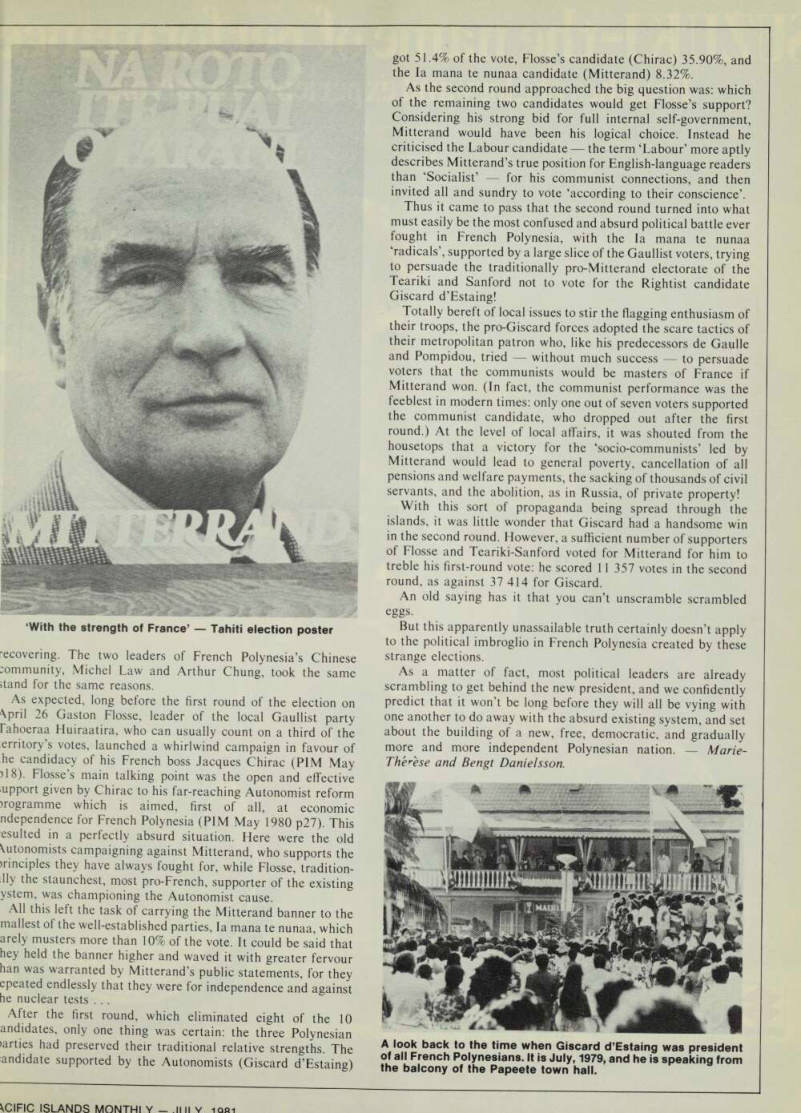
‘With the strength of France’ Tahiti election poster
A look back to the time when Giscard d’Estaing was president of all French Polynesians. It is July, 1979, and he is speaking from the balcony of the Papeete town hall.