Irian Jaya
pp. 7-9 · Read in the full issue
Letters
‘leaders’
in exile
Your correspondent C.M.
Lawrence (PIM May plO) seems proud that ‘West Papuan leaders’ have taken up volun tary exile in his country, Vanuatu. ‘West Papuan’ yes. ‘Leaders’ no.
The struggle for freedom and independence of the West Irian ese people is taking place in Irian Jaya, not in Port Moresby, Amsterdam, or Port-Vila.
Unfortunately, the West Irianese and the OPM have more generals, ministers and presidents all over the world than they have in Irian Jaya where the real action must take place.
Childish letters to ‘George in Turkey’ asking for ‘guns’ and SAM missiles to be brought in submarines to prepared landing places in Papua New Guinea and Irian Jaya originate in the paranoid dreams of these West Papuan exile ministers and gen erals. Meanwhile, for the past 20 years, brave, perhaps primi tive, West Irianese have gone on fighting and dying.
Neither the USA, the United Nations, Russia nor Cuba would risk World War 111 for the sick pipedreams of these exiled ‘West Papuan’ leaders.
No one ever takes serious notice of them, least of all the Indonesian Government which is supported by the UN and the USA, and about every other Western capitalist country.
Many such countries are even now participating in the total exploitation of Irian Jaya and its people.
For the West Irianese people, there are only two true West Irianese abroad Jacob Prai and Otto Ondawame. We would call them not ‘West Papuan’ but West Irianese leaders, as they are not absent from the country because they ran away, but because of betrayal by such ‘West Papuans’ in PNG who acted in collaboration with their White adviser friends.
At their trial in Port Moresby on charges of being prohibited immigrants neither man could understand sufficient English let alone legal English to know what was going on. Nor could their defence lawyers speak a word of Bahasa or Dutch.
And all this time there were in Port Moresby at least a half dozen ‘West Papuan exile min isters’, and dozens of West
Papuan ‘nationalists’ and ‘revol utionists’. But not one of them had the guts to utter one syllable of protest.
But they were quick to organ ise a ‘collection’ to pay the fees of tneir Australian QC, who certainly never made easier money than at the appeal hear ing for Prai and Ondawame.
And all this time the OPM had a sum exceeding KBOOO in a Port Moresby bank account.
Vitaliz Paingame
Cairns Qld Australia
Noumea veteran
looks back
With reference to your article ‘Noumea ’4O: Australian gun boat diplomacy, Kidglove Style’ (PIM Jan p 59), my impression is that Australian diplomacy played a crucial role in these events, in which I took an active part.
I took action immediately after the defeat of France. I ran up the flag of the Cross of Lorraine on my boat I was running a coastal vessel in New Caledonian waters at the time. I was immediately hauled up before representatives of the Petainist government in Noumea, who told me that I was to stop flying this flag.
Not long afterwards, follow ing instructions which had reached us from General de Gaulle in London, I set out for Port-Vila in my boat, the Ouvea, to ask Henri Sautot to come to Noumea to assume office as Free French Governor of New Caledonia.
After visiting Port-Vila I went on to Santo, where I also had business. On my return to Port-Vila several days later, still flying the Cross of Lorraine flag, I sighted the cruiser HMAS Adelaide and the tanker Norden.
After all these years, I wish to pay tribute to all those who like myself took grave risks in those times. There were many of them.
Maurice Houssard
Noumea New Caledonia More on Samoa’s
national park
The article on national park development in Samoa (PIM Apr p 22) provides an interest
ing and encouraging account of the implementation of an im portant aspect of national devel opment policy. It is however of some significance that prior to the events described in the article, the government of Western Samoa had been work ing for several years towards the establishment of a national parks system.
A request by the Western Samoan Government to the International Union for the Conservation of Nature and Natural Resources (lUCN) in 1972 came to the attention of the United Nations Develop ment Advisory Team for the Pacific (UNDAT) when it be came evident that financial as sistance would be needed to support the services of an lUCN expert. After a series of consultations, agreement was reached on an assignment to assist in drawing a master plan for national parks in particular, and for conservation in general.
This was carried out by an expert provided by the lUCN Secretariat together with UNDAT’s Physical Planning Adviser.
The resultant report, A National Parks System for Western Samoa , which was submitted to the Western Samoan Government early in 1975, contained a number of recommendations concerning the establishment and manage ment of national parks and reserves, and nature conser vation generally. These in cluded such matters as the establishment of a comprehen sive system comprising national parks, nature reserves, historic sites, wildlife sanctuaries and recreation areas; administration and staffing arrangements; legislation; public education.
After further consultations UNDAT was requested in April 1978 to fund a natural resources inventory of the O Le Pupu- Pu’e National Park, which had been selected by the govern ment as the first for develop ment. An international team comprising a geologist, a botan ist and a wildlife biologist was recruited by UNDAT and in August/September 1978 car ried out what was described as a benchmark survey of the ge ology, flora and wildlife re sources of the park.
Thus the Government already had a sound practical
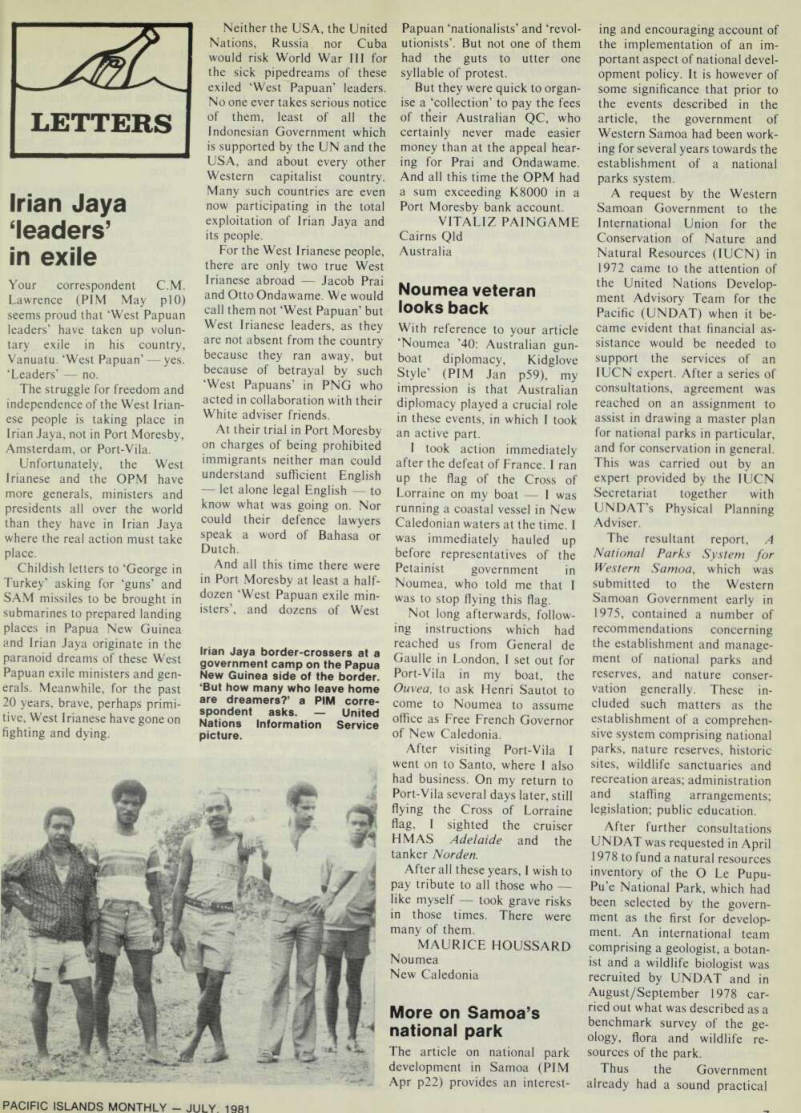
Irian Jaya border-crossers at a government camp on the Papua New Guinea side of the border. ‘But how many who leave home are dreamers?’ a PIM corre spondent asks. United Nations Information Service picture.
and scientific basis for the programme described in your April issue.
A.I. Mccutchan
Suva Fiji Mr McCutchan was the UN DAT Team Leader for the Western Samoa national park project. ... and now a park for the Cooks?
In my opinion the recent estab lishment of the O Le Pupu-Pu’e National Park in the island of Upolu (PIM Apr p 22) is an event of outstanding import ance in this part of the world where there is a regrettable lack of interest in the development of scenic reserves and the con servation of native wildlife.
And yet even smaller Pacific islands such as Morrea and Rarotonga to mention only two of them provide the nucleus of a mini national park in their rugged inland moun tains.
As regards the Cook Islands National Park, preliminary plans were prepared long ago with the assistance of New Zealand and Australian experts of great repute. The only won der to me and probably to many other people is that such well thought-out plans have now come to a standstill for no particular reason.
May Western Samoa’s example rescue them from com plete oblivion!
Robert Rousseau
Papeete French Polynesia
The things people
say in PIM ...
As a resident and traveller in the Pacific for three decades, mainly in Papua New Guinea but also a visitor to the French islands, and as a man married to a Melanesian, 1 am perhaps as well qualified as occasional re porters, or sociologists, to com ment on some of the problems in this area, and the different attitudes to them as reflected in
Pim.
The issue of May 1981 seems to me a perfect illustration of contradictory attitudes held by certain writers and readers.
The letter ‘Wrong Way in
French Polynesia’ by Henri Lombard (pp 7-9), for example, expressed exactly what I think, not only about Tahiti but all recently ‘decolonised’ islands in the South Pacific.
Daniel Tardieu’s Noumea Notebook appears also, gener ally speaking, to be very objec tive.
With due respect to Marie- Therese and Bengt Danielsson, I find it more difficult to assess the value of their Papeete Postmark. I would classify them among many European or parl-European couples who have settled in the Islands, sincerely loving them and their inhabitants, but, unconsciously perhaps, hostile to everything threatening the traditional care free Polynesian way of life.
They also seem to take sides politically. 1 am afraid that, like some of my friends still living in the typical Pacific environment, sincere and competent ob servers like the Danielssons have lost part of their objec tivity, especially insofar as the islanders’ dynamic potential is concerned. Sudden, full auton omy would prove how great a handicap their legendary and charming nonchalance is in the real world. This is what has happened, tragically, in many recently independent ex colonies. 1 am one of those who believe that some critics of France in the Pacific take their stand in the hope of seeing a larger and freer US influence in the Pacific in future. In fact if they lived in Guam or Micronesia and adopted the same position towards the US presence in the Pacific, they would be likely to find themselves on an early plane out.
John H. Huon De
Navrancourt
Atherton Qld Australia ‘Chilled’ by Tahiti article I was chilled after reading the article by Marie-Therese and Bengt Danielsson (PIM Mar p 22) about the Toto Tupuna Boys, their crimes and their trial in France. The Danielssons appear to be more concerned with establishing a difference between common criminal acts
and politically motivated acts than they are with the facts of the matter: the cold-blooded murder of an innocent man in his bed; the terrorisation of innocent women in their homes; the wanton destruction of prop erty.
There is no difference. Mur der is murder and it cannot be legitimised or dignified by a ‘political’ label.
If the Tahitians want inde pendence, I hope they gain it by peaceful means. I also hope the Danielssons will rethink their position regarding political ter rorism vs. legitimate political activism. Surely they are not so cold-hearted as their article makes them appear.
D.L. Johnston
San Diego Calif
Usa
A fond memory
of ‘Fati’
Your obituary (PIM Feb p 74) for the late Fatialofa Mamoe MP, of Western Samoa, brought back fond memories of an incident I witnessed some years ago.
Known affectionately as ‘Fati’ (a play on his name and girth), Fatialofa in his youth had been a boxer of some renown, and in later years still invariably wore a towel, trainer style, around his neck.
Relinquishing his ministerial post in the early 19705, he continued to represent his con stituency in Western Samoa’s parliament until his death. He continued also to be one of the more colourful characters on the Apia scene, particularly in the Apia RSA where, even in a bar full of personalities, he was outstanding.
The incident in question took place in the RSA where Fati, assisted by his faithful lieuten ant, Joe (a German engineer now departed for other climes), was engaged in augmenting his disposable income by way of running a raffle, the prize being a bundle of fine mats. Station ing himself strategically near the club entrance, it would have taken an even stronger person ality than Fati, of which there were few around, not to submit to his entreaties to part with only one tala for such a worth while charity. In return for this
the purchaser received a scrap of cardboard inscribed with a number. When 50 such ‘tickets’ had been issued, the draw took place, from a disused Carlton beer carton, the winner being No 7, which ticket just hap pened to have been purchased by Joe.
Much consternation, at the bar, shaking of heads, even some mumblings of ‘fraud’, until one patron, fortified by an ample sufficiency of Stainlager, summoned the courage to lay before Fati the view that per haps all was not above board.
This led, much to the entertain ment of the bar, to heated accusations, imprecations, threats and insults being traded between Fati, Joe and their accuser (a local known here only as Blackie) culminating in the latter seizing a beer carton from Joe and pouring its con tents of ‘tickets’ on to the bar.
These were revealed to be 50 pieces of cardboard all bearing the number ‘7’.
Hilarity at the bar, catcalls, whistles, stamping of feet and sheer enjoyment. Even more heated discussions between Fati and Blackie, including an inter esting discourse in Samoan on the habits of their respective ancestors, culminating in Fati, with a great display of dignity and statemanship, offering a re draw, which was promptly ac cepted and organised with Blackie as scrutineer, the win ners this time being three young girls over for a day trip from Pago Pago.
Shortly, Fati was to be seen in earnest discussion with these young ladies, after which I had the temerity to inquire politely what this had been about.
Straightforward as ever, he told me that he had explained to the three that the removal of the prized fine mats from Western Samoa would be a grave breach of local custom, bringing much misfortune upon the heads of anyone so doing. The young ladies, agreeing completely, had returned the mats to Fati’s custody. Thus Fati achieved the objectives of funds and reten tion of the mats and his dignity, Blackie achieved recognition as a man of principle and action, and the RSA patrons were all entertained for only one tala each.
A masterly performance! We
shall miss a man of his ilk. He was, in more ways than one, larger than life.
Don Stewart
Sydney NSW Australia Malden’s historian makes an appeal Eight years ago, on a visit to Fiji, I happened to read an article in a 1933 issue of PIM and it introduced me to the Line Islands, which hitherto I had not heard of, and to Malden Island in particular.
This place struck me right away as unusual, and sub sequent research confirmed it as unique. The central lagoon is of terrific depth (probably the cone of an extinct volcano) and on the barren flat surface of Malden are the most extensive Polynesian stone ruins of any uninhabited island in the Pacific.
I am now getting ready to write a book on Malden Island.
It is most unlikely that there will be another one, so it will need to be as good as it can be. ‘Complete’ would not be poss ible, but it has to read convinc ingly, at least.
A brief summary of Malden’s story might hint at the fasci nation which has sustained me throughout the often wearisome search for information about this remote and somewhat
forbidding spot.
It was officially discovered by HM’s frigate Blonde in 1825, and named for the surveying officer. Lieutenant Charles Malden, who went ashore with a party. For the next 30 years it was one of the many low islands known to whalemen, useless for ‘comforts’ of any kind, and to be avoided because of strong tide sets. But with the demand for guano as a cheap fertiliser in the late 1850 s, these unlovely equa torial coral lumps were occu pied, and their immense bird colonies • disturbed. by American interests operating from Honolulu with the exception of Malden, or Inde pendence Island, the most valu able of the lot.
The right to exploit Malden’s resources came into the hands of B. B. Nicholson, a shipping agent in Melbourne. Trying to
set the island up broke Nicholson financially (six vessels lost in under two years) and broke his health as well. He died at the age of 34, by which time the firm of Grice, Sumner & Co had inherited the lease and the problems.
After the loss of a large German ship in bizarre circum stances in 1873, insurance com panies refused to underwrite vessels going to Malden. The next year, however, Grice, Sumner had good fortune for a change, when they signed up a 36-year-old Ulsterman, Abraham McCullough, to be manager.
He was to serve on the island for 23 years. He is buried there, near the memorial to his infant son, who according to the in scription, had been ‘taken by the wild wave’. Under McCullough’s rule and that is the right word Malden Island was a going concern, and a well ordered little outpost of the British Empire. The field labourers and boatmen were recruited from the northern islands of the Cook Group.
McCullough fined them for infractions, but would permit no abuse of them by the white overseers or the crews of ships.
By the lime of McCullough's death, all the other low islands had long been abandoned, or
were being sporadically worked for tailings by the tireless John T. Arundel. Of course the opening up of Ocean Island in 1900, and later Nauru, put Malden in eclipse. But Grice, Sumner held on to the lease, and continued to work the deposits, with only New Zea land remaining as a market. It was not until 1927 that Malden Island ceased to operate as a guano station and the build ings of the beach-crest and inland settlement were left to become the island’s second col lection of ruins.
During the late 1930 s Malden was one of the islands disputed by Britain and the USA, both in quest of possible seaplane bases between North America and Australasia. The Japanese attack on Pearl Harbor cancelled all that, and the Cold War brought aircraft of stupendous technological ad vancement to the mid-Pacific.
In 1957, Malden, and Christmas Island, were the sites of ‘Operation Grapple', the first British H-Bomb tests. Five years later, the USA made similar use of them.
The most recent chapter (or paragraph) in Malden's story, as reported in PIM, November 1979, is that along with 13 other islands so earnestly staked-out by RN and USN warships 45 years ago, it is now part of the new nation of Kiribati. But two Kiribati Government ex peditions had earlier concluded that Malden could not be made suitable for habitation except at prohibitive expense.
So the birds, their numbers depleted by guano mining, im ported pigs and cats now run wild, and the flashes of super
bombs, have the island again with the ocean billows, the westerly trade wind, and the maraes and house-sites of the people who lived there centuries before the first grave of European or Cook Islander.
Ordnance huts stand with the coral-stone foundations of the guano storage sheds and staff quarters, succumbing to weather; drums of dieselene are stacked along a section of splitting railway track. The loading pier that proceeded on shear-legs from the beach-crest out over the reef, where the guano sacks, the millions of them, were winched off flatcars into lighters, lies scattered under the sea.
Tracking down information on Malden has been anything but straightforward business, yet worth all the trouble, for the co-operation and trust which I have been given by so many people. It will be my pleasure as much as duly, to acknowledge all who have thus contributed, within Australia and from six other countries, in the credits which will appear in the book.
I would now like to ask of PIM readers whom I do not know and have not reached, if there are any who might have material, however minor, to do with this out-of-the-way island; family letters, diaries, remi niscences, photographs, news paper items, etc. anything at all.
Correspondence, from any where in the world, will be promptly answered.
John C. Orr
KOA Productions, 41 Correy Avenue, Concord 2137 NSW Australia
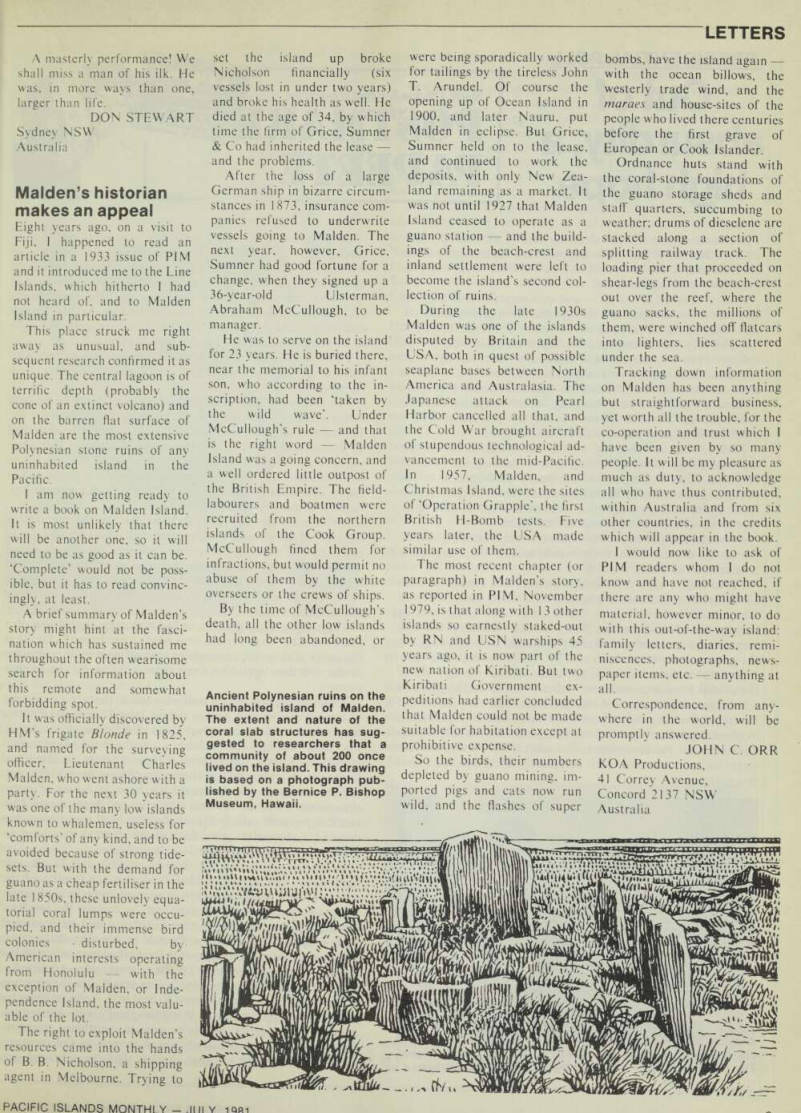
Ancient Polynesian ruins on the uninhabited island of Malden.
The extent and nature of the coral slab structures has sug gested to researchers that a community of about 200 once lived on the island. This drawing is based on a photograph pub lished by the Bernice P. Bishop Museum, Hawaii.