special kind of PNG holiday
pp. 75-78 · Read in the full issue
Travel
Two numismatic buffs take a special kind of PNG holiday
Sydney, Australia, medical practitioner Dr BILL MIRA and his wife JUDY are keen part-time numismatists. Dr Mira tells in the article below how they paid their first visit to the land of their numismatic specialisation Papua New Guinea.
About five years ago my wife Judy and I began research for a book to be titled From Cowrie to Kina: A Numismatic History of Papua New Guinea for the uninitiated this is the study of the coinages, currencies, badges and medals of PNG and their place in history.
We read anything and every thing we could find on the region archival records, annual reports, military reports, traders’ tales, missionaries’ tales, blackbirders’ tales the list seemed endless. But each added new and important snip pets to the whole. We absorbed the good, the bad and the indifferent from the profusion of literature that has been written about Gavin Souter’s Last Unknown.
A side-effect was the subcon
scious acquisition of a wealth of information on other aspects of Papua New Guinea’s history, culture, languages, ethos, etc, until we knew its story better than we knew that of Australia.
There was however, one big difference we had never been there.
The opportunity to remedy the situation came last year when Burns Philp, agents for the MS Minghua, out of Can ton, announced that the ship would be undertaking a cruise which would include a day in each of Rabaul, Madang, Lae and Cairns. Here was the chance to have a restful va cation and at the same time visit, however fleetingly, three ports in the old German Protec torate.
The Minghua left Sydney at dusk on September 9 in a howling gale. We anticipated a night of rolling decks and rebel lious stomachs. Nothing could have been further from the truth. Stabilisers are wonderful things crossing the Heads in
the Manly ferry can be more uncomfortable than our experi ence was.
What is the ship like? The brochures talked of ‘a floating resort’ and they were not far wrong. Accommodation avail able varies from a suite at almost SAI7OO to a place in a six-berth cabin on C Deck at $B4O. We settled for a two berth, with shower and toilet on A Deck at $l4OO each. This is not expensive when one remem bers that it is all-inclusive food, entertainment, the lot.
The only extras are drinks, shore excursions, poker ma chines and blackjack! A duty free shop retailed the usual range of luxuries. The liquor prices, however, appeared higher than in Sydney. An arts and crafts shop sold quality Chinese goods at bargain prices.
The cabins are spacious, clean, air-conditioned and well appointed. All have either a window or a port hole.
Medical services are avail-
able from four doctors and ancillary staff, at $3 a consul tation! An improvement would be an Australian-speaking med ico. There were some communi cation problems in this very personal area, particularly with passengers of continental ori gin. An Australian practitioner, even if only in a consultative role, would have been reassur ing, particularly for the elderly.
The food, a vital part of any holiday, was initially distinctly Chinese, However, after the first couple of days, the influence of the newly acquired Australian chef became appar ent and the Western food be came more Western, while the Chinese cuisine maintained its subtle touch of mystery.
So we sailed north, with good food, good accommodation, good company. Delightful weather added daily to our suntans and expanding waist lines. Through the Coral Sea into the Solomon Sea, until early on the morning of September 14 we entered Blanche Bay and Simpson Har bour. There it was, Rabaul, former capital of the old protec torate and mandate. All the words and pictures were true on the starboard beam the volcanoes Mother and South Daughter with Matupit below, dead ahead the Beehives, two pinnacles of rock rising steeply from the harbour, on the port quarter Vulcan and its crater, with the road to Kokopo run ning along the shoreline.
It must have been a heavy Saturday night in Rabaul it was certainly a sleepy Sunday morning, with only half a dozen men on shore, and they were
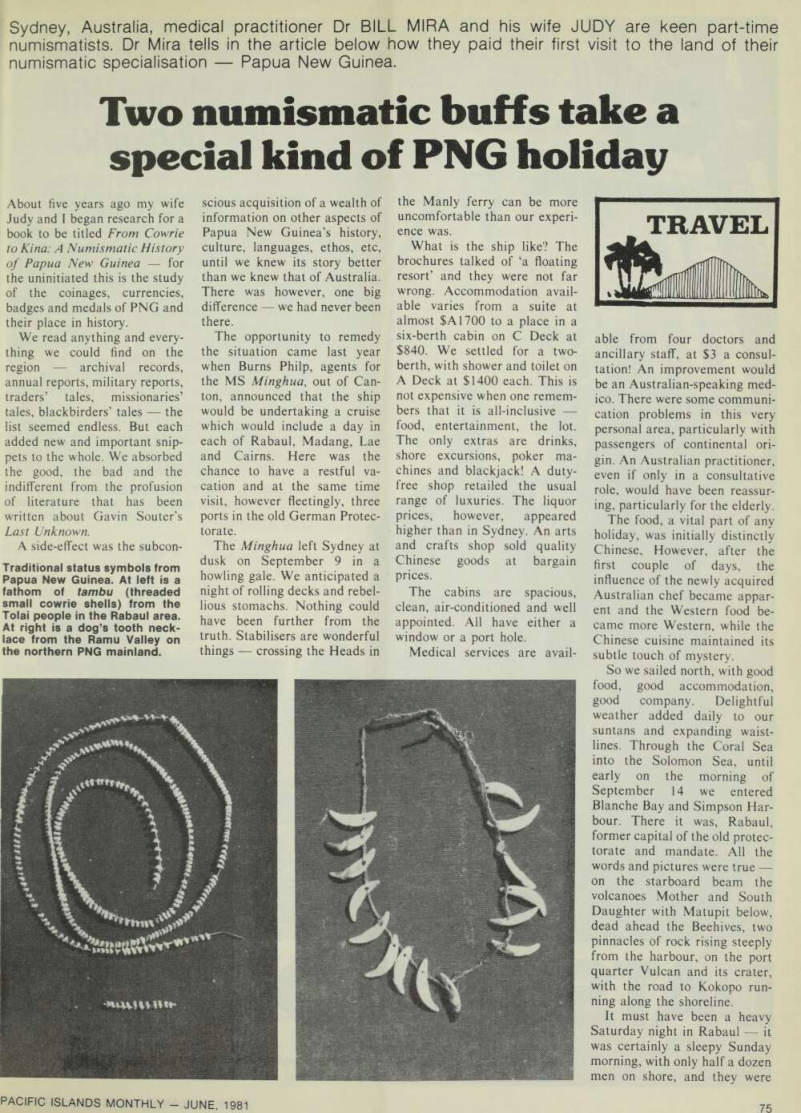
Traditional status symbols from Papua New Guinea. At left is a fathom of tambu (threaded small cowrie shells) from the Tolai people in the Rabaul area.
At right is a dog’s tooth neck lace from the Ramu Valley on the northern PNG mainland.
only there to help berth the ship. After clearance by cus toms and changing our Aust ralian dollars into kina and toea with representatives of the ANZ Bank, we set off for our first experience of Papua New Guinea.
The available local tours had been publicised and purchased on board, and we had chosen the morning excursion to Kokopo and Bitapaka, and the afternoon jaunt to the north coast of the Gazelle Peninsula.
These we hoped would en compass most of the surviving historical sites. We were not disappointed the old German headstones, the war cemetery at Bitapaka, the steps of Queen Emma’s home, the view from the site of the old residency at Namanula, were all that we had read about milestones in history. Judy and I were lucky in knowing what to look for and what we wanted to see not so many of the other tourists.
While appreciating the impossi bility of professional guides for such infrequent visitors (we were only the second cruise ship for the year), local tour oper ators must do something to •eveal to newcomers some as
pects of Rabaul’s fascinating story.
The guides were charming, friendly girls, but obviously shy and untrained. We are sure they hadn’t even had a ‘dry run’ over the route they were to follow.
None of the tours was cheap.
Even a cassette with appropri ate commentary, to be played at each significant site, would be an improvement. One big disap pointment was the fact that it was Sunday and the bung (market) was closed.
This evening was spent on board with considerable visi tations by local and expatriate citizens history came alive with tales they told of yesteryear, while valuable first hand data, a fathom of tambu and two club badges were added to our PNG project.
Captain Roy Moffit (Coastal Patrol), Frank Donovan (Cen sus 1980) and Jacob Miori (the Prime Minister’s Department) were cajoled, coerced or in veigled into our research.
After a minimum of sleep, dawn saw anchors aweigh for the run across north New Britain to our next stop. With a full day’s recuperation behind us, Tuesday’s early morning was marked by our entry into what must be one of the prettiest little harbours in the
world, Madang. Imagine sailing an ocean liner through a narrow channel in a beautifully lawned garden that is how you see Madang.
Word of our coming must have spread. A group of local youngsters with their bamboo organ (played with a pair of thongs) was waiting on the wharf. They were soon joined by students from the high school who presented a ‘tra ditional’ sing-sing.
We had again hit the jackpot it was Independence Day and everything was shut!
For our shore adventure we chose another trip into history north to Alexishafen.
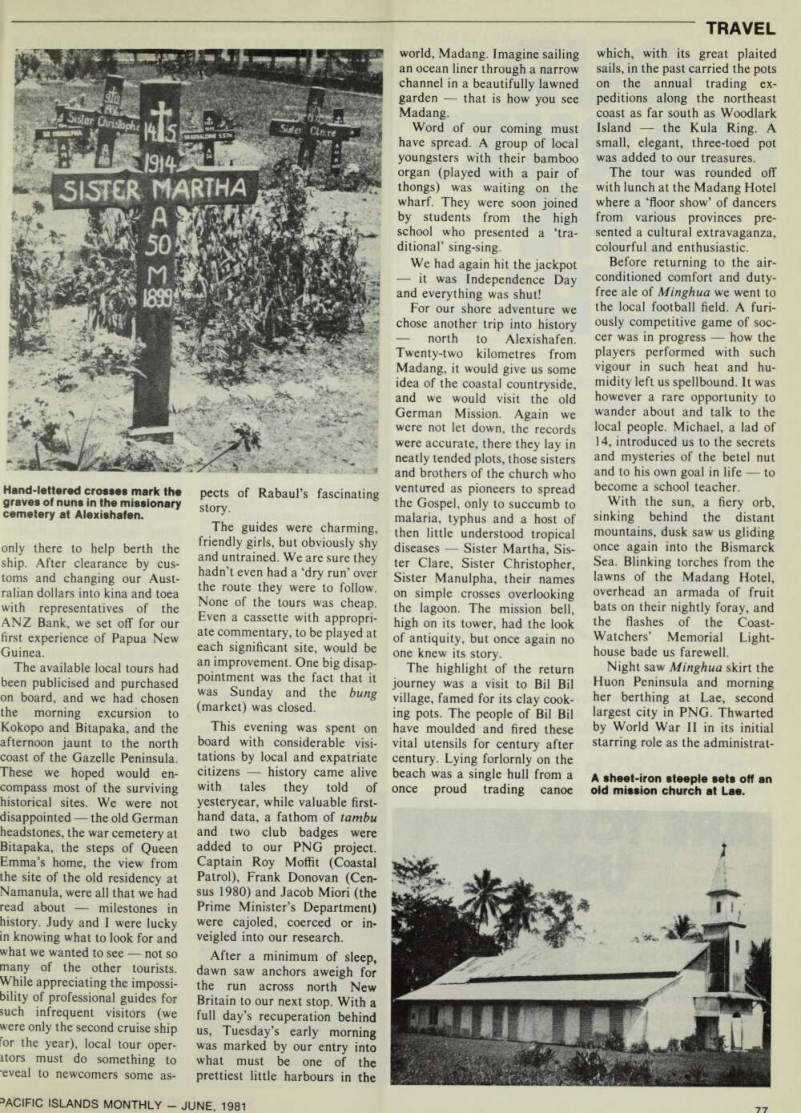
Twenty-two kilometres from Madang, it would give us some idea of the coastal countryside, and we would visit the old German Mission. Again we were not let down, the records were accurate, there they lay in neatly tended plots, those sisters and brothers of the church who ventured as pioneers to spread the Gospel, only to succumb to malaria, typhus and a host of then little understood tropical diseases Sister Martha, Sis ter Clare, Sister Christopher, Sister Manulpha, their names on simple crosses overlooking the lagoon. The mission bell, high on its tower, had the look of antiquity, but once again no one knew its story.
The highlight of the return journey was a visit to Bil Bil village, famed for its clay cook ing pots. The people of Bil Bil have moulded and fired these vital utensils for century after century. Lying forlornly on the beach was a single hull from a once proud trading canoe
which, with its great plaited sails, in the past carried the pots on the annual trading ex peditions along the northeast coast as far south as Woodlark Island the Kula Ring. A small, elegant, three-toed pot was added to our treasures.
The tour was rounded off with lunch at the Madang Hotel where a ‘floor show’ of dancers from various provinces pre sented a cultural extravaganza, colourful and enthusiastic.
Before returning to the air conditioned comfort and duty free ale of Minghua we went to the local football field. A furi ously competitive game of soc cer was in progress how the players performed with such vigour in such heat and hu midity left us spellbound. It was however a rare opportunity to wander about and talk to the local people. Michael, a lad of 14, introduced us to the secrets and mysteries of the betel nut and to his own goal in life to become a school teacher.
With the sun, a fiery orb, sinking behind the distant mountains, dusk saw us gliding once again into the Bismarck Sea. Blinking torches from the lawns of the Madang Hotel, overhead an armada of fruit bats on their nightly foray, and the flashes of the Coast- Watchers’ Memorial Light house bade us farewell.
Night saw Minghua skirt the Huon Peninsula and morning her berthing at Lae, second largest city in PNG. Thwarted by World War II in its initial starring role as the administrat-
Hand-lettered crosses mark the graves of nuns in the missionary cemetery at Alexishafen.
A sheet-iron steeple sets off an old mission church at Lae.
ive centre of the mandated territory, to replace a Rabaul devastated by the volcanic in ferno of 1937, Lae is a postwar phenomenon, owing its growth to the rapidly developing High lands economy. As the coastal terminus of the Highlands Highway, everything, excepting air cargo, that moves in or out of the Highlands comes through Lae. With one exception, its history is of the war and postwar years: the exception is an old German Mission church, said to be the only structure standing when the area was recaptured from the Japanese.
The war cemetery is the final resting place of many Allied soldiers of World War 11. Dur ing our stay a group of Diggers led by Major-General Allan Murchison combined with the local Defence Force units in a wreath-laying ceremony at the Cross of Remembrance.
Being Wednesday, the mar ket was open and we had our first experience of the wide ranging production of what is essentially an agricultural econ omy. Subsistence farmers plied the surplus from their small gardens bananas, coconuts, taro, sweet potato, peanuts, native tobacco and any number of greens we had never seen before The street vendors had gath ered with their artefacts. Al though they were modern examples of traditional craft, they provided a strong insight into the traditional ethos of the people.
We skipped the ‘Lae City Tour’ and took ‘The War Relics’ excursion. This was a misnomer, as the only war relic was a rusting Japanese hulk, half-buried in the sand off Wagan Village. The guides, however, were first class. They were three senior students from the International School. They gave a lively and knowledgeable commentary on local features and life. A dog’s tooth necklace from the Ramu valley was the final addition to our mementoes.
This was our last port before the long run along the northeast coast, through the China Strait, past Samarai, to Cairns. The availability of a suitably anno tated map would have added much to the interest of this section of the voyage we had
our own, so were able to identify most of the significant land marks as they appeared. Mount Simpson rising high in the Owen Stanley Range, Good enough Island with its 2566-metre peak peeping through a necklace of clouds, Fergusson and Normandy Islands, along with Samarai in the China Strait all have a history worth the telling.
Cairns was the final holiday stopover although scheduled to berth at bam, Minghua arrived at 6pm the evening before, giving those with sufficient zest an opportunity to sample the North Queensland night life.
Punctuality was another im portant aspect of our cruise. We arrived on time and left on time.
Many cruises are marred by late arrivals and early depar tures, but not this one!
The run from Cairns to Syd ney through the Whitsunday passage was broken by a stop of several hours off Sandy Cape where a fishing competition was held. Both passengers and crew tested their skill and, inciden tally, made some very good catches.
Early morning of Wednesday September 24 saw Minghua enter bustling Port Jackson where we landed at Number 13 Pyrmont our holiday was over.
What will be our lasting memories of our northern neigh bour? The first is children, lots of children, smiling children, shy children, ever ready to talk of their schools, their lives and their hopes for the future. The second is of history, both tra ditional and modern, just wail ing for the interested to see. The country’s tourist potential is enormous.
So ended our first visit to Papua New Guinea would we go again? Certainly. In fact, if Minghua sails north next September we will be first in the queue to buy our tickets. Some change in the itinerary could be suggested omit Cairns and include either Port Moresby, or stay three days in Lae and offer a tour to the Highlands up by road and back by air.
Finally, if you have grown tired of the old holiday pack ages then try something new go north to Papua New Guinea.