Torres Strati
pp. 72-74 · Read in the full issue
Mark missed on Torres Strati
The Torres Strait: People and History. By John Singe. Pub lished by the University of Queensland Press. St Lucia.
1979. Saw. 9 5. Isbn
0 7022 11417 5.
Over the centuries the Torres Strait Islanders ‘created a life style unique in the region, one totally integrated with the sea’.
In these words John Singe begins a history of the islands
and the people since the early days of white intrusion into the area.
The book results in part from the author’s personal knowledge of the islands which he gained while teaching Torres Strait Island high school students and working as a fisherman during the 19705. He is married to a Torres Strait Islander.
His aim is to make this book ‘the islanders’ story’. In the main thrust of his chapter on ‘The Border Problem’ he man ages to achieve this aim. For here he shows evidence of attention to islander feeling, a degree of insight into life and custom and a sensitivity to the real issues for islanders.
In response to moves to divide the Torres Strait in two by shifting the Papua New Guinean border south to the 10° parallel, there emerged ‘a remarkable political movement, which united Torres Strait Islanders to an extent never before experienced’, Singe writes. A tug-of-war over island seabed resources (oil and gas) pushed the Torres Strait on to
the front pages of Australian and Papua New Guinean dailies many times in the seventies. Yet as Singe recognises, a deep seated feeling, given expression by one island leader ‘lf you take our water and our seabed then you take our lives’ provided ‘the inspiration of a genuine movement which en joyed the support of the vast majority of Islanders’.
Singe’s awareness of the in tegrity of island nationhood and way of life is the main merit of the book. A second is his selection of 50 illustrations de picting Island life over nearly two centuries, and presenting graphically the story of in
trusion which became perma nent in 1879 when Queensland annexed the islands. The viol ence of the sea frontier is silently and powerfully portrayed in two paintings: in one, a seaman in a cutter, under command of Lieutenant George Tobin, is firing on islanders near Erub (Darnley) Island in 1792; the other depicts a scene in the same year near Tutu (Warrior) Island in which a great double outrigger island canoe is locked in unequal battle for the islands and waters of Torres Strait with the guns of the Providence and
Assistant under the command of Captain Bligh.
As a whole, however, the book in no significant way fulfils the author’s aim. It is divided into two main parts: ‘History’ and ‘The People Their Life’, with a brief concluding section on the islanders’ future. Singe’s history section is European centred and occupies about two thirds of the total pages. The chapters follow the familiar pattern of many a book on the ‘short history’ of Australia: ‘The First Whitemen’ (s/c), ‘Cape York Peninsula: Explorers and Developers’, ‘Thursday Island: the Beginning’, are typical.
Singe’s section on people is often trivial and at times totally and even dangerously mislead ing. Murray Islanders in eastern Torres Strait might be amazed and irritated to hear that they speak ‘broken English, aug mented by snatches of island language’. They speak their own Miriam language; they also speak ‘Torres broken’, a pidgin or creole language, and they speak English as well. Fantasy and fiction are so tightly inter
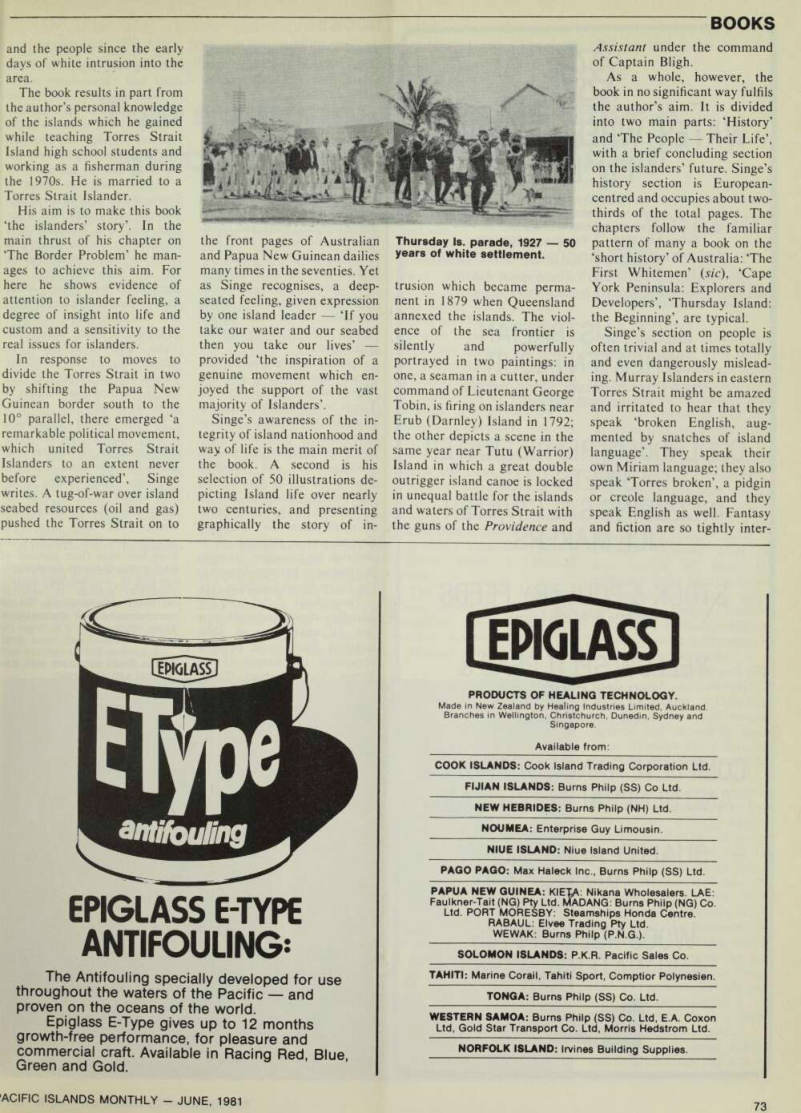
Thursday Is. parade, 1927 50 years of white settlement.
woven with fact in the sevenpage chapter on Magic and Death that it should not be taken seriously.
It is nonsense to say that islanders now living on the mainland do not keep in touch with the islands, ‘most never seeing their islands again and lost to their people . Yet Singe repeats this false claim which was given the stamp of academic respectability and circulated widely in the 19705. Perhaps the author is giving expression to wishful thinking in some quarters that island culture and islanders would vanish altogether, or at least be absorbed into the Australian population.
Two events which occurred a decade ago led to a situation where today more than half the Torres Strait Islanders are now living on the mainland, particularly in the north-east coast towns of Townsville, Cairns, Rockhampton and Mackay.
First was a sharp downturn in the pearling industry, which had served as the main source of employment for Islanders.
Second was a relaxing of restriction on Islanders’ freedom of movement by amendments to the Torres Strait Islanders’ Act.
Throughout the 19705, islanders who moved south were just as unanimous as their relatives back home in their opposition to changes in the Torres Strait border. Today
there remains a close associ ation between islanders in the strait and those down south.
Anyone who has waited for the airlines launch at the Thursday Island jetty will be aware of the constant partings and reunions of islanders moving between the mainland and the islands.
Modern language songs in Torres Strait reflect these new comings and goings. Yet wher ever they are, Islanders con tinue to be the sea people of Australia. Songs of fishing and the sea have not been sup planted as John Singe would have us believe. Wherever there are Islanders their children continue to learn songs like Taba Naba Naba Norem, the sailing song of Torres Strait: ‘Come let us go to the reef, While morning low tide, let us go in the dinghy . . .’
In the book’s concluding words, ‘lslanders have a great confidence in themselves and they exert enormous energy in activities which interest them’.
The author says he does not know where this confidence and energy will take them. He assumes too that islanders are even less sure than himself of where they want to go. Perhaps the best way to find the answer is to ask islanders to tell us themselves in their own story.—
Nonie Sharp.
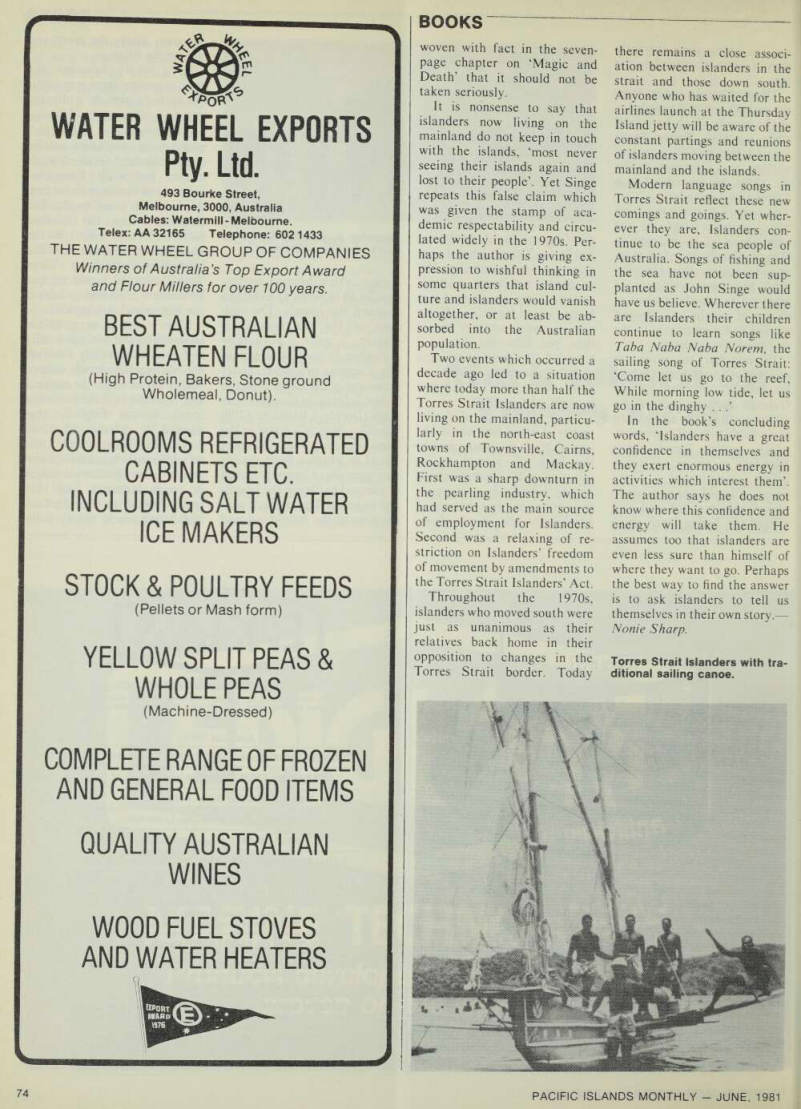
Torres Strait Islanders with tra ditional sailing canoe.