Cable partners
p. 79 · Read in the full issue
Trade
Winds
Pacific Undersea
Cable History
Cable partners in new project
Australia, New Zealand, Papua New Guinea and Fiji are the four South Pacific partners in a nine-nation project which will lay a new undersea cable across the Pacific between Australia and Canada. The Australian Overseas Telecommunications Commission, which is the majority partner in the international venture, tells the story here of the planned ANZCAN cable:
Representatives of nine countries met in Australia last year and signed an agreement to establish a new and techno logically advanced undersea telecommunications cable which will directly link Aus tralia, New Zealand, Fiji, Hawaii and Canada and will in directly serve countries throughout the Pacific. The new cable, ANZCAN (Australia, New Zealand, Canada), will re place the existing COMPAC (Commonwealth Pacific) cable over a slightly different route and will be fully operational by 1985, or possibly earlier.
The nine countries which signed the agreement are Aus tralia (which will own a majority share), New Zealand, Canada, Papua New Guinea, Fiji, Britain, France, West Germany and the Philippines.
By the time the cable goes into service other countries are ex pected to have joined the syndi cate. The contracting partners who are designing and calling lenders for the work are Austra lia, New Zealand and Canada.
The new cable will be the fourth to diagonally span the Pacific from southwest to northeast, spanning a route which for nearly 80 years has been one of the major trunk routes in world communi cations. The need for a new cable has been dictated by the approaching end of the design life of existing facilities and the rapidly expanding volume of traffic. These are the cables which have spanned the route: • THE FIRST was the Pacific Telegraph Cable, opened in 1902. It was purely a telegraph link, incapable of carrying voice traffic, and its construction completed a net work of British Empire landlines and undersea cables encircling the world. The
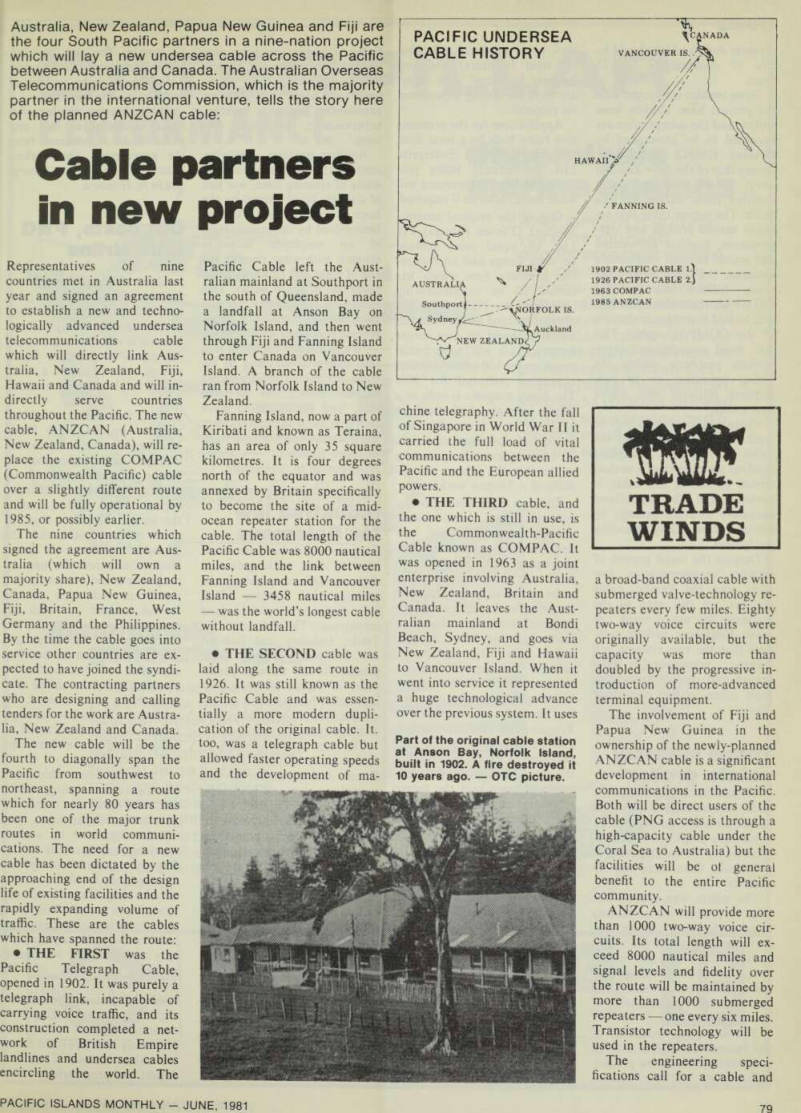
Pacific Cable left the Aust ralian mainland at Southport in the south of Queensland, made a landfall at Anson Bay on Norfolk Island, and then went through Fiji and Fanning Island to enter Canada on Vancouver Island. A branch of the cable ran from Norfolk Island to New Zealand.
Fanning Island, now a part of Kiribati and known as Teraina, has an area of only 35 square kilometres. It is four degrees north of the equator and was annexed by Britain specifically to become the site of a mid ocean repeater station for the cable. The total length of the Pacific Cable was 8000 nautical miles, and the link between Fanning Island and Vancouver Island 3458 nautical miles was the world’s longest cable without landfall. • THE SECOND cable was laid along the same route in 1926. It was still known as the Pacific Cable and was essen tially a more modern dupli cation of the original cable. It. too, was a telegraph cable but allowed faster operating speeds and the development of ma-
chine telegraphy. After the fall of Singapore in World War II it carried the full load of vital communications between the Pacific and the European allied powers. • THE THIRD cable, and the one which is still in use, is the Commonwealth-Pacific Cable known as COMPAC. It was opened in 1963 as a joint enterprise involving Australia, New Zealand, Britain and Canada. It leaves the Aust ralian mainland at Bondi Beach, Sydney, and goes via New Zealand, Fiji and Hawaii to Vancouver Island. When it went into service it represented a huge technological advance over the previous system. It uses
a broad-band coaxial cable with submerged valve-technology re peaters every few miles. Eighty two-way voice circuits were originally available, but the capacity was more than doubled by the progressive in troduction of more-advanced terminal equipment.
The involvement of Fiji and Papua New Guinea in the ownership of the newly-planned ANZCAN cable is a significant development in international communications in the Pacific.
Both will be direct users of the cable (PNG access is through a high-capacity cable under the Coral Sea to Australia) but the facilities will be of general benefit to the entire Pacific community.
ANZCAN will provide more than 1000 two-way voice cir cuits. Its total length will ex ceed 8000 nautical miles and signal levels and fidelity over the route will be maintained by more than 1000 submerged repeaters one every six miles.
Transistor technology will be used in the repeaters.
The engineering speci fications call for a cable and
Part of the original cable station at Anson Bay, Norfolk Island, built in 1902. A fire destroyed it 10 years ago.-OTC picture.