of Aloi Pilioko
pp. 67-69 · Read in the full issue

Life and work of Aloi Pilioko
Aloi Pilioko Artist of the Pacific. Published by the South Pacific Social Science Associ
ation, together with the Insti tute of Pacific Studies, Univer sity of the South Pacific. No price, or ISBN, provided.
I have long been impressed by the dynamism and vitality of the work of the Wallisian artist Aloi Pilioko. Since I first saw examples of it, my appreciation has been heightened by seeing murals he has done for several buildings around the Pacific.
Pilioko’s development as an artist owes much to the interest taken in him by Nicolai Mich outouchkine, under whose influence he came in Noumea in 1959. Himself an artist, Michoutouchkine had opened a
gallery in Noumea, and it was there that Pilioko made his first efforts at drawing and then painting. He says in Aloi Pilioko: Artist of the Pacific: ‘I felt like drawing. I was shy. I would never be able to do it. I was found behind a crate trying to draw. Shame. They dis covered me and I ran away.
When I came back, they started to encourage me. Would I ever dare? I remember drawing on the sand when I was a child of six. I did many drawings of
sailing canoes. Whenever I found a smooth beach, I would put my footprint in the sand and fill the beach with drawings.’
The present publication sets out to tell the story of the artist’s life, with emphasis on the various events and influ ences that have shaped his artistic growth. It is an unusual publication. It has parallel English and French texts, and is set in the form of a dialogue.
One of the ‘speakers’ is obvi ously Pilioko, and although this
is not stated one must presume that the other is Michout ouchkine.
It is a story worth telling, taking us from Pilioko’s birth into the Polynesian kainga on Wallis Island to the days spent at exhibitions of his work in many parts of the world, and travelling with his mentor to places such as Bulgaria, Sweden, the USSR (PIM Dec 1980 p29), and Mexico.
Although in many ways Pil ioko has become worldly wise.
he is still able to express in unadorned terms those aspects of his Islands way of life which continue to dominate his artistic expression. He says: ‘I like to portray eyes as I have watched them on people’s faces, es pecially at the market. Our native women have wide open eyes which never miss anything.
I had many things to tell which I could only do with my paint brush. I get my inspiration from my Island brothers and sisters. I like to depict their everyday attitudes, showing them danc ing, fishing and talking.’
Tribute must be paid to those responsible for producing this record of the life and times of a Pacific Islands artist the South Pacific Social Science Association, in tandem with the Institute of Pacific Studies, University of the South Pacific.
The publishers themselves acknowledge the assistance of the Australian Fund for the Preservation and Development of South Pacific Cultures, and the International Development
Research Centre.
W. G.
Coppell.
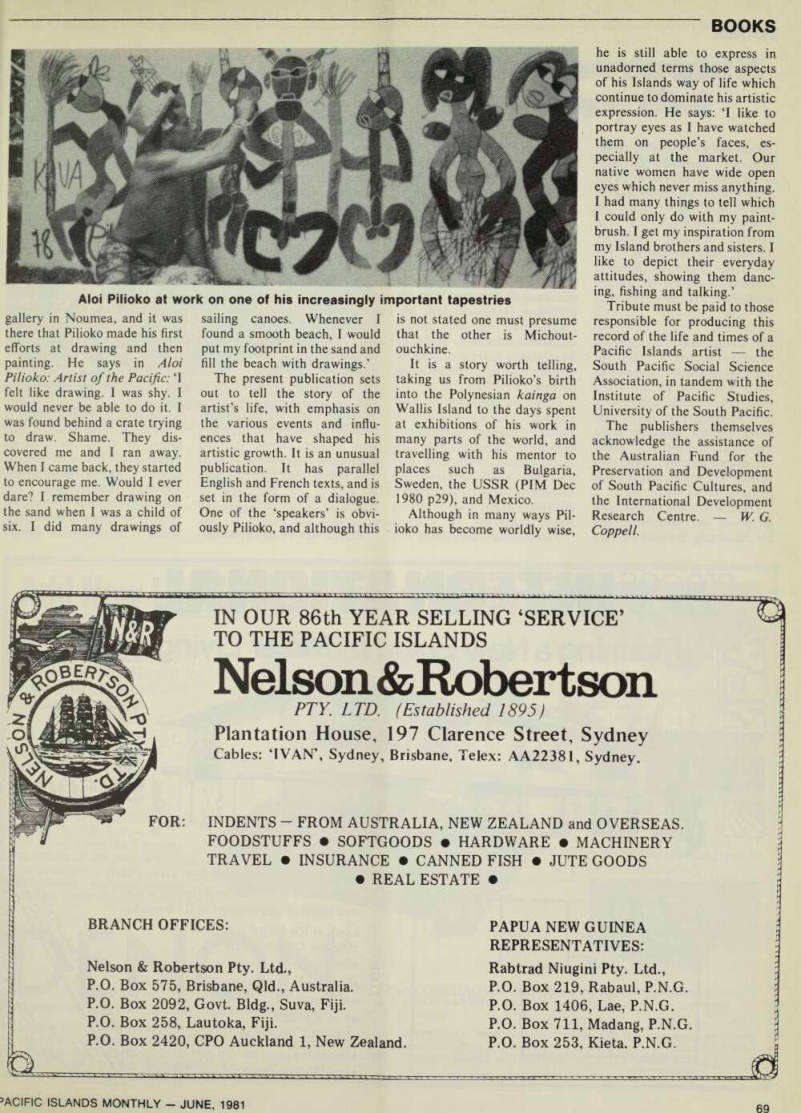
Aloi Pilioko at work on one of his increasingly important tapestries