Shipwreck story,
pp. 70-71 · Read in the full issue
140 years on
‘Naked and a Prisoner’: Captain Edward C. Barnard’s Narrative of Shipwreck in Palau 1832- 1833. Edited, with notes and an introduction, by Kenneth R.
Martin. Published by the Kendall Whaling Museum, Sharon, Massachusetts, and the Trust Territory Historic Preservation Office, Saipan. No price given. ISBN 0 93784 01 8.
The second most famous ship wreck in Palau after the Antelope in 1783 occurred in 1832. It was the whaler, Men tor, and just before midnight on May 21 she struck Ngaruangel Reef. Twelve crewmen were lost during the first hour while confusion reigned, and the Mentor was dashed to pieces on the coral rocks.
Captain Edward C. Barnard, 31, brave and determined, led his remaining crew to relative
safety on an exposed patch of reef. As the day dawned they were rescued by Palauans from Kayangel Atoll.
The adventure which fol lowed, and the fates and experi ences of the Mentor’s captain and crew were written down by Barnard a few years later. Dr Kenneth R. Marlin, director of the Kendall Whaling Museum in Sharon, Massachusetts, dis covered this narrative in the museum’s collection, where, as he relates in his introduction ‘it snoozed until accidentally redis covered in 1979’.
Barnard’s narrative is pure adventure, but it is also of par ticular historical significance because it relates the first con tact between Americans and Palauans which involved the whalemen living for any length of time in Palau (today the Re public of Belau).
Palauans are sometimes dis
tinguished from other Micro nesians as being more opportu nistic and energetic. The his toric roots of this observation are supported by Barnard’s account. Rather than kill or set back adrift the marooned Americans, the Palauans took them in and helped them. In turn, the whalemen were tat tooed, wore Palauan attire, and learned the language. Although by doing all this the Americans did not diminish their ultimate desire to return home, they did get well settled and develop excellent local relations. They also helped to reinforce and validate the Palauans’ habit of welcoming and using foreigners the Americans promised to deliver firearms later which has carried down to the present day.
Many of the early contacts between islanders and outsiders were violent. While Barnard does relate some ill-treatment at Tobi Island, the entire emphasis is clearly on the side of beneficial mutual exchange and friendship.
Martin has edited it marvel
lously and has provided excel lent notes and description. He presents it to us ‘almost exactly as Barnard wrote it’ some 150 years ago. It is an exciting, readable story, and it also provides some noteworthy eth nographic material for serious students and scholars. Of one Palauan social custom, Barnard observes: ‘ln each pye (bai) are kept from two to 10 females gener ally taken from distant towns frequently by force (sic) they are public property (sic) it at times happens that a chief will attach one of the girls of the pye to himself, on the wifes (sic) finding it out she is disposed for revenge, and they generally are (sic) they will watch for an opportunity to cut off the girls’ ears . ..’
The book is available directly from the Kendall Whaling Mu seum, or fron. the Historic Preservation Office at Saipan, CNMI 96950. We have the US Heritage, Conservation, and Recreation Service to thank for helping to fund the publication which is an important literary
contribution to have now readily available.
It is not only important for study, but makes exciting bed
time reading as well.-
Dirk
Anthony Ballendorf
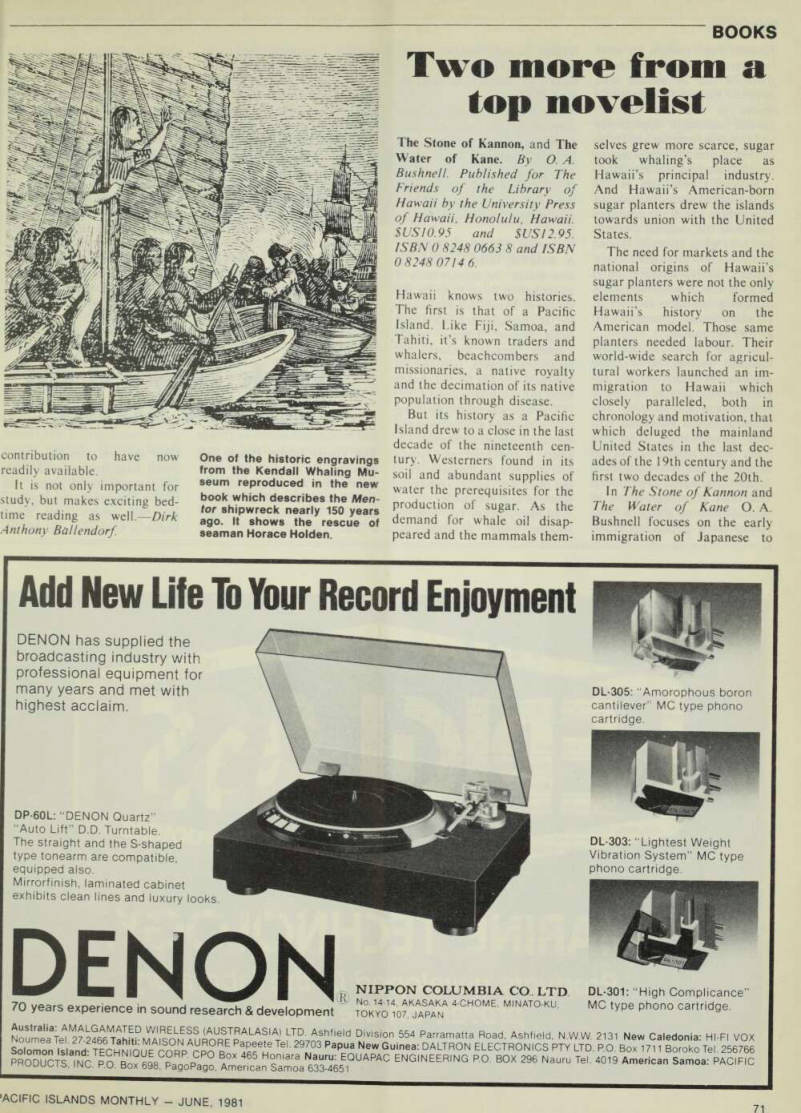
One of the historic engravings from the Kendall Whaling Mu seum reproduced in the new book which describes the Men tor shipwreck nearly 150 years ago. It shows the rescue of seaman Horace Holden.