were king
p. 67 · Read in the full issue
Books
Winds and tides were king
The W ind Commands Sailors and Sailing Ships in the Pacific.
By Harry Morton. Published by University of Queensland Press. 5A19.95. ISBN 0 7022 1560 0.
The Wind Commands is poss ibly the most comprehensive history of the discovery and opening up of the Pacific Ocean ever put together. It is the result of a quarter of a century’s research by a leading historian who has produced an essential reference work, well indexed, and with a bibliography that will assist the reader into more detailed studies on any subject pertaining to this vast area of ocean and its myriad islands.
Without sailors and ships, there would have been no devel opment of the Pacific area.
Therefore this is a book about sailors and ships, explorers and exploiters, men of vision and men of lust. It is based upon the journals of more than 100 men
and women who have sailed the Pacific Ocean.
Sailing ships could not go where and when they pleased.
Not only the direction but the timing of arrival and departure was set by tide and wind. In a despatch dated April 2, 1587 from Drake to the then Minister for the Navy, Walsingham, Drake expressed it clearly; The wind commands me away.’
What an appropriate title for this imaginative history of 600 years of exploration of an ocean of such expanse, so remote and inaccessible to the European adventurers who first dis covered its existence.
Not all the journals, of course, are Elizabethan. Many date from the 18th and 19th centuries. There are also first hand accounts written within the last few years, for men are still sailing the Pacific. I know, for I am one who has discovered its magic, and am unable to leave.
Today, setting sail in a well found ocean sailing yacht, am ply provisioned, carrying up-to date charts and having the advantages of quartz-controlled
chronometers, checked daily by
broadcast time signals, a 3000mile sail to the next island is
still an adventure. How must it have been for our ancestors who knew that they might soon be dying of scurvy or attacked by privateers from Spain, England or France, 10 000 miles from home?
Much of the book is a technical description and dis cussion of the problems of sailing and surviving, and of the development of sailing craft and navigational knowledge through the centuries. It is the perfect companion for others venturing into the area, living there, or simply sitting dream ing in less happy places.
Harry Morton is a Canadian who is now senior lecturer in American colonial history at the University of Otago, Dunedin, who can have had little time for exploring the area himself, for the dedicated research that has gone into this extensive book must surely have kept him reading in libraries and engaged in other academic pursuits for a very long time. Yet his writing has so much of the feeling of the adventures that one feels he
could well be a Hiscock or a Slocum.
The writings of Conrad, Lon don, Lubbock and Melville have been used freely and descriptions of the great sailing ships have been taken from Karlsson, Villiers, Newby, Slocum and Voss. Morton has selected the best from all and pays tribute to all in a volume which will make thinkers think more and add spice to the doings of adventurers, Fifty-nine drawings are used to illustrate the text, and the 64 full-page photographs are well selected to illustrate the many different approaches to dis covery in our Pacific Ocean.
John Hawley.
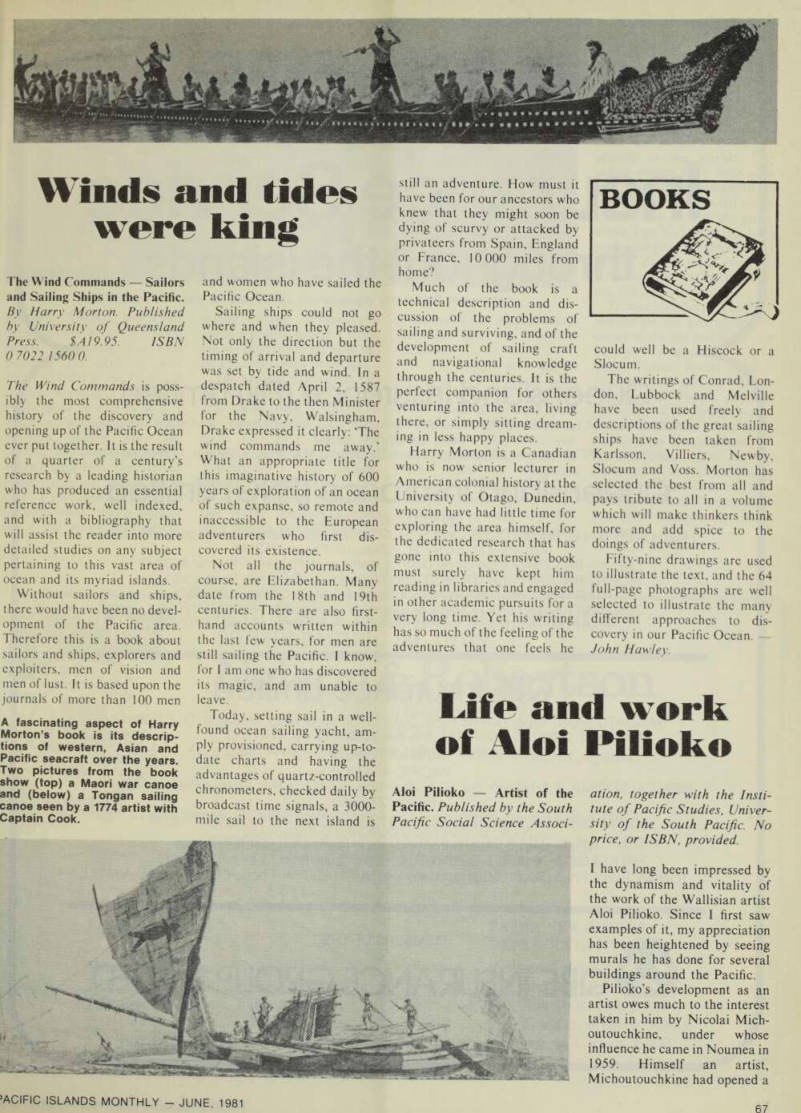
A fascinating aspect of Harry Morton’s book is its descrip tions of western, Asian and Pacific seacraft over the years.
Two pictures from the book show (top) a Maori war canoe and (below) a Tongan sailing canoe seen by a 1774 artist with Captain Cook.