People
pp. 61-65 · Read in the full issue
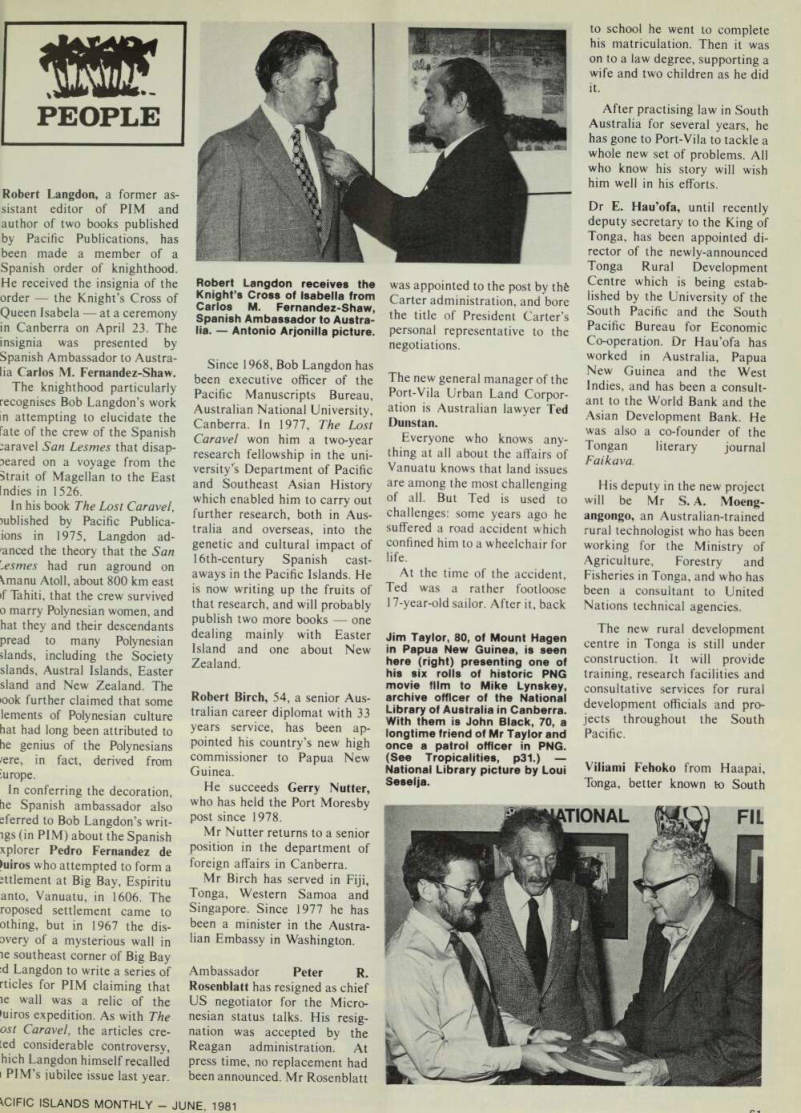


Robert Langdon, a former as sistant editor of PIM and author of two books published by Pacific Publications, has been made a member of a Spanish order of knighthood.
He received the insignia of the order the Knight’s Cross of Queen Isabela at a ceremony in Canberra on April 23. The insignia was presented by Spanish Ambassador to Austra lia Carlos M. Fernandez-Shaw.
The knighthood particularly recognises Bob Langdon’s work in attempting to elucidate the fate of the crew of the Spanish :aravel San Lesmes that disap peared on a voyage from the Strait of Magellan to the East indies in 1526.
In his book The Lost Caravel, mblished by Pacific Publica ions in 1975, Langdon ad vanced the theory that the San lesmes had run aground on Atoll, about 800 km east »f Tahiti, that the crew survived 0 marry Polynesian women, and hat they and their descendants pread to many Polynesian dands, including the Society slands, Austral Islands, Easter sland and New Zealand. The •ook further claimed that some lements of Polynesian culture hat had long been attributed to he genius of the Polynesians 'ere, in fact, derived from Europe.
In conferring the decoration, he Spanish ambassador also sferred to Bob Langdon’s writ igs (in PIM) about the Spanish xplorer Pedro Fernandez de luiros who attempted to form a Jttlement at Big Bay, Espiritu anto, Vanuatu, in 1606. The roposed settlement came to othing, but in 1967 the dis- Dvery of a mysterious wall in ie southeast corner of Big Bay :d Langdon to write a series of rticles for PIM claiming that ie wall was a relic of the >uiros expedition. As with The ost Caravel, the articles cre ted considerable controversy, hich Langdon himself recalled 1 PlM’s iubilee issue last year.
Since 1968, Bob Langdon has been executive officer of the Pacific Manuscripts Bureau, Australian National University, Canberra. In 1977, The Lost Caravel won him a two-year research fellowship in the uni versity’s Department of Pacific and Southeast Asian History which enabled him to carry out further research, both in Aus tralia and overseas, into the genetic and cultural impact of 16th-century Spanish cast aways in the Pacific Islands. He is now writing up the fruits of that research, and will probably publish two more books one dealing mainly with Easter Island and one about New Zealand.
Robert Birch, 54, a senior Aus tralian career diplomat with 33 years service, has been ap pointed his country’s new high commissioner to Papua New Guinea.
He succeeds Gerry Nutter, who has held the Port Moresby post since 1978.
Mr Nutter returns to a senior position in the department of foreign affairs in Canberra.
Mr Birch has served in Fiji, Tonga, Western Samoa and Singapore. Since 1977 he has been a minister in the Austra lian Embassy in Washington.
Ambassador Peter R.
Rosenblatt has resigned as chief US negotiator for the Micro nesian status talks. His resig nation was accepted by the Reagan administration. At press time, no replacement had been announced. Mr Rosenblatt
was appointed to the post by the Carter administration, and bore the title of President Carter’s personal representative to the negotiations.
The new general manager of the Port-Vila Urban Land Corpor ation is Australian lawyer Ted Dunstan.
Everyone who knows any thing at all about the affairs of Vanuatu knows that land issues are among the most challenging of all. But Ted is used to challenges: some years ago he suffered a road accident which confined him to a wheelchair for life.
At the time of the accident, Ted was a rather footloose 17-year-old sailor. After it, back
to school he went to complete his matriculation. Then it was on to a law degree, supporting a wife and two children as he did it.
After practising law in South Australia for several years, he has gone to Port-Vila to tackle a whole new set of problems. All who know his story will wish him well in his efforts.
Dr E. Hau’ofa, until recently deputy secretary to the King of Tonga, has been appointed di rector of the newly-announced Tonga Rural Development Centre which is being estab lished by the University of the South Pacific and the South Pacific Bureau for Economic Co-operation. Dr Hau’ofa has worked in Australia, Papua New Guinea and the West Indies, and has been a consult ant to the World Bank and the Asian Development Bank. He was also a co-founder of the Tongan literary journal Faikava.
His deputy in the new project will be Mr S. A. Moeng angongo, an Australian-trained rural technologist who has been working for the Ministry of Agriculture, Forestry and Fisheries in Tonga, and who has been a consultant to United Nations technical agencies.
The new rural development centre in Tonga is still under construction. It will provide training, research facilities and consultative services for rural development officials and pro jects throughout the South Pacific.
Viliami Fehoko from Haapai, Tonga, better known to South
Robert Langdon receives the Knight’s Cross of Isabella from Carlos M. Fernandez-Shaw, Spanish Ambassador to Austra lia. Antonio Arjonilla picture.
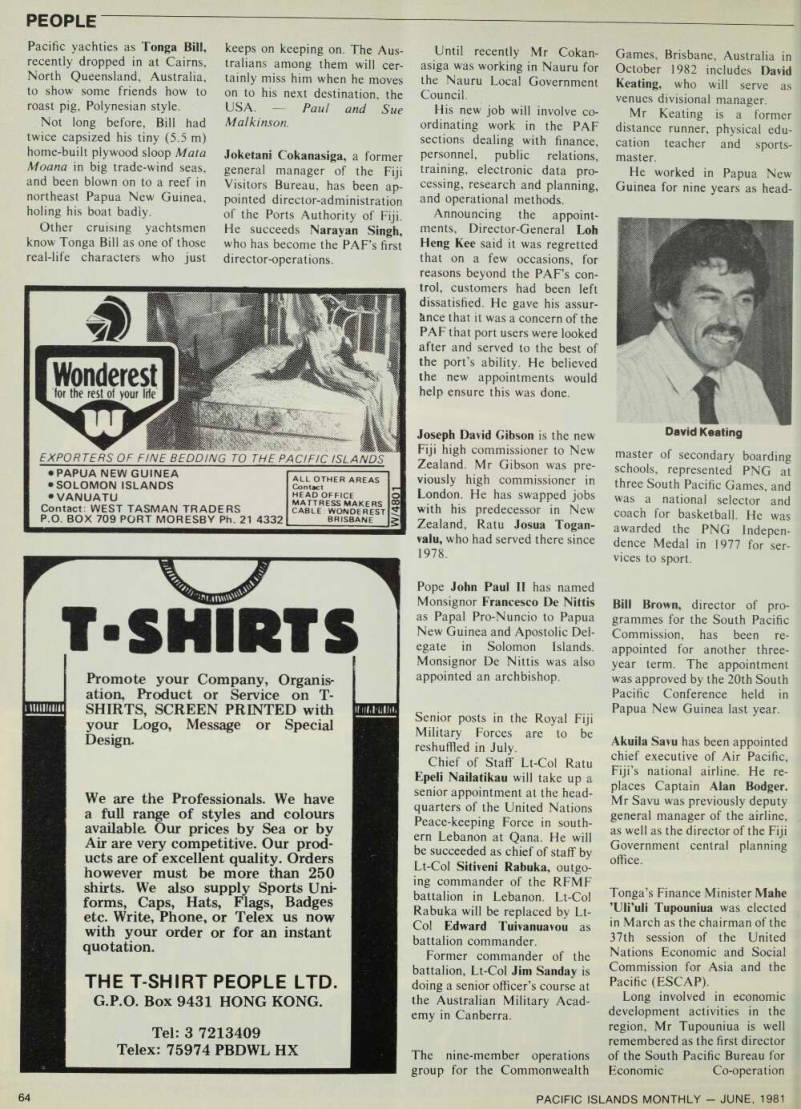
Jim Taylor, 80, of Mount Hagen in Papua New Guinea, is seen here (right) presenting one of his six rolls of historic PNG movie film to Mike Lynskey, archive officer of the National Library of Australia in Canberra.
With them is John Black, 70, a longtime friend of Mr Taylor and once a patrol officer in PNG. (See Tropicalities, p31.)
National Library picture by Loui
Seselja.
Pacific yachties as Tonga Bill, recently dropped in at Cairns, North Queensland, Australia, to show some friends how to roast pig, Polynesian style.
Not long before, Bill had twice capsized his tiny (5.5 m) home-built plywood sloop Mata Moana in big trade-wind seas, and been blown on to a reef in northeast Papua New Guinea, holing his boat badly.
Other cruising yachtsmen know Tonga Bill as one of those real-life characters who just
keeps on keeping on. The Aus tralians among them will cer tainly miss him when he moves on to his next destination, the USA. Paul and Sue Malkinson.
Joketani Cokanasiga, a former general manager of the Fiji Visitors Bureau, has been ap pointed director-administration of the Ports Authority of Fiji.
He succeeds Narayan Singh, who has become the PAF’s first director-operations.
Until recently Mr Cokan asiga was working in Nauru for the Nauru Local Government Council.
His new job will involve co ordinating work in the PAF sections dealing with finance, personnel, public relations, training, electronic data pro cessing, research and planning, and operational methods.
Announcing the appoint ments, Director-General Loh Heng Kee said it was regretted that on a few occasions, for reasons beyond the PAF’s con trol, customers had been left dissatisfied. He gave his assur ance that it was a concern of the PAF that port users were looked after and served to the best of the port’s ability. He believed the new appointments would help ensure this was done.
Joseph David Gibson is the new Fiji high commissioner to New Zealand. Mr Gibson was pre viously high commissioner in London. He has swapped jobs with his predecessor in New Zealand, Ratu Josua Togan valu, who had served there since 1978.
Pope John Paul II has named Monsignor Francesco De Nittis as Papal Pro-Nuncio to Papua New Guinea and Apostolic Del egate in Solomon Islands.
Monsignor De Nittis was also appointed an archbishop.
Senior posts in the Royal Fiji Military Forces are to be reshuffled in July.
Chief of Staff Lt-Col Ratu Epeli Nailatikau will take up a senior appointment at the head quarters of the United Nations Peace-keeping Force in south ern Lebanon at Qana. He will be succeeded as chief of staff by Lt-Col Sitiveni Rabuka, outgo ing commander of the RFMF battalion in Lebanon. Lt-Col Rabuka will be replaced by Lt- Col Edward Tuivanuavou as battalion commander.
Former commander of the battalion, Lt-Col Jim Sanday is doing a senior officer’s course at the Australian Military Acad emy in Canberra.
The nine-member operations group for the Commonwealth
Games, Brisbane, Australia in October 1982 includes David Keating, who will serve as venues divisional manager.
Mr Keating is a former distance runner, physical edu cation teacher and sports master.
He worked in Papua New Guinea for nine years as head-
master of secondary boarding
schools, represented PNG at three South Pacific Games, and was a national selector and coach for basketball. He was awarded the PNG Indepen dence Medal in 1977 for ser vices to sport.
Bill Brown, director of pro grammes for the South Pacific Commission, has been re appointed for another three year term. The appointment was approved by the 20th South Pacific Conference held in Papua New Guinea last year.
Akuila Savu has been appointed chief executive of Air Pacific, Fiji’s national airline. He re places Captain Alan Bodger.
Mr Savu was previously deputy general manager of the airline, as well as the director of the Fiji Government central planning office.
Tonga’s Finance Minister Mahe ’Uli’uli Tupouniua was elected in March as the chairman of the 37th session of the United Nations Economic and Social Commission for Asia and the Pacific (ESCAP).
Long involved in economic development activities in the region, Mr Tupouniua is well remembered as the first director of the South Pacific Bureau for Economic Co-operation
David Keating
(SPEC), and for the many posts he has held in government in Tonga.
Detective-Inspector George Namaka of the Vanuatu police has returned from a successful two-month study course in for ensic science in Adelaide, Aus tralia. Det-Insp Namaka passed all exams to become the first police officer from a developing Pacific country to complete the training.
Police Captain Robert Kumtak has become the first Marshall ese to serve as chief of police in the Marshall Islands. He suc ceeds H. Wally Wotring, who has declined another contract.
Mr Wotring said; ‘I feel it is time the Marshallese people took over the position of leader ship in this department I feel it is time they were given the opportunity. The only way to learn is to do the job.’ He added that his decision was in line with the government’s policy of phasing out expatriates so that more capable Marshallese can take over their jobs.
Captain Kumtak has been in the police force for almost 14 years. He was promoted to sergeant in 1975, in 1978 to lieutenant, and more recently to captain.
Expressing pride in his new appointment, he said: T’m look ing forward to working and helping the Marshallese people to the best of my ability.’ fhe board of regents of the College of Micronesia has an aounced the selection of Resio Moses as the new president of he Community College of Micronesia in Ponape state, iccording to the Federated States of Micronesia’s Public information Officer Derson iamon.
Moses was chosen from 33 ipplicants for the post, which vas advertised in several news )apers throughout the Pacific.
The College of Micronesia is nade up of the CCM on Ponape tate, the CCM Nursing School n the Commonwealth of the Northern Marianas, and the rticronesian Occupational Col ege in the Republic of Belau.
Mr Moses, 36, is a teacher nd administrator of wide ex
perience. He taught at the CCM in the early ’7os, and was Ponape DistAd (district admin istrator) from December 1976 to November 1977. He was a member of the House of Rep resentatives, Congress of Micronesia, from 1972 to October 1976.
Jack Nash, a former director of prison establishments in the Corrective Services Com mission of the Australian state of New South Wales, on a two year assignment with the Fiji Prison Service. Mr Nash’s title is that of prisons adviser.
His appointment follows rec ommendations made by Fiji Solicitor-General Qoriniasi Bale after his investigation of the riots which shook Fiji’s prison system in early January 1980.
Tonga’s only woman MP, Papiloa Foliaki, spent five weeks in the US in March and April attending a series of women’s conferences in various states organised to mark the half-way point of the Inter national Decade of Women.
Her trip was jointly spon sored by the Asia Foundation and the Overseas Education Fund of the American League of Women Voters.
Mrs Foliaki was one of six overseas guests invited to attend the conferences because of their ‘positive and objective’ contri butions to the International Women’s Conference in Copenhagen last year (PIM Oct 1980 p2l). Others in the group came from Southeast Asia, Sri Lanka, Africa, Colombia and New Zealand (representing the Maoris of that country).
Penny Hodgkinson in Nukualofa.
Kipling Uiari, former Lord Mayor of Port Moresby, has been appointed public affairs manager for the Ok Tedi Min ing Company. In this position he will be the top Papua New Guinean in the company. Mr Uiari was educated in Austra lia. He has been a trainee diplomat, a psychologist, and, until a year ago, secretary for PNG’s Department of Labour and Industry.
When he left the department
he went to the Public Services Commission and served as Lord Mayor until the suspension of Port Moresby City Council last October.
Professor Roger W. Hopkins, former deputy vice-chancellor of the University of the South Pacific, has resigned to take up a senior post in management studies at the University of Waikato, New Zealand. He had spent almost six years as pro fessor of accountancy at USP.
His successor as deputy vice chancellor is Professor Donald E. Paterson, head of the school of social and economic develop ment at USP. Professor Paterson has been at USP since January 1979.
Komeini Kanawi, the first Papua New Guinean to become a licensed engineer, has been given a major award by the Royal New Zealand Aeronaut ics Society. It is the Douglas Patterson Award and Medal for outstanding achievement. Mr Kanawi, who is employed by Air Niugini, is on a 12-month engineering training pro gramme with Air New Zealand.
The Douglas Patterson award was introduced recently to en courage people from the South Pacific to make a career in aviation. Mr Kanawi is from Langendrona Village, Manus Island.
The United Nations Year of the Disabled Person seems a good time to pay tribute to the achievements of a well-known resident of the Western Samoa
capital Apia, Roderick Crichton, called Liki in Samoan.
A promising boxer in his youth, Mr Crichton became blind at the age of 19.
Despite his handicap, he suc cessfully undertook a four-year course at Malua Theological College. It was while he was preaching in a south coast village of Upolu that he met and married his wife, Sia. They have five sons, the eldest 14.
After completing correspon dence courses in economics and journalism, in 1976 Liki launched his own newspaper.
The Samoa Weekly, which is still flourishing today. It caters principally for Samoan language readers. Eight thou sand copies are printed weekly, and distribution is to the two Samoas and other islands, Hawaii, New Zealand and Aus tralia.
Mr Crichton is also founder of the Association of the Blind, whose presidency he resumed in 1980. He was also elected first president of the Western Samoa Press Association last year.
His Samoa Weekly, with its Samoan-language stories, be gan the recent press revolution in the country, which now boasts 13 weekly papers/mag azines, and two fortnightlies.
William Sharpe-Dunn.
Officials from Pacific Island and Asian countries recently at tended an Australian-organised course on trade marks and their role in the economy. In Canberra, Irene Pellegrino of the Australian Patent Office discusses the course with (from left) Tere Mataio, Cook Islands; I.V. Helu, Fiji; and Tekoreaua
Kairoro, Kiribati.-AIS picture
by Darryl Lawton.