between NZ, Tahiti
p. 41 · Read in the full issue
How mutinous Bounty is boosting trade between NZ, Tahiti
In looking at French Polynesia’s trade relations with New Zea land or any other country, what must be kept constantly in mind is that in matters of the terri tory’s foreign trade all import ant decisions are made in France. In that country bureau cratic control of all economic activity is a hallowed tradition, affected hardly at all by the political colour of the govern ment of the day.
Even after Giscard d’Estaing in 1977 conceded a little more power to the local Autonomist parties of Pouvanaa, Teariki and Francis Sanford, the French Government remained sole master in such vital fields as foreign exchange, trade and transport. It is therefore hardly surprising that the struggle against this old-fashioned, colonial-style French rule has since been joined by such tra ditionally pro-French leaders as the president of the Papeete Chamber of Commerce, Charles Poroi, and the Deputy to the National Assembly in Paris, and chairman of the local Gaullist party, Gaston Flosse (PIM May 1980 p 27, and Dec 1980 p 55), and that their battle cries have been ‘Freedom of trade, freedom of the skies’.
Their strongest argument is based on a very simple geo graphical fact: their home islands are in the middle of the Pacific, and not off the French coast. Freight charges will therefore always be lower for products imported from Pacific Rim countries than from France and other European Common Market countries.
Maintenance of the present ‘big brother’ system is thus detri mental to local consumers. The militant businessmen now flock ing to the banners of Poroi and Flosse want to do away with a whole range of restrictions: exchange controls, prohibitive customs duties, a quota system favouring French imports, and the total prohibition of certain imports.
The mounting criticism, how
ever, has produced a slightly more liberal trend in French trade policies, a trend reflected in the 1980 import/export stat istics which have just become available.
To begin with, there is an
overall growth in imports from 36 billion Pacific francs in 1979 to 42 billion in 1980. The increase occurred despite the continued decline in exports down to a pitiful 698 million which would certainly have justified some government ac tion to achieve a better trade balance not only by stimulating local production, but above all by cutting down on imports. In fact, however, the situation is not as disastrous as it seems, for the huge imports' are largely paid for by earnings from tour ism, and by government spend ing, both civil and military. (See Postmark Papeete p 26.) It is nevertheless rather shocking to
note that in a territory that was once self-supporting in food, food now accounts for a quarter of all imports.
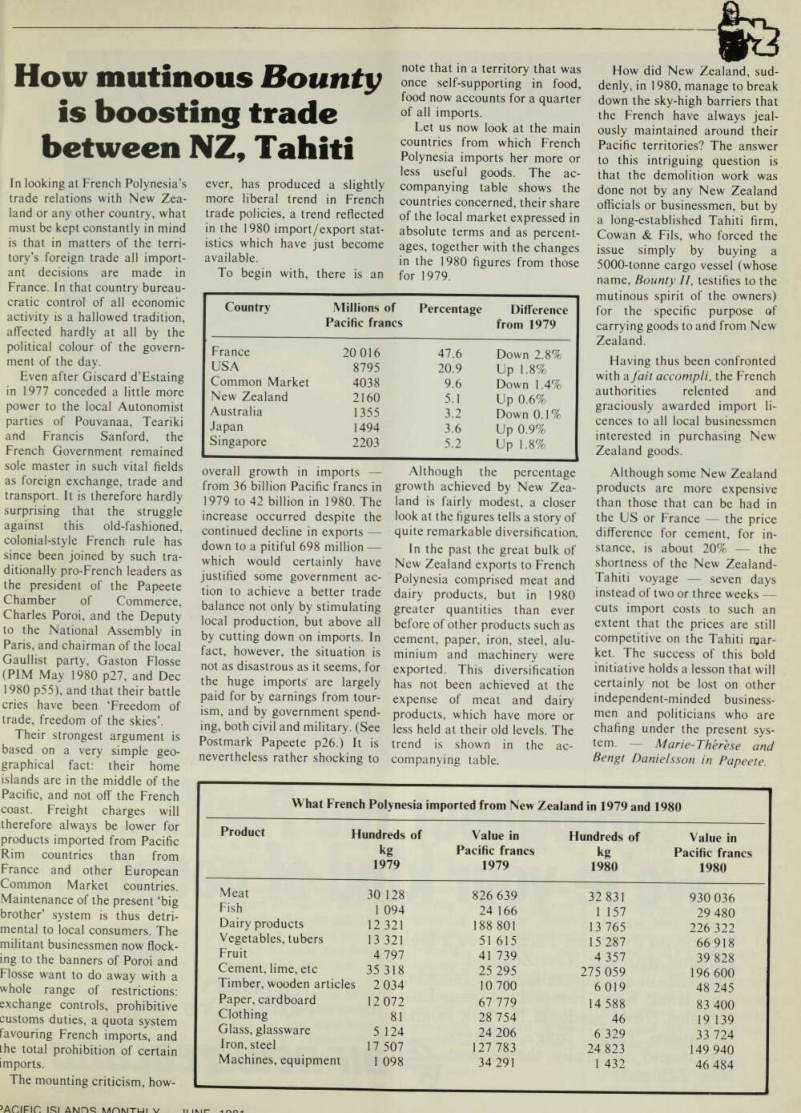
Let us now look at the main countries from which French Polynesia imports her more or less useful goods. The accompanying table shows the countries concerned, their share of the local market expressed in absolute terms and as percentages, together with the changes in the 1980 figures from those for 1979.
Although the percentage growth achieved by New Zea land is fairly modest, a closer look at the figures tells a story of quite remarkable diversification.
In the past the great bulk of New Zealand exports to French Polynesia comprised meat and dairy products, but in 1980 greater quantities than ever before of other products such as cement, paper, iron, steel, alu minium and machinery were exported. This diversification has not been achieved at the expense of meat and dairy products, which have more or less held at their old levels. The trend is shown in the ac companying table.
How did New Zealand, sud denly, in 1980, manage to break down the sky-high barriers that the French have always jeal ously maintained around their Pacific territories? The answer to this intriguing question is that the demolition work was done not by any New Zealand officials or businessmen, but by a long-established Tahiti firm, Cowan & Fils, who forced the issue simply by buying a 5000-tonne cargo vessel (whose name, Bounty 11, testifies to the mutinous spirit of the owners) for the specific purpose of carrying goods to and from New Zealand.
Having thus been confronted with a fait accompli, the French authorities relented and graciously awarded import li cences to all local businessmen interested in purchasing New Zealand goods.
Although some New Zealand products are more expensive than those that can be had in the US or France the price difference for cement, for in stance, is about 20% the shortness of the New Zealand- Tahiti voyage seven days instead of two or three weeks cuts import costs to such an extent that the prices are still competitive on the Tahiti mar ket. The success of this bold initiative holds a lesson that will certainly not be lost on other independent-minded business men and politicians who are chafing under the present sys tcm. Marie-Therese and Bengt Danielsson in Papeete.
What French Polynesia imported from New Zealand in 1979 and 1980 Product Hundreds of kg 1979 Value in Pacific francs 1979 Hundreds of kg 1980 Value in Pacific francs 1980 Meat 30 128 826 639 32 831 930 036 Fish 1 094 24 166 1 157 29 480 Dairy products 12 321 188 801 13 765 226 322 Vegetables, tubers 13 321 51 615 15 287 66918 Fruit 4 797 41 739 4 357 39 828 Cement, lime, etc 35 318 25 295 275 059 196 600 Timber, wooden articles 2 034 10 700 6019 48 245 Paper, cardboard 12 072 67 779 14 588 83 400
Clothing
81 28 754 46 19 139 Glass, glassware 5 124 24 206 6 329 33 724 Iron,steel 17 507 127 783 24 823 149 940 Machines, equipment 1 098 34 291 1 432 46 484
Country Millions of Pacific francs Percentage Difference from 1979 France 20 016 47.6 Down 2.8%
Usa
8795 20.9 Up 1.8% Common Market 4038 9.6 Down 1.4% New Zealand 2160 5.1 Up 0.6% Australia 1355 3.2 Down 0.1% Japan 1494 3.6 Up 0.9% Singapore 2203 5.2 Up 1.8%