Papua New Guinea
pp. 43-45 · Read in the full issue
Expanding links with Papua New Guinea build trade and aid
Traditionally New Zealand’s ties may have been with the Polynesian Pacific but it could hardly ignore the emergence in the 70s of Oceania’s largest Island nation, Papua New Guinea. There was a newly released ex-colonial market (previously cornered by Austra lia) to be won, and to make a breakthrough it was necessary for New Zealand to back its effort with an attractive aid programme.
The programme, now firmly established, is expanding each year and reaches all corners of
Png.
Apart from the odd ripple, especially towards the end of the 70s, the developing relation ship between PNG and New Zealand has proved mutually beneficial. The two established full diplomatic relations on September 16, 1975, when PNG achieved independence, and each country lifted its representation in the other’s capital to high commission status, both being Common wealth members.
The two countries share many common views of Pacific affairs. Both are staunch sup porters of the South Pacific Forum and its shipping line, and both strongly support the con cept of a nuclear-free Pacific, condemning the continued use of the Pacific for nuclear weapons testing.
New Zealand, following PNG and other Pacific nations, has in recent times argued for independence for other Island nations still under metropolitan colonial rule.
Since 1975 New Zealand has grown as a market for PNG primary products and as a principal source of development assistance. As in other Pacific nations, New Zealand puts strong emphasis on helping PNG to foster rural economic
development.
New Zealand’s aid pro gramme to PNG began in 1973,
the year after PNG achieved self-government. New Zea land’s then prime minister made a three-year pledge of development assistance. In 1976 the then deputy prime minister Brian Talboys pledged a continuation of New Zealand aid but hinted that it wasn’t going to be easy because of New Zealand’s own economic difficulties. Since the inception of the programme New Zealand development assistance has totalled more than SNZB million. Annual bilateral pro ject aid is now running at about $2.5 million. New Zealand aid takes two forms project aid and training and study awards for Papua New Guineans in New Zealand. Small scale pro jects (up to KlO 000) are handled directly by the High Commission headed by Miss Alison Stokes in Waigani, Port
Moresby’s administrative
centre. Anything larger is ad ministered from Wellington as part of New Zealand’s regular bilateral aid programme.
In May 1978 the PNGGov ernment decided that aid should be negotiated in two ways. Preferably it should in the form of cash grants to the national budget to be used on selected projects, or it could be in the form of direct cash aid to specific projects. Consequently, countries insisting on. making direct cash grants to projects are given a list of projects to choose from. PNG also prefers to use aid money to buy goods and services from the best value source, not necessarily from the country providing the aid. This, for a while, did not sit too well with New Zealand and led to differences between the two countries over aid.
New Zealand agrees to per mit its aid money being spent by PNG on the best value source only if New Zealand itself cannot supply the appropriate goods and services. If New Zealand feels it can supply the
goods, it insists on its money being spent back in New Zea land. A PNG Foreign Affairs official commented recently: ‘PNG and New Zealand are continuing to discuss the matter in the friendly way which has characterised their relationship.
We realise our policy is seen by some donors as tough but we believe it to be realistic on the basis that tied aid can seriously reduce the value of aid and the policy avoids situations where the aid benefits the donor
country more than the recipi ent’.
A major reason why New Zealand does not favour a system of untied cash grants is because it views development assistance as a co-operative exercise between two govern ments.
The largest single New Zea land aid project to date in PNG has been in funding a timber industry training college at Lae, at a cost of more than SNZ2 million. Other major New Zea land projects have concentrated in the agricultural and related transport sector. New Zealand is assisting with a long-term sheep research project in the Highlands and is also involved in a similar bee-keeping project there. A new coolstore has been completed for the PNG Food Marketing Corporation in Lae to help improve the distribution and marketing of fresh produce.
In the transport sector New Zealand has provided barges for agricultural transport in several Papuan provinces and in New Britain.
PNG is assisting New Zea land with its third country training programme. Under this scheme, New Zealand Govern ment-sponsored students from several South Pacific countries are studying at three PNG tertiary institutions: the Univer sity of PNG in Port Moresby, the University of Technology in Lae, and the PNG Forestry College in Bulolo.
The largest training pro gramme New Zealand has undertaken is a I'/z-year scheme
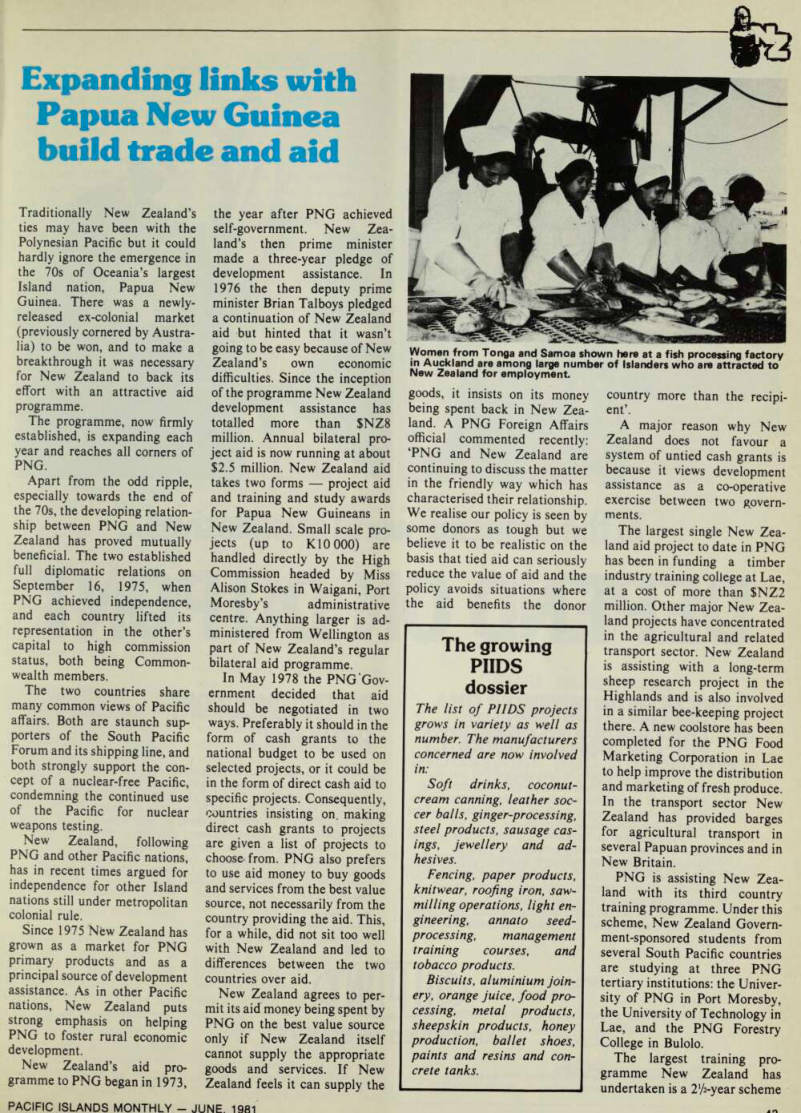
Women from Tonga and Samoa shown here at a fish processing factory in Auckland are among large number of Islanders who are attracted to New Zealand for employment.
of electrical and instrument training for 10 Air Niugini apprentices at Air New Zea land’s engineering section in Christchurch.
New Zealand is helping PNG to equalise trade between the two countries, at present run ning about three to one in favour of New Zealand. PNG is included in New Zealand’s Pacific Islands Industrial De velopment Scheme (PUDS) and the Developing Countries Liaison Unit (DCLU).
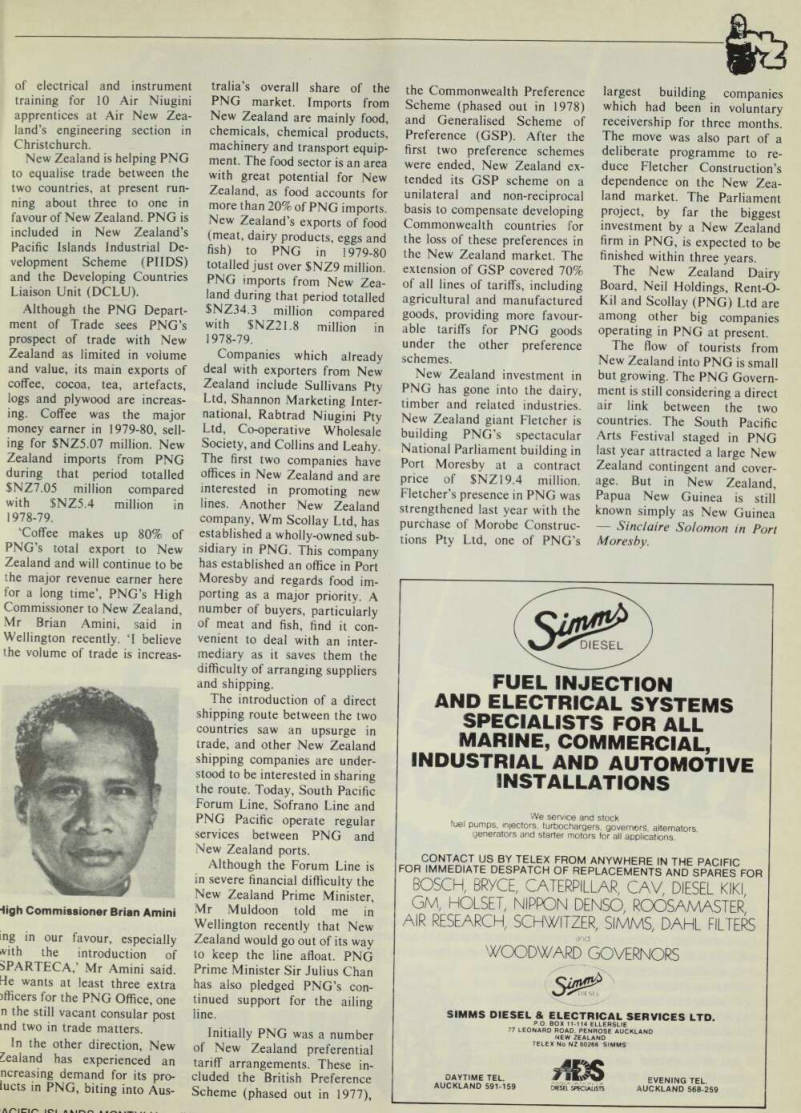
Although the PNG Depart ment of Trade sees PNG’s prospect of trade with New Zealand as limited in volume and value, its main exports of coffee, cocoa, tea, artefacts, logs and plywood are increas ing. Coffee was the major money earner in 1979-80, sell ing for SNZS.O7 million. New Zealand imports from PNG during that period totalled SNZ7.OS million compared with SNZS.4 million in 1978-79. ‘Coffee makes up 80% of PNG’s total export to New Zealand and will continue to be the major revenue earner here for a long time’, PNG’s High Commissioner to New Zealand, Mr Brian Amini, said in Wellington recently. ‘I believe the volume of trade is increas-
mg in our favour, especially with the introduction of SPARTECA,’ Mr Amini said.
Hie wants at least three extra )fficers for the PNG Office, one n the still vacant consular post md two in trade matters.
In the other direction, New Zealand has experienced an ncreasing demand for its pro lucts in PNG, biting into Aus
tralia’s overall share of the PNG market. Imports from New Zealand are mainly food, chemicals, chemical products, machinery and transport equip ment. The food sector is an area with great potential for New Zealand, as food accounts for more than 20% of PNG imports.
New Zealand’s exports of food (meat, dairy products, eggs and fish) to PNG in 1979-80 totalled just over SNZ9 million.
PNG imports from New Zea land during that period totalled 5NZ34.3 million compared with SNZ2I.B million in 1978-79.
Companies which already deal with exporters from New Zealand include Sullivans Pty Ltd, Shannon Marketing Inter national, Rabtrad Niugini Pty Ltd, Co-operative Wholesale Society, and Collins and Leahy.
The first two companies have offices in New Zealand and are interested in promoting new lines. Another New Zealand company, Wm Scollay Ltd, has established a wholly-owned sub sidiary in PNG. This company has established an office in Port Moresby and regards food im porting as a major priority. A number of buyers, particularly of meat and fish, find it con venient to deal with an inter mediary as it saves them the difficulty of arranging suppliers and shipping.
The introduction of a direct shipping route between the two countries saw an upsurge in trade, and other New Zealand shipping companies are under stood to be interested in sharing the route. Today, South Pacific Forum Line, Sofrano Line and PNG Pacific operate regular services between PNG and New Zealand ports.
Although the Forum Line is in severe financial difficulty the New Zealand Prime Minister, Mr Muldoon told me in Wellington recently that New Zealand would go out of its way to keep the line afloat. PNG Prime Minister Sir Julius Chan has also pledged PNG’s con tinued support for the ailing line.
Initially PNG was a number of New Zealand preferential tariff arrangements. These in cluded the British Preference Scheme (phased out in 1977),
the Commonwealth Preference Scheme (phased out in 1978) and Generalised Scheme of Preference (GSP). After the first two preference schemes were ended. New Zealand ex tended its GSP scheme on a unilateral and non-reciprocal basis to compensate developing Commonwealth countries for the loss of these preferences in the New Zealand market. The extension of GSP covered 70% of all lines of tariffs, including agricultural and manufactured goods, providing more favour able tariffs for PNG goods under the other preference schemes.
New Zealand investment in PNG has gone into the dairy, timber and related industries.
New Zealand giant Fletcher is building PNG’s spectacular National Parliament building in Port Moresby at a contract price of SNZI9.4 million.
Fletcher’s presence in PNG was strengthened last year with the purchase of Morobe Construc tions Pty Ltd, one of PNG’s
largest building companies which had been in voluntary receivership for three months.
The move was also part of a deliberate programme to re duce Fletcher Construction’s dependence on the New Zea land market. The Parliament project, by far the biggest investment by a New Zealand firm in PNG, is expected to be finished within three years.
The New Zealand Dairy Board, Neil Holdings, Rent-O- Kil and Scollay (PNG) Ltd are among other big companies operating in PNG at present.
The flow of tourists from New Zealand into PNG is small but growing. The PNG Govern ment is still considering a direct air link between the two countries. The South Pacific Arts Festival staged in PNG last year attracted a large New Zealand contingent and cover age. But in New Zealand, Papua New Guinea is still known simply as New Guinea Sinclaire Solomon in Port Moresby.
High Commissioner Brian Amini