money, but great
p. 39 · Read in the full issue
NZ aid: Not much money, but great amounts of care
For years Pacific Island leaders cried out to New Zealand and other developed countries ‘give us trade not aid’.
Acknowledgment was slow and so was development of the principle. New Zealand re sponded five years ago with PUDS its Pacific Island Industrial Development Scheme that moved cau tiously into the business of providing help for New Zealand firms that were interested in opening factories in the Pacific Islands.
There was criticism of the scheme, mainly because there was no guarantee that the products manufactured in the Islands would find markets in New Zealand or Australia.
But then came SPARTECA the South Pacific Regional Trade and Economic Cooper ation Agreement in January this year which provided duty free, unrestricted access for most products exported by South Pacific Forum Island countries to New Zealand and Australia.
This was on a non-reciprocal basis and would provide, said New Zealand Prime Minister Robert Muldoon, ‘a useful framework for trade and econ omic relations within the re gion’.
There were exceptions to the unrestricted access. With New Zealand industry itself writhing as a result of industry studies, and restructuring, limitations remained on footwear and fab rics. They also remained on products such as frozen passionfruit, fruit pulp, some fruit juices, canned pineapple, copra, coconut oil and coconut cream because these were pro ducts of key interest to the Cook Islands, Niue and Western Samoa which had traditional trading rights to New Zealand.
There were also limitations on imports of tomatoes and capsi cums which, because of New Zealand’s local produce, enter on a ‘licence on demand’ basis,
which means the Islands can export to New Zealand under licence subject to evidence of firm orders.
But SPARTECA, which is subject to review from time to time, established a trading framework and, at the same time, boosted interest in the PUDS scheme. Now New Zea land firms can open up oper ations in the Islands knowing that they have direct access to the massive by Island stan dards markets nearby.
Businessmen were not slow to realise that the Pacific Islands offered a gateway to European markets because of the lower tariff restrictions placed on these small countries.
The Department of Trade and Industry has decided to lift the profile of PUDS in New Zealand and recently launched a series of advertisements that pointed to the assistance avail able to businessmen thinking of moving into the Islands and the beneficial impact of SPAR TECA on trade. ‘Your business could be in the future of the Pacific,’ the advertisement tells its readers.
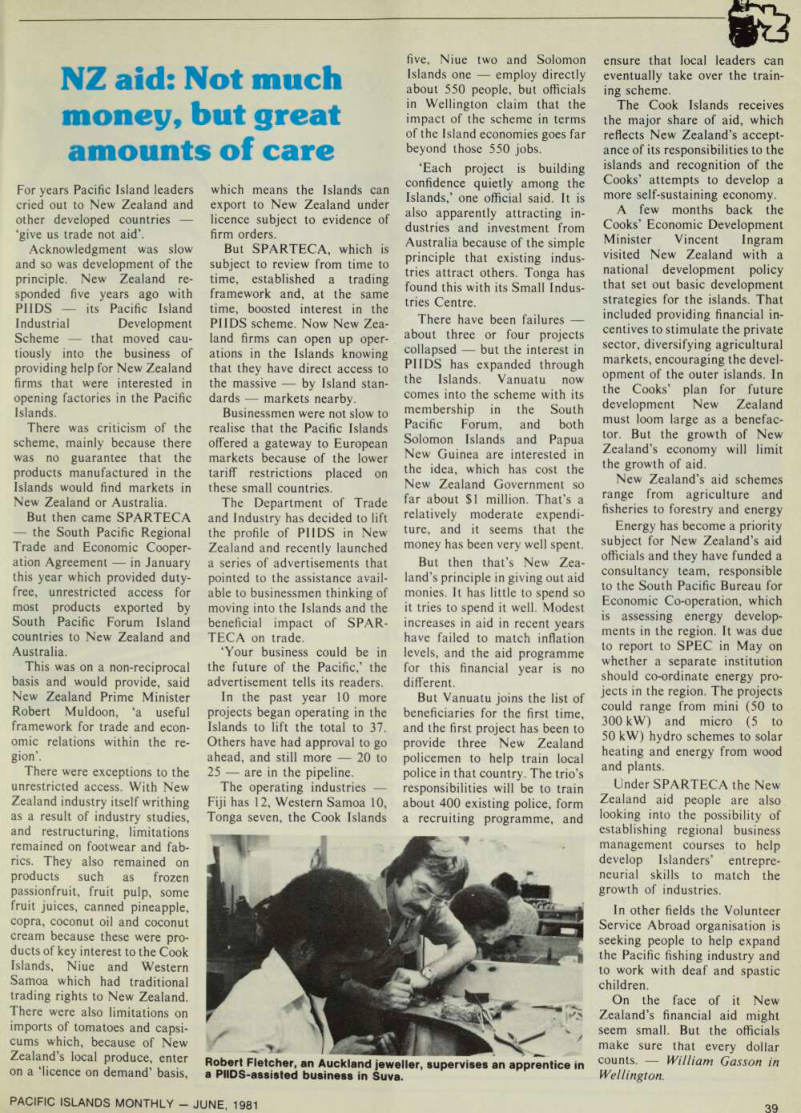
In the past year 10 more projects began operating in the Islands to lift the total to 37.
Others have had approval to go ahead, and still more 20 to 25 are in the pipeline.
The operating industries Fiji has 12, Western Samoa 10, Tonga seven, the Cook Islands
five, Niue two and Solomon Islands one employ directly about 550 people, but officials in Wellington claim that the impact of the scheme in terms of the Island economies goes far beyond those 550 jobs. ‘Each project is building confidence quietly among the Islands,’ one official said. It is also apparently attracting in dustries and investment from Australia because of the simple principle that existing indus tries attract others. Tonga has found this with its Small Indus tries Centre.
There have been failures about three or four projects collapsed but the interest in PUDS has expanded through the Islands. Vanuatu now comes into the scheme with its membership in the South Pacific Forum, and both Solomon Islands and Papua New Guinea are interested in the idea, which has cost the New Zealand Government so far about $1 million. That’s a relatively moderate expendi ture, and it seems that the money has been very well spent.
But then that’s New Zea land’s principle in giving out aid monies. It has little to spend so it tries to spend it well. Modest increases in aid in recent years have failed to match inflation levels, and the aid programme for this financial year is no different.
But Vanuatu joins the list of beneficiaries for the first time, and the first project has been to provide three New Zealand policemen to help train local police in that country. The trio’s responsibilities will be to train about 400 existing police, form a recruiting programme, and
ensure that local leaders can eventually take over the train ing scheme.
The Cook Islands receives the major share of aid, which reflects New Zealand’s accept ance of its responsibilities to the islands and recognition of the Cooks’ attempts to develop a more self-sustaining economy.
A few months back the Cooks’ Economic Development Minister Vincent Ingram visited New Zealand with a national development policy that set out basic development strategies for the islands. That included providing financial in centives to stimulate the private sector, diversifying agricultural markets, encouraging the devel opment of the outer islands. In the Cooks’ plan for future development New Zealand must loom large as a benefac tor. But the growth of New Zealand’s economy will limit the growth of aid.
New Zealand’s aid schemes range from agriculture and fisheries to forestry and energy Energy has become a priority subject for New Zealand’s aid officials and they have funded a consultancy team, responsible to the South Pacific Bureau for Economic Co-operation, which is assessing energy develop ments in the region. It was due to report to SPEC in May on whether a separate institution should co-ordinate energy pro jects in the region. The projects could range from mini (50 to 300 kW) and micro (5 to 50 kW) hydro schemes to solar heating and energy from wood and plants.
Under SPARTECA the New Zealand aid people are also looking into the possibility of establishing regional business management courses to help develop Islanders’ entrepre neurial skills to match the growth of industries.
In other fields the Volunteer Service Abroad organisation is seeking people to help expand the Pacific fishing industry and to work with deaf and spastic children.
On the face of it New Zealand’s financial aid might seem small. But the officials make sure that every dollar
counts.
William Gasson in
Wellington.
Robert Fletcher, an Auckland jeweller, supervises an apprentice in a PIIDS-assisted business in Suva.