Giscard
p. 25 · Read in the full issue
The 55 dollars of President Giscard
During his visit to Noumea in July 1979 President Giscard d’Estaing promised elderly people in New Cal edonia without pensions that the French State would start paying them a monthly al lowance.
But the administrative machinery was cumber some. April 1981 came round and the allowances had still not materialised.
Then, however, as some times happens, political pressure proved its effective ness; as a result of the constant urging of Deputy Jacques Lafleur the govern ment made the first pay ments of the CFPSOOO (SASS) monthly allowance.
This sum seems modest in deed, but there is no doubt it will do something to sweeten the days of many old folk. In New Caledonia and the Loy alty Islands, beneficiaries each received compensatory back payments of
Cfp4S 000 ($A455). The
payments went to 2630 Melanesians, 320 Euro peans, a few Vietnamese, about 100 Wallisians and a dozen or so Tahitians. The following week the scheme was extended to about 400 other people, mainly resi dents of the Loyalty group.
So the equivalent of about SAI million has now been paid to needy elderly folk in New Caledonia.
Busy tourism
scene Work has started on a hotel building project in the vicin ity of le Rocher a la Voile (Sail Rock), which domin ates Noumea’s two finest beaches. The Surf Hotel will
contain 136 rooms, and also the Casino Royal. Overall construction costs will be about SA7 million. Trees now growing in the area will be transplanted during the construction period, and then replanted as far as possible in their old positions when the job is done.
Noumea’s aquarium, which houses the world’s only collection of fluorescent coral, is in the same area. At the other end of Anse Vata beach, a luxurious nine-floor residential building is going up, while new shops are lining the length of the beach, and the freshly reno vated Lantana Hotel opened for business at about the same time as Le Paris, a complex of night clubs, cab arets, and cafe-restaurants, which is open around the clock. All these hotels are air-conditioned, and offer colour TV (English language videotapes for visi tors).
New Caledonia has confi dence in its tourist industry as, evidently, do the airlines. Thai International has just established a second weekly link between Bang kok, Manila and Noumea.
Japanese passengers fly with'
Thai International from Osaka to Manila and there join the airline’s connecting flight to Noumea. From June 1 UTA was scheduled to put two Boeing 747 s into service on the Sydney-Paris run (which includes a land ing in Noumea), thus estab lishing a new weekly Sydney-Paris, Paris-Sydney service.
Seventy thousand tourists are expected to visit New Caledonia in 1981, a good part of them Japanese and Australians.
French cricket
HQ in Noumea
It is unusual for the French national headquarters of a given sport to be established in an overseas territory. But that is what has happened with the newly established French Cricket Federation: France’s Minister for Sport Jean-Pierre Soisson has en trusted to New Caledonia the job of setting up the federation’s headquarters in Noumea.
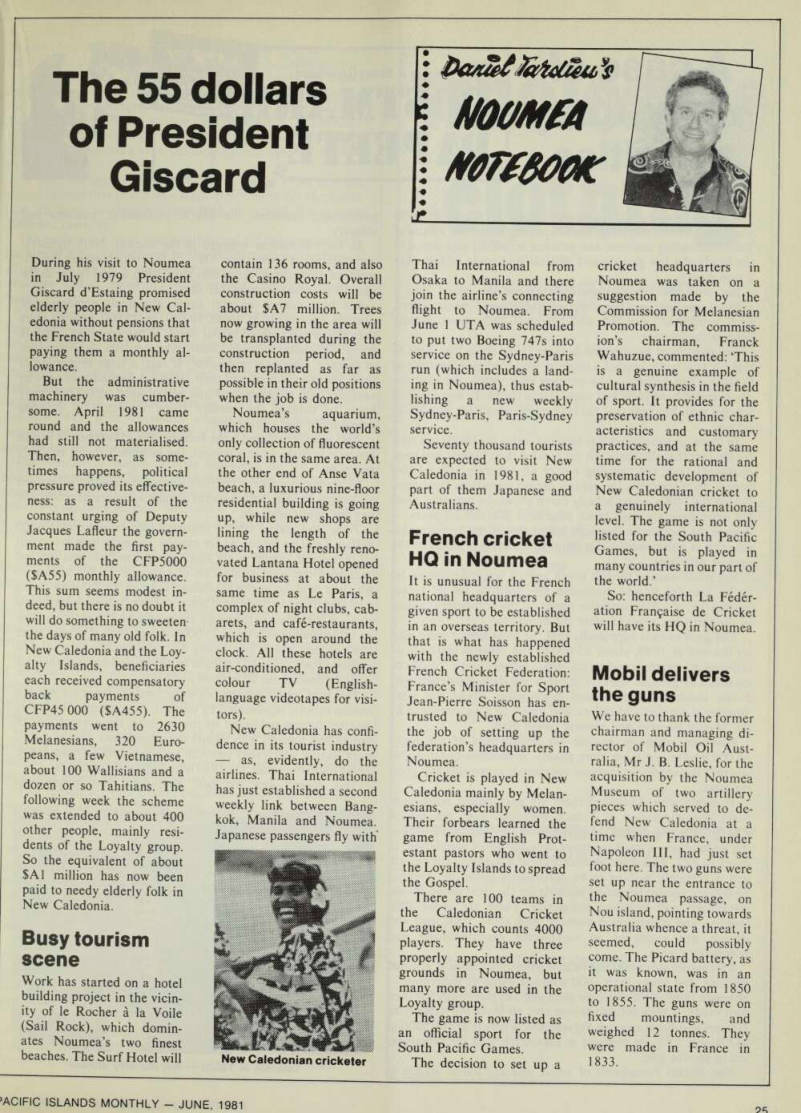
Cricket is played in New Caledonia mainly by Melan esians, especially women.
Their forbears learned the game from English Prot estant pastors who went to the Loyalty Islands to spread the Gospel.
There are 100 teams in the Caledonian Cricket League, which counts 4000 players. They have three properly appointed cricket grounds in Noumea, but many more are used in the Loyalty group.
The game is now listed as an official sport for the South Pacific Games.
The decision to set up a
cricket headquarters in Noumea was taken on a suggestion made by the Commission for Melanesian Promotion. The commiss ion’s chairman, Franck Wahuzue, commented: ‘This is a genuine example of cultural synthesis in the field of sport. It provides for the preservation of ethnic char acteristics and customary practices, and at the same time for the rational and systematic development of New Caledonian cricket to a genuinely international level. The game is not only listed for the South Pacific Games, but is played in many countries in our part of the world.’
So: henceforth La Feder ation de Cricket will have its HQ in Noumea.
Mobil delivers
the guns
We have to thank the former chairman and managing di rector of Mobil Oil Aust ralia, Mr J. B. Leslie, for the acquisition by the Noumea Museum of two artillery pieces which served to de fend New Caledonia at a time when France, under Napoleon 111, had just set foot here. The two guns were set up near the entrance to the Noumea passage, on Nou island, pointing towards Australia whence a threat, it seemed, could possibly come. The Picard battery, as it was known, was in an operational state from 1850 to 1855. The guns were on fixed mountings, and weighed 12 tonnes. They were made in France in 1833.
New Caledonian cricketer